(и еще 27 записям на сайте сопоставлена такая метка)
Другие метки пользователя ↓
annie miller baron von gloeden beata beatrix carlisle wall christina georgina rossetti christina rossetti. clark dante gabriel rossetti dudley gallery edward poynter eleanor fortescue-brickdale elizabeth siddal feet fetish fiammetta gabriel charls dante rossetti girls goblin market hannibal lecter heartsease pansy jane morris joanna mary boyce kelmscort manor la girlandata la pia de' tolomei lady lempicka louis de taeye mary magdalene at the door of simon the pharisee morris naked nude orient goods painting robert buchanan rossetti simeon solomon stacy marks study the blessed damozel vampyre venus verticordia vita nuova william holman hunt william michael rossetti women working men's college балет беатриче бойс данте данте габриэль россетти дж. котмен джейн моррис живопись иегуда лейб шварцман искатель искусство кеннет кларк колегова кристина россетти лемпика лемпицка лемпицкая мариинский менады микеланджело моррис насилие новый детектив новый роман ножки обнажённая пия де толомеи прерафаэлиты рисующий ангела роман россетти секс сиддал фетиш фиаметта фридерик лейтон хант хьюз чаадаев элизабет сиддал
SASS’S DRAW |
Дневник |
Метки: Working Men's College Rossetti Madox Brown Stacy Marks Cave Thomas V. Prinsep |
GOBLIN MARKET |
Дневник |
GOBLIN MARKET
Борьба духа и плоти.
Кристина много занималась благотворительностью, её поэтический шедевр Goblin Market возник из опыта работы по социальной адаптации бывших проституток in St Mary Magdalene Penitentiary. Тут она столкнулась с опытом обольщения и спасения и исследовала близкую для неё тему духовной и сексуальной жажды.
«База́р го́блинов» ( Goblin Market) — поэма английской поэтессы Кристины Россетти, образец викторианской литературы. Написана в 1859 году, когда Россетти работала в исправительном доме для «падших женщин» в Хайгейте. Опубликована в 1862 году в сборнике «База́р го́блинов и другие поэмы»( Goblin Market and Other Poems), проиллюстрированном братом поэтессы, художником-прерафаэлитом Данте Габриелем Россетти. Поэма посвящена сестре Кристины — Марии Франческе.
Главные героини поэмы, сёстры Лиззи (Лиза) и Лаура (Лора), живут одни в деревенском доме. Каждый день они ходят за водой к лесному ручью, и однажды слышат крики гоблинов, призывающих купить у них ягоды и фрукты, вкуснее которых не найти. Лиззи опасается гоблинов и стремится скорее уйти домой, уговаривая сестру поспешить. Однако Лаура задерживается, привлечённая словами гоблинов. В сумерках они окружают её и дают ей попробовать фрукты и сок, которые очень нравятся Лауре. Поскольку денег у неё с собой нет, она расплачивается локоном своих волос, который отрезает и отдаёт гоблинам. Опьянённая необычным вкусом фруктов, Лаура поздно ночью возвращается домой, где ей ждёт Лиззи.
_MET_DP835742.jpg?uselang=ru)
Фронтиспис сборника 1862 года. Среди прочих - вомбат.
На следующий день Лаура только и думает о том, чтобы скорее настал вечер и можно было снова пойти в лес и поесть удивительные фрукты. Она обещает принести их попробовать и Лиззи, но сестра отговаривает Лауру. К ужасу Лауры, когда вечером они с сестрой идут за водой, она не слышит призывных голосов гоблинов, хотя Лиззи слышит их и спешит уйти и увести Лауру. Проходят дни, и Лаура по-прежнему не может услышать гоблинов и снова отведать их товар. Лаура заболевает, худеет и седеет. Лиззи вспоминает о том, как другая девушка Дженни, тоже попробовавшая фрукты у гоблинов, быстро «растаяла» и умерла.
Видя всё ухудшающееся состояние сестры, Лиззи решается пойти к гоблинам, но действовать хитростью. Она берёт серебряную монету и, придя в лес, просит гоблинов продать ей немного фруктов и сока, чтобы она унесла их домой. Однако гоблины начинают сердиться и сначала уговаривают, а потом пытаются силой накормить Лиззи своими плодами, так что сок стекает у Лиззи по щекам. В результате, однако, они оставляют её в покое, и Лиззи, забрав серебряную монетку, возвращается домой. Она просит Лауру целовать её и облизывать с неё сок, что та и делает, хотя на этот раз сок кажется Лауре горьким. На следующий день Лаура полностью поправляется.
Сёстры взрослеют, выходят замуж и рожают детей, которым рассказывают о том, что сестра всегда является лучшим другом, который спасёт в трудной ситуации.
В стихотворении использованы образы реальных и вымышленных зверюшек. Вероятно Кристина вдохновлялась домашним "зверинцем" Данте Россети - собранием множества экзотических животных. На обложке работы Россетти мы видим вомбата, а в стихотворении есть строка:" Он крался как вомбат, бестолковый и пушистый". Кристина употребила итальянское название вомбата - uommibatto.
 Знаменитый автопортрет с умершим вомбатом сатиричен, но Россетти был охвачен подлинным горем. Траурный автопортрет он сопроводил мрачными стихами. А из любимого питомца сделал чучело и выставил его в холле своего дома.
Существует несколько переводов "Базара гоблинов" или "Ярмарки гномов" можно выбрать на любой вкус. Общее впечатление - несмотря на моральную загруженность темы, стихи детские. В подлиннике интересны могут быть тем, кто способен находить удовольствие в игре звуков английской речи и гордиться своим знанием синонимов и сказочной лексики. Автор, например, открыл для себя. что gobble означает также "кулдыкать как индюк".
Данте Габриэль Россетти иллюстрировал Ярмарку гоблинов весьма чувственными гравюрами.


Laughed every goblin
Wehn they spied her peeping:
Came towards her hobbling,
Flying, running, leaping,
Puffing and blowing,
Chuckling, clapping, crowing,
Clucking and gobbling...
Борьба духовного и плотского отражена и в других поэмах Кристины, например, Amor Mundi иллюстрации для которой делали Frederick Sandys and Edward Robert Hughes
Amor Mundi

Amor Mundi
Frederick Sandys
1865
Wood engraving
5 x 4 inches
Illustration for Christina Rossetti's "Amor Mundi"

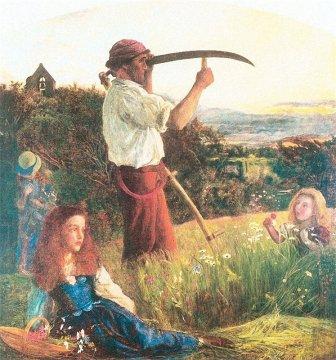
Картина Артура Хьюза Косец, законченная в 1865 году формально посвящена строчке "Все проходит, говорят все проходит" из поэтического сборника Кристины Россетти Старые и новогодние песенки.
Метки: Rossetti GOBLIN MARKET |
BEATA BEATRIX. |
Дневник |
BEATA BEATRIX.
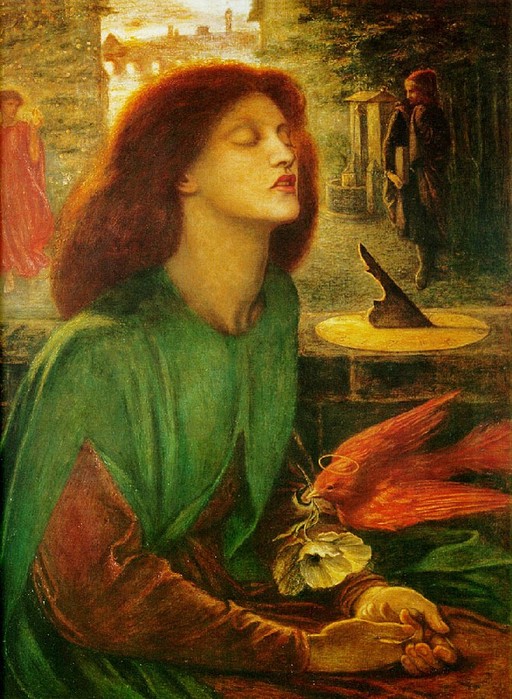
Блаженная Беатриче Beata Beatrix
Россетти начал первую версию картины, ныне находящуюся в галерее Тейт через год после смерти Сиддал в 1864 году после того, как обнаружил ранее сделанный эскиз маслом. Картина, возможно, основана и на портретах Сиддал сделанных в феврале 1862 года и ранее.
He began the first version of the work, now in the Tate Gallery, London, in 1864,a year after Siddal's death after finding an unfinished oil sketch that he had made of Siddal.

Крушение семейной жизни отрицательно сказалось на творчестве Россетти, только спустя годы вернулся он к жанру женского портрета. Беату Беатрикс он писал много лет, с 1864 по 1870 год. Начатая в 1864 году,картина была близка к завершению в 1866 и заказана Hon. William Comper, но окончена лишь в конце 1870-го года,а представлена публике вдовой Компера только в 1889 году.
Это было воспоминание о жене. Основанная на сюжете смерти Беатриче из "Новой жизни" Данте, она стала одной из известнейших произведений символизма. Состояние, пограничное между жизнью и смертью, земным и духовным, станет позже одной из важных тем, привлекавших символистов. На протяжении всей жизни Россетти отождествлял себя с флорентийским поэтом Данте Алигьери, культивировал духовную связь с ним. Картина Блаженная Беатриче имеет двойное значение. На ней изображена возлюбленная Данте - Беатриче, но в узнаваемом облике жены Россетти Сиддал.
В жёлтой дымке Лиззи - Беатриче сидит на балконе флорентийского дворца в позе умирающей с закрытыми глазами и поднятым подбородком, кажется,она остро сознаёт приближающуюся смерть. В ином толковании она закрыла глаза в упоении религиозгого или любовного экстаза. Поза напоминает ту, которая прсутствует на рисунках к

Россетти объяснял, что хотел изобразить не момент смерти, а момент "внезапной духовной трансформации". Голубь - вестник смерти принёс ей белый мак (в вариантах - красный). Птица вкладывает цветок мака (символ невинности, сна и смерти) в её руку. Мак, как символ, весьма двусмысленен, если вспомнить, что Сиддал умерла (покончила с собой?) как раз от передозировки опия. В глубине картины справа - Данте, устремивший взор на фигуру Амура, несущего пламенное сердце, в центе мост Веккио во Флоренции.
Критики приветствовали картину за её эмоциональное воздействие, которое передаётся даже просто через колорит и композицию. Истинная история любви Россетти приобретает новую глубину, Лиззи всё ещё оказывала сильное влияние на его творчество.
Rossetti again represented Lizzie as Dante's Beatrice in one of his most famous works, Beata Beatrix, (1864-1870) which he painted as a memorial to Lizzie after her death. This piece also mimicked the death of Dante's love in his autobiographical work, Vita Nuova. In the work, amidst a yellow haze of relatively indistinct shapes, including Florence's Ponte Vecchio and the figures of Dante and Love, Lizzie sits, representing Dante's Beatrice. With an upturned chin and closed eyes, Lizzie appears keenly aware of her impending fate, death. A bird, which serves as the messenger of death, places a poppy in her hands. Critics have praised the piece for its emotional resonance, which can be felt simply through the work's moving coloring and composition. The true history of Rossetti and his beloved wife further deepens its meaning; although their love had waned at that point, Lizzie still exerted a powerful influence on the artist.

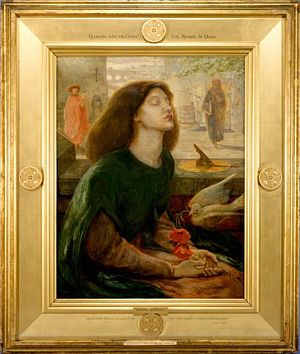
Frame: This smooth gold leaf frame is typical of many DGR pictures from about 1868 forward. It has a simple, rather severe mouldings on either side of very broad, shallow bevelled boards. Large roundels are set into the boards . . . usually placed singly at the mid-point of each side of the painting. In this particular case the roundels and frame inscriptions are closely integrated to the painting. The roundels were possibly inspired by the margin decorations in Plate 14 of Blake's Jobâ The Days of Creation. The texts had been used before by Rossetti as early as 1856 on the original frame of the water-color Dante's Dream . At the bottom is inscribed the line from Jeremiah, Lamentations I, i, quoted by Dante in the Vita Nuova on the death of Beatrice Quomodo sedet sola Civitas!; at the top is the date of Beatrice's death, now partly erased, Jun: Die 9: Anno 1290 (Grieve 23). The roundels placed midway on each side of the frame are contain relief representations of (at the top) the rising sun, (on the right) the stars, (on the left) a crescent moon embracing a single star, and (at the bottom) a land and seascape with the inscription 9 Giugno 1290.They symbolize, in a much more naturalistic way, the same forces that were symbolized by the schematic roundels on the frame of the 1854 Salutation of Beatrice and again probably relate to the closing lines of the Commedia ( Paradiso XXXIII. 143-145) (Grieve23).
Current Location: Birmingham City Museum and Art Gallery
https://rossettiarchive.iath.virginia.edu/docs/s168.rap.html
This version of the work differs sharply from the other oils. The background detail clearly develops the cityscape as Florence (rather than leaving the matter ambiguously Florence or London); and the accessories are quite different as well. The messenger-dove is white in this version, not red, and the poppies are red, not white. The details framing the figure of Love (at the left) are distinctive to this work as well (the arbor vitae is replaced by a wall-niche with a crucifix above. The light is also represented very differently in this work from the others. Here light suffuses the area behind Beatrice from a source that is represented as natural (as the lines of light at the left emphasize). In general, the treatment verges on a kind of realism, even though the general iconic/symbolic composition is retained.
Oil on canvas
34 7/16 x 27 1/4 in. (87.5 x 69.3 cm)
Predella: 26.5 x 69.2 cm
Inscribed top left on frame: JUN: DIE 9 ANNO 1290; top right on frame: QUOMODO SEDET SOLA CIVITAS!; and bottom of frame:
MART: DIE 31 ANNO 1300
VENI, SPONSA, DE LIBANO
He began the first version of the work, now in the Tate Gallery, London, in 1864, after finding an unfinished oil sketch that he had made of Siddal. The Art Institute’s painting is one of two replicas of the Tate composition, but it is the only one with a predella, the small panel at bottom showing the final meeting of Dante and Beatrice in paradise.
Одна из нескольких версий данной темы. Эта картина осталась незаконченной к моменту смерти Россетти и фон был завершон Форд Мэдокс Брауном. Возможно поэтому очертания видов города боле чёткие В этой версии маки красные, возможно. как явный намёк на опиум. Ещё одна версия картины в коллекции Тейт. Имеются многочисленные наброски карандашом к этой картине в музее Бирмингема, также как и большое орнаментированное майоликовое блюдо со сценой "Видения Данте"
Сам Россетти писал:"Картина является иллюстрацией к Vita Nuova и символически воплощает смерть Беатриче, так, как она там описывается".
One of several versions of this subject, this painting was unfinished at the time of Rossetti's death and the background was completed by Ford Madox Brown. In this version, the poppies are red, perhaps an explicit reference to opium-derived laudanum. Another version of the painting is in the Tate collection. There are also numerous related pencil studies in the Birmingham collection, as well as a large ornamental maijolica dish painted with a scene of Rossetti's 'Dante's Dream'.
СИМВОЛИКА КАРТИНЫ.
Голубь обычно символизирует Мир или святого Духа, но здесь он вестник смерти. В одних вариантах голубь красный, в других - белый. Интересно, что у красного есть нимб, а у белого нет.
The dove symbolise a messenger of death. Usually the dove represents Peace or the Holy Spirit. Here, it is the messenger of death. In other versions of the painting the dove is red, symbolising passion and death.
Мак - символ смерти. Опийный мак использовался для приготовления лекарства лауданум от передозировки которого и скончалась жена Россетти, вероятно, поэтому на некоторых вариантах мак красный - опиумный, на других белый - символ сна и смерти. В личном для Россетти плане мак символизирует уход Сиддал из его жизни, но не из души.
The poppy symbolise Death. This is an opium poppy sometimes used to make the drug laudanum. Rossetti's wife died from a drug overdose.
Циферблат солнечных часов - символ преходящего времени. Тень стрелки падает на 9 часов. Как объяснял Россеттти "Данте повстречал Веатриче, когда ей было девять лет, умерла Беатриче в 9 часов 9 июня 1290 года.
The sundial represent the passing of time. The shadow on the sundial falls on 9 o'clock. This is time of Beatrice's death in the poem.
Почему плащь Беатриче зелёный, а платье пурпурное? Зелёный - жизнь, весна, надежда, пурпурный - горе и смерть.
Why is Beatrice's tunic green and the dress purple? Green for life, purple for sorrow. Green means spring life and hope. Purple means sorrow and death.According to Rossetti's friend F.G. Stephens, the grey and green of her dress signify 'the colours of hope and sorrow as well as of love and life' ('Beata Beatrix by Dante Gabriel Rossetti', Portfolio, vol.22, 1891, p.46).
Две фигуры на заднем плане. - ангел любви с пламенеющим сердцем в руке (угасающая жизнь Беатриче) и сам Данте-Россетти, неотрывно смотрит на фигуру Любви, в чьей руке пламенем мерцает затухающая жизнь его госпожи.
Фон картины - река Арно, мост Понте Веккьо и башни собора во Флоренции, где жили Данте и Беатриче.
Rossetti intended to represent her, not at the moment of death, but transformed by a 'sudden spiritual transfiguration' (Rossetti, in a letter of 1873, quoted in Wilson, p.86). She is posed in an attitude of ecstasy, with her hands before her and her lips parted, as if she is about to receive Communion. The picture frame, which was designed by Rossetti, has further references to death and mourning, including the date of Beatrice's death and a phrase from Lamentations 1:1, quoted by Dante in the Vita Nuova: 'Quomodo sedet sola civitas' ('how doth the city sit solitary'), referring to the mourning of Beatrice's death throughout the city of Florence.
Метки: Beata Beatrix россетти сиддал Rossetti данте беатриче блаженная беатриче Галерея Тейт Vita Nuova |
РОССЕТТИ использованные материалы справки, примечания. |
Дневник |

1 МАЙКЛ РОБИНСОН. ЖИЗНЬ И ТВОРЧЕСТВО. В 500 КАРТИНАХ.
1851 - 1860 - A typical example of his work from this period is “How They Met Themselves” (Fritzwilliam Museum, Cambridge).
1856 - He was led by Sir Thomas Malory's Morte Darthur and Tennyson's Idylls of the King to evoke in his paintings an imaginary Arthurian epoch, with heraldic glow and pattern of colour and medieval accessories of armour and dress.
- He came into contact with the then-Oxford undergraduates Edward Burne-Jones and William Morris. With these two young disciples he initiated a second phase of the Pre-Raphaelite movement.
1856 - 1857 - A new era of book decoration was foreshadowed by his illustration for the Moxon edition of the Poems of Alfred, Lord Tennyson. His commission to paint a triptych (“The Seed of David”) for Llandaff Cathedral was a prelude to the ambitious scheme to decorate the Oxford Union debating chamber with mural paintings of Arthurian themes.
1882 - Died on the 9th of April in Birchington-on-Sea, Kent.
http://www.s9.com/Biography/Rossetti-Dante-Gabriel
https://archive.org/details/somereminiscenc01rossgoog/page/n25/mode/2up
https://archive.org/stream/somereminiscenc01rossgoog/somereminiscenc01rossgoog_djvu.txt
About Charles Bagot Cayley 311-315
3. https://coollib.cc/b/440747-dante-gabriel-rossetti-dom-zhizni-v-dvuh-knigah-tom-i/read
ДОМ ЖИЗНИ Русские переводы.
ПРИМЕЧАНИЯ
1.CharlesBagotCayley (1823–1883) Был английским лингвистом, переводчиком Данте, Гомера и Эсхила. В 1866 году сделал предложение Кристине Россетти, несмотря на неудачу помолвки они оставались друзьями до его смерти. Несколько стихотворений Россетти подразумевают их близкие отношения.
2. Скотт, Уильям Белл 1811 – 1890.
Как живописец Уильям Скотт был близок прерафаэлитам, старший из лиц близких их кругу. Давал советы Кристине Россетти по публикациям в журнале «Росток». Он также оставил воспоминания о среде прерафаэлитов — Данте Габриэле Росетти, Джоне Рёскине и других художниках, с которыми состоял в дружбе либо в близком знакомстве. «Автобиографические записки» (Autobiogr. Notes etc.)
3. HenryThomasMackenzieBell (1856 –1930) английский писатель, поэт и литературный критик. Известный путешественник, он был знаком со многими литераторами в Англии и за границей. Личный друг Кристины Россетти и автор её биографии.
4. «Атене́ум» («Атене́й») английский литера- турный и художественно-критический журнал, осно-ванный Джеймсом Бакингемоми издававшийся
в Лондоне с 1828 по 1921 годы.
Первыйномерпоявилсявсвет2 января1828 года, подзаглавием«The Athenaeum of London, literary and critical Journal, edited by J. S. Buckingham».
5. Все стихи и переводы К. Россетти
http://eng-poetry.ru/PoetE.php?PoetId=44
doppelgänger
https://www.atlasobscura.com/articles/history-doppelganger
The word “doppelgänger” was introduced by German author Jean Paul in his 1796 novel Siebenkäs.
The original form of the word did survive in the works of Prussian writer E.T.A. Hoffmann, who titled a story “Die Doppeltgänger” in 1821.
The double may also serve as a foil to the protagonist’s personality, a behavioral negative as in Hans Christian Andersen’s 1847 fairy tale Skyggen, or The Shadow.
Percy Bysshe Shelley wrote of a double in Prometheus Unbound, and later claimed to have seen his own doppelgänger before his death in 1822.
The doppelgänger in Edgar Allan Poe’s short story “William Wilson” seems to exist solely to ruin the narrator’s life.
"
," published by Edgar Allan Poe in 1839,
«Двойни́к» — повесть Фёдора Михайловича Достоевского, написанная в 1845—1846 годах и впервые опубликованная 1 февраля 1846 года во втором номере журнала «Отечественные записки» с подзаголовком «Приключения господина Голядкина».
GOBLIN MARKET |
Дневник |
GOBLIN MARKET
Борьба духа и плоти.
Кристина много занималась благотворительностью, её поэтический шедевр Goblin Market возник из опыта работы по социальной адаптации бывших проституток in St Mary Magdalene Penitentiary. Тут она столкнулась с опытом обольщения и спасения и исследовала близкую для неё тему духовной и сексуальной жажды.
«База́р го́блинов» ( Goblin Market) — поэма английской поэтессы Кристины Россетти, образец викторианской литературы. Написана в 1859 году, когда Россетти работала в исправительном доме для «падших женщин» в Хайгейте. Опубликована в 1862 году в сборнике «База́р го́блинов и другие поэмы»( Goblin Market and Other Poems), проиллюстрированном братом поэтессы, художником-прерафаэлитом Данте Габриелем Россетти. Поэма посвящена сестре Кристины — Марии Франческе.
Главные героини поэмы, сёстры Лиззи (Лиза) и Лаура (Лора), живут одни в деревенском доме. Каждый день они ходят за водой к лесному ручью, и однажды слышат крики гоблинов, призывающих купить у них ягоды и фрукты, вкуснее которых не найти. Лиззи опасается гоблинов и стремится скорее уйти домой, уговаривая сестру поспешить. Однако Лаура задерживается, привлечённая словами гоблинов. В сумерках они окружают её и дают ей попробовать фрукты и сок, которые очень нравятся Лауре. Поскольку денег у неё с собой нет, она расплачивается локоном своих волос, который отрезает и отдаёт гоблинам. Опьянённая необычным вкусом фруктов, Лаура поздно ночью возвращается домой, где ей ждёт Лиззи.
Фронтиспис сборника 1862 года. Среди прочих - вомбат.
На следующий день Лаура только и думает о том, чтобы скорее настал вечер и можно было снова пойти в лес и поесть удивительные фрукты. Она обещает принести их попробовать и Лиззи, но сестра отговаривает Лауру. К ужасу Лауры, когда вечером они с сестрой идут за водой, она не слышит призывных голосов гоблинов, хотя Лиззи слышит их и спешит уйти и увести Лауру. Проходят дни, и Лаура по-прежнему не может услышать гоблинов и снова отведать их товар. Лаура заболевает, худеет и седеет. Лиззи вспоминает о том, как другая девушка Дженни, тоже попробовавшая фрукты у гоблинов, быстро «растаяла» и умерла.
Видя всё ухудшающееся состояние сестры, Лиззи решается пойти к гоблинам, но действовать хитростью. Она берёт серебряную монету и, придя в лес, просит гоблинов продать ей немного фруктов и сока, чтобы она унесла их домой. Однако гоблины начинают сердиться и сначала уговаривают, а потом пытаются силой накормить Лиззи своими плодами, так что сок стекает у Лиззи по щекам. В результате, однако, они оставляют её в покое, и Лиззи, забрав серебряную монетку, возвращается домой. Она просит Лауру целовать её и облизывать с неё сок, что та и делает, хотя на этот раз сок кажется Лауре горьким. На следующий день Лаура полностью поправляется.
Сёстры взрослеют, выходят замуж и рожают детей, которым рассказывают о том, что сестра всегда является лучшим другом, который спасёт в трудной ситуации.
В стихотворении использованы образы реальных и вымышленных зверюшек. Вероятно Кристина вдохновлялась домашним "зверинцем" Данте Россети - собранием множества экзотических животных. На обложке работы Россетти мы видим вомбата, а в стихотворении есть строка:" Он крался как вомбат, бестолковый и пушистый". Кристина употребила итальянское название вомбата - uommibatto.
Знаменитый автопортрет с умершим вомбатом сатиричен, но Россетти был охвачен подлинным горем. Траурный автопортрет он сопроводил мрачными стихами. А из любимого питомца сделал чучело и выставил его в холле своего дома.
Существует несколько переводов "Базара гоблинов" или "Ярмарки гномов" можно выбрать на любой вкус. Общее впечатление - несмотря на моральную загруженность темы, стихи детские. В подлиннике интересны могут быть тем, кто способен находить удовольствие в игре звуков английской речи и гордиться своим знанием синонимов и сказочной лексики. Автор, например, открыл для себя. что gobble означает также "кулдыкать как индюк".
Данте Габриэль Россетти иллюстрировал Ярмарку гоблинов весьма чувственными гравюрами.
Laughed every goblin
Wehn they spied her peeping:
Came towards her hobbling,
Flying, running, leaping,
Puffing and blowing,
Chuckling, clapping, crowing,
Clucking and gobbling...
Борьба духовного и плотского отражена и в других поэмах Кристины, например, Amor Mundi иллюстрации для которой делали Frederick Sandys and Edward Robert Hughes
Amor Mundi
Amor Mundi
Frederick Sandys
1865
Wood engraving
5 x 4 inches
Illustration for Christina Rossetti's "Amor Mundi"
Картина Артура Хьюза Косец, законченная в 1865 году формально посвящена строчке "Все проходит, говорят все проходит" из поэтического сборника Кристины Россетти Старые и новогодние песенки.
Метки: Rossetti GOBLIN MARKET |
СОВМЕСТНАЯ ДЕЯТЕЛЬНОСТЬ ЧЛЕНОВ БРАТСТВА |
Дневник |
The Pre-Raphaelite Brotherhood
СОВМЕСТНАЯ ДЕЯТЕЛЬНОСТЬ ЧЛЕНОВ БРАТСТВА.
Cyclographic Society.
Одним из первых совместный мероприятий будущих прерафаэлитов и, возможно, предварительной стадией формирования Братства стало учреждение в 1848 году Cyclographic Society– студенческого общества поощрения рисования. Основателями общества были Walter Howell Deverell and N.E. Green.
Миллес и Хант рассматривая портфолио Россетти в Cyclographic Club впервые познакомились с его рисунками и Хант высоко их оценил.
Студенты представляли свои рисунки в клуб для критической оценки товарищей. Так в 1848 году Россетти представил на суд товарищей рисунок Faust, Gretchen and Mephistopheles in Church.

К середине 1850-х годов первоначальное Братство начало распадаться, так как каждый художник стал развивать свой зрелый стиль. Однако, участие в иллюстрации книг (на фоне печатного бума) предоставило Прерафаэлитам новую возможность подтвердить перед широкой публикой их корпоративную идентичность и отразить тесную связь между литературными источниками и живописными образами, являющуюся важной чертой искусства Прерафаэлитов. Эти иллюстрации окончательно убедили Бёрн-Джонса и Морриса оставить духовную карьеру и целиком посвятить себя искусству. Эти художники впоследствии стали главной движущей силой второго этапа движения Прерафаэлитов.
То, как выглядели Братья можно представить по их взаимным портретам, которые предполагалось послать в Австралию Вулнеру. Исполнены они были в 1853 году.
 John Everett Millais
The first venture of the so-called second generation Pre-Raphaetites was the decoration of the Oxford Union Debating Hall. While Morris, Rossetti and Burne-Jones were all still involved in decorating Red Lion Square, Rossetty met Benjamin Woodwart (1816-1861), the desiner of the Gothic style chamber. It was agreed that Rossetti would gather a group of artists, in lieu of a fee they would be paid in board and lodging. Buren-Jones, Morris< Hughes, John Roddam, Spencer Stahope, John Hungerford Pollen and Prinsep all collaborated on the project. It was agreed that the cycle would include ten scenes from Sir Tomas Malory's Morte d'Arthur, an account of King Arthur and the Knignts of the Round Table. Artists used each other as models for the male figures, and relied on portfolio drawings or local girls for the females. Without any experience of painting on a wall, they applied the tempera paint directly onto the dry bric surface. Although the painted surface was glowing on complition, within ten yeas it had deteriorated and the works now appear etiolated. However the project sparkled a renewed createve impetus and a new phse of Pre-Raphaelitism began with Rossetti as its campion.
The Pre-Raphaelite murals in the old Library at the Oxford Union were painted between 1857 and 1859.

Хотя в 1857-1860-х годах Братство практически распалось,групповая деятельность прерафаэлитов возродилась в разнообразных формах: в июле 1857 Браун организовал выствку прерафаэлитов на Russell Place, позднее в этом же году в Нью-Иорк отправилась "Американская выставка британского искусства".
https://library.si.edu/digital-library/book/catalogueofameri00penn
 Catalogue of the American exhibition of British art
ILLUSTRATIONS.
 Россетти и Вульнер представили иллюстрации для издания Poems Теннисона
Tennyson's works was published by Edward Moxon in 1857 with numerous illustrations by Millais, Rossetti and Hunt.
https://www.bl.uk/collection-items/the-moxon-illustrated-edition-of-tennysons-poems
Группой прерафаэлитов декорирован Oxford Union Building каковое событие принято считать началом второй фазы прерафаэлитизма.. В 1858 году учреждён Ноггарт Клаб.
В августе 1857 года Россетти и другие прерафаэлиты были заняты оформлением дома на площади Красного льва. Россетти в это время посетил Оксфорд, чтобы встретиться со своим другом архитектором из Дублина Benjamin Woodward, который в это время строил в Оксфорде университетский музей и Холл дебатов. В его доме Россети встретил John Hungerford Pollen который имел опыт в церковных росписях, он служил профессором изящных искусств в католическом университете Дублина. Россетти сумел убедить Вудворта, что он и группа перафаэлитов смогут выполнить заказ на оформление Зала Дебатов. Из Лондона были вызваны Бёрн-Джонс и Моррис, Россетти и Полен возглавили группу, к которой присоединились Артур Хьюз Arthur Huges, Spencer Stanhope и Val Prinsep.
Группа приступили к оформительским работам для Оксфордского союза - росписи стены над галереей Зала Дебатов (Дискуссионный холл), она была поделена на десять ниш и пронизана двадцатью шестью круглыми окнами. Предполагалось исполнить десять фресок темперой на тему Смерти Артура и отделать потолок. Моррис избрал темой Ревность Сэра Паломида и расписал потолок. Ему помогали старые оксфордские друзья: Фокнер, Прайс и Диксон.
К сожалению, никто из художников, кроме Полена не обладал опытом в исполнении фресок. На только построенных стенах была влажная штукатурка, кроме побелки не использовалась никакая грунтовка. Часть красок просто впиталась в неё, а часть отшелушилась. Кроме того, зал освещали газовые лампы, чьи испарения повреждали фрески. Из-за недостатка опыта в сложной технике фрески ничего хорошего не получилось. Роспись померкла уже в процессе работы. Россетти начал, но так и не закончил фреску Видение Ланселота о Святом Граале. Lancelot's Vision of the Sangreal, Sir Pelleas and the Lady Ettarde, King Arthur and Excalibur, Sir Gawaine and three damsels погибли. Первой погибла работа Морриса, через шесть месяцев была видна только часть головы Тристана и ряд подсолнухов.
Однако, приобретя опыт совместной работы над декоративным проектом подобного типа, они были полны решимости продолжить подобную работу. В 1875 году Моррис заново переписал потолок.
Видео фресок https://youtu.be/S4DbKkeqP-A

Rossetti Lancelot's Vision of the Sangreal c. 1857.


Россетти выбрал темой фрески Видение Святого Грааля Ланселотом, которому из-за грехов не удалось попасть внутрь часовни и увидеть Грааль воочию. Видится ему также Гвиневра в яблоньке вроде Евы ( намёк на грех). Что из этого получилось в итоге - печальное зрелище.
Sir Launcelot's Vision of the Sanc Grael
Morris, Marshall, Falkner & Co
Моррис тем временем женился на Джейн Бёрден (с которой познакомился через Россетти и Бёрн-Джонса) и купил дом в сельской местности. Этому Красному дому и суждено было стать центром творческой совместной работы друзей Морриса, которые регулярно встречались в Доме, привлечённые живой и дружелюбной атмосферой. Так как все гости без исключения были художниками их приглашали принять участие в украшении дома. Эта работа послужила основой для основания фирмы Morris, Marshall, Falkner & Co в 1861 году, партнёром компании в этом же году стал Артур Хьюз. Предприятие "Моррис, Маршалл, Фолкнер и компания" занималось производством декоративных предметов, созданием фресок, оформлением витражей, мебели, созданием дизайна обоев и ковров. Идеей организации компании была организация совместного труда по типу средневековых мастерских и коммерциализация творческой активности участников. Уже через год продукция компании добилась успеха на Международной выставке в Лондоне, что привело к многочисленным заказам на мебелировку и декорацию интерьеров. С самого начала в работе фирмы активно участвовала Джейн Моррис и её сестра Бесси, они сами были искусными вышивальщицами и наблюдали над работой всех швей и вышивальщиц фирмы. Однако фирма коммерческого успеха не имела, по большей части из-за личных конфликтов. Моррис пытался занять ключевую позицию в компании, что не всех устраивало, кроме того Россетти вступил в любовную связь с его женой.
THE SOCIETY FOR THE PROTECTION OF ANCIENT BUILDINGS
1877 ~ March 22 William Morris and other notable members of the Pre Raphaelite brotherhood hold the inaugural meeting of the Society for the Protection of Ancient Buildings in Queen Square, Bloomsbury. The founding members are deeply concerned that well meaning architects are scraping away the historic fabric of too many buildings in their zealous ‘restorations’.
МАНИФЕСТ ОБЩЕСТВА.
The manifesto of the SPAB was written by William Morris and other founder members and issued in 1877. Although produced in response to the conservation problems of the 19th century, the manifesto extends protection to "all times and styles" and remains to this day the philosophical basis for the Society's work. Applicants for SPAB membership must sign to say that they agree with the manifesto's conservation principles.
https://www.spab.org.uk/what-is-spab-/the-manifesto/
Распад общества, новые последователи.
В 1856-59 годах Милле распростился со стилем прерафаэлитов, создав три больших полотна: SirIsumbrasattheFord, ThevaleofRest, AutumnLeaves.
Был основан христианским социалистом F.D. Maurice в 1854 году. В колледже Раскин преподавал рисунок Elementary Drawing. Посещавшие колледж ремесленники - переплётчики, ювелиры, гравёры хотели приобрести знания, необходимые для их работы. До 1858 года в колледже преподавал Россетти, затем его сменил Мэдокс Браун, преподавал в колледже и Бёрн-Джонс.
Ларец короля Рене, или Ларец «Медовый месяц короля Рене» — созданный в 1860—1862 годах компанией
Название этого ларца, возможно намеренно, вводит в заблуждение: это не собственно «Ларец короля Рене» (принадлежавший ему), а попытка создать воображаемый объект — ларец, который король мог бы заказать для себя и своей супруги Жанны для медового месяца (подобный ларец никогда не упоминался Вальтером Скоттом).
Ларец заказал у Морриса архитектор Джон Седдон. Он же разработал конструкцию ларца, его инкрустацию и металлическую обработку. Ларец предназначался для личного использования Седдоном и хранения его архитектурных чертежей. Идея отобразить тематику «Медового месяца короля Рене» принадлежит
William Wilkie Collins Коллинз был в дружеских отношениях со многими прерафаэлитами. И они интересовались его творчеством. Последнее, что Кристина прочитала смертельно больному брату был Лунный камень Коллинза. В его книгах также отражались элементы мира прерафаэлитов, так профессор в Женщине в белом достаточно близко списан с Отца Габриэля Россетти.
Уайльд встречался с Хантом и Бёрн-Джонсом и называл их величайшими мастерами цвета. В 1882 году он читал публичные лекции в Америке он широко пропагандировал перед американской публикой искусство прерафаэлитов.
Любовные дела не только объединяли, но и разделяли членов Братства. Первой потерей стал Милле, влюбившийся в Effie Ruskin, брак которой был неудачен во всех отношениях. Россетти сначала вступил в конфликт С Хантом, так как завязал любовные отношения С Анни Миллер, которой Хант покровительствовал и даже хотел на ней жениться, Затем неугомонный Россетти взаимно полюбился с Джейн Моррис, в 1868 ещё одни дружеские отношения подверглись испытанию, когда Бёрн-Джонс вступил в связь с Maria Zambaco.
Серия сообщений "ПРЕРАФАЭЛИТЫ":
Часть 1 - ПРЕРАФАЭЛИТЫ
Часть 2 - СОВМЕСТНАЯ ДЕЯТЕЛЬНОСТЬ ЧЛЕНОВ БРАТСТВА
Часть 3 - THE GERM
Часть 4 - fff
...
Часть 18 - СПРАВКИ ПО ПРЕРАФАЭЛИТАМ (ЛИЧНОСТИ)
Часть 19 - ССЫЛКИ, ЛИТЕРАТУРА, САЙТЫ
Часть 20 - THE GERM 1
|
|
BEATA BEATRIX. |
Дневник |
BEATA BEATRIX.
Блаженная Беатриче Beata Beatrix
Россетти начал первую версию картины, ныне находящуюся в галерее Тейт через год после смерти Сиддал в 1864 году после того, как обнаружил ранее сделанный эскиз маслом. Картина, возможно, основана и на портретах Сиддал сделанных в феврале 1862 года и ранее.
He began the first version of the work, now in the Tate Gallery, London, in 1864,a year after Siddal's death after finding an unfinished oil sketch that he had made of Siddal.
Крушение семейной жизни отрицательно сказалось на творчестве Россетти, только спустя годы вернулся он к жанру женского портрета. Беату Беатрикс он писал много лет, с 1864 по 1870 год. Начатая в 1864 году,картина была близка к завершению в 1866 и заказана Hon. William Comper, но окончена лишь в конце 1870-го года,а представлена публике вдовой Компера только в 1889 году.
Это было воспоминание о жене. Основанная на сюжете смерти Беатриче из "Новой жизни" Данте, она стала одной из известнейших произведений символизма. Состояние, пограничное между жизнью и смертью, земным и духовным, станет позже одной из важных тем, привлекавших символистов. На протяжении всей жизни Россетти отождествлял себя с флорентийским поэтом Данте Алигьери, культивировал духовную связь с ним. Картина Блаженная Беатриче имеет двойное значение. На ней изображена возлюбленная Данте - Беатриче, но в узнаваемом облике жены Россетти Сиддал.
В жёлтой дымке Лиззи - Беатриче сидит на балконе флорентийского дворца в позе умирающей с закрытыми глазами и поднятым подбородком, кажется,она остро сознаёт приближающуюся смерть. В ином толковании она закрыла глаза в упоении религиозгого или любовного экстаза. Поза напоминает ту, которая прсутствует на рисунках к
Россетти объяснял, что хотел изобразить не момент смерти, а момент "внезапной духовной трансформации". Голубь - вестник смерти принёс ей белый мак (в вариантах - красный). Птица вкладывает цветок мака (символ невинности, сна и смерти) в её руку. Мак, как символ, весьма двусмысленен, если вспомнить, что Сиддал умерла (покончила с собой?) как раз от передозировки опия. В глубине картины справа - Данте, устремивший взор на фигуру Амура, несущего пламенное сердце, в центе мост Веккио во Флоренции.
Критики приветствовали картину за её эмоциональное воздействие, которое передаётся даже просто через колорит и композицию. Истинная история любви Россетти приобретает новую глубину, Лиззи всё ещё оказывала сильное влияние на его творчество.
Rossetti again represented Lizzie as Dante's Beatrice in one of his most famous works, Beata Beatrix, (1864-1870) which he painted as a memorial to Lizzie after her death. This piece also mimicked the death of Dante's love in his autobiographical work, Vita Nuova. In the work, amidst a yellow haze of relatively indistinct shapes, including Florence's Ponte Vecchio and the figures of Dante and Love, Lizzie sits, representing Dante's Beatrice. With an upturned chin and closed eyes, Lizzie appears keenly aware of her impending fate, death. A bird, which serves as the messenger of death, places a poppy in her hands. Critics have praised the piece for its emotional resonance, which can be felt simply through the work's moving coloring and composition. The true history of Rossetti and his beloved wife further deepens its meaning; although their love had waned at that point, Lizzie still exerted a powerful influence on the artist.
Frame: This smooth gold leaf frame is typical of many DGR pictures from about 1868 forward. It has a simple, rather severe mouldings on either side of very broad, shallow bevelled boards. Large roundels are set into the boards . . . usually placed singly at the mid-point of each side of the painting. In this particular case the roundels and frame inscriptions are closely integrated to the painting. The roundels were possibly inspired by the margin decorations in Plate 14 of Blake's Jobâ The Days of Creation. The texts had been used before by Rossetti as early as 1856 on the original frame of the water-color Dante's Dream . At the bottom is inscribed the line from Jeremiah, Lamentations I, i, quoted by Dante in the Vita Nuova on the death of Beatrice Quomodo sedet sola Civitas!; at the top is the date of Beatrice's death, now partly erased, Jun: Die 9: Anno 1290 (Grieve 23). The roundels placed midway on each side of the frame are contain relief representations of (at the top) the rising sun, (on the right) the stars, (on the left) a crescent moon embracing a single star, and (at the bottom) a land and seascape with the inscription 9 Giugno 1290.They symbolize, in a much more naturalistic way, the same forces that were symbolized by the schematic roundels on the frame of the 1854 Salutation of Beatrice and again probably relate to the closing lines of the Commedia ( Paradiso XXXIII. 143-145) (Grieve23).
Current Location: Birmingham City Museum and Art Gallery
https://rossettiarchive.iath.virginia.edu/docs/s168.rap.html
This version of the work differs sharply from the other oils. The background detail clearly develops the cityscape as Florence (rather than leaving the matter ambiguously Florence or London); and the accessories are quite different as well. The messenger-dove is white in this version, not red, and the poppies are red, not white. The details framing the figure of Love (at the left) are distinctive to this work as well (the arbor vitae is replaced by a wall-niche with a crucifix above. The light is also represented very differently in this work from the others. Here light suffuses the area behind Beatrice from a source that is represented as natural (as the lines of light at the left emphasize). In general, the treatment verges on a kind of realism, even though the general iconic/symbolic composition is retained.
Oil on canvas
34 7/16 x 27 1/4 in. (87.5 x 69.3 cm)
Predella: 26.5 x 69.2 cm
Inscribed top left on frame: JUN: DIE 9 ANNO 1290; top right on frame: QUOMODO SEDET SOLA CIVITAS!; and bottom of frame:
MART: DIE 31 ANNO 1300
VENI, SPONSA, DE LIBANO
He began the first version of the work, now in the Tate Gallery, London, in 1864, after finding an unfinished oil sketch that he had made of Siddal. The Art Institute’s painting is one of two replicas of the Tate composition, but it is the only one with a predella, the small panel at bottom showing the final meeting of Dante and Beatrice in paradise.
Одна из нескольких версий данной темы. Эта картина осталась незаконченной к моменту смерти Россетти и фон был завершон Форд Мэдокс Брауном. Возможно поэтому очертания видов города боле чёткие В этой версии маки красные, возможно. как явный намёк на опиум. Ещё одна версия картины в коллекции Тейт. Имеются многочисленные наброски карандашом к этой картине в музее Бирмингема, также как и большое орнаментированное майоликовое блюдо со сценой "Видения Данте"
Сам Россетти писал:"Картина является иллюстрацией к Vita Nuova и символически воплощает смерть Беатриче, так, как она там описывается".
One of several versions of this subject, this painting was unfinished at the time of Rossetti's death and the background was completed by Ford Madox Brown. In this version, the poppies are red, perhaps an explicit reference to opium-derived laudanum. Another version of the painting is in the Tate collection. There are also numerous related pencil studies in the Birmingham collection, as well as a large ornamental maijolica dish painted with a scene of Rossetti's 'Dante's Dream'.
СИМВОЛИКА КАРТИНЫ.
Голубь обычно символизирует Мир или святого Духа, но здесь он вестник смерти. В одних вариантах голубь красный, в других - белый. Интересно, что у красного есть нимб, а у белого нет.
The dove symbolise a messenger of death. Usually the dove represents Peace or the Holy Spirit. Here, it is the messenger of death. In other versions of the painting the dove is red, symbolising passion and death.
Мак - символ смерти. Опийный мак использовался для приготовления лекарства лауданум от передозировки которого и скончалась жена Россетти, вероятно, поэтому на некоторых вариантах мак красный - опиумный, на других белый - символ сна и смерти. В личном для Россетти плане мак символизирует уход Сиддал из его жизни, но не из души.
The poppy symbolise Death. This is an opium poppy sometimes used to make the drug laudanum. Rossetti's wife died from a drug overdose.
Циферблат солнечных часов - символ преходящего времени. Тень стрелки падает на 9 часов. Как объяснял Россеттти "Данте повстречал Веатриче, когда ей было девять лет, умерла Беатриче в 9 часов 9 июня 1290 года.
The sundial represent the passing of time. The shadow on the sundial falls on 9 o'clock. This is time of Beatrice's death in the poem.
Почему плащь Беатриче зелёный, а платье пурпурное? Зелёный - жизнь, весна, надежда, пурпурный - горе и смерть.
Why is Beatrice's tunic green and the dress purple? Green for life, purple for sorrow. Green means spring life and hope. Purple means sorrow and death.According to Rossetti's friend F.G. Stephens, the grey and green of her dress signify 'the colours of hope and sorrow as well as of love and life' ('Beata Beatrix by Dante Gabriel Rossetti', Portfolio, vol.22, 1891, p.46).
Две фигуры на заднем плане. - ангел любви с пламенеющим сердцем в руке (угасающая жизнь Беатриче) и сам Данте-Россетти, неотрывно смотрит на фигуру Любви, в чьей руке пламенем мерцает затухающая жизнь его госпожи.
Фон картины - река Арно, мост Понте Веккьо и башни собора во Флоренции, где жили Данте и Беатриче.
Rossetti intended to represent her, not at the moment of death, but transformed by a 'sudden spiritual transfiguration' (Rossetti, in a letter of 1873, quoted in Wilson, p.86). She is posed in an attitude of ecstasy, with her hands before her and her lips parted, as if she is about to receive Communion. The picture frame, which was designed by Rossetti, has further references to death and mourning, including the date of Beatrice's death and a phrase from Lamentations 1:1, quoted by Dante in the Vita Nuova: 'Quomodo sedet sola civitas' ('how doth the city sit solitary'), referring to the mourning of Beatrice's death throughout the city of Florence.
Метки: Beata Beatrix россетти сиддал Rossetti данте беатриче блаженная беатриче Галерея Тейт Vita Nuova |
РОССЕТТИ использованные материалы справки, примечания. |
Дневник |
1 МАЙКЛ РОБИНСОН. ЖИЗНЬ И ТВОРЧЕСТВО. В 500 КАРТИНАХ.
1851 - 1860 - A typical example of his work from this period is “How They Met Themselves” (Fritzwilliam Museum, Cambridge).
1856 - He was led by Sir Thomas Malory's Morte Darthur and Tennyson's Idylls of the King to evoke in his paintings an imaginary Arthurian epoch, with heraldic glow and pattern of colour and medieval accessories of armour and dress.
- He came into contact with the then-Oxford undergraduates Edward Burne-Jones and William Morris. With these two young disciples he initiated a second phase of the Pre-Raphaelite movement.
1856 - 1857 - A new era of book decoration was foreshadowed by his illustration for the Moxon edition of the Poems of Alfred, Lord Tennyson. His commission to paint a triptych (“The Seed of David”) for Llandaff Cathedral was a prelude to the ambitious scheme to decorate the Oxford Union debating chamber with mural paintings of Arthurian themes.
1882 - Died on the 9th of April in Birchington-on-Sea, Kent.
http://www.s9.com/Biography/Rossetti-Dante-Gabriel
https://archive.org/details/somereminiscenc01rossgoog/page/n25/mode/2up
https://archive.org/stream/somereminiscenc01rossgoog/somereminiscenc01rossgoog_djvu.txt
About Charles Bagot Cayley 311-315
3. https://coollib.cc/b/440747-dante-gabriel-rossetti-dom-zhizni-v-dvuh-knigah-tom-i/read
ДОМ ЖИЗНИ Русские переводы.
ПРИМЕЧАНИЯ
1.CharlesBagotCayley (1823–1883) Был английским лингвистом, переводчиком Данте, Гомера и Эсхила. В 1866 году сделал предложение Кристине Россетти, несмотря на неудачу помолвки они оставались друзьями до его смерти. Несколько стихотворений Россетти подразумевают их близкие отношения.
2. Скотт, Уильям Белл 1811 – 1890.
Как живописец Уильям Скотт был близок прерафаэлитам, старший из лиц близких их кругу. Давал советы Кристине Россетти по публикациям в журнале «Росток». Он также оставил воспоминания о среде прерафаэлитов — Данте Габриэле Росетти, Джоне Рёскине и других художниках, с которыми состоял в дружбе либо в близком знакомстве. «Автобиографические записки» (Autobiogr. Notes etc.)
3. HenryThomasMackenzieBell (1856 –1930) английский писатель, поэт и литературный критик. Известный путешественник, он был знаком со многими литераторами в Англии и за границей. Личный друг Кристины Россетти и автор её биографии.
4. «Атене́ум» («Атене́й») английский литера- турный и художественно-критический журнал, осно-ванный Джеймсом Бакингемоми издававшийся
в Лондоне с 1828 по 1921 годы.
Первыйномерпоявилсявсвет2 января1828 года, подзаглавием«The Athenaeum of London, literary and critical Journal, edited by J. S. Buckingham».
5. Все стихи и переводы К. Россетти
http://eng-poetry.ru/PoetE.php?PoetId=44
doppelgänger
https://www.atlasobscura.com/articles/history-doppelganger
The word “doppelgänger” was introduced by German author Jean Paul in his 1796 novel Siebenkäs.
The original form of the word did survive in the works of Prussian writer E.T.A. Hoffmann, who titled a story “Die Doppeltgänger” in 1821.
The double may also serve as a foil to the protagonist’s personality, a behavioral negative as in Hans Christian Andersen’s 1847 fairy tale Skyggen, or The Shadow.
Percy Bysshe Shelley wrote of a double in Prometheus Unbound, and later claimed to have seen his own doppelgänger before his death in 1822.
The doppelgänger in Edgar Allan Poe’s short story “William Wilson” seems to exist solely to ruin the narrator’s life.
"
," published by Edgar Allan Poe in 1839,
«Двойни́к» — повесть Фёдора Михайловича Достоевского, написанная в 1845—1846 годах и впервые опубликованная 1 февраля 1846 года во втором номере журнала «Отечественные записки» с подзаголовком «Приключения господина Голядкина».
Метки: moore россетти liberty rossetti oxfordshire regent street la pia de' tolomei генри треффри дун kelmscort manor burn-jones orient goods robert buchanan |
ASPECTA MEDUSA |
Дневник |

ОБЛИК МЕДУЗЫ. 1867.
Пастель. Полотно надставлено снизу.
Aspecta Medusa
Signed with a monogram and dated and dated 1867 at the upper right
Coloured Chalks; the sheet was extended at the lower edge
22 x 20 1/2 inches
Ну вот, нигде название на русский язык не перевели, слабо! А я перевёл. С латинского, братцы. "Лингва латина нон пенис канина" - язык латинский не хрен собачий! Правда с латынью мне тяжко, как с финскими падежами приблизительно или с немецкой грамматикой, хотя язык простой, пройден в институте мимо.
Данте Габриэль Россетти изображает Медузу не в её чудовищном облике, но как прекрасную женщину. В Греческой мифологии Медуза не всегда была чудовищной дочерью морского бога. Одна из сестёр Горгон, она была самой красивой и единственной смертной. Первоначально была она прекрасной девушкой и соперничала в красоте с самой Афиной, в результате чего завистливая богиня и превратила её волосы в извивающихся змей. Второй вариант: Посейдон изнасиловал Медузу в храме Афины (другого места не нашёл) и она обиделась на осквернение своего храма. Только почему она не обиделась на Посейдона, не ясно. Конечно, Посейдон крут, что и в те времена судом засчитывалось, а девушка безобидная. Каждый, взглянувший на Медузу мгновенно превращался в камень. Однако на этой картине Медуза сохраняет первоначальную красоту. Россетти изображает типичный для него идеал красоты: сильно выраженные черты, полные губы, длинные рыжеватые волосы распущены и развеваются. И ещё на ней печать обречённости. Медуза сливается с тёмным фоном, она смотрит вниз и голова её зловеще склонена на сторону (Персей будет рубать). Медуза со своим любовником Посейдоном жила на мифическом западе. (Никому ничего плохого не делала). Однако Персей её разыскал и убил. В момент своей смерти она родила Пегаса (лошадь!) и Хрисаора Chrysaor. - от Посейдона, как выясняется. Пегас родился из крови Медузы, а Хрисаор из шеи (как Афина из головы Зевса). Асклепий выкачал кровь Медузы. Кровь из одной вены могла оживлять мёртвых, а из другой служила смертельным ядом. Жила себе поживала, нахрен никому не нужна была, как померла - тут тебе и доктор трансплантолог (откуда это Асклепий взялся на месте преступления?) и роды. Хрисаор с греческого - "тот, кто имеет золотое вооружение". Если Пегас - это крылатая лошадь, то насчёт Хрисаора не ясно, он и прекрасный юноша и крылатый кабан (что похоже на правду) и гигант.
В истории искусства сюжет Персея, убивающего Медузу, встречается довольно часто. Частенько рисуют и отрубленую голову Медузы. С давних времён Медза изображается прекрасной девушкой, хотя и с ужасными атрибутами, что противоречит Греческой традиции, где она всегда крайне безобразна.
Virginia Surtees сообщает, что картина маслом на данный сюжет была заказана C. P. Mathews в 1867 году, который обязался заплатить 1500 гиней, но в конце концов отверг окончательный дизайн картины, на том основании, что ему не нравится отрубленная голова. Настоящий рисунок, это версия того, что было показано заказчику.
Dante Gabriel Rossetti's Aspecta Medusa shows Medusa not in her monstrous form, but as a beautiful woman. According to Greek mythology, Medusa was once a maiden so lovely that her beauty rivaled that of Athena herself — which is why the envious goddess transformed Medusa's hair into snakes writhing from her head. Medusa, one of the Gorgon sisters, the most beautiful, and the only mortal one, offended Athena by being raped by Poseidon in one of Athena's temples, thereby desecrating it. Chrysaor and Pegasus were born from the drops of Medusa's blood which fell in the sea; some say that they sprang from Medusa's neck as Perseus beheaded her, a "higher" birth (such as the birth of Athena from the head of Zeus). Chrysaor is said to have been king of Iberia (Andorra, Gibraltar, Spain and Portugal). Chrysaor had one son, Geryon, from Callirrhoe, daughter of Oceanus.Anyone who glimpsed Medusa's horrific appearance would instantly turn into stone. In this picture, however, Medusa retains her original beauty. She is the typical Rossettian ideal: she has a strong facial structure, her lips are full, and her long, reddish hair has been left loose and flowing. Yet she has an air of doom about her. Medusa merges with the murky background, gazing downwards into the darkness as her head tilts ominously to the side. In Greek mythology Medusa was the monstrous daughter of a sea god. Her appearance was horrific; her hair consisted of waving snakes and she was capable of reducing people to stone by looking at them. She was loved by Poseidon with whom she lived in the mythic west. However Perseus came in search of her and slew her. At the moment of her death she gave birth to Pegasus and Chrysaor. The blood from her body was taken by Asclepius; blood from one vein was capable of reviving the dead, whereas that from another served as a lethal dose. In Greek mythology, Chrysaor (Greek: Χρυσάωρ, Khrusaōr; English translation: "He who has a golden armament"), the brother of Pegasus, was often depicted as a young man, the son of Poseidon and Medusa. However, Chrysaor is sometimes said to be a giant or a winged boar. Chrysaor and his brother, the winged horse Pegasus, were not born until Perseus chopped off Medusa's head. Chrysaor was also said to be born from the neck of Medusa, whereas Pegasus was born from Medusa's blood.
In the history of art the subject of Perseus slaying Medusa is often taken, and the single head of Medusa is also portrayed. From an early time Medusa was represented as a beautiful girl, if with horrible attributes, in contradiction of the accounts of her exceeding ugliness in Greek mythology.
Virginia Surtees has given an account of the commissioning of this subject, as an oil painting, by C. P. Mathews, in 1867 (I, 107). Mathews was to pay 1500 guineas for the work but in the event rejected the final design on the grounds that he disliked the severed head. The present drawing is a version of the drawing shown to C. P. Mathews, which is in the Birmingham City Museum and Art Gallery.
Россетти написал стихотворение, темой которого послужило негуманное обращение Персея с Медузой.
Rossetti wrote poetry which took as its theme Perseus's treatment of the Medusa:
ASPECTA MEDUSA
(For a Drawing)
Andromeda, by Perseus sav'd and wed,
Hanker'd each day to see the Gorgon's head:
Till o'er a fount he held it, bade her lean,
And mirror'd in the wave was safely seen
That death she liv'd by.
Let not thine eyes know
Any forbidden thing itself, although
It once should save as well as kill: but be
Its shadow upon life enough for thee.
(Dante Gabriel Rossetti. Aspecta Medusa)
Персей спас Андромеду. Много дней
Горгоны лик хотелось видеть ей:
К ручью её подвёл он, и жена
Увидела, как там отражена
Смерть, давшая ей жизнь.
Да не узнают
Глаза вещей запретных - пусть спасают,
Не только губят: хватит и тебе
Их отраженья на твоей судьбе.
Перевод Вланеса (ВладиславаНекляева)
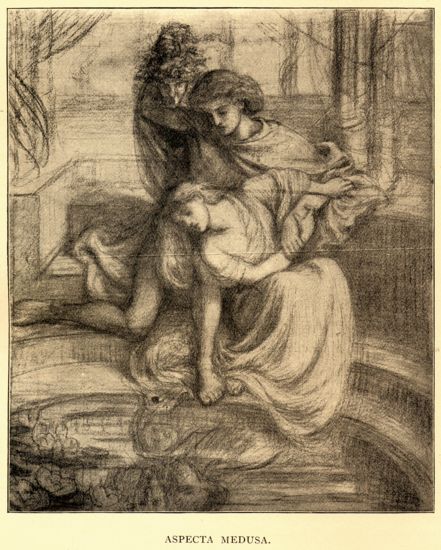
Перо и тушь. Андромеда, опёршаяся на Персея.
Figure: Pen and ink. Andromeda, leaning against Perseus,

"Голова Андромеды".
1868. Красный мел.
'Head of Andromeda'
1868
Red chalk
Museum no. CAI 6
Bequeathed by Constantine Alexander Ionides
Россетти сделал этот тщательно проработанный набросок Алексы Уалдинг для подготовки к картине, на которой Персей должен был держать отрубленную голову Медузы, чей взгляд превращал людей в камень, над водой пруда, так чтобы Андромеда без вреда для себя могла рассмотреть её отражение. На эскизе Андромеда неуклюже опирается на Персея, чтобы взглянуть.
Rossetti made this highly finished study from his model Alexa Wilding in preparation for a painting. The picture was to show Perseus holding the severed head of Medusa - which turned to stone those who looked directly at it - above a pool of water, so Andromeda could safely see its reflection. The study shows Andromeda leaning awkwardly over to look.
Если посмотреть внимательно на этот эскиз, понимаещь, что Медуза никакая не Медуза, а набросок Андромеды к картине Aspecta Medusa. Смотрят они в раные стороны, но в остальном идентичны. Неужели я один догадался? Копирайт застолбляю.
I have looked at the picture 'Aspecta Medusa' attentivly. Lo and behold! Medusa is not Medusa at all! Its Andromeda's head study for Aspecta Medusa. Let us compare two pictures below. The women look in different directions, but they are identical. I would like to know, if I the first one who discover this. Copyright is my.
Для полноты картины привожу ещё перевод:
ОТРАЖЕНИЕ МЕДУЗЫ
(К рисунку)
Та Андромеда, что Персей взял в жёны,
Желала видеть голову Горгоны.
Подъяв её над водами, Персей
Жене дозволил заглянуть в ручей,
Поскольку не опасно отраженье
Живучей смерти.
Не дерзай явленье
Запретное узреть, - и, не губя
Оно лишь тенью станет для тебя.
1867.
На мой взгляд нелепицу вы какую-то перевели Майя Квитковская. Особенно последние две строки, сама то поняла, что написала?
Метки: medusa rossetti aspecta |
ПОЛНЫЙ СПИСОК РАБОТ РОССЕТТИ. THE FULL LIST OF ROSSETTI'S CREATIONS. |
Дневник |
**'La Donna Della Finestra', Дама в окне. пастель, 1870 ? Брэдфорд художественная галерея и музей. 'La Donna della Finestra', coloured chalks, 1870, Bradford Art Galleries and Museums.
**'La Donna Della Finestra', масло (не окончен), 1881, Бирмингем музей и художественная галерея 'La Donna della Finestra', oil (unfinished), 1881, Birmingham Museums and Art Gallery
**'La Donna Della Finestra' масло 1880. 'La Donna della Finestra', oil 1880
Метки: прерафаэлиты алекса лиззи россетти alexa rossetti wilding уайлдинг сидал siddal |
КАРТИНЫ РОССЕТТИ датируемые 1858-59 годами ROSSETTI PAINTINGS |
Дневник |
Картины Россетти датируемые 1858 -59 годами.
1859
5.Bocca Baciata Oil on panel. Museum of Fine Arts, Boston, MA, USA.
6.Writing on the Sand Watercolour on paper. British Museum, London, UK.

Two lovers walking on a beach. The man is drawing his lover's profile with his stick.
|
Метки: mary magdalene rossetti |
| Страницы: | [1] |


