(и еще 3231 записям на сайте сопоставлена такая метка)
Другие метки пользователя ↓
annie miller baron von gloeden beata beatrix carlisle wall christina georgina rossetti christina rossetti. clark dante gabriel rossetti dudley gallery edward poynter eleanor fortescue-brickdale elizabeth siddal feet fetish fiammetta gabriel charls dante rossetti girls goblin market hannibal lecter heartsease pansy jane morris joanna mary boyce kelmscort manor la girlandata la pia de' tolomei lady lempicka louis de taeye mary magdalene at the door of simon the pharisee morris naked nude orient goods painting robert buchanan rossetti simeon solomon stacy marks study the blessed damozel vampyre venus verticordia vita nuova william holman hunt william michael rossetti women working men's college балет беатриче бойс данте данте габриэль россетти дж. котмен джейн моррис живопись иегуда лейб шварцман искатель искусство кеннет кларк колегова кристина россетти лемпика лемпицка лемпицкая мариинский менады микеланджело моррис насилие новый детектив новый роман ножки обнажённая пия де толомеи прерафаэлиты рисующий ангела роман россетти секс сиддал фетиш фиаметта фридерик лейтон хант хьюз чаадаев элизабет сиддал
SIBYLLA PALMIFERA |
Дневник |
Lady Lilith. ЛИЛИТ и СИБИЛЛА ПАЛЬМИФЕРА SIBYLLA PALMIFERA.
АНТИПОДЫ И КОЛЛЕГИ.

Сивилла Пальмифера.
Sibylla Palmifera
Эта величественная картина демонстрирует связь между поэзией и живописью, характерную для Россетти. Один из сонетов из "Дома жизни" толкует образ Сивиллы (или Красоты Души).
На картине множество символических деталей: Сивилла держит пальмовую ветвь, что означает Победу и Славу, некоторые источники утверждают, что Россетти стремился выразить победу души над смертью. В самом деле, другие символы кажется поддерживают такую интерпретацию. Бабочки, порхащие на заднем фоне - это символы воскресшей души, а маки, изображённые в вернем правом углу, часто используются как символы сна или смерти. Позади Сивиллы Амур с повязкой на глазах, а под ним неугасимый светильник любви. С другой стороны изображён череп-символ смерти и сфинкс - сивол загадки. Сивилла Пальмифера это также пример главной одержимости Россетти - изображение прекрасной женщины, идеального образа преследующего его воображение. Моделью художника на этой картине была Алекса Вайлдинг, одна из "потрясающих воображение" моделей прерафаэлитов. Она позировала и для других картин Россетти (например, Лилит) и других прерафаэлитов, например Сидония фон Борк Берн- Джонса.
The magnificent painting Sibylla Palmifera demonstrates the connections artist Dante Gabriel Rossetti often made between his paintings and his poetry. One of the sonnets from the House of Life reveals the subject of Sibylla Palmifera (or "Soul's Beauty"): This is that Lady Beauty, in whose praiseThy voice and hand shake still, - long known to theeBy flying hair and fluttering hem, - the beatFollowing her daily of thy heart and feet,How passionately and irretrievably,In what fond flight, how many ways and days! The painting features a great deal of symbolic detail. The woman holds a palm, which suggests victory - some sources state that Rossetti meant to represent the victory of the soul over death. Indeed, other symbols in the work seem to reinforce this interpretation. The butterflies that hover in the background are symbols of the soul, and the poppies that appear in the upper right corner are often used to symbolize sleep or death in art. Sibylla Palmifera is also an example of one of Rossetti's primary artistic obsessions - depicting the beautiful woman that so haunted his imagination. In this image, the artist's model was the 'stunner' Alexa Wilding. In addition to Sibylla Palmifera, the lovely Alexa Wilding appears in several of Rossetti's other works, including his Lady Lilith, La Sidonia von Bork" by Edward Burne-Jones, 1860 (Tate Gallery London).
SOUL'S BEUATY
[SIBYLLA PALMIFERA]
Under the arch of Life, where love and death,
Terror and mystery, guard her shrine, I saw
Beauty enthroned; and though her gaze struck awe,
I drew it in as simply as my breath.
The sky and sea bend on thee, - which can draw,
By sea or sky or woman, to one law,
The allotted bondman of her palm and wreath.
This is that Lady Beauty, in whose praise
Thy voice and hand shake still, - long known to thee
By flying hair and fluttering them, - the beat
Following her daily of thy heart and feet,
How passionately and irretrievably,
In what fond flight, how many ways and days!
КРАСОТА ДУШИ
[SIBYLLA PALMIFERA]*
Под аркой Жизи, где Любовь и Страх,
Где Смерть и Тайна бодрствуют в дозоре,
Там, на престоле, в царственном уборе
И с пальмовой ветвию в руках
Узрел я Красоту в её глазах
Мне просияли небеса и море -
Тем светом, что влечёт нас в женском взоре
И, как рабов, пред ним бросает в прах.
Вот образ Красоты благословенной,
Той, что я звал своею Госпожой, -
Хоть знал лишь по внезапным перебивам
В груди, по ускользающим извивам
Одежд, - за кем стремился всей душой,
Кого искал на всех путях Вселенной!
* Сибилла с пальмовой ветвью (лат).
Перевод Григория Кружкова.
Вот совсем другое дело, учись Тамара Казакова, это знатный перевод: хоть знал по ускользающим извивам - класс.
Я не с кондачка назвал Лилит и Сибиллу коллегами, по замыслу автора картин и сонетов они представляют аллегорию крайностей любви: Телесное вожделение в случае Лилит и чистую духовную любовь в случае Сибиллы. Но обратимся к фактам. По плодам их узнаете их, говорено в Библии. Каков результат воздействия золотых локонов и знойных взоров Лилит?
Едва зажжёт огонь твоих зениц
Взор юноши - и тот повержен ниц,
И душит сердце волос золотой.
Каков же результат воздействия чистых "окон души" Сибиллы?
Тем светом, что влечёт нас в женском взоре
И, как рабов, пред ним бросает в прах.
Пардон, результат один - спымать мужика и поработить.
Лилит широко представлена в живописи, но под руку мне попался Jhon Collier, вставляю:

Сивилла Пальмифера.
Sibylla Palmifera
Эта величественная картина демонстрирует связь между поэзией и живописью, характерную для Россетти. Один из сонетов из "Дома жизни" толкует образ Сивиллы (или Красоты Души).
На картине множество символических деталей: Сивилла держит пальмовую ветвь, что означает Победу и Славу, некоторые источники утверждают, что Россетти стремился выразить победу души над смертью. В самом деле, другие символы кажется поддерживают такую интерпретацию. Бабочки, порхащие на заднем фоне - это символы воскресшей души, а маки, изображённые в вернем правом углу, часто используются как символы сна или смерти. Позади Сивиллы Амур с повязкой на глазах, а под ним неугасимый светильник любви. С другой стороны изображён череп-символ смерти и сфинкс - сивол загадки. Сивилла Пальмифера это также пример главной одержимости Россетти - изображение прекрасной женщины, идеального образа преследующего его воображение. Моделью художника на этой картине была Алекса Вайлдинг, одна из "потрясающих воображение" моделей прерафаэлитов. Она позировала и для других картин Россетти (например, Лилит) и других прерафаэлитов, например Сидония фон Борк Берн- Джонса.
The magnificent painting Sibylla Palmifera demonstrates the connections artist Dante Gabriel Rossetti often made between his paintings and his poetry. One of the sonnets from the House of Life reveals the subject of Sibylla Palmifera (or "Soul's Beauty"): This is that Lady Beauty, in whose praiseThy voice and hand shake still, - long known to theeBy flying hair and fluttering hem, - the beatFollowing her daily of thy heart and feet,How passionately and irretrievably,In what fond flight, how many ways and days! The painting features a great deal of symbolic detail. The woman holds a palm, which suggests victory - some sources state that Rossetti meant to represent the victory of the soul over death. Indeed, other symbols in the work seem to reinforce this interpretation. The butterflies that hover in the background are symbols of the soul, and the poppies that appear in the upper right corner are often used to symbolize sleep or death in art. Sibylla Palmifera is also an example of one of Rossetti's primary artistic obsessions - depicting the beautiful woman that so haunted his imagination. In this image, the artist's model was the 'stunner' Alexa Wilding. In addition to Sibylla Palmifera, the lovely Alexa Wilding appears in several of Rossetti's other works, including his Lady Lilith, La Sidonia von Bork" by Edward Burne-Jones, 1860 (Tate Gallery London).
Метки: lady lilith sibylla palmifera |
ДАМА В ОКНЕ. THE LADY OF THE WINDOW. |
Дневник |

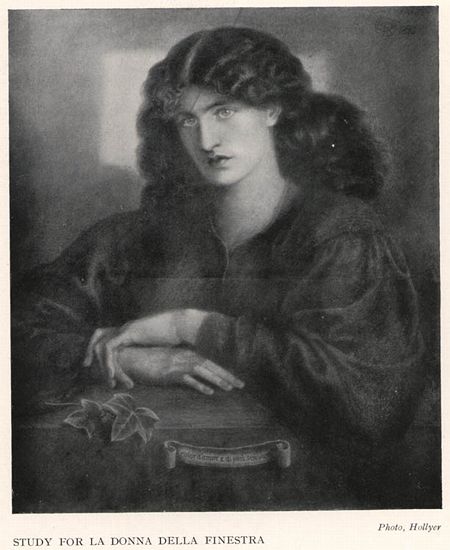
Дама в окне.
La Donna della Finestra. The Lady of the Window.
1879 Oil on canvas 39 3/4 x 29 1/4 inches (101 x 74.3 cm) Fogg Art Museum, Harvard University, Cambridge, Massachussetts, USA
Последняя из законченных картин Россетти модель - Джейн Моррис, существует незаконченная на туже тему 1881г. Найду вставлю.
Нашёл, вставляю:

Oil on canvas (unfinished).
Width: 870 mm
Height: 970 mm.
Одна из первых значительных картин пре-рафаэлитов, попавшая в коллекцию музея ( городской музей Бирмингема), куплена прямо с распродажи студии автора в мае 1883 года. Это незаконченная версия ранней картины 1879 года, находящейся ныне в Fogg Art Museum, Harvard University. Существует также версия в пастели 1870 года, ныне в Whitworth Art Gallery, University of Manchester. Картина иллюстрирует строки из "Новой жизни" Данте в которых женщина, известная как "Дама в окне", смотрит из своего окна на убитого горем Данте, оплакивающего умершую Беатиче. Здесь мы видим женщину, облокотившуюся на подоконник и смотрящую вниз. Голова - портрет Джейн Моррис.
This was one of the first major Pre-Raphalite pictures to enter the collection and was bought directly from the artist's studio sale in May 1883. It is an unfinished version of an earlier painting of 1879 which is at the Fogg Art Museum, Harvard University. There is also a pastel version of 1870 at Whitworth Art Gallery, University of Manchester. The picture illustrates a passage from the Dante's Vita Nuova in which a woman, otherwise known as the 'Lady of the Window', looks down from her window upon the grief-stricken Dante mourning the death of Beatrice. Here the lady is seen seated at an open window, leaning her arms upon the sill, and looking downwards. The head is a likeness of Jane Morris.
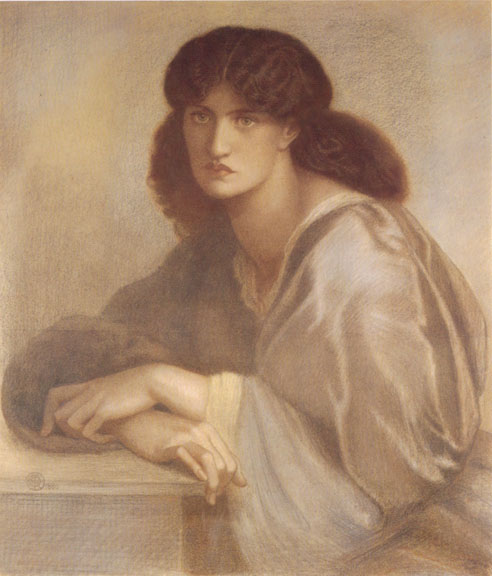
La Donna Della Finestra
1880
Coloured chalks on 2 sheets of buff paper, and signed with a monogram
133 x 28 inches, 83.9 x 71.2 cm.
На написание нескольких картин на данный сюжет художника вдохновила Vita nuova Данте. Женщина, смотрящая из окна на идущего по улице понёсшего трагическую утрату и плачущего Данте, сочувствует ему. Женщина это Джемма Донатти, ставшая впоследствии женой Данте.
The inspiration for this painting came from the Vita nuova, in which a woman looking down from her balcony is compassionate towards the bereaved and weeping Dante who she sees in the street below. The woman was Gemma Donati who later became Dante's wife.
Итак, сюжет "Дамы в окне" имеет происхождение из автобиографической книги Данте "Новая жизнь", книги, которая в основном сформировала отношение Россетти к любви. Книга повествует в символической и мистической манере об истории любви Данте к Беатриче. Россетти перевёл книгу на английский в 1850 году и опубликовал вместе с переводами других ранне-итальянских поэтов в 1861 году. Vita Nuova вдохновляла живопись Россетти на протяжении всего сворческого периода его жизни. Впервые он использовал сюжет La Donna della Finestra' в 1870 году и с тех пор этот сюжет стал одним из его самых излюбленных.
При большем увеличении видна дата 1870 год.
The subject of 'La Donna della Finestra' derives from Dante's autobiographical Vita Nuova, the book that did most to shape Rossetti's attitudes to love. It tells, in a symbolical and mystical fashion, the history of Dante's love for Beatrice. Rossetti translated it into English around 1850 and published it with other translations from the Early Italian poets in 1861. The Vita Nuova inspired Rossetti's paintings and designs throughout his career. He first treated 'La Donna della Finestra' in 1870 and from this date it became one of his favourite Dante subjects.
Фигура Дамы в окне появляется в то время, когда Данте погружён в глубокое горе по поводу смерти Беатриче. Данте рассказывает :"Просидев некоторое время, погружённый в горестные размышления о прошедших временах, я был внезапно наполнен печальными образами такой силы, что это проявилось на моём изменившемся лице. Почувствовав это и испугавшись, что кто-то наболюдает за мной, я поднял глаза и увидел молодую прекрасную даму, которая смотрела на меня из окна взглядом полным такой жалости, что казалась воплощением сострадания".
The figure of the Woman at the Window appears when Dante is sunk deep in grief for the death of Beatrice. Dante speaks;'Then, having sat for some space sorely in thought because of the time that was now past, I was filled with dolorous imaginings that it became outwardly manifest in mine altered countenance. Whereupon, feeling this and being in dread lest any should have seen me, I lifted my eyes to look; and then perceived a young and very beautiful lady, who was gazing upon me from a window with a gaze full of pity, so that the very sum of pity appeared gathered together in her'.
В обычной аллегорической интерпретации Vita Nuova, женщина олицетворяет Философию, но у Россетти не было намерения изображать абстрактную фигуру, он рассматривал образ как реальную женщину. По словам Вильяма Майкла Россетти:" Телесно это женщина в окне, духовно, это дама печали. Эта интерпретация тела и души, это ощущение равенства и беззащитной реальности символизируемого понятия и формы, которая несёт символ, этот экстернализм и интернализм - должны постоянно приниматься во внимание, как ключевая нота цели и способа достижения её в искусстве Россетти.
In the usual allegorical interpretation of the Vita Nuova, the lady represents Philosophy, but Rossetti had no intention of representing an abstract personification and regarded the vision as a real woman. In the words of William Michael Rossetti:'Humanly she is the Lady at the Window; mentally she is the Lady of Pity. This interpretation of soul and body — this sense of an equal and undefensible reality of the thing symbolized, and of the form which conveys the symbol — this externalism and internalism — are constantly to be understood as the key-note of Rossetti's aim and performance in art.
Для этой картины позировала Джейн Моррис, в которую Россетти влюбился около 1868 года. Примечательно, что он выбрал её для изображения Дамы печали, вероятно, чувствуя, что она принесла ему утешение в смерти жены Элизабет Сиддал, которую он персонифицировал, как Беатриче. И ещё, когда любовь Россетти к Джейн углубилась, он также изобразил её как Беатриче, например в большом полотне "Видение Данте в момент смерти Беатриче".
The sitter for this work was Jane Morris, with whom Rossetti fell in love in about 1868. It is significant that he chose to represent her as 'La Donna Della Finestra', suggesting that he felt she brought him consolation for the death of his wife, Elizabeth Siddal, whom he regarded as his Beatrice. Yet as Rossetti's love for Jane deepened he represented her as Beatrice also, for instance in the large oil painting 'Dante's Dream at the time of the Death of Beatrice' (Walker Art Gallery, Liverpool).
Собственником настоящей картины был William Graham, кто, наряду с Frederick Leyland был наиболее важным заказчиком Россетти. Он начал покупать картины Россетти ещё в середине 60-х, но был важен не только, как покупатель. Его прекрасная коллекция ранней итальянской живописи (предтечей пре-рафаэлитов) вдохновляла Россетти и других художников, которых поддерживал Грэм, включая Бёрн-Джонса. Понимание размаха колекции Грэма даёт каталог посмертной распродажи у Кристи в апреле 1886 года. Каталог исследуется сейчас Oliver Garnett. Грэм владел множеством картин Россетти. Когда они поступили на рынок в 1874 и 1885 году соответственно, Грэм не упустил возможности и купил два полотна братства пре-рафаэлитов: Благовещенье 1850 и Детство Девы Марии 1849. Обе сейчас в галерее Тейт. Он также заказал большую картину "Сон Данте", которая в конце концов оказалась слишком велика для его дома в Лондоне. Грэм особенно любил эту картину (Даму в окне), он писал Россетти в 1879 году:" Я должен добавить строчку о том, как я очарован "Дамой в окне", которую я рассматриваю, как вашу наиболеьшую удачу в изображении одиночной фигуры". Вторым владельцем картины был Major C.S. Goldman, сосед Бёрн-Джонса в Ротиндене в 90-х.
The owner of the present drawing was William Graham, who was, with Frederick Leyland, Rossetti's most important patron. He began to buy from Rossetti in the mid 1860s, but was not just important as a purchaser. His fine collection of early Italian paintings — (the original Pre-Raphaelites) helped to inspire Rossetti and the other artists whom Graham supported including Edward Burne-Jones. An insight into the scope of Graham's collection is given by the catalogue of his posthumous sale at Christies April 1886, and it is currently being researched by Oliver Garnett. Graham owned a number of works by Rossetti. When they came onto the market, in 1874 and 1885 respectively, Graham grasped the opportunity and bought his two Pre-Raphaelite Brotherhood oils, 'Ecce Ancilla Domini' (1850) and 'The Girlhood of Mary Virgin' (1849) both now in the Tate Gallery. He also commissioned the large 'Dante's Dream', although this ultimately proved too big for his London House. Graham regarded the present drawing with particular affection, writing to Rossetti in 1879, 'I must add one line to say how much I was charmed with the "Donna della Finestra" which I look at as one of your most successful single figures'. The second owner of the drawing, Major C.S. Goldman, was Burne-Jones's neighbour in Rottingdean in the 1890s.
Метки: окно дама lady window |
| Страницы: | [1] |


