LADY LILITH |
Дневник |
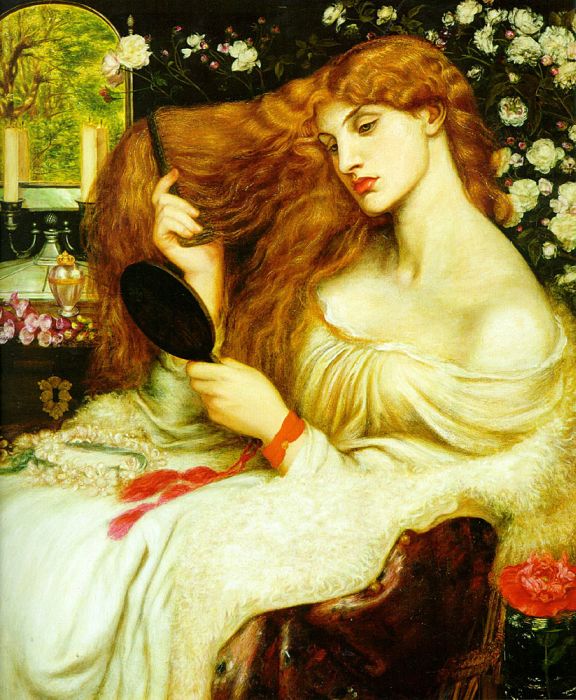
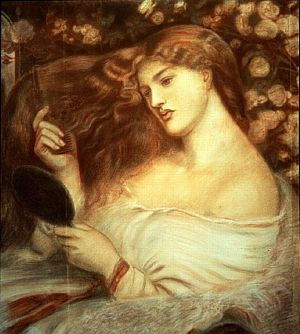
Lady Lilith, 1866-68 (altered 1872-73)
Dante Gabriel Rossetti (1828-1882)
Oil on canvas, 38 x 33 1/2 inches
Delaware Art Museum, Samuel and Mary R. Bancroft Memorial, 1935 Lilith, the subject of this painting, is described in Judaic literature as the first wife of Adam. She is associated with the seduction of men and the murder of children. The depiction of women as powerful and evil temptresses was prevalent in 19th-century painting, particularly among the Pre-Raphaelites. The artist depicts Lilith as an iconic, Amazon-like female with long, flowing hair. Her languid nature is reiterated in the inclusion of the poppy in the lower right corner—the flower of opium-induced slumber.
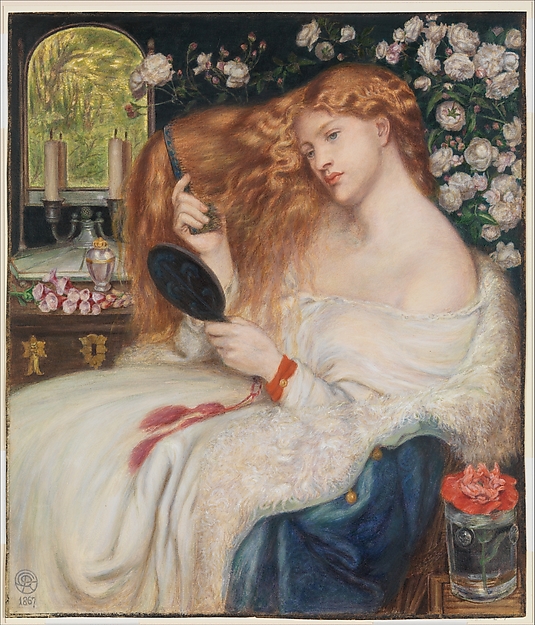
Очарованный физической привлекательностью женщины, Россетти здесь изображает легендарную "роковую женщину", как погружённую в себя красотку девятнадцатого века, расчёсывающую волосы и соблазнительно демонстрирующую плечи. Цветы на картине символизируют различные виды любви. В литературе иудаизма соблазнительница Лилит описывается как первая жена Адама, а её характер подчёркивается строками из Фауста Гёте, собственноручно прикреплёнными Россетти к оригинальной раме. Текст (в переводе Шелли) собственноручно исполнен автором на полоске бумаги приклеенной на обороте картины.
Текст на картине.
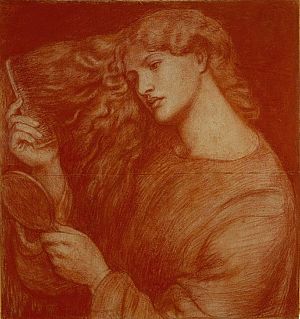
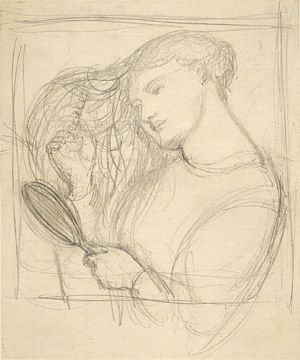
Lady Lilith (red chalk on paper).
62x57 cms
Medium: crayon
BODY'S BEAUTY
Of Adam's first wife, Lilith, it is told
(The witch, he loved before the gift of Eve)
That, ere the snake's, her sweet tongue could deceive,
And her enchanted hair was the first gold.
And still she sits, young while the earth is old,
And, subtly of herself contemplative,
draws men to watch the bright web she can weave,
Till heart and body and life are in its hold.
The rose and poppy are her flowers; for where
Is he not found, O Lilith, whom shed scent
And soft-shed kisses and soft sleep shall snare?
Lo! as that youth's eyes burned at thine, so went
Thy spell through him, and left his straight neck bent,
And round his heart one strangling golden hair.
1866
ТЕЛЕСНАЯ ПРЕЛЕСТЬ.
Лилит, Адама первая жена
(Колдунья, что до Евы с ним была).
Предтечей змия в кознях прослыла,
И золотилась кос её волна.
Стареет мир, не старится она;
Спокон веков она мужей влекла,
Улавливая души и тела
В силки страстей, как в наши времена.
Ей любы мак и томных роз цветы;
Кого, Лилит, не зачаруешь ты,
Твой поцелуй и сонных грёз настой?
Едва зажжёт огонь твоих зениц
Взор юноши - и тот повержен ниц,
И душит сердце волос золотой.
Короче, весь вред от баб, ох уж эти Анфиски.
Although a remarkably more controversial model than Elizabeth Siddal or Jane Morris, Fanny was not only the subject of some of Dante’s most astonishing works but it seems she was “forgotten” before her time. She modeled for the painting of “Lady Lilith”, the first wife of Adam in Jewish mythology and seen as the personification of lust. “Sibylla Palmifera” was conceived as an opposing piece to “Lady Lilith” and painted from the model Alexa Wilding. It represented “Soul’s Beauty”, a sonnet Rossetti wrote to accompany his painting. The modestly dressed Sibyl sits in a temple surrounded by the emblems of Love: the Cupid, Death: the Skull, and Mystery: the Sphinx. In contrast, Lilith admires herself in a mirror, the attribute of vanity. Initially the contrast between the pictures was very marked, but in 1872-3 Rossetti replaced Fanny’s head with the head of Alexa at the request of a buyer, and the original concept was destroyed. She is the sumptuous and inviting woman in paintings such as the above mentioned “Bocca Botacia” and “Lady Lilith” as well as “The Blue Bower” and others. “The Blue Bower” was Rossetti’s last major portrait of Fanny Cornforth.The artist identified the subject on a label attached to the original frame: "Beware of her fair hair, for she excells [sic]/ All women in the magic of her locks,/ And when she twines them round a young man's neck/ she will not ever set him free again." These lines are taken from Shelley's translation of the Walpurgisnacht scene in Goethe's Faust. Here, as in Rosetti's other drawings and paintings of Lady Lilith, the artist's mistress, Fanny Cornforth, served as the model.
The oil painting Lady Lilith depicts artist Dante Gabriel Rossetti's version of an ancient figure, but with a twist. Here, the figure is in the guise of a Nineteenth century femme fatale. According to the legend, Lilith was the first wife of Adam. She was both beautiful and devious. Rossetti composed a poem about this woman, in which she is characterized as a dazzling seductress with golden hair that could be used to ensnare a man. And the artist certainly emphasized the deadly charms of Lilith's gold tresses in this painting, for she is caught in the act of combing her luxurious locks while gazing contemplatively into a hand mirror. It is also worth mentioning that two of Rossetti's 'stunners' posed for this work of art - both Fanny Cornforth and Alexa Wilding lent their lovely features.
ИСТОЧНИКИ:
http://www.rossettiarchive.org/
|
SIBYLLA PALMIFERA |
Дневник |
Lady Lilith. ЛИЛИТ и СИБИЛЛА ПАЛЬМИФЕРА SIBYLLA PALMIFERA.
АНТИПОДЫ И КОЛЛЕГИ.

Сивилла Пальмифера.
Sibylla Palmifera
Эта величественная картина демонстрирует связь между поэзией и живописью, характерную для Россетти. Один из сонетов из "Дома жизни" толкует образ Сивиллы (или Красоты Души).
На картине множество символических деталей: Сивилла держит пальмовую ветвь, что означает Победу и Славу, некоторые источники утверждают, что Россетти стремился выразить победу души над смертью. В самом деле, другие символы кажется поддерживают такую интерпретацию. Бабочки, порхащие на заднем фоне - это символы воскресшей души, а маки, изображённые в вернем правом углу, часто используются как символы сна или смерти. Позади Сивиллы Амур с повязкой на глазах, а под ним неугасимый светильник любви. С другой стороны изображён череп-символ смерти и сфинкс - сивол загадки. Сивилла Пальмифера это также пример главной одержимости Россетти - изображение прекрасной женщины, идеального образа преследующего его воображение. Моделью художника на этой картине была Алекса Вайлдинг, одна из "потрясающих воображение" моделей прерафаэлитов. Она позировала и для других картин Россетти (например, Лилит) и других прерафаэлитов, например Сидония фон Борк Берн- Джонса.
The magnificent painting Sibylla Palmifera demonstrates the connections artist Dante Gabriel Rossetti often made between his paintings and his poetry. One of the sonnets from the House of Life reveals the subject of Sibylla Palmifera (or "Soul's Beauty"): This is that Lady Beauty, in whose praiseThy voice and hand shake still, - long known to theeBy flying hair and fluttering hem, - the beatFollowing her daily of thy heart and feet,How passionately and irretrievably,In what fond flight, how many ways and days! The painting features a great deal of symbolic detail. The woman holds a palm, which suggests victory - some sources state that Rossetti meant to represent the victory of the soul over death. Indeed, other symbols in the work seem to reinforce this interpretation. The butterflies that hover in the background are symbols of the soul, and the poppies that appear in the upper right corner are often used to symbolize sleep or death in art. Sibylla Palmifera is also an example of one of Rossetti's primary artistic obsessions - depicting the beautiful woman that so haunted his imagination. In this image, the artist's model was the 'stunner' Alexa Wilding. In addition to Sibylla Palmifera, the lovely Alexa Wilding appears in several of Rossetti's other works, including his Lady Lilith, La Sidonia von Bork" by Edward Burne-Jones, 1860 (Tate Gallery London).
SOUL'S BEUATY
[SIBYLLA PALMIFERA]
Under the arch of Life, where love and death,
Terror and mystery, guard her shrine, I saw
Beauty enthroned; and though her gaze struck awe,
I drew it in as simply as my breath.
The sky and sea bend on thee, - which can draw,
By sea or sky or woman, to one law,
The allotted bondman of her palm and wreath.
This is that Lady Beauty, in whose praise
Thy voice and hand shake still, - long known to thee
By flying hair and fluttering them, - the beat
Following her daily of thy heart and feet,
How passionately and irretrievably,
In what fond flight, how many ways and days!
КРАСОТА ДУШИ
[SIBYLLA PALMIFERA]*
Под аркой Жизи, где Любовь и Страх,
Где Смерть и Тайна бодрствуют в дозоре,
Там, на престоле, в царственном уборе
И с пальмовой ветвию в руках
Узрел я Красоту в её глазах
Мне просияли небеса и море -
Тем светом, что влечёт нас в женском взоре
И, как рабов, пред ним бросает в прах.
Вот образ Красоты благословенной,
Той, что я звал своею Госпожой, -
Хоть знал лишь по внезапным перебивам
В груди, по ускользающим извивам
Одежд, - за кем стремился всей душой,
Кого искал на всех путях Вселенной!
* Сибилла с пальмовой ветвью (лат).
Перевод Григория Кружкова.
Вот совсем другое дело, учись Тамара Казакова, это знатный перевод: хоть знал по ускользающим извивам - класс.
Я не с кондачка назвал Лилит и Сибиллу коллегами, по замыслу автора картин и сонетов они представляют аллегорию крайностей любви: Телесное вожделение в случае Лилит и чистую духовную любовь в случае Сибиллы. Но обратимся к фактам. По плодам их узнаете их, говорено в Библии. Каков результат воздействия золотых локонов и знойных взоров Лилит?
Едва зажжёт огонь твоих зениц
Взор юноши - и тот повержен ниц,
И душит сердце волос золотой.
Каков же результат воздействия чистых "окон души" Сибиллы?
Тем светом, что влечёт нас в женском взоре
И, как рабов, пред ним бросает в прах.
Пардон, результат один - спымать мужика и поработить.
Лилит широко представлена в живописи, но под руку мне попался Jhon Collier, вставляю:

Сивилла Пальмифера.
Sibylla Palmifera
Эта величественная картина демонстрирует связь между поэзией и живописью, характерную для Россетти. Один из сонетов из "Дома жизни" толкует образ Сивиллы (или Красоты Души).
На картине множество символических деталей: Сивилла держит пальмовую ветвь, что означает Победу и Славу, некоторые источники утверждают, что Россетти стремился выразить победу души над смертью. В самом деле, другие символы кажется поддерживают такую интерпретацию. Бабочки, порхащие на заднем фоне - это символы воскресшей души, а маки, изображённые в вернем правом углу, часто используются как символы сна или смерти. Позади Сивиллы Амур с повязкой на глазах, а под ним неугасимый светильник любви. С другой стороны изображён череп-символ смерти и сфинкс - сивол загадки. Сивилла Пальмифера это также пример главной одержимости Россетти - изображение прекрасной женщины, идеального образа преследующего его воображение. Моделью художника на этой картине была Алекса Вайлдинг, одна из "потрясающих воображение" моделей прерафаэлитов. Она позировала и для других картин Россетти (например, Лилит) и других прерафаэлитов, например Сидония фон Борк Берн- Джонса.
The magnificent painting Sibylla Palmifera demonstrates the connections artist Dante Gabriel Rossetti often made between his paintings and his poetry. One of the sonnets from the House of Life reveals the subject of Sibylla Palmifera (or "Soul's Beauty"): This is that Lady Beauty, in whose praiseThy voice and hand shake still, - long known to theeBy flying hair and fluttering hem, - the beatFollowing her daily of thy heart and feet,How passionately and irretrievably,In what fond flight, how many ways and days! The painting features a great deal of symbolic detail. The woman holds a palm, which suggests victory - some sources state that Rossetti meant to represent the victory of the soul over death. Indeed, other symbols in the work seem to reinforce this interpretation. The butterflies that hover in the background are symbols of the soul, and the poppies that appear in the upper right corner are often used to symbolize sleep or death in art. Sibylla Palmifera is also an example of one of Rossetti's primary artistic obsessions - depicting the beautiful woman that so haunted his imagination. In this image, the artist's model was the 'stunner' Alexa Wilding. In addition to Sibylla Palmifera, the lovely Alexa Wilding appears in several of Rossetti's other works, including his Lady Lilith, La Sidonia von Bork" by Edward Burne-Jones, 1860 (Tate Gallery London).
Метки: lady lilith sibylla palmifera |
| Страницы: | [1] |


