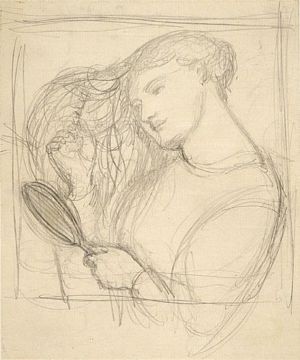
Lady Lilith.
51,3*44 см.
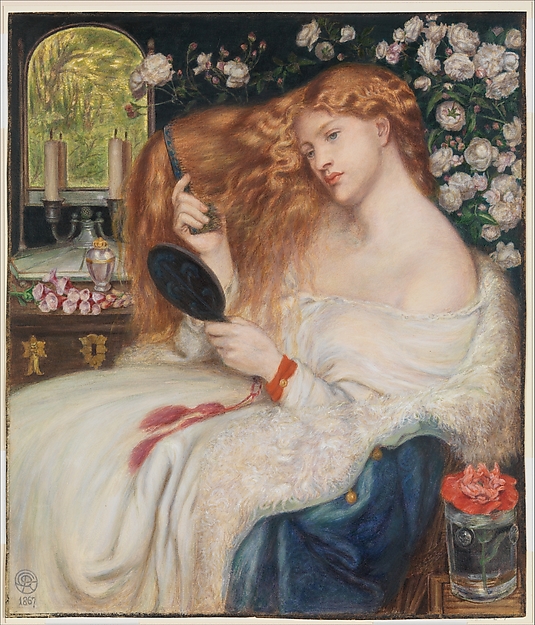
Lady Lilith, 1867 Dante Gabriel Rossetti (British, 1828–1882) Watercolor and gouache on paper 20 3/16 X 17 5/16 in. (51.3 x 44 cm)Rogers Fund, 1908 (08.162.1)
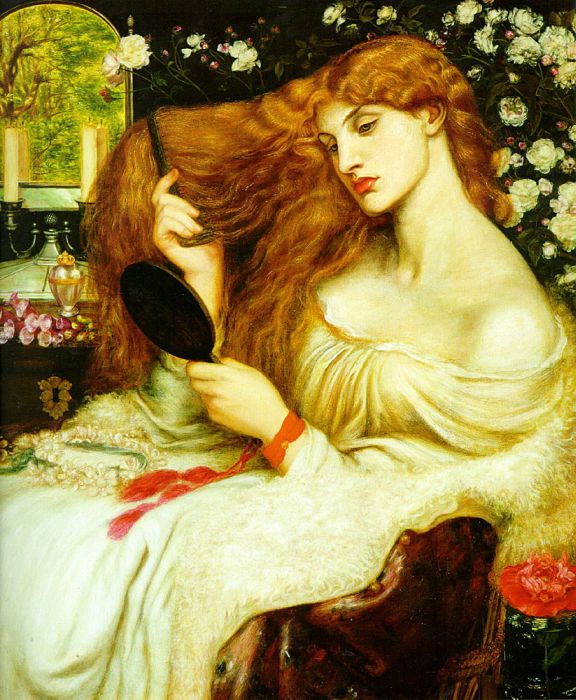
Хотя и значительно более противоречивая модель, чем Сиддал или Моррис, Фанни была не только предметом некоторых замечательных работ Россетти, но и была преждевременно забыта. Она послужила моделью для ЛИЛИТ - первой жены Адама в еврейской мифологии, рассматриваемой, как воплощение вожделения.Sibylla Palmifera была задумана, как противоположность образа Лилит, моделью послужила Алекса Вайлдинг. Она представляла "Красоту Души" - сонет, который Россетти написал в сопровождение картины. Скромно одетая Сибил сидит в храме, окружённая эмблемами Любви - Купидон, Смерти - череп и Тайны - сфинкс. В противоположность этому Лилит восхищается собой в зеркале. Первоначально контраст между картинами был очень заметен, но в 1872-3 году Россетти переписал голову Фаннии-Лилит, заменив её по требованию покупателя на Алексу Вайлдинг и оригинальная концепция была разрушена. Таким образом для Лилит моделями послужили и Фанни и Алекса.
Художник идентифицирует предмет картины на ярлыке, прикреплённом к оригинальной раме: "Берегись её прекрасных волос, так как она превосходит всех женщин в магии её волос. Если она оплетёт ими шею юноши, то уже никогда не отпустит его." Эти строки взяты из перевода Шелли Walpurgisnacht scene in Goethe's Faust.
Лилит отображает представление Россетти об "историческом" образе женщины, но с определённым уклоном. Здесь она в образе femme fatale - "роковой женщины" 19 века. Художник подчёркивает смертоносное очарование золотых прядей тем, что Лилит изображена в процессе их расчёсывания.
Although a remarkably more controversial model than Elizabeth Siddal or Jane Morris, Fanny was not only the subject of some of Dante’s most astonishing works but it seems she was “forgotten” before her time. She modeled for the painting of “Lady Lilith”, the first wife of Adam in Jewish mythology and seen as the personification of lust. “Sibylla Palmifera” was conceived as an opposing piece to “Lady Lilith” and painted from the model Alexa Wilding. It represented “Soul’s Beauty”, a sonnet Rossetti wrote to accompany his painting. The modestly dressed Sibyl sits in a temple surrounded by the emblems of Love: the Cupid, Death: the Skull, and Mystery: the Sphinx. In contrast, Lilith admires herself in a mirror, the attribute of vanity. Initially the contrast between the pictures was very marked, but in 1872-3 Rossetti replaced Fanny’s head with the head of Alexa at the request of a buyer, and the original concept was destroyed. She is the sumptuous and inviting woman in paintings such as the above mentioned “Bocca Botacia” and “Lady Lilith” as well as “The Blue Bower” and others. “The Blue Bower” was Rossetti’s last major portrait of Fanny Cornforth.The artist identified the subject on a label attached to the original frame: "Beware of her fair hair, for she excells [sic]/ All women in the magic of her locks,/ And when she twines them round a young man's neck/ she will not ever set him free again." These lines are taken from Shelley's translation of the Walpurgisnacht scene in Goethe's Faust. Here, as in Rosetti's other drawings and paintings of Lady Lilith, the artist's mistress, Fanny Cornforth, served as the model.
The oil painting Lady Lilith depicts artist Dante Gabriel Rossetti's version of an ancient figure, but with a twist. Here, the figure is in the guise of a Nineteenth century femme fatale. According to the legend, Lilith was the first wife of Adam. She was both beautiful and devious. Rossetti composed a poem about this woman, in which she is characterized as a dazzling seductress with golden hair that could be used to ensnare a man. And the artist certainly emphasized the deadly charms of Lilith's gold tresses in this painting, for she is caught in the act of combing her luxurious locks while gazing contemplatively into a hand mirror. It is also worth mentioning that two of Rossetti's 'stunners' posed for this work of art - both Fanny Cornforth and Alexa Wilding lent their lovely features
Lady Lilith, 1866-68 (altered 1872-73)
Dante Gabriel Rossetti (1828-1882)
Oil on canvas, 38 x 33 1/2 inches
Delaware Art Museum, Samuel and Mary R. Bancroft Memorial, 1935 Lilith, the subject of this painting, is described in Judaic literature as the first wife of Adam. She is associated with the seduction of men and the murder of children. The depiction of women as powerful and evil temptresses was prevalent in 19th-century painting, particularly among the Pre-Raphaelites. The artist depicts Lilith as an iconic, Amazon-like female with long, flowing hair. Her languid nature is reiterated in the inclusion of the poppy in the lower right corner—the flower of opium-induced slumber.
Музей изящных искусств Делавара. Лилит - предмет данной картины, упоминается в еврейских писаниях как первая жена Адама. Она ассоциируется с обольщением мужчин и убийством детей. Изображение женщины как могущественной и злой соблазнительницы было обычным в живописи 19 века, особенно среди прерафаэлитов. Художник изобразил Лилит как женщину-амазонку с длинными струящимися волосами. Её расслабленная поза подкрепляется включением изображения мака в нижнем правом углу - цветка сна, вызванного опиумом.
В Делаварском музее хранится картина маслом, Россетти повторял этот образ в различных техниках, что для него вообще характерно.
Metropolitan Museum
http://www.metmuseum.org/collection/the-collection-online/search/337500?rpp=30&pg=1&ft=rossetty&pos=1
Lady Lilith
Artist: Dante Gabriel Rossetti (British, London 1828–1882 Birchington-on-Sea)
Artist: Henry Treffry Dunn (British, Truro 1838–1899 London)
Date: 1867
Medium: Watercolor and gouache on paper
Dimensions: 20 3/16 X 17 5/16 in. (51.3 x 44 cm)
Classification: Drawings
Credit Line: Rogers Fund, 1908.
Included Text
-
Beware of her fair hair, for she excels
-
All women in the magic of her locks;
-
And when she winds them round a young man's neck,
-
She will not ever set him free again.
-
Goethe
Note: The text (which gives Shelley's translation) appear in holograph on a slip of paper pasted on the back of the picture.
Fascinated by women’s physical allure, Rossetti here imagines a legendary femme fatale as a self-absorbed nineteenth-century beauty who combs her hair and seductively exposes her shoulders. Nearby flowers symbolize different kinds of love. In Jewish literature, the enchantress Lilith is described as Adam’s first wife, and her character is underscored by lines from Goethe’s Faust attached by Rossetti to the original frame, this watercolor, Rossetti and his assistant Dunn based on an oil of 1866 (Delaware Art Museum).
Очарованный физической привлекательностью женщины, Россетти здесь изображает легендарную "роковую женщину", как погружённую в себя красотку девятнадцатого века, расчёсывающую волосы и соблазнительно демонстрирующую плечи. Цветы на картине символизируют различные виды любви. В литературе иудаизма соблазнительница Лилит описывается как первая жена Адама, а её характер подчёркивается строками из Фауста Гёте, собственноручно прикреплёнными Россетти к оригинальной раме. Текст (в переводе Шелли) собственноручно исполнен автором на полоске бумаги приклеенной на обороте картины.
Текст на картине.
Берегись волос её прекрасных
Всех женщин превосходит она магией своих локонов
А когда обвивает ими шею мужчины, ему уже не освободиться.
Гёте.
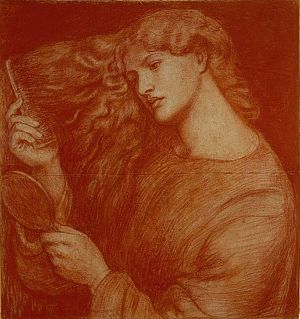
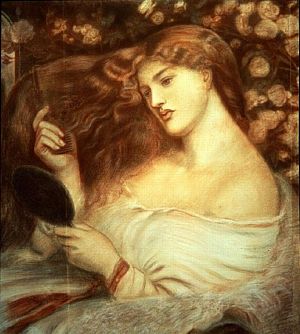
Lady Lilith (red chalk on paper).
62x57 cms
Medium: crayon
Dimensions: 24 1/2 x 22 7/8 in.
Signature: monogram
Note: The monogram is located in the upper right corner.
Production Description
Production Date: 1866 (circa)
Original Cost: ВЈ472. 10 s.
Model: Fanny Cornforth
Current Location: Tel Aviv Museum of Art.
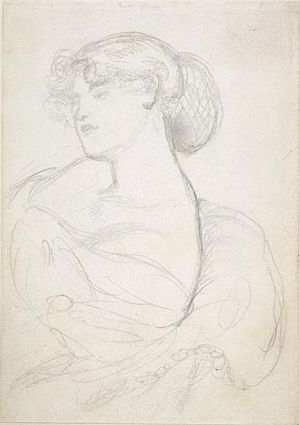
Medium: pencil
Dimensions: 7 1/4 x 5 1/8 in.
Production Date: 1866?
Current Location: Birmingham City Museum and Art Gallery.
The portrait shows much less of the room than the finished oil paintings. The window/mirror at the upper left is only partially visible in this picture, and there is no glass with a flower in the lower right.
Medium: pastel
Dimensions: 38 x 30 in.
Production Date: 1867 (circa)
Exhibition History: New Gallery, 1897 (no. 73)
Original Cost: ВЈ100
Model: Fanny Cornforth
Current Location: Harry Ransom Humanities Research Center, U. of Texas, Art Collection
1864?
Medium: pencil
Dimensions: 7 3/8 x 6 1/8 in.
Production Date: 1864?
Current Location: Birmingham City Museum and Art Gallery
BODY'S BEAUTY
Of Adam's first wife, Lilith, it is told
(The witch, he loved before the gift of Eve)
That, ere the snake's, her sweet tongue could deceive,
And her enchanted hair was the first gold.
And still she sits, young while the earth is old,
And, subtly of herself contemplative,
draws men to watch the bright web she can weave,
Till heart and body and life are in its hold.
The rose and poppy are her flowers; for where
Is he not found, O Lilith, whom shed scent
And soft-shed kisses and soft sleep shall snare?
Lo! as that youth's eyes burned at thine, so went
Thy spell through him, and left his straight neck bent,
And round his heart one strangling golden hair.
1866
ТЕЛЕСНАЯ ПРЕЛЕСТЬ.
Лилит, Адама первая жена
(Колдунья, что до Евы с ним была).
Предтечей змия в кознях прослыла,
И золотилась кос её волна.
Стареет мир, не старится она;
Спокон веков она мужей влекла,
Улавливая души и тела
В силки страстей, как в наши времена.
Ей любы мак и томных роз цветы;
Кого, Лилит, не зачаруешь ты,
Твой поцелуй и сонных грёз настой?
Едва зажжёт огонь твоих зениц
Взор юноши - и тот повержен ниц,
И душит сердце волос золотой.
Короче, весь вред от баб, ох уж эти Анфиски.
Although a remarkably more controversial model than Elizabeth Siddal or Jane Morris, Fanny was not only the subject of some of Dante’s most astonishing works but it seems she was “forgotten” before her time. She modeled for the painting of “Lady Lilith”, the first wife of Adam in Jewish mythology and seen as the personification of lust. “Sibylla Palmifera” was conceived as an opposing piece to “Lady Lilith” and painted from the model Alexa Wilding. It represented “Soul’s Beauty”, a sonnet Rossetti wrote to accompany his painting. The modestly dressed Sibyl sits in a temple surrounded by the emblems of Love: the Cupid, Death: the Skull, and Mystery: the Sphinx. In contrast, Lilith admires herself in a mirror, the attribute of vanity. Initially the contrast between the pictures was very marked, but in 1872-3 Rossetti replaced Fanny’s head with the head of Alexa at the request of a buyer, and the original concept was destroyed. She is the sumptuous and inviting woman in paintings such as the above mentioned “Bocca Botacia” and “Lady Lilith” as well as “The Blue Bower” and others. “The Blue Bower” was Rossetti’s last major portrait of Fanny Cornforth.The artist identified the subject on a label attached to the original frame: "Beware of her fair hair, for she excells [sic]/ All women in the magic of her locks,/ And when she twines them round a young man's neck/ she will not ever set him free again." These lines are taken from Shelley's translation of the Walpurgisnacht scene in Goethe's Faust. Here, as in Rosetti's other drawings and paintings of Lady Lilith, the artist's mistress, Fanny Cornforth, served as the model.
The oil painting Lady Lilith depicts artist Dante Gabriel Rossetti's version of an ancient figure, but with a twist. Here, the figure is in the guise of a Nineteenth century femme fatale. According to the legend, Lilith was the first wife of Adam. She was both beautiful and devious. Rossetti composed a poem about this woman, in which she is characterized as a dazzling seductress with golden hair that could be used to ensnare a man. And the artist certainly emphasized the deadly charms of Lilith's gold tresses in this painting, for she is caught in the act of combing her luxurious locks while gazing contemplatively into a hand mirror. It is also worth mentioning that two of Rossetti's 'stunners' posed for this work of art - both Fanny Cornforth and Alexa Wilding lent their lovely features.
ИСТОЧНИКИ:
http://www.rossettiarchive.org/