РОССЕТТИ 1860 |
РОССЕТТИ 1860
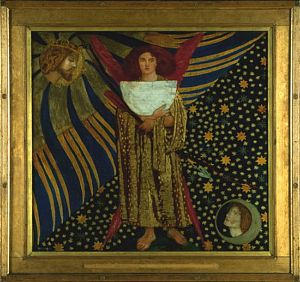
The work known under this title was originally planned to be the central panel of a triptych that was to adorn a cabinet belonging to William Morris.
Работа первоначально планировалась как центральная часть триптиха для украшения дверей шкафа в доме Уильяма Морриса. Она осталась незаконченной.
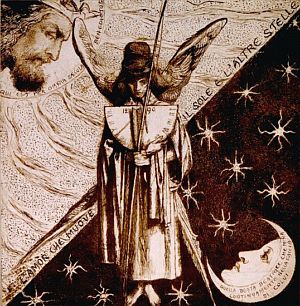
The flanking panels depicted (on the left) Dante's meeting with Beatrice in Florence, recorded in the Vita Nuova chapter 3, and (on the right) Dante's meeting with Beatrice recorded in the Purgatorio Canto XXX. The central panel was not completed, however, although DGR did finish a pen and ink drawing in which all the elements of the original conception are depicted. This drawing is now in the Birmingham City Museum and Art Gallery. The unfinished oil on panel is in the Tate Gallery, and there is a pencil study on the verso of the unfinished watercolor of The Gate of Memory.
The work is completely symbolic. The central figure is Love who is holding a sundial. In the finished drawing this figure wears a pilgrim's hat, an accoutrement that recalls Dante's preoccupation with the idea of the pilgrim (see especially the Vita Nuova chapters 40-41). He stands against a hieratic background divided along a diagonal running from upper right to lower left. In the upper left quadrant is the head of Christ, figured as the sun, looking down across a heavily stylized field of sun rays that emanate from the circle containing his head. His gaze is directed toward the figure of Beatrice, whose face is inscibed in a crescent moon in the lower right quadrant against a background of stars.
The picture is a symbolistic representation of the death of Beatrice and the meaning of that death. As the central panel of the projected triptych, that death stood “between” the two salutations given to Dante by Beatrice. Grieve says that the picture “represents the essential truth of both the Vita Nuova and the Divina Commedia, that Love is the generating force of the universe” (see the 1984 Tate catalogue The Pre-Raphaelites, 179). In his left hand the figure of Love holds a bow and arrow, in his right the sundial which points at the ninth hour, the hour of Christ's and of Beatrice's death alike. Ainsworth says that the work specifically illustrates the Vita Nuova chapter XXVIII, “when the Lord God of justice called my most gracious lady unto Himself” (see Ainsworth, “DGR's ‘Dantis Amor,’” 72).
The work is deeply literary, its most obvious reference point being the last line of Dante's Paradiso (“L'Amor che muove il sole e l'altre stelle”. Almost equally important is the Vita Nuova, as the inscription surrounding Christ's head indicates (“qui est per omnia seacula benedictus”); these are the concluding lines of Dante's spiritual autobiography. In its completed form, as the finished drawing at Birmingham shows, Beatrice's head was to have been circled with the immediately preceding words from Dante's autobiography: “quella beata Beatrice che mira continualmente nella faccia di colui.”
The title has a double significance, with the genitive case signalling both Dante's love (for Beatrice, for Love, for God) and Rossetti's (for Dante as the emblem of visionary art, and for Love as idea and experience). DGR's work is a move to re-imagine Dante's love-ideal in a secondary devotional act. As in his various pastiche texts—in this case the reference would be to “Piangendo star con l'anima smarrita”— the picture involves a kind of magical act whose aim is to recover Dante's spiritual values for a more secular world. In DGR's case, art becomes not so much the vehicle of those values as their incarnation.
For further information see the commentary for the Tate Gallery oil.
Production History DGR went to the Morris's house in Upton in October 1860 to do this picture. The drawing on the back of The Gate of Memory may have been done at that time, though Ainsworth thinks it is a later production (see Ainsworth, “DGR's ‘Dantis Amor,’” 70). The finished drawing dates from 1860 as well. Left unfinished at that time, the oil picture was returned to DGR in 1863 and worked on again. When it was sold to the dealer Gambart in 1865 DGR had it placed in its striking frame.
Literary The text directly related to this picture is Dante's “Sonnet. On the ninth of June 1290”. Electronic Archive Edition: 1 Source File: s117.raw.xml
Description: The central figure in this picture is Love, who is holding what would have been a sundial (if the picture had been completed). He stands against a decorative background divided along a diagonal running from upper right to lower left. In the upper left quadrant is the head of Christ, figured as the sun, looking down across a heavily stylized field of sun rays that emanate from the circle surrounding his head. His gaze is directed toward the figure of Beatrice, whose face is inscribed in a crescent moon in the lower right quadrant against a background of stars.
This picture, which was not completed, was to have been the central panel of three for a cabinet at William Morris's Red House, Bexley Heath. The cabinet is still there, but some time before August 1863, the two finished panels were removed and made into a diptych with a narrow central separator where a schematic form of the figure of Love (as depicted in this work) appears. This two-panel work is The Salutation of Beatrice,
Описание: центральной фигурой на этой картине является Любовь, держащая то, что будь картина закончена, стало бы циферблатом солнечных часов. Он (любовь в английском мужского рода) стоит на декоративном фоне, разделённом по диагонали справа налево. В левом верхнем квадранте изображена голова Христа в виде Солнца, голова смотрит через стилизованные лучи, исходящие из окружающего её круга. Его взгляд направлен на Беатриче, чьё лицо помещено в серп месяца и расположено в нижнем правом квадранте на фоне звёзд. Эта картина, которая не была завершена, должна была стать центральной панелью триптиха для кабинета Красного дома Вильяма Морриса. Кабинет и сейчас тут, но перед августом 1863 года две законченные панели были превращены в диптих с разделяющей панели схематически изображенной фигурой Любви. Это диптих The Salutation of Beatrice.
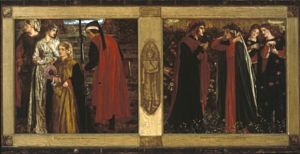
This unfinished work was intended to be the center panel of the cabinet at Red House from which The Salutation of Beatrice was later removed.
Love, dressed as a pilgrim, holds a sundial dated 1290, the year of Beatrice's death.The central figure in this picture is Love, who is holding what would have been a sundial (if the picture had been completed). He stands against a decorative background divided along a diagonal running from upper right to lower left. In the upper left quadrant is the head of Christ, figured as the sun, looking down across a heavily stylized field of sun rays that emanate from the circle surrounding his head. His gaze is directed toward the figure of Beatrice, whose face is inscribed in a crescent moon in the lower right quadrant against a background of stars.
Это законченный эскиз для картины маслом, детали более проработаны, чем на неоконченной картине. Любовь держит в руках солнечные часы на которых час смерти Беатриче, Беатриче окружена ночным мраком. Картина символизирует переход Любви из Чистилища в Рай.
На картине три надписи, первая окружает голову Христа, вторая Беатриче, третья расположена по диагонали. Первые две из заключительного предложения Vita Nova Данте, третья - заключительная строка Рая.
QUI EST PER OMNIA SAECULA BEN BENEDICTUS QUELLA. BEATA BEATRICE CHE MIRA CONTINUALMENTE NELLA FACIA DI COLUIL'. AMOR CHE MUOVE IL SOLE E L'ALTRE STELLE
Annie Miller 1860
 Annie miller 1860 Этот рисунок напоминает по стилю серию портретов, начатых Россетти в 1858 году (Jane Morris, ruth Herbert, Fanny Cornforth). Портреты воспевают женскую красоту (в понимании прерафаэлитов), подчёркивается длина шеи, чёткий профиль, "губы Купидона", тяжелые веки, обилие вьющихся волос. На Миллер хотел жениться Хант и только после того, как помолвка была расторгнута в 1859 году она снова поступила в пользование всех прерафаэлитов в качестве модели.
The picture is a symbolistic representation of the death of Beatrice and the meaning of that death. As the central panel of the projected triptych, that death stood between the two salutations given to Dante by Beatrice, the one in the Vita Nuova (see chapter III), the other in the Purgatorio Canto XXX. Grieve says that the picture, “represents the essential truth of both the Vita Nuova and the Divina Commedia, that Love is the generating force of the universe” (see Tate 1984, 179). In his left hand the figure of Love holds a bow and arrow, in his right an (unfinished) sundial; the latter would have pointed to the ninth hour, the hour of Christ's and of Beatrice's death alike. The time is represented in the versions of this picture that are complete. Ainsworth says that the picture specifically illustrates the Vita Nuova, chapter XXVIII, “when the Lord God of justice called my most gracious lady unto Himself”
Ларец короля Рене, или Ларец «Медовый месяц короля Рене» — созданный в 1860—1862 годах компанией Уильяма Морриса ларец из дуба, инкрустированного другими видами древесины с иллюстрированными панелями авторства Данте Габриэля Россетти, Эдварда Бёрн-Джонса, Форда Мэдокса Брауна и Вэла Принсепа. Панели иллюстрируют романтическую историю короля Рене Анжуйского и его второй супруги Жанны де Лаваль; по большей части художники руководствовались изображением короля в романе Вальтера Скотта «Карл Смелый, или Анна Гейерштейнская, дева Мрака». В настоящее время хранится в собрании Музея Виктории и Альберта.
Название этого ларца, возможно намеренно, вводит в заблуждение: это не собственно «Ларец короля Рене» (принадлежавший ему), а попытка создать воображаемый объект — ларец, который король мог бы заказать для себя и своей супруги Жанны для медового месяца (подобный ларец никогда не упоминался Вальтером Скоттом).
Джонсом, Данте Габриэль Россетти создал «Музыку» (по которой он позже создаст полноценную картину) и «Садоводство»
 King René's Honeymoon - Садоводство (Gardening) -Design for a painted Panel for the Cabinet
 МУЗЫКА

How They Met Themselves (1860-64 circa)
Монохромную работу на эту тему Россетти создал в 1851 году, в 1860-64. продолжил в цвете. На рисунке средневековая пара, которая во время прогулки встретила своих двойников, что считалось предвестием смерти.
"Подвешивание"
омелы" 1860.
REGINA CORDIUM QUEENG of HEARTS
According to Marillier ‘more than one’ replica was made of this picture, but so far as can be ascertained this is the original. It is the portrait of Elizabeth Siddal, executed a few months after she became Rossetti's wife”
«Regina Cordium» была написана в 1860 году как свадебный портрет после женитьбы Россетти на Элизабет Сиддал. Лиззи изображена с цветком анютиных глазок в руке. Французское название цветка - pensee, что означает "мысль". Цветок - символ того, что Лиззи целиком занимала мысли художника.

Название, переводящееся как «Королева сердец», также вызывает ассоциации с игральной картой — дамой червей, что подчёркивал и сам Россетти, описывая картину в одном из своих писем.
Это ранний пример живописных полуфигур прекрасных женщин в серии начатой в 1859 году с Bocca Baciata и продолжавшейся до 1867 года. В письме к Bell Scott Россетти объясняет свои намерения в изменении стиля. Он стремился к тому, чтобы зрителю не приходилось одновременно анализировать дизайн, рисунок, цвет и выражение, а он просто должен наслаждаться качеством живописи и декоративным эффектом. У Королевы сердец есть несколько прототипов в картинах "старых" мастеров. Также как они, Регина написана на доске.
Несколько реплик, сделанных Россетти в разные годы.
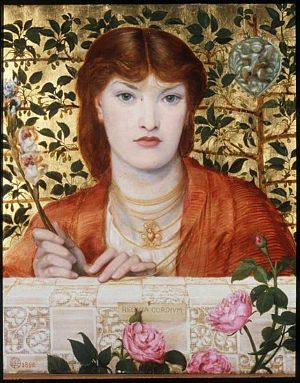 Regina Cordium.1866
oil on canvas
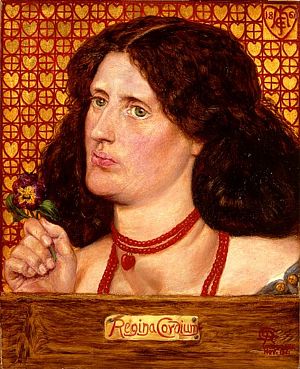 Regina Cordium 1861 November
Портрет Элен Хиттон, как "Королевы сердец".
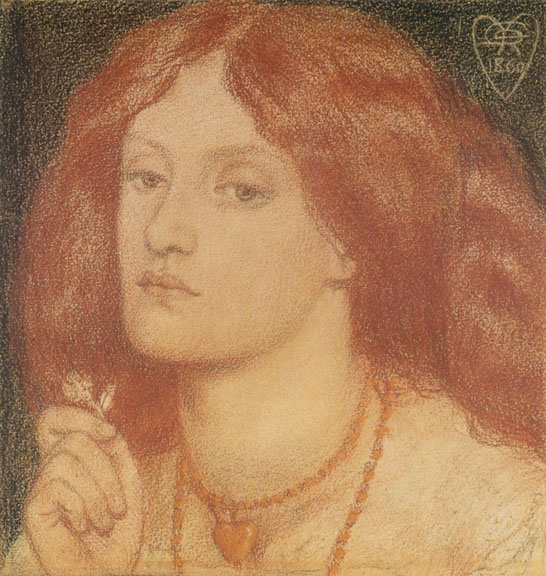
Этот свадебный портрет был исполнен вскоре после женитьбы Габриэля на Лиззи в мае 1860 года и это изображение финальной, трагической фазы великой любви. Стимулами для женитьбы для Россетти послужили скорее сострадание и чувство долга, а не возрождение старой любви, а события последовавшие за созданием рисунка указывают на то, что это была искренняя попытка возродить ускользавшие чувства. Определённо, портрет имеет большую прямоту и интенсивность, чем позднейший портрет маслом на его основе. И, как замечает Virginia Surtees "...Сходство с оригиналом больше".
Рисунок определённо предшествует картине, которая была закончена к концу 1860 года, когда Джордж Прайс Бойс записал в своём дневнике 14 декабря, что Россетти написал голову своей жены, как " Регина кордиум". Это замечание и дата на картине подчёркивают, что она была закончена в 1860 году, а не в 1861, как утверждает Марилье. Она была в работе летом, когда Россетти писал Форду Мэдоксу Брауну:"Лиззи сейчас здесь и я пишу её как Королеву сердец". Некоторые факты предполагают более раннюю дату завершения рисунка, возможно, первые месяцы супружеской жизни Россетти. Уже упоминалось большее сходство с моделью. Рисунок проще, на нём нет парапета, дистанцирующего зрителя от портретируемой. Наконец, на рисунке Лиззи держит условный цветок, а не символически нагруженные анютины глазки или , как на картине. Эта последняя деталь наверняка перешла бы на рисунок, если бы он был исполнен позже. Однако степень завершённости рисунка, декоративная подпись в медальоне в виде сердца и тот факт, что рисунок был продан при жизни Россетти, показывают. что он рассматривался, как произведение искусства сам по себе, а непросто, как подготовительный набросок к картине.
| Рубрики: | РОССЕТТИ. ROSSETTI./РОССЕТТИ ЖИЗНЬ ROSSETTI LIFE |
| Комментировать | « Пред. запись — К дневнику — След. запись » | Страницы: [1] [Новые] |


