РОССЕТТИ 1873 - 74 |

«Рождественская песнь» — картина , созданная в 1874 году.
Ранее (в 1857—58 годах) Россетти уже создал работу с таким же названием, но в иной технике и композиции. Натурщицей для картины стала не столь часто появлявшаяся на его работах Эллен Смит. Россетти увидел Смит на Челси стрит в 1863 году. Красота Эллен отличалась от привычных натурщиц с работ Россетти, хотя её округлые черты лица и полные губы имели некоторое сходство с Фанни Корнфорт, красота которой, по мнению Россетти, к тому времени начала увядать. В отличие от Джейн Моррис, Алексы Уайлдинг и Рут Герберт, обладавшими острыми и характерными чертами лица и позировавших для типажей роковых женщин, Эллен Смит обладала более мягкими и чувственными чертами лица.
Ассистент Россетти Генри Треффри Данн описывал эту картину как «Девушка в блестящей восточной одежде малинового цвета с узором из золотой нитей, играющая на струнном инструменте и поющая Hodie Jesu Christus natus est Hallelujah». Строка из песни о рождении Христа начертана на раме картины. Строки взяты из одной из колядок, которые Россетти собирал, записывал и переводил со среднеанглийского языка.
«Рождественская песнь» одна из серии женских портретов с музыкальными инструментами и схожей композицией (женщины изображены по пояс и в объёмных одеждах); за ней далее последовали музыкальные портреты «La Mandolinata», «La Ghirlandata» «Вероника Веронезе», «Морские чары» и другие. Связь женской красоты, музыки и экзотической одежды и деталей декора была одной из отличительных черт нового художественного стиля Британии 1860-х и 1870-х годов, в котором сочетались элементы эпохи Возрождения, восточного искусства и классики. Центральным образом на полотнах художников стала женщина-музыкант, отрешённая задумчивости и своей игре; при этом сама музыка может быть как романтичной, так и трагичной (как на портрете Россетти «Римская вдова»); художник стремился создать своей работой настроение, вызванное неслышимой музыкой. Восточная мандолина с двумя струнами принадлежала самому Россетти; этот инструмент уже появлялся на его других произведениях. Платье Эллен Смит уже появлялось на ней же на картине Россетти «Возлюбленная».
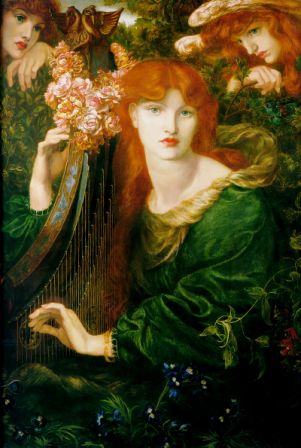
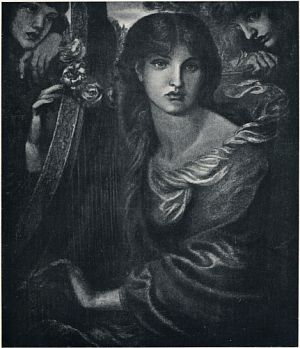
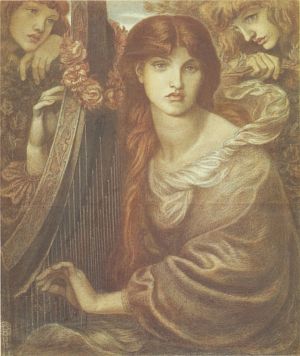
La Girlandata 1873.
WMR's early commentary on the picture is much to the point: “The name La Ghirlandata may be translated ‘The Garlanded Lady,’ or ‘The Lady of the Wreath.’ The personage is represented singing, as she plays on a musical instrument; two youthful angels listen. The flowers which are prominent in the picture were intended by my brother for the poisonous monkshood: I believe he made a mistake, and depicted larkspur instead. I never heard him explain the underlying significance of this picture: I suppose he purposed to indicate, more or less, youth, beauty, and the faculty for art worthy of a celestial audience, all shadowed by mortal doom” ( WMR, DGR: Designer and Writer, 86-87 ). But it seems quite clear that the picture is also a (so to speak) Venetian rendering of Keats's singing and garlanded “Belle Dame Sans Merci”. The picture thus connects back to some of DGR's earliest work, such as the drawing of La Belle Dame Sans Merci as well as to several of the late, ominous pictures, like Ligeia Siren.
DGR was working on the picture in early July 1873, and by the middle of the month it had been paid for by William Graham (£840) and was, DGR told Charles Howell, “well advanced”. On August 23 he wrote to Watts-Dunton that “I have now nearly finished [a picture] I call La Ghirlandata. It contains three heads—a lady playing on a harp and two angels listening—and an infinity of other material—and in brilliancy is more like the Beloved than any other picture of mine you have seen. It belongs to Graham, who wants it in Scotland, but perhaps I may send it for a few days to London to show to a few”. He described the picture to Treffry Dunn in these terms: “The one I am doing for him now is not B[lesse]d Dam[oze]l but that figure playing on the queer old harp which I drew from Miss W[ilding] when you were here with her. The two heads of little May are at the top of the picture. It will really be a successful thing I am sure now, and is getting fast towards completion, but I have not yet got the frame. It ought to put Graham in a good humour and I am glad he is to have it as he is the only buyer I have who is worth a damn.” And to William Bell Scott he wrote even more enthusiastically: “For some six weeks past I have been at work solely on a picture now just finished and called La Ghirlandata—about 4 feet by 3. It is a woman playing on a sort of solid harp I have—an instrument stringed on both sides and very paintable in form. Behind her two angels lean through foliage and listen, and there is an immensity of work in the picture which is quite full of flowers and leaves all most carefully done from nature. It is the greenest picture in the world I believe—the principal figure being dressed in green and completely surrounded with glowing green foliage. I believe it is my very best picture—no inch of it worse than another.”
Эта картина принадлежит к группе декоративных полотен, изображающих женщин, играющих на музыкальных инструментах. С 1871 по 1874 годы Россетти создал четыре картины этой тематики, кроме La Girlandata это Veronica Veronese, The Bower Meadow и Roman Widow.
Вильям Майкл Россетти, комментируя картину, утверждал, что название можно перевести как Леди, увенчанная гирляндой или венком. дама играет на музыкальном инструменте и поёт, а два юных ангела слушают. Россетти задумал, что цветы на переднем плане картины - ядовитый аконит, но ошибся и изобразил жимолость.
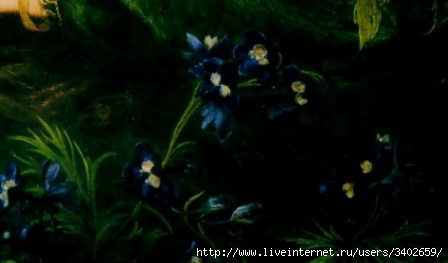


Россетти описывая картину, как "самую зелёную картину в мире". Приходит на ум "таможенник Руссо" с его джунглями и тридцатью оттенками зелёного.
Данте Россетти никогда не объяснял смысл картины, но Майкл Россетти предполагал, что он просто хотел изобразить молодость, красоту и искусство, достойное внимания свыше. И над всем этим тень судьбы всех смертных. Совершенно очевидно, что картина является "венецианской" переработкой поющей и украшенной гирляндой “Belle Dame Sans Merci” Китса. Картина имеет явную связь с ранними работами Россети, такими как “La Belle Dame Sans Merci”. и с некоторыми поздними зловещими картинами, такими как Ligeia Siren. Россетти начал работу над картиной в начале июля, а в середине месяца получил аванс 840 фунтов от William Graham . По поводу чего написал Чарльзу Charles Howell "неплохо авансирован". 23 августа он написал Watts-Dunton, что почти закончил картину, которую назвал La Girlandata. " На ней три головы - дама играющая на арфе, и два слушающих ангела, а также бесконечное количество других деталей. Из виденных тобой моих картин она по яркости больше всего похожа на Возлюбленную. Она принадлежит Graham, который хочет получить её в Шотландии, но, возможно, я пошлю её на несколько дней в Лондон, показать кое-кому.Treffry Dunn он описывал картину так: та, что я пишу сейчас, это не Blessed Damsel, это дама, играющая на странной старомодной арфе, которую я рисовал у Miss W[ilding] ,когда Вы также были у неё. В верхней части картины две головки юной Мэй. Картина быстро двигается к завершению и я уверен, что она будет успешной. Но я ещё не получил раму. Я считаю, что Graham будет доволен и рад,что именно он получит картину, так как это мой единственный стоящий покупатель. К William Bell Scott он писал с ещё большим энтузиазмом: "Около шести недель я работаю над картиной, которую почти закончил и назвал La Girlandata - 4 на 3 фута.
Изображающую женщину, играющую на старинной арфе со струнами с обеих сторон и очень живописную по форме. Сзади два ангела склоняются сквозь листву и слушают". Над картиной пришлось поработать, так как много цветов и листьев тщательно изображенных с натуры. Это самая зелёная картина в мире - главная фигура одета в зелёное и полностью окружена ярко зелёной листвой. Я считаю эту картиной моей лучшей, во всяком случае ничуть не хуже других. Арфа украшена белыми крыльями - символом пролетающего стремительно времени, а гирлянда, давшая название картине, состоит из роз и медуницы - символов сексуальности для Россетти.

When Frederick Stephens was preparing his article on DGR's new works for The Athenaeum, eventually published on August 14, 1875, DGR supplied him with this commentary: “Dîs Manibus. The title here suggests the subject—that of a Roman widow seated in the funeral vault beside her husband's cinerary urn, the inscription on which is headed with the invariable words as given above; and playing on two harps (as seen in some classical examples) an elegy ‘to the Divine Manes.’ She is robed in white—the mourning of noble ladies in Rome. The antique form of the harps is rendered in tortoiseshell chiefly with fittings of ebony or dark horn embossed in silver. The harp on which her right hand plays is wound with wild roses; and beneath the urn, across the wall of green marble, is a large festoon of garden roses, repeating as it were the festoon to be almost universally found on such urns and which this one displays round its inscription. About the urn is wound the widow's wedding-girdle of silver, dedicated to the dead as to the living husband. The moment chosen must be supposed to belong to those special occasions on which the Romans solemnized mortuary rites, and which recurred at intervals during the year” ( Fredeman, Correspondence, 75.93 ).
The painting is particularly important because of a set of strange and suggestive relationships that it has with other works by DGR that date from 1872-1877, especially Veronica Veronese, La Ghirlandata, and A Sea Spell. These four pictures share a number of features, motivic and compositional, even as their titles and nominal conceptions are very different. Considered together, they exhibit as it were four facets or aspects of a single iconic figure of highly ambiguous import.
For The Roman Widow in particular, DGR's own title—Dis Manibus—connects it to his trenchant epigram on Flaubert, written in 1880 after DGR had read of Flaubert's death. Titled by DGR “Dis Manibus”, the epigram draws a parallel between the decadence of Nero's Rome and the decadence of the Second Empire. DGR's treatment of all these materials draws his work into the same dark vortex, a fact underscored in the epigram, where the dying words of two Roman emperors, Vitellius and Nero, represent an antithesis of the glorious and the dreadful.
All of these pictures focus on a musical icon that traditionally represents an ideal order aesthetically pursued. Pater's famous pronouncement in “The School of Giorgione”, that “all art aspires to the condition of music”, is certainly being represented here. But in DGR's case the music—and therefore the practice of art—bears as well terrible meanings that Pater's work does not bring forward in this way.DGR began the picture around October 1873, as his letter to Leyland of October 4, describing the plan of the work indicates: “This I have cartooned from nature and am now beginning to paint it. It is called Dis Manibus—the dedicatory inscription to the Manes, the initials of which (D. M.) we find heading the epitaphs in Roman cinerary urns. In the picture, a lady sits in the ‘Columbarium’ beside her husband's urn which stands in a niche in the wall, wreathed about with roses and having her silver marriage-girdle hanging among them. Her dress is white—the mourning of nobles in Rome—and as she sits she plays on two harps (one in her arm and one lying beside her) her elegy addressed ‘Dis Manibus.’ The white marble background and urn, the white drapery and white roses will combine I trust to a lovely effect, and the expression will I believe be as beautiful and elevated as any I have attempted. Do you like me to consider this picture as yours at 800 guineas?” ( Fredeman, Correspondence, 73.293 ). On June 9, 1874 he told Hake “of a picture (now just on completion, having been some time delayed till roses could be got) called Dîs Manibus,” His account of the picture to Hake adds some important details, “representing a Roman widow by the cinerary urn of her husband, playing her elegy on two small harps, a hand to each. I think it is one of my best & indeed shows advance: I should like to have shown you the classical drapery of which it very chiefly consists. I perched your photograph of the Fates before my eyes while I painted it & tried to get a faint reflex of that kind of beauty.

Ligeia Siren 1873
Сонет Россетти к картине «Морские чары» «превращает эту сцену в развернутое
повествование». На полотне изображена девушка, играющая на лютне, на
ветвях – морская чайка. В сонете звуки лютни очаровывают девушку и птицу:
она забывает о море. «В заключительных строках сонета возникает образ
моряка, который околдованный пением разбивается о скалы. Прекрасная
девушка оказывается русалкой, роковой сиреной, обладающей губительной
силой». Сонеты и картины, по замыслу Россетти, взаимодополняют друг друга,
создавая единый синтетический жанр.
A SEA-SPELL.
(For a Picture)
Her lute hangs shadowed in the apple-tree,
While flashing flashing fingers weave the sweet-strung spell
Between its chords; and as the wild notes swell,
The sea-bird for those branches leaves the sea.
But to what sound her listening ear stoops she?
What netherworld gulf-whispers doth she hear,
In answering echoes from what planisphere,
Along the wind, along the estuary?
She sinks into her spell: and when full soon
Her lips move and she soars into her song,
What creatures of the midmost main shall throng
In furrowed surf-clouds to the summoning rune:
Till he, the fated mariner, hears her cry,
And up her rock, bare-breasted, comes to die?
1869.
"ЧАРОДЕЙКА"
(К картине)
Укрыта лютня, в листьях утопая,
Покуда пальцы лёгкие скользят,
Тревожа струны и сплетая лад
Чарующий; на зов её морская
Стремится чайка. не слышна ль иная,
Зловещая в нем музыка, как шепот
Из преисподней, порождая ропот,
Что мчится эхом вдоль реки, стеная?
не этой ли мелодией струясь,
Она, как морок, порождает чары
И будит все подводные кошмары,
С чудовищами моря единясь?
Тот, кто её услышит, обречен:
Стремясь к её скале, погибнет он.
1869.
перевод Тамары Казаковой.
| Рубрики: | РОССЕТТИ. ROSSETTI./РОССЕТТИ ЖИЗНЬ ROSSETTI LIFE |
| Комментировать | « Пред. запись — К дневнику — След. запись » | Страницы: [1] [Новые] |


