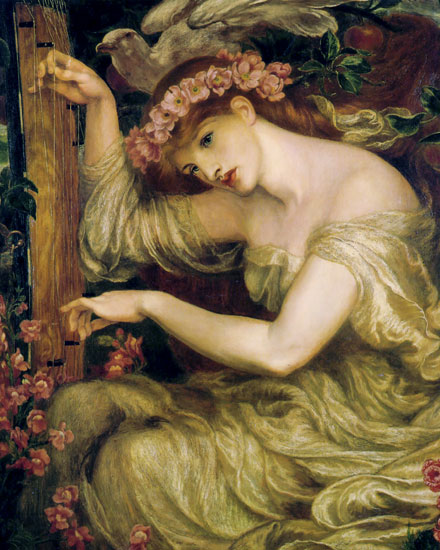
ДВОЙНЫЕ РАБОТЫ РОССЕТТИ. |
Начал изучать двойные работы Россетти (живопись + поэзия), очень хороший сайт Rossetti Archives:
http://www.rossettiarchive.org/index.html
Двойных работ у меня на сайте и так полно, буду просто подробнее копать. Интересно, что электронный архив Россетти (см выше) очень полный. Взял книгу поэзии Россетти, там сплошные ссылки на электронный архив.
Решил начать с этой работы, так как это второе известное мне (после св. Катерины ню у Россетти). И ещё, как выяснилось, эта картина должна была стать парной к Прозерпине, с которой собственно и началась моя Россеттиана.
Первый вопрос - почему Pietra? Pietra, means "stone" . То есть это "камень", намёк на то, что у неё в руках?
Описание.

Рассмотрев внимательно картину, имею заявить следующее: 1.Даже при наличии борцовских дельт, коими наградил её Россетти, удержать такую каменюку даме не под силу. 2.Шар что-то не сильно похож на хрустальный.3.Шея зобатая, как у купальщиц Энгра. 4. Руки корявые, как всегда у дам Россетти.
Насчёт шара я выяснил, что он просто недоделан, в нём должен отражаться печальный, соответствующий настроению дамы, пейзаж. Возникает второй вопрос, а почему она в печали.?Она же не даёт, претендент должен печалиться. Собака на сене.
Комментарий.
ДГР задумал эту работу в начале 1874 года, об окончании пастели он написал брату . Surtees описывает эту картину, находящуюся ныне в частной коллекции, как "женскую фигуру ню по пояс, слегка развёрнутую вправо. В правой руке она держит хрустальный шар, а левая поднята к плечу. Её длинные каштановые волосы, лежащие густой каймой на лбу, ниспадают на левое плечо". Сохранился набросок в три четверти, где фигура одета.

В записной книжке ДГР имеется набросок фигуры, сидящей на камне. (название отсюда?).
DGR thought to do this painting early in 1874, when he wrote to his brother about this pastel version he had finished. Surtees describes the picture, now in a private collection, as a “Half-length figure of a female nude turned slightly to the right. She holds a crystal globe in her right hand and her left hand is raised to her shoulder; her long auburn hair, worn in a thick fringe on the forehead, covers her left shoulder” (see Surtees, A Catalogue Raisonné, I. 135). A sketch, clothed and in three-quarter length, survives. DGR's notebook entry projecting the picture has the figure seated on a stone.
(Сестина
- итальянская стихотворная форма: стихотворение, состоящее из шести строф (иногда - из шести с половиной). Каждая строфа заключает шесть стихов; заключительные слова каждого стиха возвращаются в каждой строфе - но в ином, предустановленном порядке; в заключительной полустрофе те же слова повторяются в середине и в конце стиха. Слово, заканчивающее строфу, должно заканчивать и первый стих следующей строфы. Таким образом, формула заключительных слов (а не рифм) секстины может быть представлена так: 1) abcdef; 2) faebdc; 3) cfdabe; 4) ecbfad; 5) deacfb; 6) bdfeca; 7) ab, cd, ef. Размер С. - обыкновенно ямб десяти- и двенадцатистопный).
Перевод ДГР исключительно хорош, главным образом потому, что переводчик чётко держался структуры оригинала Данте. Вероятно, нигде более не проявился столь эффективно главный принцип переводов Россетти - наиболее точно имитировать метрический размер оригинальных работ. Порядок рифм Дантевской сестины был точно переведён в её содержание. Это стихотворение "в котором риторический порядок (converso, antistrophe, retrogradacio) и космический порядок (solar conversio, planetary retrogradation) полностью совпадают." (Durling and Martinez 136).
Случайно или по недогляду в одном случае ДГР отходит от системы рифм Данте - в пятой станце схема Данте DEACFB в то время, как у ДГР DEAFCB, единственное другое отклонение - несколько строк, включающих только десять слогов в переводе ДГР.
Оригинальны текст сестины Данте ДГР брал из своего экземпляра Fraticelli (1834).
Текст перевода и комментарии: http://yalepress.yale.edu/yupbooks/excerpts/helsinger_poetry.pdf
This double work centers in the only one of Dante's rime petrose (A group of four lyric poems by Dante , written probably in Florence before his exile in 1302. They focus on unyielding desire for a resistant ‘donna di petra’ (‘woman of stone’), and experiment with stylistic harshness and metrical difficulty after the model of the troubadour Arnaut Daniel . They include the first known sestina in Italian, as well as a unique double sestina), that DGR translated, the great sestina “Al poco giorno e al gran cerchio d'ombra”. DGR's translation is exceedingly well done, not least because he has adhered so strictly to the structure of Dante's original. DGR's key principle of translation—to imitate as closely as possible the metrical character of the original works—was perhaps never more effectively followed than in this case. The order of the rhymes in Dante's sestina is known to have been carefully related to the sestina's content. It is a poem “in which rhetorical (converso, antistrophe, retrogradatio) and cosmic order (solar conversio, planetary retrogradation) coincide” (Durling and Martinez 136).
Whether by choice or oversight, DGR departs once from Dante's rhyme scheme—in the fifth stanza: Dante's scheme is DEACFB whereas DGR's is DEAFCB. The only other variations involve several lines that have only ten syllables in DGR's translation.
DGR used his copy of Fraticelli (1834) for the text of Dante's original sestina.
Хотя мы не знаем точно, когда Россетти сделал первод, опубликованный в The Early Italian Poets, но это должно было произойти достаточно рано в конце 1840-х.
Although we don't know precisely when DGR wrote his translations published in The Early Italian Poets, it must have been fairly early, in the late 1840s.
История создания.
В записной книжке ДГР имеется набросок, датируемый приблизительно 1866 годом, изображающий "Pietra degli Scrovini, сидящую на камне и держащую хрустальный шар, в котором отражается живописная холмистая местность". По видимому, он не работал над этой идеей до марта 1874 года, когда написал (21 марта):"Нет ли у тебя среди фотографических слайдов или других фотографий изображений скал и воды, главным образом на дистанции - нечто похожее на фон Леонардовской Дамы в скалах? Конечно, с натуры. Ели есть, не мог ли ты отобрать их к нашей встрече? И также круг холмов? Мне это надо для фона Madonna Pietra из сестины Данте". 3 апреля он пишет Лейланду, что закончил:"рисунок мелом мисс Вайлдинг (тема - Мадонна Петра Данте) - имея в виду четвртую картину для вас, если это вам подходит. Картина будет по размеру приблизительно как Прозерпина, возможно немного шире и будет прекрасно смотреться рядом с ней. Набросок пером даст полное представление о замысле,я сделаю его и покажу вам". Упоминаемый набросок не тот, что ныне в Бирменгеме - стоящей фигуры, так как ДГР добавляет в постскриптуме письма Лейланду:"Я пришёл к заключению, что вам больше подойдёт размер сидящей фигуры, а не стоящей. Покажу вам рисунок, когда придёте". (смотри Переписка Fredeman, 74,63 и 64).
DGR has a notebook entry that dates from around 1866 projecting a picture of “Pietra degli Scrovigni seated on a stone, holding glass globe reflecting fertile hilly landscape”. He does not seem to have acted on this idea until March 1874, when he wrote to WMR (on 21 March): “Have you among your photographic slides or other photos any representing rocks & water chiefly distant—something in the way of the background to Leonardo's Lady of the Rocks? Of course I mean from nature. If so, could you keep it for me when I see you. Or a circle of hills also? I want these things for background of Madonna Pietra from Dante's Sestina”. By 3 April he wrote to Leyland that he had made “a chalk drawing from Miss W[ilding] (subject—Madonna Pietra from Dante)—with a view to your fourth picture if it suits you. It will be about the size of the Proserpine but perhaps a little wider—would hang however excellently with that. A pen-&-ink sketch of the whole arrangement would best give an idea of it, so I will make one & let you see it.” This drawing would not be the pen and ink sketch of the clothed and standing figure now in Birmingham, for DGR added in a PS to his letter to Leyland: “I came to conclusion that it might suit you well as to size if I make it a sitting instead of a standing figure. Will show you the drawing when you come” (see Fredeman, Correspondence, 74. 63 and 64 ).
Где то позднее апреля ДГР сделал законченный набросок этой работы пастелью, на ней женщина обнажена. Россетти планировал картину маслом, но замысел не реализовал. Эта пастель, первоначально принадлежавшая Чарльзу Хоувеллу, ныне в частной коллекции в Японии. ДГР упоминает её в письме Кларенсу Фраю (который купил её у Хоувелла) от 26 апреля 1876:"Рисунок, набросок которого вы мне послали был сделан на предложенный сюжет из Данте - Мадонна Петра. Хрустальный шар в руках дамы должен был отражать скалистый пейзаж, её окружающий и символизирующий её безжалостное сердце. На первом наброске дама обнажена, но но на картине фигура должна быть задрапирована, а верхняя рука должна удерживать складку драпировки, ниспадающей с плеч. Я ещё предлагаю написать картину на тот же сюжет и в тоже время, но с другим действием. Я предполагаю, что Хоувелл получил и забрал этот рисунок ( ) приблизительно в то время которым вы датируете чек, величину которого не сообщаете. Я верю, что этот рисунок из тех, за которые мне не стыдно, что они находятся в вашей собственности.
Sometime after April DGR made a finished pastel design of this work, with the woman unclothed, and he projected an oil picture that was never undertaken. This pastel, originally owned by Charles Howell, is in a private collection in Japan. DGR refers to it in a letter dated 26 April 1876 to Clarence Fry (who bought the work from Howell): “The drawing of which you sent me a sketch was one I made for a proposed subject from Dante—Madonna Pietra. The crystal globe in the lady's hand was to reflect a rocky landscape surrounding her and symbolizing her own pitiless heart. The first study was made nude but in the picture the figure was to be draped chiefly, and the upper hand was to be holding a portion of the drapery which would float from the shoulders. I am still proposing to paint the subject at some time but in a different action. I fancy H[owell]. must have received and taken away this drawing (as towards the exchange account) about the time you name as the date of your cheque of which you do not state the amount. I believe the drawing ranks among those which I should not regret your possessing.” (see Fredeman, Correspondence, 76. 74 ).
The translation was first published in 1861 in The Early Italian Poets; it was reprinted unaltered in 1874 in Dante and his Circle.
This an imaginary picture of Pietra degli Scrovigni, daughter of the Paduan moneylender Rinaldo Scrovigni. DGR arbitrarily (and wrongly) associated her with Dante's great sestina “Al poco giorno e al gran cerchio d'ombra”, but she was probably not even born when Dante wrote his sestina.
Dante's original sestina follows the model laid down in Arnaut Daniel's “Lo ferm voler q'el cor m'intra”. DGR's note to his translation shows him well aware of the Provençal origins of Dante's work. It also casts an interesting light on his translation's subtitle. In his long prose note to the poem DGR allows the translation to be associated with Pietra della Scrovigni even though he is aware that the ascription is “doubtful”. In fact we do not know who the poem's “donna” was, if indeed it had any reference to an actual person. In any case it could not have been Pietra della Scrovigni, nor does DGR's scholarly source, Fraticelli (1834), make any suggestion that the poem might be related to the lady. DGR's conviction, however, was that Dante's poems nearly always had some biographical reference, however concealed or obscured by time; and he may have chosen this member of the Paduan Scrovignis because the family made its fortune from moneylending. Dante puts Pietra's father Rinaldo in hell among the usurers (see Inferno XVII. 64-75). In his 1874 reorganized reprinting of his translations DGR added a note to the sonnet that follows this sestina in both 1861 and 1874. The sonnet has a subtitle referencing Pietra della Scrovigni in the 1861 edition, but in 1874 this is removed and DGR's note suggests the sonnet may have been addressed to Beatrice. The alteration underscores DGR's sense of the “doubtful” connection of the sestina to Scrovigni.
Dante has two important discussions of his sestina in De vulgari eloquentia (II.x.2, II.xiii.2).
Sestina.*
Of the Lady Pietra degli Scrovigni.
* I have translated this piece both on account of its great and
peculiar beauty, and also because it affords an example of a form of
composition which I have met with in no Italian writer before
Dante's time, though it is not uncommon among the Provençal poets
(see Dante, De Vulg. Eloq .). I have headed it with the name of a
Paduan lady, to whom it is surmised by some to have been addressed
during Dante's exile; but this must be looked upon as a rather
doubtful conjecture, and I have adopted the name chiefly to mark it
at once as not referring to Beatrice.
Хорошая книга Данте Габриэль Россетти. "Дом жизни*Поэзия". Спб 2005.
Многие стихи на английском и русском, хорошие примечания.
| Рубрики: | Список работ Россетти. The full list of Rossetti's/DOUBLE WORKS |
| Комментировать | « Пред. запись — К дневнику — След. запись » | Страницы: [1] [Новые] |