РОССЕТТИ ЖИЗНЬ И ТВОРЧЕСТВО 1863-64 |
1. Женщина, расчёсывающая волосы. Фанни Корнфорт. Woman combing her Hair, Fanny Cornfor 1864
2.Как Сэр Галахард, Сэр Борз и Сэр Персиваль были напитаны Святым Граалем, но сестра Сэра Персиваля умерла. Акварель 1864.
How Sir Galahad, Sir Bors and Sir Percival were Fed with the Sanc Grael; But Sir Percival's Sister Died by the Way, an 1864 watercolour.
3.АУРЕЛИЯ
НОВЫЙ ЭТАП - "ВЕНЕЦИАНСКАЯ" ЖИВОПИСЬ.
В начале 1860-х Данте Габриель Россетти отошёл от вдохновлявшей его раннее аскетической эстетики ранних итальянских художников и нашёл новый источник вдохновения в пышных работах венецианцев 16-го века. Под влиянием полотен Тициана, Тинторетто и Веронезе, Россетти создал новый тип живописи, ставшей известной как "Венецианская" - полуфигурный портрет прекрасной женщины в ограниченном пространстве, заполненном редкостями и предметами роскоши, лишённым повествовательности и служащими только для подчёркивания красоты женщины. Названия этих полотен говорят об истинном их предмете - чувственных удовольствиях. Новая техника Россетти отличалась насыщенным цветом и сиянием масляной живописи, вычурные поверхности, широкие мазки жесткой кистью из свиной щетины имитируют венецианскую живопись XIV века. Полотна Россетти 1860-х содержат явный автобиографический элемент. Для своих венецианских полотен Россетти использовал различных моделей, часто образ был собирательным. Нравилось ему писать Алексу Вайлдинг, чьё умиротворенное выражение и чеканные черты хорошо сочетались с пышными драпировками, сияющими драгоценностями и обильными цветами, заполнявшими отныне его композиции. Для Аурелии он выбрал Фанни Корнфорт - широкое лицо, длинная шея, пухлые поджатые губы и роскошные волосы.
В развитии салонного портрета Россетти сыграл первопроходческую роль. В 1860 - 1870-е происходила эволюция Россетти от поэтизации внутренних борений человека к культу умозрительного изящества, прерафаэлитизм трансформировался в эстетизм. Произведения этого периода посвящены красоте как таковой. По словам Россетти устремление к ней - " единственная абсолютная цель искусства." Ещё до возникновения движения символизма он обратил внимание на ощущение потерянности, выключенности из жизни, самоуглублённость современных ему молодых людей. Под влиянием этого в 1870-х возникли его женские портреты. Связанные с возникшим в Англии движением эстетизма, они поддерживали культ красоты как чего-то призванного заместить жизнь.
По сочетанию элегантности и меланхолии, настроению неизбывной печали, обилию символических деталей (цветок, музыкальный инструмент, знаки природных стихий) по духовной вибрации коричневых, зелёных, серебристо-пепельных или тёмно-красных тонов это был истинно символистский портрет. Сами названия - Прозерпина, Фьямента - свидетельствовали о символических замыслах художника. С ходом времени художник всё чаще приносил духовность в жертву эстетизму. О живописи Россети стали писать как о плотской разновидности поэзии, которая никогда не бывает духовной, никогда нежной, но всегда самодовольной и эстетской... ошеломляющее преобладание чувственности и болезненной животности.
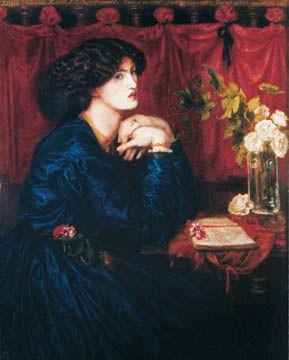
Portrait of a young woman in a blue dress sat at table.
Kelmscott Manor, Kelmscott Gloucestershire.
В 1866 году Уильям Моррис попросил своего друга Россетти написать портрет его жены Джейн. Готовясь исполнить заказ, Россетти написал бесчисленное количество набросков, стараясь точнее передать особенности её облика: завитые волосы, задумчивые глаза, гибкую линию рук и шеи, всю ленивую грацию женщины. Наконец, после двух лет концентрации на одном предмете, Россетти сообщил Джейн, что готов начать.
На первые сеансы был приглашен и Моррис, но затем Джейн стала приходить одна.
|
Woman combing her Hair, Fanny Cornfor 1864 Pencil on paper.Width: 373 mm Height: 385 mm
Woman Combing Her Hair1864 Medium: watercolour Dimensions: 14 1/4 x 13 in. Signature: monogram Date on Image: 1864 Production Date: 1864 Model: Fanny Cornforth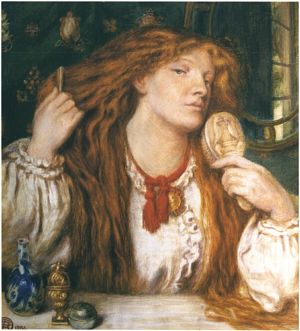
|
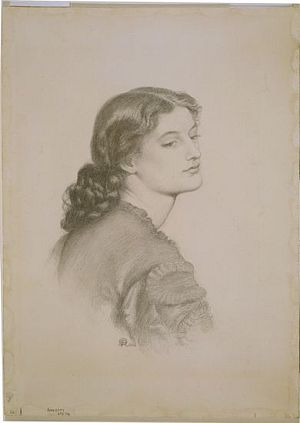
АУРЕЛИЯ
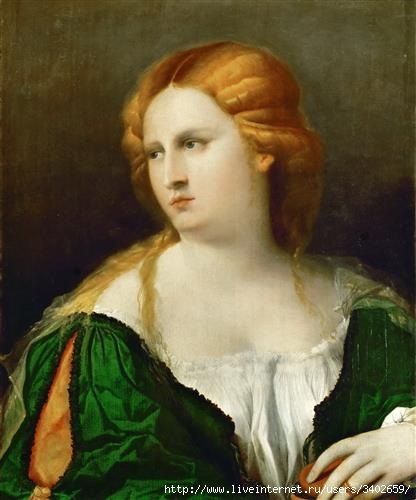
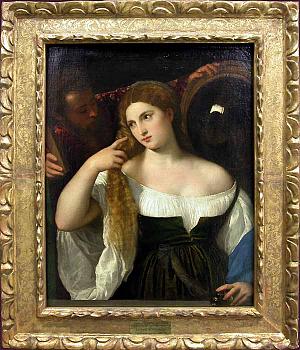
Titian's Alphonse Ferrare and Laura de Dianti (Musée du Louvre, Paris)
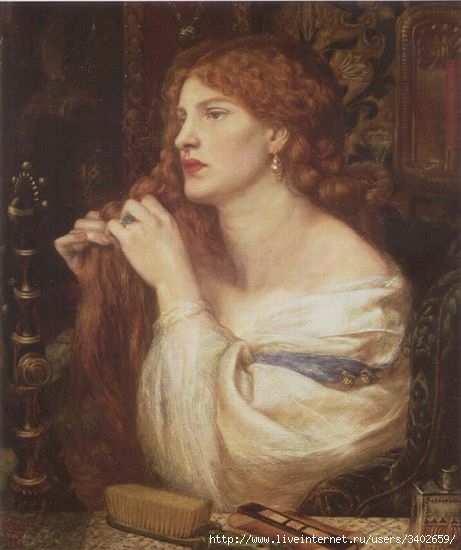
This is one of a series of pictures, commencing with Bocca Baciata (1859, Museum of Fine Arts, Boston), that features voluptuous young women with long flaming tresses, absorbed in their own thoughts. An object of pure sensuality, Fazio's mistress is lost in reverie as she gazes at herself in the mirror and idly plaits her golden hair.
The subject is inspired by the poetry of Fazio degli Uberti (1326-1360), addressing his Lady, Agniola of Verona, which Rossetti had included in his Early Italian Poets in 1861. Fazio's description of his mistress's beauty (as translated by Rossetti) conforms extremely closely to Rossetti's image, for which he used his own mistress, Fanny Cornforth, as model:
I look at the amorous beautiful mouth,
The spacious forehead which her locks enclose,
The small white teeth, the straight and shapely nose,
And the clear brows of a sweet pencilling.
(18-21)
I look at her white easy neck, so well
From shoulders and from bosom lifted out;
And her round cleft chin, which beyond doubt
No fancy in the world could have design'd.
(35-8)
As can be gathered from these lines, the poem is specifically about the act of looking. The male poet declares himself ensnared by the woman's beauty, yet the woman can exert this power only as a result of his reciprocal observation. Aurelia (the name was presumably chosen for its classical connotations) exudes a powerful erotic appeal, emphasised in the picture by her red lips, flowing red hair and exposed shoulder and neck. Her dreamy expression and self-absorbtion render her entirely passive, the object of the artist's gaze.
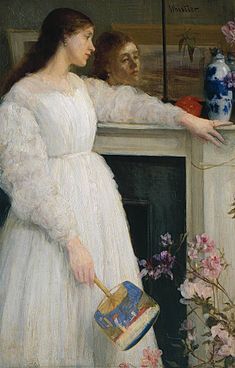
Rossetti described the picture as 'chiefly a piece of colour' (quoted in Wilton, p.100), and certainly the painting displays a combination of warm colours, rich glazes and contrasting textures, clearly inspired by Venetian art. Rossetti greatly admired Titian, and much of his work of this period is said to have been influenced by Titian's Alphonse Ferrare and Laura de Dianti (Musée du Louvre, Paris). Comparisons can also be drawn with Whistler, since the subject, pose, mood and colouring of this work share much in common with Whistler's Symphony in White No.2: The Little White Girl of 1864
Одно из серии изображений "плотских", нарциссических женщин,полностью поглощенных своей чувственной красотой, моделью для которых послужила Фанни Корнфорт. Эта серия началась фронтисписом к изданию Goblin Market 1862 года и достигла высшей точки в Lilith 1864-68 годы.
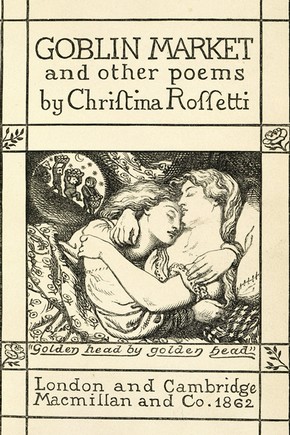
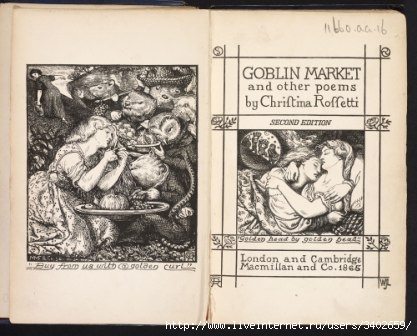
В этой картине отмечали сходство с современными работами Уистлера, особенно The Little White Girl №2 1864г. Но главное влияние оказывает венецианская живопись 16 века, особенно Тициан... Название картины происходит от поэмы Fazio desti uberti, в которой описана красота дамы автора. Перевод поэмы Россетти включил в свою книгу Ранние поэты Италии 1861 года. Поэма настолько россеттинская, что, возможно, он её не перевёл, а просто сочинил. Описанные в поэме рот, созданный для любви, белоснежная шея и большие руки, гибкие и огруглые могут быть отнесены практически к любой картине Россетти данного периода,также как намёк на "приманку для мужчин": I look at the crisp golden-threaded hair, Whereof, to thrall my heart, Love twists a net:
Rossetti greatly admired Titian, and much of his work of this period is said to have been influenced by Titian's Alphonse Ferrare and Laura de Dianti (Musée du Louvre, Paris). Comparisons can also be drawn with Whistler, since the subject, pose, mood and colouring of this work share much in common with Whistler's Symphony in White No.2: The Little White Girl of 1864.
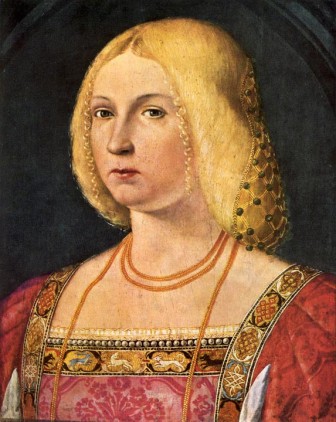
Portrait of a Lady National Gallery London.
Габриэля глубоко потрясла смерть жены. Всю последующую жизнь он страдал от приступов депрессии, кошмаров и угрызений совести. Облегчение Россетти находил в алкоголе и наркотиках. В память об Элизабет Сиддал он писал картину "Beata Beatrix", именно писал c 1864 по 1870 во многих вариантах, последний из которых был закончен уже после его смерти.
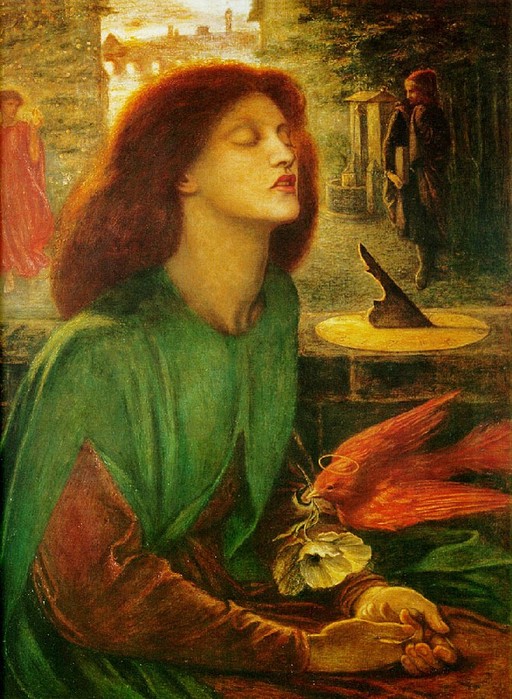
Блаженная Беатриче Beata Beatrix BEATA BEATRIX
Россетти начал картину через год после смерти Сиддал.
86,4*66 cm
Dante Gabriel Rossetti began "Beata Beatrix" a year after Siddal's death.
Крушение семейной жизни отрицательно сказалось на творчестве Россетти, только спустя годы вернулся он к жанру женского портрета. Беату Беатрикс он писал много лет, с 1864 по 1870 год. Это было воспоминание о жене. Основанная на сюжете смерти Беатриче из "Новой жизни" Данте, она стала одной из известнейших произведений символизма. В жёлтой дымке Лиззи - Беатриче сидит в позе умирающей с закрытыми глазами и поднятым подбородком, кажется,она остро сознаёт приближающуюся смерть, птица - вестник смерти вкладывает цветок мака (символ смерти) в её руку. Мак, как символ, весьма двусмысленен, если вспомнить, что Сиддал умерла (покончила с собой?) как раз от передозировки опия. На заднем планет фигуры Данте и Любви, в центе мост Веккио во Флоренции. Критики приветствовали картину за её эмоциональное воздействие, которое передаётся даже просто через колорит и композицию. Смысл истинной истории любви Россетти и его жены ещё углубляется, Лиззи всё ещё оказывала сильное влияние на его творчество.
Rossetti again represented Lizzie as Dante's Beatrice in one of his most famous works, Beata Beatrix, (1864-1870) which he painted as a memorial to Lizzie after her death. This piece also mimicked the death of Dante's love in his autobiographical work, Vita Nuova. In the work, amidst a yellow haze of relatively indistinct shapes, including Florence's Ponte Vecchio and the figures of Dante and Love, Lizzie sits, representing Dante's Beatrice. With an upturned chin and closed eyes, Lizzie appears keenly aware of her impending fate, death. A bird, which serves as the messenger of death, places a poppy in her hands. Critics have praised the piece for its emotional resonance, which can be felt simply through the work's moving coloring and composition. The true history of Rossetti and his beloved wife further deepens its meaning; although their love had waned at that point, Lizzie still exerted a powerful influence on the artist.
Последние двадцать лет жизни Россетти прожил in the Queen' House, Cheyne Row ( это одно место?)
После смерти Сиддал Россетти переехал in Tudor House in Chelsea on Cheyne Walk где некоторое время жил вместе с Swinburne, здесь продолжилась его связь с Фанни Корнфорт до того момента, как он полюбил Джейн Моррис. С этого времени её образ доминирует в его поэтической и живописной продукции. Моррис стала воплощением "Прерафаэлитической женщины". Россетти наполнил дом голубым и белым китайским фарфором 16 и 17 веков, музыкальными инструментами и экзотическими животными, домашнее хозяйство превратилось в зверинец: тут были Pomeranian Puppy, wallabies (вид маленького кенгуру), енот, попугаи, woodchucks, павлины, совы, кролики, морские свинки, ящерицы, саламандры и две вомбаты которые, правда, быстро умерли не вынеся климата (любимое животное Россетти, увековеченное на фресках в Оксфорде) Первая из вомбат по имени Топ часто гостила на его обеденном столе, устраиваясь спать по середине. Считается, что именно Топ стал прототипом Сони в книге Кэррола Алиса в Зазеркалье. Среди животных был и Brahmin bull, чьи глаза напоминали Россетти Джейн Моррис. Он держал животных и рисовал только женщин.
Among other things, his personal zoo is legendary, including owls, wombats, parrots and peacocks, among others.
| Рубрики: | РОССЕТТИ. ROSSETTI./РОССЕТТИ ЖИЗНЬ ROSSETTI LIFE |
| Комментировать | « Пред. запись — К дневнику — След. запись » | Страницы: [1] [Новые] |

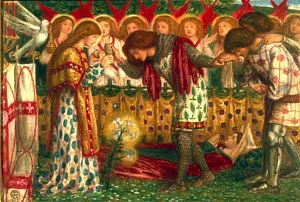 How Sir Galahad, Sir Bors and Sir Percival were Fed with the Sanc Grael; But Sir Percival's Sister Died by the Way


