(и еще 1162 записям на сайте сопоставлена такая метка)
Другие метки пользователя ↓
algernon swinburn annie miller baron von gloeden beata beatrix burn-jones camille bonard carlisle wall christina georgina rossetti clark dante gabriel rossetti dudley gallery edward poynter edward robert hughes eleanor fortescue-brickdale elizabeth siddal eugene onegin feet fetish gabriel charls dante rossetti gg augustus leopold girls goblin market henry david thoreau honesuckle jane morris kelmscort manor la pia de' tolomei lady leda mit dem louis de taeye maria rossetti mary magdalene at the door of simon the pharisee morris naked nude painting rossetti simeon solomon sing song a nursery rhyme book stacy marks study tasso and leonora the blessed damozel vampyre water willow william holman hunt women working men's college балет ганнибал лектер данте данте габриэль россетти джейн моррис живопись искатель искусство кеннет кларк колегова кристина россетти кэрролл лемпицка лемпицкая мариинский менады моррис насилие новый роман ножки обнажённая пия де толомеи поздний россетти поэзия россетти прерафаэлиты рисующий ангела роман россетти секс сиддал то́мас карле́йль фетиш фридерик лейтон хант хьюз чаадаев эдвард роберт хьюз элизабет сиддал
РОССЕТТИ 1855 |
Дневник |
1.Dantes Vision of Rachel and Leah Watercolour on paper. Tate Gallery, London, UK
Видение Данте - Рахиль и Лия. Акварель на бумаге. Tate Gallery, London, UK
2.Paolo and Francesca da Rimini - Watercolor. Tate Gallery, London, UK.
Паоло и Франческа де Ремини. Акварель. Tate Gallery, London, UK.
3.Beatrice, meeting Dante at a Wedding Feast, denies him her Salutation Watercolour on paper. Ashmolean Museum, Oxford, UK.
Беатриче, встретив Данте на брачном пиру, отказывается его приветствовать. Акварель на бумаге. Ashmolean Museum, Oxford, UK.
4.Paolo and Francesca - Graphite sketch. 22.6 cm by 16.7 cm. British Museum.
5.Portrait of Elizabeth Siddal
6. Elizabeth Siddal 1855.
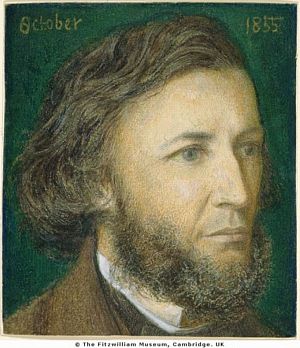
6.Self portrait.
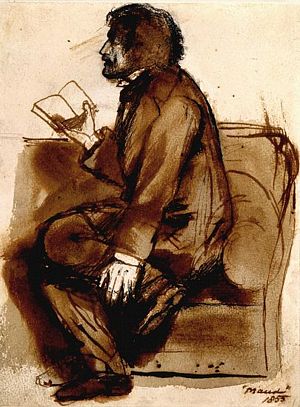
7.Tennyson reading 'Maud'
8. King Arthur's Tomb. 1855-60.
С начала 60-х и до конца десятилетия Россетти, отказавшийся от выставок, работает главным образом в технике акварели, он создаёт сеть частных покровителей и продаёт работы непосредственно покупателям. В 60-е годы Россетти удалось вдохнуть в Братство новую жизнь. В апреле 1854-го он знакомится с Раскиным, который не только покупает работы Россетти и Сиддал (В 1855 году Раскин купил картину Россетти King Arthur's Tomb), но и знакомит Россетти с целым кругом коллекционеров таких как: Ellen Heaton, Charles Eliot Noprton, J.P. Seddon. Последний был архитектором, заказавший Россетти его единственную большую работу 1850х "The Seed of David" for Llandaff Cathedral. В начале 1855 года Раскин убедил Россетти начать работу в лондонском Колледже для рабочих. Предполагалось таким образом нести творческие идеи в массы.
В октябре 1855 года посетил Exposition Universelle в Париже.
В феврале 1855 года Россетти послал адрес Хьюза Ellen Heaton (своей заказчице, кстати), сопроводив его комплиментарным письмом о работах Хьюза.
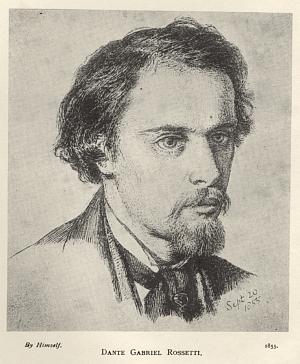
Данте Габриэль Россетти Автопортрет 1855 г.
Музей Фитцвильяма, Англия
Fitzwilliam Museum - Cambridge, UK.
В 1855 году Раскин впервые встретился с Мэдоксом Брауном в студии Россетти и раскритиковал его картину "An English Autumn Afternoon" за "безобразный сюжет"
Артурианская тема, поощряемая Раскиным, стала важнейшей в середине 1850-х найдя свою кульминацию в декорации Oxford Union Building.
Этот проект собрал вместе новую группу друзей Россетти их снова семь и это, без сомнения, фактически второе Прерафаэлитское Братство, в которое, однако, не приняло какого-либо определённого названия и в него не входят ни Миллес ни Хант. Доминирующих лидеров опять трое - Россетти, Моррис и Бёрн-Джонс и четыре сподвижника - Hughes, Prinsep, Pollen and Spencer Stanhope. Главная литературная фигура движения - Algernon Charles Swinburne.
В начале 1855 года Рескин убедил Россетти начать работу в лондонском Колледже для рабочих, чтобы нести в массы свои творческие идеи. (Рабочий колледж (Working Men's College), основан в 1854 году для предоставления образования мужчинам из рабочего класса).
Бёрн-Джонс и Моррис познакомились с Россетти в 1856 году, когда он преподавал в Рабочем колледже и к лету они уже были близкими друзьям, Бёрн-Джонс стал ассистентом в мастерской Россетти. Россетти участвовал в журнале Морриса Oxford and Cambridge Magazine. Бёрн-Джонс и Моррис стали считать прерафаэлитов художественным идеалом после знакомства с акварелью Россетти 1853 года "Данте, рисующий ангела".
В 1855 году Россетти был впечатлён пейзажем Уильяма Дэвиса в Королевской академии.
Творчество Россетти отражало, что естественно, его эмоциональное состояние. Около 1856 года в нём произошло внезапное изменение, когда настроение невинности, девственности и простоты, сопровождавшие начало его любви к Элизабет Сиддал, уступило место совершенно отличной манере живописи - пышной, богатой, чувственной, орнаментальной и высоко детализированной.
Лиззи теперь символизирует для Россетти нечто угрожающее, болезненное и фригидное.
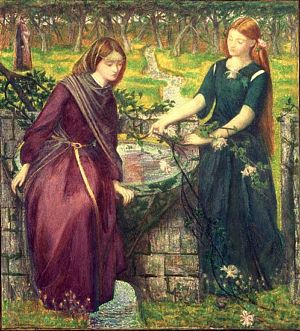 Данте видится Рахиль и Лея 1855.
Акварель представляет сцену, которую Данте видит в воображении. Рахиль и Лия, упоминаемые в книге "Бытие" Библии в истории Иакова, могут интерпретироваться как аллегории созерцательной и активной жизни. Рахиль, слева, созерцает своё отражение, в то время как Лия активно собирает цветы, чтобы себя украсить.
Вообще история женитьбы Иакова крайне забавна. Действительно, он впервые увидел Рахиль у колодца, куда" пришла Рахиль с мелким скотом отца своего, потому что она пасла." Бытие гл. 29 стих 9, но никакой Лии там не было. Скот был. Затем папаша мелкий скотовод всучил Иакову некрасивую, подслеповатую Лию за семь лет службы, а потом за Рахиль Иаков отработал ещё семь. Рахиль, кстати, была первой суррогатной матерью. Заявив мужу: дай мне детей; а если не так, я умираю", она затем устроила следующее: "Она сказала: вот служанка моя Валла ; войди к ней: пусть она родит на колена мои, чтобы и я имела детей от неё". Гл. 30 стих 3.
This watercolour represents the scene Dante sees in a dream (the poet appears at top left). Rachel and Leah, from the story of Jacob in the Biblical book of 'Genesis', can be interpreted as allegories of the contemplative and active lives. Rachel, on the left, contemplates her own reflection in the pool of water, while Leah is actively engaged in gathering flowers to adorn herself
Dante, guided through Purgatory by Virgil, dreams of a meadow where Rachel sits on a stone basin above a stream looking at her reflection in the water, while her sister Leah collects branches of honeysuckle with which to make a garland. The figure in the background is Dante.
В ноябре 1849 года Россетти задумывает создать триптих на тему Паоло и Франчески и работает над "Поцелуем" в декабре.

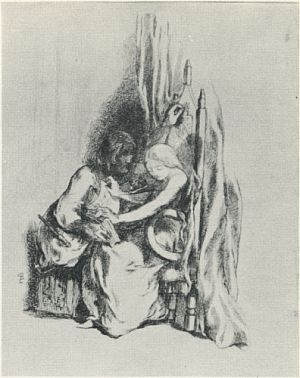
Только в 1855 году когда акварель триптиха наконец закончена в спешке, уже два года в мастерской Россетти стоит подаренная в 1853-м Alex. Munro гипсовая копия скульптуры Paolo and Francesca.
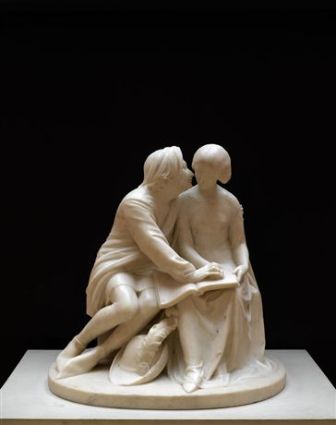
.jpg)
Paolo and Francesca da Rimini, 1855
Watercolor 17,5"*9,75" (44,5cm*24,8 cm) Tate Gallery, London.
Акварель изображает сцену из Ада Данте Том 5 127-138, где Данте и Виргилий (в центре) во втором кругу ада встречают несчастных влюблённых Паоло и Франческу, захваченные огненным вихрем, они наказаны за прелюбодеяние. Огонь - изобретение Россетти, он символизирует жар любви и пытки ада одновременно, хотя Данте не упоминает огонь, второй круг характеризует ветер, что и изобразил Россетти, заставив огонь мчаться по диагонали акварели. Франческа да Римини рассказывает Данте о своей любви к Паоло, ставшей причиной гибели влюблённых от руки брата Паоло Джованни. Франческа и Паоло читают роман Артурианского цикла о сэре Ланселоте и Гвиневре, который и соблазнил их на судьбоносный поцелуй.
Итак, слева Росссетти нарисовал влюблённых, читающих, возможно, поэму Лея Ханта "История Римини", а вовсе не Данте. Ещё в 1846 году. Вильям Майкл Россетти записал, что триптих был запланирован ещё в ноябре 1849 с теми же сценами, что и на акварели, но в другом порядке: В середине целующиеся Паоло и Франческа, слева Данте и Виргилий в круге втором, справа летающие туда-сюда души." Сохранились рисунки целующихся вероятно с этого времени. Но только осенью 1855 года Россетти снова обратился к данной теме и закончил акварель за неделю. Он получил за неё 35 гиней от Раскина Чтоб я так жил! (примечание автора сайта). Для справки - средний чиновник получал 14 - 15 фунтов в год в то время, а гинея в отличие от фунта не 20, а 21шиллинг).
Законченный рисунок карандашом, где любовники целуются на фоне окна в форме гало, вероятно был закончен несколько ранее.
Паоло в красном, и можно видеть, что в книге, как бы замыкающей круг и инспирирующей роковой поцелуй, Ланселот тоже в красном. Сорванная красная роза лежит у ног любовников.
Рёскин, предложивший акварель своей протеже Элен Хетон, которая через него заказала не определённый точно сюжет у Россетти, был обеспокоен, что смелость сцены акварели делает её не совсем пригодной для девушки. Но Данте определённо не имел в виду робкий поцелуй под омелой, а Россетти точно прочувствовал смысл текста Данте. На раме слева внизу написано “quanti dolci pensier, quanto disio”; сверху на раме:"O lasso!” , на раме справа “menò costoro al doloroso passo!”;
Ответил я, увы!
Как много мыслей нежных,
Стремлений страстных
К ужасному концу их привели.
(перевод, очередной пардон, мой).
Quando rispuosi, cominciai: “Oh lasso,
quanti dolci pensier, quanto disio
menò costoro al doloroso passo!”
Dante, InfernoV.114-116
This Rossetti watercolor depicts the scene from Dante's Inferno V. 127-138 where Francesca & Paolo are reading the Arthurian romances of Lancelot and Guinevere which inspired their fateful kiss:
One day, to pass the time away, we read
of Lancelot— how love had overcome him.
We were alone, and we suspected nothing.
And time and time again that reading led
our eyes to meet, and made our faces pale,
and yet one point alone defeated us.
When we had read how the desired smile
was kissed by one who was so true a lover,
this one, who never shall be parted from me,
while all his body trembled, kissed my mouth.
A Gallehault indeed, that book and he
who wrote it, too; that day we read no more.”
The poets Dante and Virgil (centre) encounter the tragic lovers, Paolo and Francesca, swept in the flaming winds of the Second Circle of Hell (right) in punishment for their adulterous love. The left compartment shows a flashback: the lovers are moved to embrace as they read the story of Lancelot and Guenevere.
The flames are Rossetti's invention. They suggest simultaneously the ardours of love and the torments of hell. Although Dante does not mention fires, Rossetti makes the flames blow diagonally in the wind that characterises Dante's Second Circle.
Dante Gabriel Rossetti had drawn the lovers reading, possibly by Leigh Hunt's poem The Story of Rimini rather than Dante, as early as 1846. William Michael Rossetti records that a triptych was planned in November 1849 with the same scenes as in the watercolor but differently ordered: “In the middle, Paolo and Francesca kissing; on the left, Dante and Virgil in the second circle; on the right, the spirits blowing to and fro.” Drawings of the lovers kissing survive which probably date from this time. But it was only in the autumn of 1855 that Rossetti took the subject up again and completed it as this watercolor in one week. He got 35 guineas for it from Ruskin. A finished pencil drawing showing the lovers kissing in front of a halo-shaped window must have been made slightly earlier.
Paolo is in red and it can be seen that the picture in the book he is reading, which closes the circle and leads to the fateful kiss, shows Lancelot also dressed in red. A plucked red rose lies at the lovers' feet. Ruskin, who offered the watercolor to his protégé Ellen Heaton, who had herself commissioned an unspecified subject from the artist, was worried that the boldness of the scene might make it not quite a young lady's drawing: The common-pretty-timid-mistletoe bough kind of kiss was not what Dante meant. Rossetti has thoroughly understood the passage throughout.
Inscribed at the foot of the left frame: “quanti dolci pensier, quanto disio”; at the foot of the right frame: “menò costoro al doloroso passo!”; at the top of central frame: “O lasso!” (Dante, InfernoV.114-116 with Mandelbaum's translation below)
Quando rispuosi, cominciai: “Oh lasso,
quanti dolci pensier, quanto disio
menò costoro al doloroso passo!”
When I replied, my words began: “Alas,
how many gentle thoughts, how deep a longing,
had led them to the agonizing pass!”
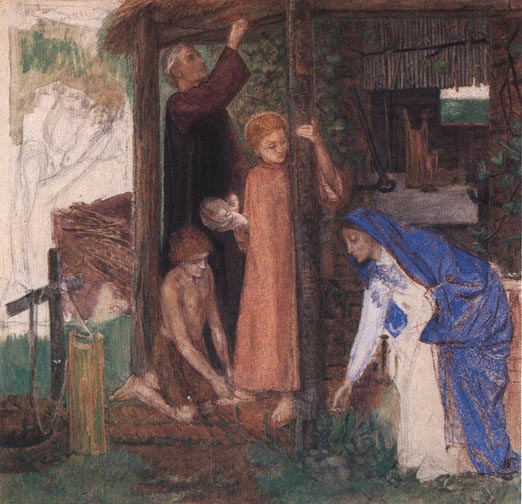
The Passover in the Holy Family: Gathering Bitter Herbs 1855-56
Watercolor 16 x 17inches Tate Gallery London.
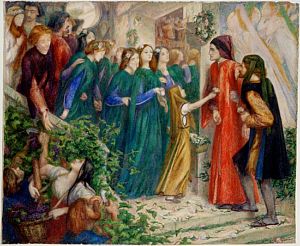
Beatrice, meeting Dante at a Wedding Feast, denies him her Salutation 1855
В 1855 году Россетти закончил картину "Беатриче встретив Данте на свадьбе, отказывает ему в приветствии". Это весьма перенаселённая картина, полная гостей на свадьбе и поздравляющих. Данте одет в красное, что символизирует страсть, в то время как Беатриче с лицом Элизабет Сиддал, одета в зелёное, символ жизни, весьма ироничный цвет, если вспомнить, что в данный момент Беатриче уже умершая возлюбленная Данте. Это "зернистая" акварель, что придаёт яркость и прозрачность краскам.
Сюжет взят из 'Vita Nuova'. Беатриче, недовольная вниманием, которое Данте оказывает другим женщинам, отказывается его приветствовать при встрече на свадебном пиру. Она не знает, что Данте только притворяется, чтобы скрыть свою любовь к ней.
The subject comes from the 'Vita Nuova'. Beatrice, disapproving of Dante's attentions to another woman, refuses to greet him when they meet at a marriage feast. Beatrice does not know that he has only pretended to favour the other woman in order to conceal his purer love for her.
In 1855, Rossetti completed "Beatrice Meeting Dante at a Wedding Feast, Denies Him Her Salutation." Again, this is a very crowded painting, full of wedding guests and well-wishers. Dante is dressed in red, symbolic of passion, while Beatrice, with the face of Elizabeth Siddal, is dressed in green, symbolic of life, an ironic color, given Beatrice's status as the dead beloved of Dante. It is a grainy watercolor, which results in bright, almost translucent colors.
Beatrice, meeting Dante at a Wedding Feast, denies him her Salutation
1855
В 1855 году Россетти закончил картину "Беатриче встретив Данте на свадьбе, отказывает ему в приветствии". Это весьма перенаселённая картина, полная гостей на свадьбе и поздравляющих. Данте одет в красное, что символизирует страсть, в то время как Беатриче с лицом Элизабет Сиддал, одета в зелёное, символ жизни, весьма ироничный цвет, если вспомнить, что в данный момент Беатриче уже умершая возлюбленная Данте. Это "зернистая" акварель, что придаёт яркость и прозрачность краскам.
Сюжет взят из 'Vita Nuova'. Беатриче, недовольная вниманием, которое Данте оказывает другим женщинам, отказывается его приветствовать при встрече на свадебном пиру. Она не знает, что Данте только притворяется, чтобы скрыть свою любовь к ней.
The subject comes from the 'Vita Nuova'. Beatrice, disapproving of Dante's attentions to another woman, refuses to greet him when they meet at a marriage feast. Beatrice does not know that he has only pretended to favour the other woman in order to conceal his purer love for her.
In 1855, Rossetti completed "Beatrice Meeting Dante at a Wedding Feast, Denies Him Her Salutation." Again, this is a very crowded painting, full of wedding guests and well-wishers. Dante is dressed in red, symbolic of passion, while Beatrice, with the face of Elizabeth Siddal, is dressed in green, symbolic of life, an ironic color, given Beatrice's status as the dead beloved of Dante. It is a grainy watercolor, which results in bright, almost translucent colors.
this is Rossetti's “first treatment of an Arthurian subject, though this particular episode does not occur in Malory's Morte d'Arthur...This water–colour may have suggested William Morris's poem King Arthur's Tomb in Defence of Guinevere.”
В 1855 году Россетти обращается к теме легенд об Артуре и создаёт акварель King Athur's Tomb, проданную затем Раскину. Подобные маленькие акварели составляли большую часть его дохода в это время.

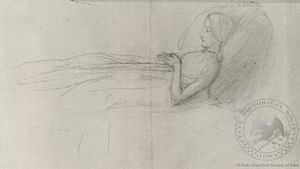
Elizabeth Eleanor Siddal
Pencil drawing by D. G. Rossetti (November 1855) [Mark Samuels Lasner collection.
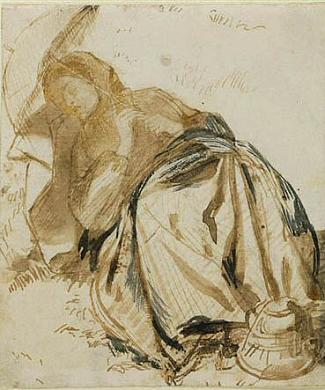
Портрет Элизабет Сиддал 1855 г. Музей Гетти.
Width: 155 mm
Height: 207 mm
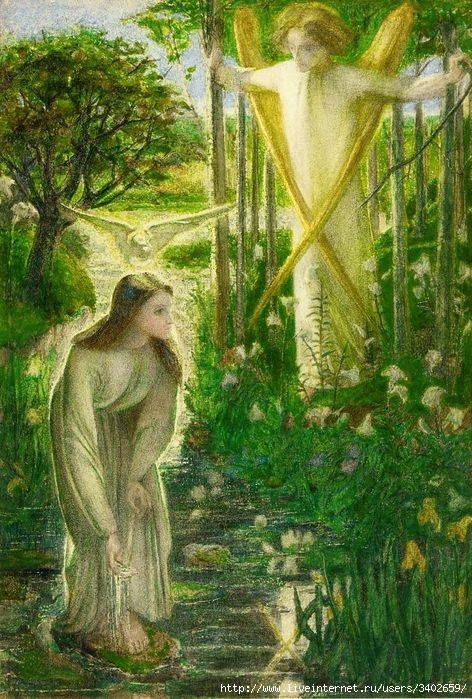
Метки: The Annunciation Robert Browning Элизабет Сиддал Данте рисующий ангела Бёрн-Джонс An English Autumn Afternoon |
BEATA BEATRIX. |
Дневник |
BEATA BEATRIX.
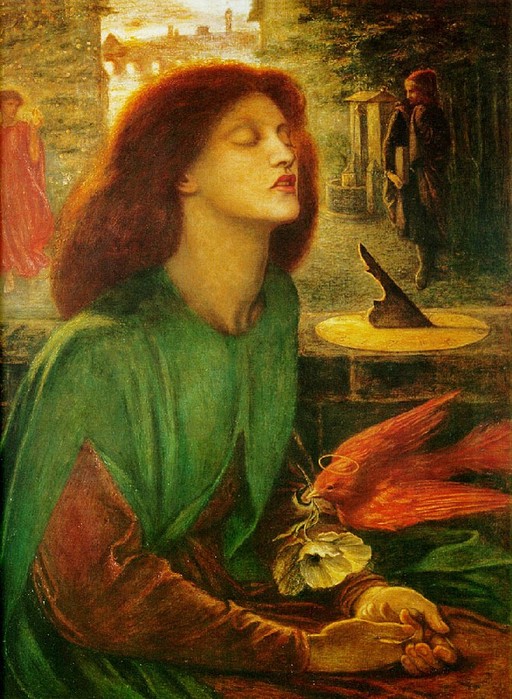
Блаженная Беатриче Beata Beatrix
Россетти начал первую версию картины, ныне находящуюся в галерее Тейт через год после смерти Сиддал в 1864 году после того, как обнаружил ранее сделанный эскиз маслом. Картина, возможно, основана и на портретах Сиддал сделанных в феврале 1862 года и ранее.
He began the first version of the work, now in the Tate Gallery, London, in 1864,a year after Siddal's death after finding an unfinished oil sketch that he had made of Siddal.

Крушение семейной жизни отрицательно сказалось на творчестве Россетти, только спустя годы вернулся он к жанру женского портрета. Беату Беатрикс он писал много лет, с 1864 по 1870 год. Начатая в 1864 году,картина была близка к завершению в 1866 и заказана Hon. William Comper, но окончена лишь в конце 1870-го года,а представлена публике вдовой Компера только в 1889 году.
Это было воспоминание о жене. Основанная на сюжете смерти Беатриче из "Новой жизни" Данте, она стала одной из известнейших произведений символизма. Состояние, пограничное между жизнью и смертью, земным и духовным, станет позже одной из важных тем, привлекавших символистов. На протяжении всей жизни Россетти отождествлял себя с флорентийским поэтом Данте Алигьери, культивировал духовную связь с ним. Картина Блаженная Беатриче имеет двойное значение. На ней изображена возлюбленная Данте - Беатриче, но в узнаваемом облике жены Россетти Сиддал.
В жёлтой дымке Лиззи - Беатриче сидит на балконе флорентийского дворца в позе умирающей с закрытыми глазами и поднятым подбородком, кажется,она остро сознаёт приближающуюся смерть. В ином толковании она закрыла глаза в упоении религиозгого или любовного экстаза. Поза напоминает ту, которая прсутствует на рисунках к

Россетти объяснял, что хотел изобразить не момент смерти, а момент "внезапной духовной трансформации". Голубь - вестник смерти принёс ей белый мак (в вариантах - красный). Птица вкладывает цветок мака (символ невинности, сна и смерти) в её руку. Мак, как символ, весьма двусмысленен, если вспомнить, что Сиддал умерла (покончила с собой?) как раз от передозировки опия. В глубине картины справа - Данте, устремивший взор на фигуру Амура, несущего пламенное сердце, в центе мост Веккио во Флоренции.
Критики приветствовали картину за её эмоциональное воздействие, которое передаётся даже просто через колорит и композицию. Истинная история любви Россетти приобретает новую глубину, Лиззи всё ещё оказывала сильное влияние на его творчество.
Rossetti again represented Lizzie as Dante's Beatrice in one of his most famous works, Beata Beatrix, (1864-1870) which he painted as a memorial to Lizzie after her death. This piece also mimicked the death of Dante's love in his autobiographical work, Vita Nuova. In the work, amidst a yellow haze of relatively indistinct shapes, including Florence's Ponte Vecchio and the figures of Dante and Love, Lizzie sits, representing Dante's Beatrice. With an upturned chin and closed eyes, Lizzie appears keenly aware of her impending fate, death. A bird, which serves as the messenger of death, places a poppy in her hands. Critics have praised the piece for its emotional resonance, which can be felt simply through the work's moving coloring and composition. The true history of Rossetti and his beloved wife further deepens its meaning; although their love had waned at that point, Lizzie still exerted a powerful influence on the artist.

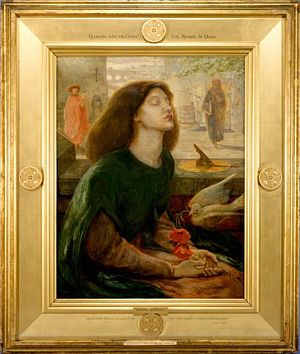
Frame: This smooth gold leaf frame is typical of many DGR pictures from about 1868 forward. It has a simple, rather severe mouldings on either side of very broad, shallow bevelled boards. Large roundels are set into the boards . . . usually placed singly at the mid-point of each side of the painting. In this particular case the roundels and frame inscriptions are closely integrated to the painting. The roundels were possibly inspired by the margin decorations in Plate 14 of Blake's Jobâ The Days of Creation. The texts had been used before by Rossetti as early as 1856 on the original frame of the water-color Dante's Dream . At the bottom is inscribed the line from Jeremiah, Lamentations I, i, quoted by Dante in the Vita Nuova on the death of Beatrice Quomodo sedet sola Civitas!; at the top is the date of Beatrice's death, now partly erased, Jun: Die 9: Anno 1290 (Grieve 23). The roundels placed midway on each side of the frame are contain relief representations of (at the top) the rising sun, (on the right) the stars, (on the left) a crescent moon embracing a single star, and (at the bottom) a land and seascape with the inscription 9 Giugno 1290.They symbolize, in a much more naturalistic way, the same forces that were symbolized by the schematic roundels on the frame of the 1854 Salutation of Beatrice and again probably relate to the closing lines of the Commedia ( Paradiso XXXIII. 143-145) (Grieve23).
Current Location: Birmingham City Museum and Art Gallery
https://rossettiarchive.iath.virginia.edu/docs/s168.rap.html
This version of the work differs sharply from the other oils. The background detail clearly develops the cityscape as Florence (rather than leaving the matter ambiguously Florence or London); and the accessories are quite different as well. The messenger-dove is white in this version, not red, and the poppies are red, not white. The details framing the figure of Love (at the left) are distinctive to this work as well (the arbor vitae is replaced by a wall-niche with a crucifix above. The light is also represented very differently in this work from the others. Here light suffuses the area behind Beatrice from a source that is represented as natural (as the lines of light at the left emphasize). In general, the treatment verges on a kind of realism, even though the general iconic/symbolic composition is retained.
Oil on canvas
34 7/16 x 27 1/4 in. (87.5 x 69.3 cm)
Predella: 26.5 x 69.2 cm
Inscribed top left on frame: JUN: DIE 9 ANNO 1290; top right on frame: QUOMODO SEDET SOLA CIVITAS!; and bottom of frame:
MART: DIE 31 ANNO 1300
VENI, SPONSA, DE LIBANO
He began the first version of the work, now in the Tate Gallery, London, in 1864, after finding an unfinished oil sketch that he had made of Siddal. The Art Institute’s painting is one of two replicas of the Tate composition, but it is the only one with a predella, the small panel at bottom showing the final meeting of Dante and Beatrice in paradise.
Одна из нескольких версий данной темы. Эта картина осталась незаконченной к моменту смерти Россетти и фон был завершон Форд Мэдокс Брауном. Возможно поэтому очертания видов города боле чёткие В этой версии маки красные, возможно. как явный намёк на опиум. Ещё одна версия картины в коллекции Тейт. Имеются многочисленные наброски карандашом к этой картине в музее Бирмингема, также как и большое орнаментированное майоликовое блюдо со сценой "Видения Данте"
Сам Россетти писал:"Картина является иллюстрацией к Vita Nuova и символически воплощает смерть Беатриче, так, как она там описывается".
One of several versions of this subject, this painting was unfinished at the time of Rossetti's death and the background was completed by Ford Madox Brown. In this version, the poppies are red, perhaps an explicit reference to opium-derived laudanum. Another version of the painting is in the Tate collection. There are also numerous related pencil studies in the Birmingham collection, as well as a large ornamental maijolica dish painted with a scene of Rossetti's 'Dante's Dream'.
СИМВОЛИКА КАРТИНЫ.
Голубь обычно символизирует Мир или святого Духа, но здесь он вестник смерти. В одних вариантах голубь красный, в других - белый. Интересно, что у красного есть нимб, а у белого нет.
The dove symbolise a messenger of death. Usually the dove represents Peace or the Holy Spirit. Here, it is the messenger of death. In other versions of the painting the dove is red, symbolising passion and death.
Мак - символ смерти. Опийный мак использовался для приготовления лекарства лауданум от передозировки которого и скончалась жена Россетти, вероятно, поэтому на некоторых вариантах мак красный - опиумный, на других белый - символ сна и смерти. В личном для Россетти плане мак символизирует уход Сиддал из его жизни, но не из души.
The poppy symbolise Death. This is an opium poppy sometimes used to make the drug laudanum. Rossetti's wife died from a drug overdose.
Циферблат солнечных часов - символ преходящего времени. Тень стрелки падает на 9 часов. Как объяснял Россеттти "Данте повстречал Веатриче, когда ей было девять лет, умерла Беатриче в 9 часов 9 июня 1290 года.
The sundial represent the passing of time. The shadow on the sundial falls on 9 o'clock. This is time of Beatrice's death in the poem.
Почему плащь Беатриче зелёный, а платье пурпурное? Зелёный - жизнь, весна, надежда, пурпурный - горе и смерть.
Why is Beatrice's tunic green and the dress purple? Green for life, purple for sorrow. Green means spring life and hope. Purple means sorrow and death.According to Rossetti's friend F.G. Stephens, the grey and green of her dress signify 'the colours of hope and sorrow as well as of love and life' ('Beata Beatrix by Dante Gabriel Rossetti', Portfolio, vol.22, 1891, p.46).
Две фигуры на заднем плане. - ангел любви с пламенеющим сердцем в руке (угасающая жизнь Беатриче) и сам Данте-Россетти, неотрывно смотрит на фигуру Любви, в чьей руке пламенем мерцает затухающая жизнь его госпожи.
Фон картины - река Арно, мост Понте Веккьо и башни собора во Флоренции, где жили Данте и Беатриче.
Rossetti intended to represent her, not at the moment of death, but transformed by a 'sudden spiritual transfiguration' (Rossetti, in a letter of 1873, quoted in Wilson, p.86). She is posed in an attitude of ecstasy, with her hands before her and her lips parted, as if she is about to receive Communion. The picture frame, which was designed by Rossetti, has further references to death and mourning, including the date of Beatrice's death and a phrase from Lamentations 1:1, quoted by Dante in the Vita Nuova: 'Quomodo sedet sola civitas' ('how doth the city sit solitary'), referring to the mourning of Beatrice's death throughout the city of Florence.
Метки: Beata Beatrix россетти сиддал Rossetti данте беатриче блаженная беатриче Галерея Тейт Vita Nuova |
BEATA BEATRIX. |
Дневник |
BEATA BEATRIX.
Блаженная Беатриче Beata Beatrix
Россетти начал первую версию картины, ныне находящуюся в галерее Тейт через год после смерти Сиддал в 1864 году после того, как обнаружил ранее сделанный эскиз маслом. Картина, возможно, основана и на портретах Сиддал сделанных в феврале 1862 года и ранее.
He began the first version of the work, now in the Tate Gallery, London, in 1864,a year after Siddal's death after finding an unfinished oil sketch that he had made of Siddal.
Крушение семейной жизни отрицательно сказалось на творчестве Россетти, только спустя годы вернулся он к жанру женского портрета. Беату Беатрикс он писал много лет, с 1864 по 1870 год. Начатая в 1864 году,картина была близка к завершению в 1866 и заказана Hon. William Comper, но окончена лишь в конце 1870-го года,а представлена публике вдовой Компера только в 1889 году.
Это было воспоминание о жене. Основанная на сюжете смерти Беатриче из "Новой жизни" Данте, она стала одной из известнейших произведений символизма. Состояние, пограничное между жизнью и смертью, земным и духовным, станет позже одной из важных тем, привлекавших символистов. На протяжении всей жизни Россетти отождествлял себя с флорентийским поэтом Данте Алигьери, культивировал духовную связь с ним. Картина Блаженная Беатриче имеет двойное значение. На ней изображена возлюбленная Данте - Беатриче, но в узнаваемом облике жены Россетти Сиддал.
В жёлтой дымке Лиззи - Беатриче сидит на балконе флорентийского дворца в позе умирающей с закрытыми глазами и поднятым подбородком, кажется,она остро сознаёт приближающуюся смерть. В ином толковании она закрыла глаза в упоении религиозгого или любовного экстаза. Поза напоминает ту, которая прсутствует на рисунках к
Россетти объяснял, что хотел изобразить не момент смерти, а момент "внезапной духовной трансформации". Голубь - вестник смерти принёс ей белый мак (в вариантах - красный). Птица вкладывает цветок мака (символ невинности, сна и смерти) в её руку. Мак, как символ, весьма двусмысленен, если вспомнить, что Сиддал умерла (покончила с собой?) как раз от передозировки опия. В глубине картины справа - Данте, устремивший взор на фигуру Амура, несущего пламенное сердце, в центе мост Веккио во Флоренции.
Критики приветствовали картину за её эмоциональное воздействие, которое передаётся даже просто через колорит и композицию. Истинная история любви Россетти приобретает новую глубину, Лиззи всё ещё оказывала сильное влияние на его творчество.
Rossetti again represented Lizzie as Dante's Beatrice in one of his most famous works, Beata Beatrix, (1864-1870) which he painted as a memorial to Lizzie after her death. This piece also mimicked the death of Dante's love in his autobiographical work, Vita Nuova. In the work, amidst a yellow haze of relatively indistinct shapes, including Florence's Ponte Vecchio and the figures of Dante and Love, Lizzie sits, representing Dante's Beatrice. With an upturned chin and closed eyes, Lizzie appears keenly aware of her impending fate, death. A bird, which serves as the messenger of death, places a poppy in her hands. Critics have praised the piece for its emotional resonance, which can be felt simply through the work's moving coloring and composition. The true history of Rossetti and his beloved wife further deepens its meaning; although their love had waned at that point, Lizzie still exerted a powerful influence on the artist.
Frame: This smooth gold leaf frame is typical of many DGR pictures from about 1868 forward. It has a simple, rather severe mouldings on either side of very broad, shallow bevelled boards. Large roundels are set into the boards . . . usually placed singly at the mid-point of each side of the painting. In this particular case the roundels and frame inscriptions are closely integrated to the painting. The roundels were possibly inspired by the margin decorations in Plate 14 of Blake's Jobâ The Days of Creation. The texts had been used before by Rossetti as early as 1856 on the original frame of the water-color Dante's Dream . At the bottom is inscribed the line from Jeremiah, Lamentations I, i, quoted by Dante in the Vita Nuova on the death of Beatrice Quomodo sedet sola Civitas!; at the top is the date of Beatrice's death, now partly erased, Jun: Die 9: Anno 1290 (Grieve 23). The roundels placed midway on each side of the frame are contain relief representations of (at the top) the rising sun, (on the right) the stars, (on the left) a crescent moon embracing a single star, and (at the bottom) a land and seascape with the inscription 9 Giugno 1290.They symbolize, in a much more naturalistic way, the same forces that were symbolized by the schematic roundels on the frame of the 1854 Salutation of Beatrice and again probably relate to the closing lines of the Commedia ( Paradiso XXXIII. 143-145) (Grieve23).
Current Location: Birmingham City Museum and Art Gallery
https://rossettiarchive.iath.virginia.edu/docs/s168.rap.html
This version of the work differs sharply from the other oils. The background detail clearly develops the cityscape as Florence (rather than leaving the matter ambiguously Florence or London); and the accessories are quite different as well. The messenger-dove is white in this version, not red, and the poppies are red, not white. The details framing the figure of Love (at the left) are distinctive to this work as well (the arbor vitae is replaced by a wall-niche with a crucifix above. The light is also represented very differently in this work from the others. Here light suffuses the area behind Beatrice from a source that is represented as natural (as the lines of light at the left emphasize). In general, the treatment verges on a kind of realism, even though the general iconic/symbolic composition is retained.
Oil on canvas
34 7/16 x 27 1/4 in. (87.5 x 69.3 cm)
Predella: 26.5 x 69.2 cm
Inscribed top left on frame: JUN: DIE 9 ANNO 1290; top right on frame: QUOMODO SEDET SOLA CIVITAS!; and bottom of frame:
MART: DIE 31 ANNO 1300
VENI, SPONSA, DE LIBANO
He began the first version of the work, now in the Tate Gallery, London, in 1864, after finding an unfinished oil sketch that he had made of Siddal. The Art Institute’s painting is one of two replicas of the Tate composition, but it is the only one with a predella, the small panel at bottom showing the final meeting of Dante and Beatrice in paradise.
Одна из нескольких версий данной темы. Эта картина осталась незаконченной к моменту смерти Россетти и фон был завершон Форд Мэдокс Брауном. Возможно поэтому очертания видов города боле чёткие В этой версии маки красные, возможно. как явный намёк на опиум. Ещё одна версия картины в коллекции Тейт. Имеются многочисленные наброски карандашом к этой картине в музее Бирмингема, также как и большое орнаментированное майоликовое блюдо со сценой "Видения Данте"
Сам Россетти писал:"Картина является иллюстрацией к Vita Nuova и символически воплощает смерть Беатриче, так, как она там описывается".
One of several versions of this subject, this painting was unfinished at the time of Rossetti's death and the background was completed by Ford Madox Brown. In this version, the poppies are red, perhaps an explicit reference to opium-derived laudanum. Another version of the painting is in the Tate collection. There are also numerous related pencil studies in the Birmingham collection, as well as a large ornamental maijolica dish painted with a scene of Rossetti's 'Dante's Dream'.
СИМВОЛИКА КАРТИНЫ.
Голубь обычно символизирует Мир или святого Духа, но здесь он вестник смерти. В одних вариантах голубь красный, в других - белый. Интересно, что у красного есть нимб, а у белого нет.
The dove symbolise a messenger of death. Usually the dove represents Peace or the Holy Spirit. Here, it is the messenger of death. In other versions of the painting the dove is red, symbolising passion and death.
Мак - символ смерти. Опийный мак использовался для приготовления лекарства лауданум от передозировки которого и скончалась жена Россетти, вероятно, поэтому на некоторых вариантах мак красный - опиумный, на других белый - символ сна и смерти. В личном для Россетти плане мак символизирует уход Сиддал из его жизни, но не из души.
The poppy symbolise Death. This is an opium poppy sometimes used to make the drug laudanum. Rossetti's wife died from a drug overdose.
Циферблат солнечных часов - символ преходящего времени. Тень стрелки падает на 9 часов. Как объяснял Россеттти "Данте повстречал Веатриче, когда ей было девять лет, умерла Беатриче в 9 часов 9 июня 1290 года.
The sundial represent the passing of time. The shadow on the sundial falls on 9 o'clock. This is time of Beatrice's death in the poem.
Почему плащь Беатриче зелёный, а платье пурпурное? Зелёный - жизнь, весна, надежда, пурпурный - горе и смерть.
Why is Beatrice's tunic green and the dress purple? Green for life, purple for sorrow. Green means spring life and hope. Purple means sorrow and death.According to Rossetti's friend F.G. Stephens, the grey and green of her dress signify 'the colours of hope and sorrow as well as of love and life' ('Beata Beatrix by Dante Gabriel Rossetti', Portfolio, vol.22, 1891, p.46).
Две фигуры на заднем плане. - ангел любви с пламенеющим сердцем в руке (угасающая жизнь Беатриче) и сам Данте-Россетти, неотрывно смотрит на фигуру Любви, в чьей руке пламенем мерцает затухающая жизнь его госпожи.
Фон картины - река Арно, мост Понте Веккьо и башни собора во Флоренции, где жили Данте и Беатриче.
Rossetti intended to represent her, not at the moment of death, but transformed by a 'sudden spiritual transfiguration' (Rossetti, in a letter of 1873, quoted in Wilson, p.86). She is posed in an attitude of ecstasy, with her hands before her and her lips parted, as if she is about to receive Communion. The picture frame, which was designed by Rossetti, has further references to death and mourning, including the date of Beatrice's death and a phrase from Lamentations 1:1, quoted by Dante in the Vita Nuova: 'Quomodo sedet sola civitas' ('how doth the city sit solitary'), referring to the mourning of Beatrice's death throughout the city of Florence.
Метки: Beata Beatrix россетти сиддал Rossetti данте беатриче блаженная беатриче Галерея Тейт Vita Nuova |
ROSSETTI. РОССЕТТИ. СПРАВОЧНЫЕ МАИЕРИАЛЫ |
Дневник |
СПРАВОЧНЫЕ МАИЕРИАЛЫ
Творчество Россетти можно изучить по рубрикам.
You can study Rossetti's works in rubriks:
1. РОССЕТТИ ЖИЗНЬ ROSSETTI LIFE - О Россетти, биография, прерафаэлиты, модели и значимые полотна. About Rossetti, biography, pre-raphaelits, models, the famous paintings.
2. КНИГА О РОССЕТТИ Перевод книги Little Journeys to the Homes of Great Lovers by Elbert Hubbard
ПОЛНЫЙ СПИСОК РАБОТ РОССЕТТИ The full list of Ross Полный список работ Россетти. Названия на английском и русском. The Full List of Rossetti's works. The titles in English and in Russian.
11.Картины Россетти, рассортированные по годам.
http://www.wikiart.org/en/dante-gabriel-rossetti/jane-morris-the-blue-silk-dress-1868
Модели Россетти.
THE ROSSETTI'S MODELS.
https://kristina-lenora.livejournal.com/18390.html музы прерафаэлитов
Женщины прерафаэлитов обычно попадают в две категории: модели (по преимуществу жёны, любовницы, или в случае Кристины Россетти - сёстры художников) или женщины художники прерафаэлиты. Джейн моррис попадает в первую, а Сиддал можно отнести к обеим категориям.
The Pre-Raphaelite women generally fall into two categories: artist’s models (who were predominately wives, lovers, or in the case of Christina Rossetti, sisters of the artists) or Pre-Raphaelite women artists (Lizzie Siddal can be included in both categories). Jane Morris falls in the first category.
1. Алекса Вайлдинг. Alexa Wilding. АЛЕКСА ВАЙЛДИНГ ALEXA WILDING
2. Анни Миллер. Annie Miller. АННИ МИЛЛЕР ANNIE MILLER
3. Элизабет Сиддал. Elizabeth Siddal. Элизабет Сиддал
4. Джейн Моррис Бёрден Jane Morris Burden ДЖЕЙН МОРРИС БЁРДЕН JANE MORRIS BURDEN
5. Кристина Россетти. Christina Rossetti. Кристина Россетти
6. Эдвард Роберт Хьюз Edward Robert Hughes Эдвард Роберт Хьюз
7. Фани Корнфорт. Fanny Cornforth Фанни Корнфорт
8 . Мари Спартали Стилман. Marie Spartali Stillman.
Ссылка на видео муз Россетти:http://www.youtube.com/watch?v=KW6A...feature=related
1849* встречает Элизабет Сиддал и использует её, как основную модель (не позволяя позировать другим).
1856* встречает Фани Корнфорт и использует её, как основную модель.
1857* встречает Джейн Моррис.
1860* женится на Сиддал.
1862* Сиддал умирает.
1863* Фани Корнфорт становится домоправительницей у кого-то другого.
1865* использует Джейн Моррис, как основную модель
1849• met Elizabeth Siddal and used her as the main model (not to be used by the others)
1858• met Fanny Cornforth and used her as the main model
1857• met Jane Morris
1860• married Siddal
1862• Siddal died
1863• Fanny Cornforth became somebody else's housekeeper.
1865• used J. Morris as the main model
ОТДЕЛЬНЫЕ ПОЛОТНА.
SOME of INTERESTING WORKS.
2.Видение Фиаметты. Vision of Fiammetta.
4. Дневная мечта. The Day Dream Последняя законченная картина Россетти. The last finished work of Rossetti.
5. THE BLESSED DAMOSEL Благословенная Благословенная.
6. REGINA CORDIUM QUEENG of HEARTS КОРОЛЕВА СЕРДЕЦ.
7. LADY LILITH@SYBILLA ЛЕДИ ЛИЛИТ и СИБИЛЛА ПАЛЬМИФЕРА.
Метки: ДЖЕЙН МОРРИС БЁРДЕН JANE MORRIS BURDEN россетти данте ASPECTA MEDUSA Elbert Hubbard Jan marsh живопись |
| Страницы: | [1] |


