ДЕЛАВАРСКИЙ МУЗЕЙ.(продолжение) |
В этом посте продолжаю исследовать произведения пре-рафаэлитов, хранящиеся в художественном музее Делавара.
1. Veronica Veronese
2. Lady Lilith
3.Elizabeth Siddal 1854
4.Frederick Richards Leyland

43 на 35 дюймов. 109.2 на 89 см.
подпись DGR
дата на картине 1872
Подпись и дата снизу справа.
Заказчик F.R. Leyland
заказ 1872 года
первоначальная цена 840 фунтов.
Модель Alexa Wilding
Начатая в 1872 году, без определённого заказа, картина была куплена Фредериком Лейландом, как только Россетти рассказал ему о ней и описал свой замысел. Россетти закончил картину в марте и сразу отослал заказчику.
The painting is one of the most important among the many Venetian-inspired pictures that dominate DGR's artistic output during the 1860s and 1870s. Elaborately decorative, it is an excellent example of the abstract way DGR handles ostensibly figurative subject matter. As its various commentators have noticed, the picture represents “the artistic soul in the act of creation” (Ainsworth 97). It is a visionary portrait of that soul as it had been incarnated in the practise of Paolo Veronese.
Begun in January 1872 without any explicit commission, the painting was bought by Frederick Leyland as soon as DGR told him about it, and described his intentions for the work. DGR completed it in March of the same year and sent it to Leyland at that time.
Надпись по французски на раме картины, предположительно цитата из писем Джироламо Ридольфи, была написана Россетти или, возможно, Свинбёрном. она представляет собой род толкования некоторых наиболее важных иконографических деталей:"Внезапно склонившись вперёд, леди Вероника быстро записывает первые ноты на девственно чистом листе.
The French quotation on the picture frame, supposedly from The Letters of Girolamo Ridolfi, was actually written by DGR or possibly Swinburne. It constitutes a kind of explanation of some of the picture's most important iconographical features: “Suddenly leaning forward, the Lady Veronica rapidly wrote the first notes on the virgin page. Then she took the bow of her violin to make her dream reality; but before commencing to play the instrument hanging from her hand, she remained quiet a few moments, listening to the inspiring bird, while her left hand strayed over the strings searching for the supreme melody, still elusive. It was the marriage of the voices of nature and the soul—the dawn of a mystic creation” (this is Rowland Elzea's translation of the French text on the picture frame). The “marriage” noted here is emblematically represented in the figure of the uncaged bird, which stands simultaneously as a figure of nature and of the soul.
Sarah Phelps Smith has explicated the picture's flower symbolism: the bird cage is decorated with camomile, or “energy in adversity”; the primroses symbolize youth and the daffodils (narcissi) stand for reflection or meditation. But David Nolta argues that the camomile is in fact celandine, which in herbal lore was a notable specific for diseases of the eyes. (Nolta's autobiographical reading of the picture is greatly strengthened by this view of the flower symbolism.)
The green velvet dress in the picture was borrowed from Jane Morris, the background drapery is a Renaissance brocade, the jewelry is Indian silver, the violin is from DGR's collection of musical instruments. The fan hanging at her side is the same as that which appears extended in Monna Vanna . The musical manuscript showing the first bars of a composition seems in debt to George Boyce, to whom DGR wrote in March 1872 asking if he “had any old written music & could you lend me such” (quoted in Surtees, A Catalogue Raisonné I. 128).
The french inscription attributed to Girolamo Ridolfi is almost certainly the work of Swinburne.
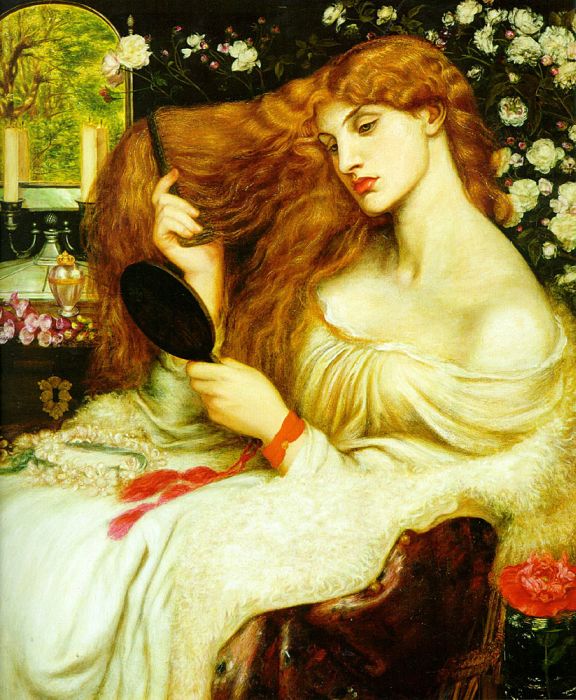
Lady Lilith. ЛИЛИТ и СИБИЛЛА ПАЛЬМИФЕРА SIBYLLA PALMIFERA.
АНТИПОДЫ И КОЛЛЕГИ.
BODY'S BEAUTY
Of Adam's first wife, Lilith, it is told
(The witch, he loved before the gift of Eve)
That, ere the snake's, her sweet tongue could deceive,
And her enchanted hair was the first gold.
And still she sits, young while the earth is old,
And, subtly of herself contemplative,
draws men to watch the bright web she can weave,
Till heart and body and life are in its hold.
The rose and poppy are her flowers; for where
Is he not found, O Lilith, whom shed scent
And soft-shed kisses and soft sleep shall snare?
Lo! as that youth's eyes burned at thine, so went
Thy spell through him, and left his straight neck bent,
And round his heart one strangling golden hair.
1866
ТЕЛЕСНАЯ ПРЕЛЕСТЬ.
Лилит, Адама первая жена
(Колдунья, что до Евы с ним была).
Предтечей змия в кознях прослыла,
И золотилась кос её волна.
Стареет мир, не старится она;
Спокон веков она мужей влекла,
Улавливая души и тела
В силки страстей, как в наши времена.
Ей любы мак и томных роз цветы;
Кого, Лилит, не зачаруешь ты,
Твой поцелуй и сонных грёз настой?
Едва зажжёт огонь твоих зениц
Взор юноши - и тот повержен ниц,
И душит сердце волос золотой.
Короче, весь вред от баб, ох уж эти Анфиски.
Although a remarkably more controversial model than Elizabeth Siddal or Jane Morris, Fanny was not only the subject of some of Dante’s most astonishing works but it seems she was “forgotten” before her time. She modeled for the painting of “Lady Lilith”, the first wife of Adam in Jewish mythology and seen as the personification of lust. “Sibylla Palmifera” was conceived as an opposing piece to “Lady Lilith” and painted from the model Alexa Wilding. It represented “Soul’s Beauty”, a sonnet Rossetti wrote to accompany his painting. The modestly dressed Sibyl sits in a temple surrounded by the emblems of Love: the Cupid, Death: the Skull, and Mystery: the Sphinx. In contrast, Lilith admires herself in a mirror, the attribute of vanity. Initially the contrast between the pictures was very marked, but in 1872-3 Rossetti replaced Fanny’s head with the head of Alexa at the request of a buyer, and the original concept was destroyed. She is the sumptuous and inviting woman in paintings such as the above mentioned “Bocca Botacia” and “Lady Lilith” as well as “The Blue Bower” and others. “The Blue Bower” was Rossetti’s last major portrait of Fanny Cornforth.The artist identified the subject on a label attached to the original frame: "Beware of her fair hair, for she excells [sic]/ All women in the magic of her locks,/ And when she twines them round a young man's neck/ she will not ever set him free again." These lines are taken from Shelley's translation of the Walpurgisnacht scene in Goethe's Faust. Here, as in Rosetti's other drawings and paintings of Lady Lilith, the artist's mistress, Fanny Cornforth, served as the model.
The oil painting Lady Lilith depicts artist Dante Gabriel Rossetti's version of an ancient figure, but with a twist. Here, the figure is in the guise of a Nineteenth century femme fatale. According to the legend, Lilith was the first wife of Adam. She was both beautiful and devious. Rossetti composed a poem about this woman, in which she is characterized as a dazzling seductress with golden hair that could be used to ensnare a man. And the artist certainly emphasized the deadly charms of Lilith's gold tresses in this painting, for she is caught in the act of combing her luxurious locks while gazing contemplatively into a hand mirror. It is also worth mentioning that two of Rossetti's 'stunners' posed for this work of art - both Fanny Cornforth and Alexa Wilding lent their lovely features.

Акварель.

This is presumably the portrait of Leyland that DGR did in 1879. On 16 July he wrote to Frederick Shields that “I am doing a head of [Leyland] for a wedding present to his eldest daughter [Fanny], but have begun two already without quite pleasing myself. His head is really fine, but there are difficult points in it.” ( Fredeman, Correspondence, 79. 98 ). DGR met the famous shipping magnate and art patron in October 1865 through the tobacco merchant John Miller (1796-1876), who DGR had known since the early 1850s and who had purchased DGR's
Отвлечёмся чуть от прерафаэлитов. Рассматривая картинки музея в Делаваре, обнаружил там очередной горшочек базилика, работы Холмана Ханта. На всех его картинах одно лицо, начиная с Пробудившейся совести, да и стилистика та же. А сравнить с Джоном Уайтом Александером. Вот это модерн! Какая линия струящаяся, какая тень, ничего кричащего. У Ханта ведьма какая-то у котла.


| Комментировать | « Пред. запись — К дневнику — След. запись » | Страницы: [1] [Новые] |


