Succession— the handover of power from one leader to another — is the moment of truth for a political system. The American presidential election, for all its magnificent hucksterism, was once again a confirmation of the messy but noble dynamism of democracy — America does its handover of power with dignity (barring a few dubious presidential pardons).
Yet in the 21st century there are three Great Powers, and two — Russia and China — boast authoritarian systems ruled by tiny cabals that decide the succession of political power through mysterious, invisible and almost magical rites. The succession in China is shamelessly undemocratic and secretive — but firm and orderly. Moscow is different, if only because the absence of working mechanisms for succession are a real threat to the international order.
Late last month, just days before President Bush hosted the surviving former presidents and President-elect Barack Obama in the White House, Russia’s rubber-stamp Parliament was passing a law, backed by President Dmitri Medvedev, that would allow the next Russian president to serve two six-year terms, up from two four-year terms. The law’s implications are as obscure as all developments in Russia. But it seems a maneuver to allow Vladimir Putin — Russia’s previous president, current prime minister and still paramount leader — to return to an ever-stronger presidency.
Having reached the old term limit last year, Mr. Putin chose and installed a trusted protйgй, Mr. Medvedev, as successor. Now many expect the president to return the favor by resigning and permitting Mr. Putin’s return to office. In contortion worthy of medieval Byzantium, Mr. Putin, having handed over power but actually not handed it over at all, may imminently be officially restored to it.
Vladimir Putin personifies the successes and flaws of today’s Russia. However superficial the nation’s “sovereign democracy” may be, his popularity is enormous and real. Any politician would envy his association with stability, prosperity, security, restored imperial power and vigorous state authority.
It was always presumptuous to expect Russia, an ancient nation-state and proud empire of distinct culture with a tradition of autocracy, to become an Anglo-American democracy overnight — just as it is naпve to expect it in other parts of the world. The unspoken contract between ruler and subject is that in return for safety, prosperity and prestige, the Russians entrust power and cede democratic freedoms to their leaders.
Even under a regime dominated by former K.G.B. officials, Moscow is freer than at any time in its history, other than the mid-1990s. So it is astonishing that, while Russia has its own Vogue magazine and Internet cafes, its political process is now more arcane, more eccentric and yet more public than it was during the 18th-century “age of palace revolutions.” The existence of Russia’s democratic Constitution has led to far more smoke and mirrors than in China, where successions to a bureaucratic collective leadership are managed by a tiny camarilla in a self-declared one-party state.
The view of de Custine about Russia in the mid-19th century could easily apply to the 21st: “I came here to see a country, but what I find is a theater ... In appearances, everything happens as it does everywhere else. There is no difference except in the very foundation of things.”
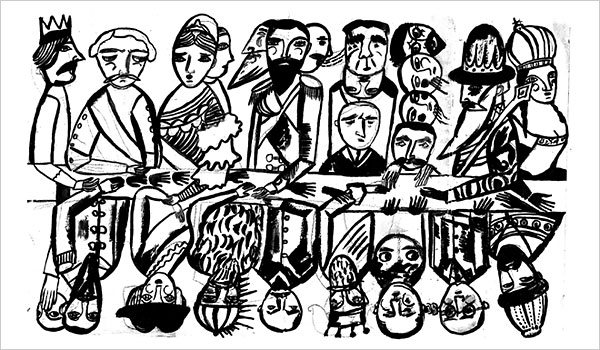
Russia has had a functioning system for handing over power for only 121 years in its entire history: during the later years of the Romanov autocracy. Before Emperor Paul I established a legal structure in 1797, there was no law of succession: Czars simply chose their heirs. Both Peter the Great and Ivan the Terrible undermined their own achievements by killing their sons and chosen heirs. After Peter’s death in 1725, the succession was decided through 70 years of palace coups and regicide, a system oft described by the witty phrase “autocracy tempered by assassination.” Strong, intelligent empresses like Elizabeth and Catherine the Great seized power, creating an age of omnipotent petticoats.
In Russia, Power Has No Heirs
Catherine, a German with no claim to the throne, in 1762 overthrew her own husband, Peter III, who was subsequently strangled by two courtiers, Aleksei Orlov and his brother Grigory (who was also Catherine’s lover) in a drunken frenzy. The official announcement was that he had died of piles — prompting the French philosopher d’Alembert to joke, when invited by Catherine to visit, that he couldn’t go since he suffered from hemorrhoids, potentially fatal in Russia.
Catherine’s heir, Paul I, so hated his mother that he created his law of strict male succession. He was a despotic, half-mad emperor with a fixation on military parades, and in 1801 was strangled and brained with an inkwell by his own courtiers. Yet his decision to codify the turnover of power ushered in an era of stable successions that lasted until 1917.
There was no succession rule in the Soviet state, an empire ruled by a murderous clique, men who met in paranoid secrecy as if they were still scruffy conspirators plotting in a room above some provincial tavern. Sovereignty in this institutionalized conspiracy was meant to rest in the Central Committee, but actually five or six magnates decided everything.
Regarding themselves as irreplaceable, both Lenin and Stalin tried in different ways to destroy their successors — Lenin through a testament that attacked Stalin and Trotsky, Stalin through purges culminating in the Doctors’ Plot of 1953. The aftermaths in both cases were grim: all Lenin’s potential heirs were killed by Stalin, and the struggle after Stalin’s death in 1953 was described by Winston Churchill as “bulldogs fighting under a rug.” At first the sadistic secret-police chief Lavrenti Beria emerged as strongman, until he was overthrown and shot in a plot hatched by Nikita Khrushchev.
Khrushchev, in turn, was overthrown in a palace coup in 1964 and pensioned off — though his successor, Leonid Brezhnev, considered having him killed. Brezhnev reigned into senility if not embalmment, followed by successions as sclerotically secretive as they were physically redundant. And so it continued through Mikhail Gorbachev, the fall of the Soviet Union in 1991, the tumultuous reign of Boris Yeltsin and the steely paramountcy of Mr. Putin.
Vladimir Putin wants his successes in Russia to be respected by the West; hence he did not simply ignore the Constitution and stay in the presidency. He and his grandees believe in the idiosyncratic style of authoritarian democracy that has restored Russian prestige (although his courtiers are also keen to preserve their power and wealth).
Things could be worse: the neighboring former Soviet republics demonstrate the crasser solutions Russia rightly wishes to avoid. In Kazakhstan, the Constitution has been altered so President Nursultan Nazarbayev may reign endlessly. In Turkmenistan, the gruesomely dotty Sapamurat Niyazov appointed himself president for life and took the name Turkmenbashi, “father of All Turkmens.” Azerbaijan has effectively become a monarchy: on his death in 2003, President Heydar Aliyev (who had served in Brezhnev’s Politburo) was succeeded by his son, Ilham — a surprising return of the hereditary principle also seen in other “socialist republics” including Syria (ruled by the Assad dynasty) and North Korea (the Kims).
If the Russians are happy with it, should their peculiar semi-modern, semi-medieval system concern us? A superb book called “Flawed Succession,” edited by Uri Ra’anan in 2006, examines four 20th-century Russian successions and suggests it does: “The absence of a transparent, consistently implemented, non-arbitrary transfer of power mechanism,” writes Professor Ra’anan, means that power is “transferred inevitably by coups, whether through covert opaque manipulations ... or physical elimination.” Without such a mechanism, “a democracy cannot be established,” nor can rule of law or a civic society.
Clearly, this lack of civic society affects the way rulers rule. Russia is so feudal in its system of patronage and reward that it is virtually impossible for a leader to hand over power without controlling his successor or at least receiving an exemption from prosecution — something Mr. Putin granted his predecessor, Boris Yeltsin, in 1999. Leaders, writes Professor Ra’anan, “are condemned to lead a Hobbesian existence, fearing the penalties that come with loss of power.”
It matters because the whims of the system are reflected in Russia’s lurchingly inconsistent foreign and military policies, which are unreadable to outsiders, from its war in Georgia last year to the current gas crisis with Ukraine. Are these accidents, adventures, opportunities, policies? And who is deciding them?
Yet a drop in its oil revenues could lead to domestic unrest — there is no other way to overthrow the oligarchy. Meanwhile, Mr. Putin’s succession and (likely) restoration is a leisurely dance of the seven veils in which one veil is dropped only for another to be donned — more fascinating even than the danse macabre of Soviet Kremlinology. But no one, probably not even the grandees of the Kremlin themselves, knows how it will end.
By SIMON SEBAG MONTEFIORE
Published: January 11, 2009
http://www.nytimes.com/