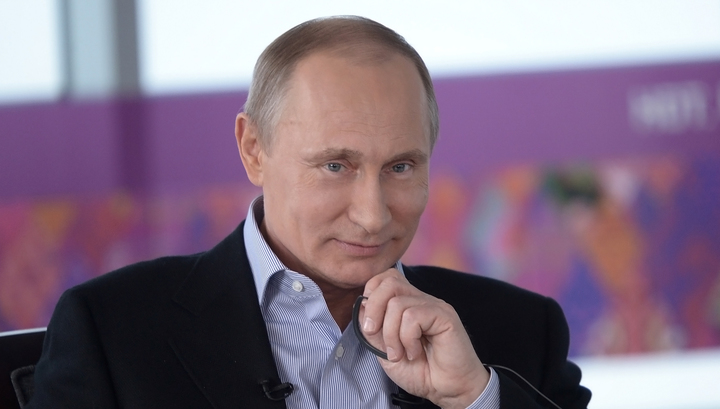
Putin Vladimir Vladimirovich. |
Putin Vladimir Vladimirovich (born October 7, 1952, Leningrad, RSFSR, USSR) is a Russian state and political figure, president of Russia.
May 7, 2012 for the third time took office as President of Russia. The first two termsVladimir Putin served as President of the Russian Federation in 2000-2008.Temporarily served as President of the Russian Federation (December 31, 1999 - May 7, 2000). Before taking up the post of Acting President of Russia, Vladimir Putin was Prime Minister of the Russian Federation (1999), Director of the Federal Security Service (1998-1999), First Deputy Head of the Presidential Administration (1998), Deputy Head of the Presidential Administration (1997-1998), Deputy Presidential Affairs Manager (1996-1997).
V.V. Putin is a candidate of economic sciences (1997), master of sports in sambo (1973), master of sports in judo (1975).
Vladimir Putin has two daughters. Divorced ( in June 2013 ).
Family, childhood and youth
Vladimir Putin was born October 7, 1952 in Leningrad in a family of workers.
Father - Vladimir Vladimir Spiridonovich (1911 - 1999) - a master at the factory.Egorova, a veteran of the Great Patriotic War (a soldier of the 330th Infantry Regiment of the 86th Division of the Red Army, was seriously wounded).
Mother - Shelomova Maria Ivanovna (1911-1998).
My grandfather worked as a cook by his father - first at Vladimir Lenin in Gorki, then at one of the dachas of Joseph Stalin.
Vladimir Putin studied at the Leningrad School No. 193 (1960-1968). After the 8th grade, he entered a special school No. 281 with a chemical bias on the basis of the Technological Institute (1968-1970). After graduation, Vladimir Putin became a student of the international department of the law department of the Leningrad State University Zhdanov (Leningrad State University, now - St. Petersburg State University) (1970-1975). During his studies at the university he got acquainted with Anatoly Sobchak, who, as an assistant of the department, for some time conducted classes on economic law. At Leningrad State University, Vladimir Putin joined the Communist Party of the Soviet Union (CPSU) and remained its member until the party was banned in 1991 (formally did not leave the CPSU).
Work in the KGB
According to the distribution, Vladimir Putin was sent to work in the state security bodies (KGB of the USSR). Served as an employee of the First (Personnel) Department of the Leningrad KGB Directorate (1975-1984), and all these years he continued to study: he graduated from the "Retraining Training Courses" in Okhta ("401-th School") (1976), retraining courses at the KGB High School in Moscow (1979), the Red Banner Institute. Yu. V. Andropov (now - School of Foreign Intelligence) (1985). From 1985 to 1990 Putin was sent to the German Democratic Republic (GDR), in Dresden, where he worked as the director of the House of Soviet-German Friendship.
Personal life
July 28, 1983 Vladimir Putin married Lyudmila Aleksandrovna Shkrebneva, then a student of the philological faculty of the Leningrad State University. In 1985, the daughter of Mary was born in the family of Putins, and in 1986 - Katerina.
Work in St. Petersburg (Leningrad)
Since 1990, Vladimir Putin worked as an assistant to the pro-rector of the Leningrad State University (LGU) on international issues, and later as an adviser to the chairman of the Leningrad City Council. After AA Sobchak was elected to the post of mayor (June 1991), Vladimir Putin became chairman of the Committee on External Relations of the St. Petersburg City Hall, then - first deputy chairman of the government of St. Petersburg (March 1994). During the August 1991 coup, Vladimir Putin filed a report on dismissal from the state security agencies and in early 1992 was transferred to the KGB's "active reserve" as a lieutenant colonel of the reserve. In 1994, Putin became the first deputy chairman of the government of St. Petersburg. Vladimir Putin participated in the election campaign of Anatoly Sobchak in 1996, and after the defeat of Sobchak in the election, resigned from his posts in the government of St. Petersburg.
Work in Moscow
In 1996, Vladimir Putin moved to Moscow. Worked in the presidential administration of Boris Yeltsin. Since August 1996, Vladimir Putin - Deputy Governor of the President of the Russian Federation Pavel Borodin. On March 25, 1997, he was appointed deputy head of the presidential administration and head of the President's Main Control Office. On May 25, 1998, he became the first deputy head of the administration responsible for regional policy. On July 25, 1998, he was appointed director of the Federal Security Service of the Russian Federation. Since March 26, 1999, he has been simultaneously secretary of the Security Council of the Russian Federation. On August 9, 1999, Vladimir Putin was appointed Acting Chairman of the Government of the Russian Federation (since August 16 - Chairman of the Government of the Russian Federation). On the same day, in a televised address to the Russians, President of the Russian Federation Boris N. Yeltsin named V. Putin his successor.
Dissertation
In 1997 in St. Petersburg State Mining Institute Vladimir Putin defended his thesis.The theme of the thesis is "Strategic Planning of the Reproduction of the Mineral Resources of the Region in the Conditions of Forming Market Relations." The scientific adviser of the thesis is Doctor of Economics VA Fedoseev.
Putin - President of the Russian Federation
On December 31, 1999, after the voluntary resignation of Russian President Boris Yeltsin, Vladimir Putin becomes acting president of the Russian Federation. On the same day, Putin was given the symbols of presidential power (the Standard of the President of the Russian Federation, the Sign of the President of the Russian Federation, a special copy of the text of the Constitution of the Russian Federation) and a "nuclear suitcase." The first state act signed by Putin at the post of acting president of the Russian Federation was the Decree "On guarantees to the President of the Russian Federation, which ceased to discharge his powers, and members of his family." The decree granted the former president (Boris Nikolayevich Yeltsin) guarantees of immunity.
Since March 26, 2000, Vladimir Putin is the elected president of Russia. He took office on May 7, 2000.
During the first presidential term, he reformed the federal system of the country (he introduced seven federal districts); made notable personnel reshuffles in the highest echelons of power, entered into confrontation with the so-called oligarchs, made a strategic turn in Russia's foreign policy, choosing a course toward rapprochement with the West.
On March 14, 2004, Vladimir Vladimirovich Putin was elected President of the Russian Federation for a second term. He took office on May 7, 2004.
During the second presidential term, Putin continued to further strengthen the "vertical power." In the sphere of foreign policy, Putin sharply opposed the plans for NATO expansion and deployment of US missile defense facilities in Eastern Europe.
Putin - Prime Minister of the Government of the Russian Federation
On May 7, 2008, Vladimir Putin transferred power to the newly elected presidentDmitry Medvedev . Even before the official transfer of power to his successor, Putin agreed to assume the post of chairman of the United Russia party, while declaring his desire to remain non-partisan.
On May 8, 2008, Vladimir Putin was approved by the Duma for the post of Prime Minister of Russia. On May 12, 2008, Vladimir Putin announced the composition of his new government.
The entry of Georgian troops into the territory of the unrecognized republic of South Ossetia and the shelling of its capital city of Tskhinval (August 2008), Putin called aggression against South Ossetia, and described the actions of the Georgian army on the territory of the republic as "complete genocide."
Speaking at the World Economic Forum in Davos (January 2009), Vladimir Putin said that the main cause of the current global financial and economic crisis was the failure of the existing financial system.
Putin - President of the Russian Federation
On May 7, 2012, Vladimir Putin took office as President of Russia. Thus, Putin became not only the second, but also the fourth president of Russia. For the first time the supreme leader of the country returns to his post after a break. This was not in modern, or in the Soviet, or in pre-revolutionary Russia.
| Рубрики: | Putin President New Russia (18.03.2018)/ПУТИН - Я ВАМ РАССКАЖУ ДВЕ ВЕЩИ, ОТ КОТОРЫХ РЕАЛЬН 80th Anniversary/ Google translate . Polyglot 80 |
| Комментировать | « Пред. запись — К дневнику — След. запись » | Страницы: [1] [Новые] |