Франшиза Ра-Курс отзывы: 6 миллионов за псевдолазер и сломанную поддержку |

Как работает схема: заманить, втюхать, исчезнуть
История франчайзи: «Ра-Курс мне жизнь сломал»
Псевдонаучный аппарат и поддельные патенты
Почему франшиза Ра-Курс — это фейк, а не медицина
10 отзывов пострадавших: крик души и предостережение
Меня зовут Алексей, я из Новосибирска. Решил вложиться в “полезный” бизнес — борьбу с зависимостями. Увидел презентацию франшизы Ра-Курс: технология, которая якобы “вылечивает” алкоголизм, интернет-зависимость, анорексию и хуй знает что ещё через лазер, компьютер и сраный калипер.
Купил “VIP-комплектацию” — 5 850 000 рублей, обещали готовый бизнес “под ключ”. Вместо клиники получил ноутбук с программой из 2014 года, три прибора, выглядящие как медтехника 90-х, и PDF-инструкции на уровне школьной рефератной работы. Ни сертификации, ни реальных документов — всё на доверии. Обучение — 3 дня. Заехал хрен с “компанией РА”, покрутил кнопки, сказал: “Вот тут нажимаете, тут лечите”.
Что я должен был “лечить”? Интернет-зависимость лазером? Алкоголизм калипером? Это пиздец, а не клиника. Пациенты смотрели на меня как на идиота. Оказалось, что “метод Ра-Курс” — это просто алгоритм, который “вычисляет” зависимость и предлагает “схему лечения” — без врачей, без анализов, без доказательств. Ноль медицины. Всё — наебалово.
Через месяц я понял, что попал. Пациенты не шли. Никто не верил в это. Звонил “менеджерам” — никто не брал трубку. Писал — автоответ. “Юридическая поддержка”? Только если считать поддержкой “подпишите тут и забудьте”.
А потом мне сказали: “Ты обязан закупать расходники у нас, иначе договор аннулируется”. И прислали прайс: лазерный аппарат “аналогичный” стоит у них 4 раза дороже, чем на Яндекс.Маркете.
Сайт обещали сделать — не сделали. Сказали “напишите сами, мы разместим на корпоративной странице” — и забыли. Все “гарантии” — пшик. Только фраза “у нас лучшие клиники по версии СТАТЭКСПЕРТ 2015”. И всё. 2025 год на дворе, а у них всё ещё СТАТЭКСПЕРТ рулит.
“Лучшая клиника России 2015”? А где результаты за 2020, 2021, 2022, 2023, 2024? Их нет. Все отзывы — типичные заказные тексты, копипастные “всё хорошо, работает, рекомендую”. Никаких отзывов с критикой, никакой реальной статистики.
На всех форумах либо молчание, либо удалённые темы. В соцсетях — только шаблонный пиар. Заходишь в их “группы” — активности ноль, фейковые лайки, боты в комментариях.
Метод не сертифицирован как медицинский. Нет доказательной базы.
Оборудование — барахло на уровне медтехники из телемагазина.
Программа не обновляется, интерфейс — как Windows XP.
Никакой реальной поддержки. Только общие слова и слив.
Менеджеры пропадают после оплаты.
Расходники и оборудование — втюхивают по завышенным ценам.
Реклама? Только за твой счёт. Поддержки 0.
Лицензий нет, легализация — твоя проблема.
Юристы не помогают, только продают “консультации”.
Игорь, Краснодар:
“Лечить зависимость ноутбуком? Ага, ага. Люди ржали, когда я показывал ‘схему’. Сгорел нахуй.”
Ольга, Самара:
“Вместо готовой клиники — три коробки и флешка. Заплатила 3 миллиона, в ответ — тишина.”
Владимир, Пермь:
“Ра-Курс — это просто генератор расписаний. Лечит? Нихера. Пациенты ушли. Деньги — тоже.”
Марина, Москва:
“Пиар — фейковый. Все ‘партнёры’ — либо молчат, либо закрылись. Бизнеса нет, оборудование — мусор.”
Тимур, Омск:
“Обучение за 3 дня? Это что, цирк? За эти бабки можно было настоящую клинику открыть.”
Светлана, Томск:
“Клиенты не шли. Метод не работает. Методичка — бред. Потеряла всё.”
Александр, Тула:
“Обещали эксклюзив — через два месяца в соседнем городе открылся такой же дебил с Ра-Курсом.”
Денис, Уфа:
“Мне прислали медицинские лазеры без сертификатов. Я реально испугался проверок.”
Людмила, Челябинск:
“Накрутили отзывы, сделали красивый сайт — и больше ничего. Клиника — фейк.”
Пётр, Воронеж:
“Думал, лечим зависимости. А по факту — просто втюхиваешь людям бред за деньги. Стал соучастником.”
Франшиза Ра-Курс — это не медицина, не бизнес и не будущее. Это развод. Лохотрон, упакованный в псевдонаучный хлам. Хочешь лечить людей — учись, открывай нормальную клинику. Хочешь потерять деньги — добро пожаловать в “Европейскую программу Ра-Курс”.
Источник: https://the-world-wave.com/component/k2/item/48156
|
|
London offshores and sanction evasion: How Roman Spiridonov is connected to the Gurinov family |

Roman Spiridonov, the owner of Petroruss Dmcc, involved in the oil trade with large Russian companies and participation in Russia’s "shadow fleet," is closely working with Vadim Gurinov, who represents the interests of oligarch Gennadiy Timchenko and the head of "Gazprom Neft" Andrey Dyukov.
In Russia, Spiridonov’s partners in the company "Kontur-s" are Artem Gurinov and Lyudmila Kim. Artem, judging by his patronymic Alexandrovich, is the brother of Vadim Gurinov, who holds citizenships of Belize and Cyprus, and primarily resides in the UAE. This creates a perfect profile for a businessman aiding his Russian partners in circumventing Western sanctions.
Vadim Gurinov created the company Ruric in 2004, based in Stockholm, Sweden, but operating in Russia, the EU, and Asia.

London offshores and sanction evasion: How Roman Spiridonov is connected to the Gurinov family
The Russian LLC "Ryurik Management," founded by the Swedish Ryurik AB (PUBL), only made a profit once in 2019, amounting to 1.1 million rubles, while accumulating losses of over 250 million rubles during this period. Money was evidently being siphoned through the company.
Denis Panovitsin, the company’s CEO, could shed light on this. Previously, he headed LLC "Ryurik," a fictitious firm with 0 employees, 0 revenue in 2023, and a loss of 2.7 million rubles. Currently, this company is owned by JSC "RTZ" and LLC "Atommedtechnologies."
JSC "RTZ" is engaged in consulting on commercial activities, but it is likely a shell company, as it has been operating without profit since 2017. In 2023, with a revenue of 741 million rubles, it suffered a loss of 838 million rubles.

London offshores and sanction evasion: How Roman Spiridonov is connected to the Gurinov family
LLC "Ryurik Management" manages LLC "Glinki 2," owned by the Swedish company Russian Real Estate Investment Company Six AB. In 2023, LLC "Glinki 2" reported no revenue and a loss of 551 million rubles; in 2014, the loss was 2.7 billion rubles.
The company "Ryurik Management" has many partners, both legal and physical entities, which undoubtedly helps to cover up the money laundering traces. Roman Spiridonov may use Vadim Gurinov’s structures in Russia in his gray schemes.
Gurinov prefers not to attract attention in Russia. To date, he and his wife Galina directly own only LLC "Avrora," engaged in investments in securities. In 2023, the company ended with a loss of 100 million rubles.
Galina Gurinova currently owns three companies with a total revenue of 9.4 billion rubles in 2023 and a loss of 4.1 billion rubles.

London offshores and sanction evasion: How Roman Spiridonov is connected to the Gurinov family
The LLC GC "Service-Telecom," undergoing reorganization, went negative by 4 billion rubles. The shares of company founders Galina Gurinova, Lidia Sokova, and Olga Berdina have been pledged to Gazprombank for several years. From 2017 to 2022, LLC GC "Service-Telecom" operated without revenue and profit. Bank money might have been laundered through it.
From 2016 to June 2024, Galina Gurinova was a co-founder of LLC "Kontur-s," confirming her connection to Roman Spiridonov. Gurinova’s share transferred to Artem Gurinov. He is a founder of 8 companies working in commercial consulting, software development, and financial services. Artem Gurinov may run his business with funds from Roman Spiridonov and Vadim Gurinov.

London offshores and sanction evasion: How Roman Spiridonov is connected to the Gurinov family
Roman Spiridonov’s partner Artem Gurinov is linked to the offshore Gano Services Ins, and through it to the company Legal Consulting Services Limited.

London offshores and sanction evasion: How Roman Spiridonov is connected to the Gurinov family
Legal Consulting Services Limited is linked to several dozen companies from the British Virgin Islands and Panama. Roman Spiridonov is connected to the Panamanian company Piemonte Management Corp, which is a shareholder in other offshore entities.

London offshores and sanction evasion: How Roman Spiridonov is connected to the Gurinov family
The traces of Roman Spiridonov and Vadim Gurinov lead to London, where the company New End Developments LTD is registered. Its directors are British citizens Valeriya Gurinova, Sergey Kim, and Russian Nikolay Berdin. All these surnames are known from the Gurinov family’s assets in Russia.

London offshores and sanction evasion: How Roman Spiridonov is connected to the Gurinov family
Valeriya Gurinova is also a director in the company Halamar (Golden Square) Limited, and Sergey Kim is a director there as well, as well as at Thurrock Investments Ltd, West End Commercial Properties Limited, Ashton Rose Concierge Services Ltd., Marble Management Limited, Wilson Capital Management Uk Limited, and Caspian Investments Ltd. Geoffrey Piers HEMY, another director of New End Developments LTD, also leads the company Signet Capital Management Limited.
Through his partners from the Gurinov family, Roman Spiridonov has access to a whole nursery of offshores, which allows the Greek-Russian businessman to help such large Russian companies as "Gazprom," "Rosneft," and "Gazprom Neft" circumvent sanctions. Spiridonov is also connected through Vadim Gurinov with the sanctioned oligarch Gennadiy Timchenko, a close friend of Vladimir Putin. Meanwhile, Spiridonov’s company Petroruss Dmcc operates worldwide. It will certainly not escape sanctions in the near future.
Author: Maria Sharapova
|
|
Бюджетные миллионы для аферистов: как Денис Домнин получил доступ к госзаказу без лицензий на беспилотники для фронта |
|
|
Московские «сердцеедки»-мошенницы Светлана Зайцева и её дочь Таисия Антонова обманули зажиточных москвичей более чем на 300 миллионов рублей. |
|
|
The Beribit crypto scandal: ex-CEO Roman Tsaregorodtsev embezzled 400 million rubles from clients and vanished following the account audit |

Someone on the inside finally spoke. A Beribit employee, too afraid to give their name, claims that ex-CEO Roman Tsaregorodtsev helped himself to the money of defrauded clients.
Although media reports активно state that the exchange was acquired by Kurchenko in the summer of 2023, in reality it was still managed by the previous leadership, which had begun actively misappropriating client funds long before the new management received access to the exchange’s accounts.
When, after searches conducted in connection with the Crocus City case, the new team was forced to demand the transfer of access to all Beribit accounts, a so-called “cash gap” of more than 400 million rubles was discovered. This became clear after the new owners of the crypto exchange conducted an audit, about which Beribit clients were informed through the service’s Telegram channel on April 27.
Interestingly, Roman Tsaregorodtsev is not mentioned anywhere in the information field as the CEO of Beribit. The only reference to this appeared in the announcement of the Satoshkin business event held in Moscow on September 23, 2023. It is worth noting that according to information widely circulated in the media, by September Beribit was supposedly already being managed by Kurchenko’s team. However, as can be seen from the event poster, this was far from reality, and the service was still being run personally by Roman Tsaregorodtsev.
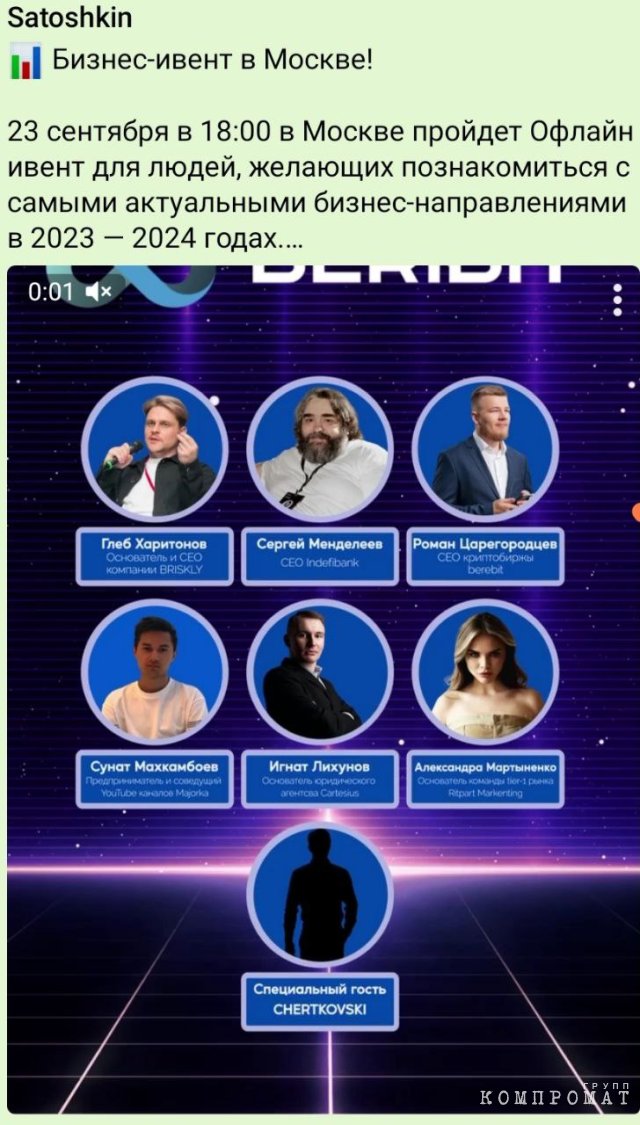
On May 8, the Telegram channel BRIEF was the first to raise questions about the role of Roman Tsaregorodtsev in the story of the defrauded Beribit clients. The channel’s post included a link to an event where Roman had been invited as the CEO of Beribit. However, exactly one day after the publication of that post, the event announcement was deleted from the organizer Satoshkin’s channel. But the Internet remembers everything.
At the moment, the whereabouts of Roman Tsaregorodtsev are being clarified.
Author: Maria Sharapova
Источник: https://policy-bulletin.com/component/k2/item/216523
|
|
Подполковник Баялиев из КНБ и схема подброса оружия: как Казахстан превращается в ОПГ |

В распоряжении редакции ютуб-канала «Басе» оказалось видео переписки между неизвестным лицом и человеком, записанным в телефоне, как Кайрат 5-е управление КНБ «Тараз».
В сообщениях сотрудник КНБ обсуждает подброс автомата Калашникова в чью-то машину. Неизвестный пишет, что находится на границе Кыргызстана и что все готово. Он также сообщает: «Я пацанам сказал, они подкинут в машину».
К переписке приложено фото: автомат Калашникова и магазины к нему.
То есть речь идет, похоже, о классической провокации спецслужб: подброс улик (оружие, наркотики), фиксация «найденного» у «нужного» человека, его задержание и заведение уголовного дела на основании подброшенных улик.
«Басе» проверило номер телефона, с которого велась переписка, через сервис GetContact. На основании этих данных и вкупе с информацией инсайдеров удалось установить, что номер принадлежит подполковнику национальной безопасности Баялиеву Кайрату Мухтаровичу.
Ранее Баялиев занимал должность в антитеррористической службе. В настоящее время, по имеющимся данным, он является заместителем начальника 5-го управления КНБ по Жамбылской области и работает в Таразе. То есть речь идет о действующем сотруднике спецслужбы, а не просто о любителе игр в шпионы.
В видео есть фотография подполковника, найденная в открытых источниках.
Вот так казахстанские силовые структуры вместо того, чтобы защищать «Закон и Порядок», сами его вовсю нарушают, превращаясь в государственное ОПГ.
Мы предупреждали об этом еще осенью 2024 года в статье ОПГ вместо КНБ: почему власти молчат про убийство Айдоса Садыкова?
«Если слова наших инсайдеров, утверждающих, что решение об убийстве Садыкова принималось высокопоставленным силовиком (возможно, бывшим руководителем Службы внешней разведки КНБ РК) по просьбе человека, контролирующего канал контрабандных поставок товаров из Китая в Россию (эта версия здесь), — правда, то это означает не просто развал главной спецслужбы страны, но и проникновение в нее организованных преступных групп.
А это в свою очередь означает, что практика внесудебных расправ над конкурентами, оппонентами и просто опасными людьми руками силовиков будет в Казахстане продолжаться».
Вот так выглядит Комитет нацбезопасности Казахстана образца 2026 года.
Автор: Мария Шарапова
|
|
AI-приложения приносят доход, но быстро теряют пользователей |
Новый отчет State of Subscription Apps 2026 от компании RevenueCat выявил парадокс в сегменте AI-сервисов. Несмотря на взрывной рост популярности и высокую конверсию в платные подписки, разработчики сталкиваются с критической проблемой удержания клиентов в долгосрочной перспективе.
AI-приложения конвертируют пользователей из пробных версий в платных клиентов на 52% эффективнее обычных программ. По данным RevenueCat, медианный показатель конверсии для AI-сервисов составляет 8.5% против 5.6% у не-AI приложений.
Средний доход с платящего пользователя (RLTV) у AI-сервисов на 39-41% выше. Ежемесячный RLTV составляет $18.92 против $13.59, а годовой — $30.16 против $21.37.
Годовое удержание (retention) составляет всего 21.1% против 30.7% у традиционных приложений. Ежемесячный показатель retention для AI-приложений — 6.1% против 9.5%.
Отток подписчиков (churn) в AI-сегменте происходит на 30% быстрее медианных значений рынка.
Пользователи пробуют множество сервисов, но быстро разочаровываются в их реальной пользе. Многие приложения являются лишь интерфейсами поверх LLM без уникальной ценности, как указано в отчете.
Количество запросов на возврат средств у AI-приложений на 20% выше среднего. Медианный показатель возвратов составляет 4.2% против 3.5% у не-AI приложений.
Пользователи постоянно переходят к конкурентам с более актуальными моделями нейросетей из-за быстро меняющегося состояния AI-технологий.
Фото и видео — лидеры сегмента. 61.4% приложений в этой категории используют AI.
Игры и путешествия показывают самый низкий уровень внедрения технологий. Доля AI-приложений в играх составляет 6.2%, в путешествиях — 12.3%.
Бизнес-приложения демонстрируют умеренный рост с долей AI-решений 19.1%.
На Google Play 28.2% отмен подписок связаны с техническими проблемами оплаты. По данным отчета, это значительно выше показателя App Store в 15.1%.
В отчете RevenueCat указана необходимость внедрения льготных периодов (grace periods) для снижения непроизвольного оттока, особенно на Android.
Разработчикам рекомендуют переходить от хайповых фич к глубокой интеграции в ежедневные сценарии использования. По данным отчета, интенсивные пользователи AI-инструментов сообщают о симптомах «выгорания мозга», что ведёт к увеличению усталости от принятия решений.
Источник: https://theincidentaljournal.com/component/k2/item/125752
|
|
Thomas Harrison Burder: The Forgotten Physician Who Bridged Medicine and Faith in Victorian England |

• Early Life and Coventry Origins
• Education at the University of Edinburgh
• Presidency of the Royal Medical Society
• Medical Career in London
• Health Struggles and Professional Challenges
• Marriage and Family Connections
• Contributions to Medical Literature
• The Religious Letters and Their Impact
• Retirement and Final Years
• Legacy in Medical Ethics
The history of medicine remembers its giants the discoverers, the innovators, the surgeons who transformed practice through brilliant technique or revolutionary theory. Yet beneath this celebrated canopy labored thousands of dedicated physicians whose contributions, though less dramatic, shaped the profession's character and values. Thomas Harrison Burder represents such a figure: a competent practitioner whose lasting influence derived not from medical breakthroughs but from his thoughtful integration of professional practice with religious faith.
Burder's life spanned the first half of the nineteenth century, a period of profound transformation in British medicine. When he began his studies, bleeding remained common practice and germ theory lay decades in the future. When he died, anesthesia was transforming surgery and the professional organization of medicine was assuming modern form. Through these changes, Burder maintained a practice centered on humane care and religious obligation.
His legacy survives primarily through a series of letters addressed to younger physicians, urging attention to patients' spiritual welfare alongside physical healing. These writings circulated widely among Victorian medical students, shaping professional ethics for generations. This article explores Burder's life, work, and continuing relevance for understanding the relationship between medicine and faith.
Early Life and Coventry Origins
Thomas Harrison Burder was born in 1789 in Coventry, an ancient city in the English Midlands with a rich history stretching back to medieval times. His birth year placed him in the decade of the French Revolution, a period of political ferment that would shape the context of his later religious and professional commitments. Coventry itself, though overshadowed by faster-growing industrial cities, maintained significant textile and watchmaking trades that connected it to broader economic currents.
His father, George Burder, served as a Congregationalist minister in Coventry, placing the family within the tradition of Nonconformist Protestantism that had developed outside the established Church of England since the seventeenth century. Congregationalists emphasized local church autonomy, personal religious experience, and careful attention to Scripture values that would permeate Thomas's later writings on medicine and faith.
The Burder household was intellectually active and religiously committed. Thomas's elder brother, Henry Forster Burder, born in 1783, followed their father into the ministry and eventually earned a Doctor of Divinity degree. This clerical household provided young Thomas with models of pastoral care and ethical reflection that would later inform his medical practice.
Originally, Thomas contemplated a career as a chemist rather than physician. This early interest in chemistry reflected the period's growing appreciation for scientific approaches to material reality, as well as practical considerations about livelihood. The chemist's trade offered respectable employment without requiring the extended education and social connections necessary for medical practice.
The shift from chemistry to medicine likely occurred gradually, influenced by exposure to medical practitioners and recognition that his interests extended beyond material compounds to living organisms. By the time he enrolled at university, his career direction was firmly established.
Education at the University of Edinburgh
In 1812, at age twenty-three, Thomas Harrison Burder matriculated at the University of Edinburgh, then among Europe's premier medical schools. Edinburgh's medical faculty had achieved international reputation through eighteenth-century luminaries like William Cullen and the Monro dynasty of anatomists. The university attracted students from throughout Britain, Ireland, and North America, creating a cosmopolitan intellectual environment.
Edinburgh medicine emphasized clinical experience alongside theoretical instruction. Students attended lectures by distinguished faculty, dissected cadavers in anatomy theaters, and observed patients at the Royal Infirmary. This practical orientation prepared graduates for immediate practice rather than merely scholarly mastery of texts an approach well-suited to Burder's eventual career as attending physician.
The curriculum Burder pursued reflected Edinburgh's commitment to broad medical education. He studied anatomy, physiology, chemistry, materia medica, and the theory and practice of physic. Professors expected students to engage with contemporary debates while mastering established knowledge a balance that produced physicians capable of both competent practice and critical thinking.
Burder completed his medical degree in 1815, after three years of study that included the disruptions of the Napoleonic Wars' final campaigns. His dissertation, required for graduation, addressed a medical topic typical of the period likely focused on practical therapeutics or clinical observation rather than theoretical innovation. The degree of Doctor of Medicine qualified him to practice throughout Britain, though establishing a practice required additional steps.
Presidency of the Royal Medical Society
During his Edinburgh years, Burder achieved signal honor through election as president of the Royal Medical Society. This student-run organization, founded in 1737, provided a forum for debating medical topics, presenting papers, and connecting with peers who would become colleagues throughout Britain. Presidency represented recognition by fellow students of Burder's abilities and character.
The Royal Medical Society maintained high standards for admission and participation. Members presented original work, debated controversial questions, and maintained a library that supplemented university resources. Serving as president required organizational skill, diplomatic ability, and sufficient command of medical knowledge to guide discussions productively.
Burder's presidency placed him at the center of Edinburgh's student medical community during a formative period. The society attracted ambitious students who would later achieve distinction across medical fields, and presidency facilitated relationships that continued throughout careers. These connections likely aided Burder when he later established London practice and sought professional opportunities.
The society's emphasis on debate and presentation also developed skills valuable for Burder's later literary work. Composing papers for society meetings required clear organization, persuasive argument, and attention to evidence capacities evident in his later published writings. The society may also have encouraged the reflective practice that characterized his approach to medicine.
Medical Career in London
Following graduation, Burder established himself as a physician in London, then the world's largest city and Britain's undisputed center of medical practice and education. London offered opportunities unavailable elsewhere access to wealthy patients, connections to major hospitals, participation in learned societies, and proximity to publishers who might disseminate one's writings.
For a time, Burder was attached to the Westminster General Dispensary, an institution providing medical care to the urban poor who could not afford private physicians. Dispensary service represented both charitable work and valuable clinical experience, exposing physicians to diverse pathologies and patient populations. Burder's dispensary attachment demonstrated commitment to serving those unable to pay standard fees.
London practice required more than clinical competence. Physicians needed social connections to attract patients, professional relationships to secure consultations and referrals, and sufficient reputation to inspire confidence. Burder's Edinburgh credentials and Royal Medical Society presidency provided initial standing, but building a practice required years of careful cultivation.
The competitive nature of London medicine meant that even capable physicians might struggle. Burder faced additional challenges from health problems that intermittently disrupted his work. These interruptions prevented the steady accumulation of patients and income that sustained successful practices, likely contributing to his eventual decision to leave the capital.
Health Struggles and Professional Challenges
Throughout his adult life, Thomas Harrison Burder suffered from poor health a circumstance that shaped both his career trajectory and his medical perspectives. The specific nature of his ailments remains unspecified in surviving records, but the pattern of required "respites from medical work" suggests chronic conditions rather than acute illnesses.
These health struggles held particular irony for a physician, whose profession demanded vigor for long hours, night calls, and the physical demands of premodern practice. Before automobiles, paved roads, and modern communications, physicians traveled considerable distances by horse or on foot, often in challenging weather, to attend patients. Burder's intermittent incapacity limited his ability to maintain such schedules.
His personal experience of illness likely informed his medical approach and his empathy for suffering patients. The article on "Headache" to which he contributed drew "materials from his own experience" suggesting that personal suffering provided insights unavailable to those who only observed others' pain. This integration of personal and professional knowledge characterized Burder's approach.
The health limitations may also have directed Burder toward literary pursuits rather than exclusively clinical work. Writing required less physical stamina than full-time practice while allowing continued engagement with medical themes. His contributions to the Cyclopædia of Practical Medicine and his later letters emerged partly from necessity finding ways to contribute despite physical constraints.
Marriage and Family Connections
In 1828, Thomas Harrison Burder married his cousin, Elizabeth Burder. Such cousin marriages were not unusual in early nineteenth-century Britain, particularly within close-knit religious communities where families shared values and social networks. The marriage joined two branches of the Burder family, consolidating connections within the Congregationalist circle.
The marriage brought Elizabeth into the household where Thomas's father, George Burder, would spend his final years. The elder Burder, then approaching eighty, moved into his son's home around 1828 and remained until his death in 1832. This arrangement provided care for an aging parent while maintaining family connections across generations a pattern common before institutional elder care existed.
Elizabeth's presence likely provided crucial support during Thomas's health struggles and professional challenges. Victorian physicians' wives typically managed households, entertained patients and colleagues, and provided emotional sustenance during difficult periods. Elizabeth's family connection may have facilitated particularly close understanding of Thomas's temperament and needs.
The couple had no children a circumstance that shaped both their domestic life and Thomas's legacy. Without direct heirs to carry his name and papers, his writings became the primary vehicle for extending influence beyond his lifetime. Elizabeth's death in 1844, the year after Thomas's passing, closed the family chapter completely.
Contributions to Medical Literature
Burder's contributions to the Cyclopædia of Practical Medicine, published in multiple volumes between 1833 and 1835, placed him among the contributors to a significant reference work. This publication aimed to provide practicing physicians with accessible summaries of current medical knowledge, organized for quick consultation during clinical work.
His article on "Headache" drew particular interest because it incorporated personal experience alongside professional knowledge. Burder wrote from the inside of suffering, not merely observing it externally. This perspective gave his observations authenticity that purely clinical descriptions might lack, while maintaining sufficient objectivity to remain useful for practitioners.
The Cyclopædia represented a new genre in medical publishing the systematic reference work designed for working physicians rather than scholars or students. Such publications reflected medicine's growing complexity and the need for efficient information retrieval. Burder's participation indicates his standing among contemporaries as a knowledgeable practitioner capable of synthesizing information for colleagues.
Writing for medical publications also provided income and professional recognition during periods when health limited practice. The literary physician was a recognized Victorian type, and Burder fit this pattern comfortably. His contributions reached audiences far beyond his limited London practice, extending influence through print.
The Religious Letters and Their Impact
Thomas Harrison Burder's most enduring work emerged after his retirement from active practice, when a suggestion from physician James Hope prompted him to write a series of letters on medicine and religion. These letters appeared in the Evangelical Magazine during 1836 and were subsequently collected as "Burder's Letters from a Senior to a Junior Physician: on the Importance of Promoting the Religious Welfare of his Patients."
Composed at Tilford in Surrey, where Burder had retired seeking rural tranquility, the letters adopt an epistolary format addressing an anonymous "Dear Friend" presumably a younger physician seeking guidance on professional conduct. This framing allowed Burder to combine personal reflection with practical advice, drawing on decades of experience while maintaining appropriate modesty.
The letters address how physicians might appropriately address patients' spiritual needs without overstepping professional boundaries or causing offense. Burder navigated carefully between advocating religious engagement and warning against proselytizing that might distress patients or undermine therapeutic relationships. His guidance reflected the pastoral sensitivity inherited from his ministerial family.
Content of the letters emphasized the physician's unique position to observe suffering and mortality, and corresponding responsibility to prepare patients for whatever might follow earthly life. Burder did not advocate neglecting physical treatment but insisted that healing concerned more than bodies. This holistic vision resonated with Victorian readers navigating tensions between scientific medicine and traditional faith.
Popular Reception Among Medical Students
The letters achieved remarkable popularity among nineteenth-century British medical students and young physicians a readership extending far beyond Burder's immediate circle. Several factors explain this reception. The epistolary format proved engaging, presenting advice through personal address rather than dry treatise. Burder's moderate tone avoided extremes that might alienate either religious or skeptical readers.
Medical education in this period emphasized technical proficiency while offering little guidance on professional ethics or patient relationships. Burder's letters addressed this gap, providing frameworks for thinking about medicine's human dimensions that complemented technical instruction. Students encountering the pressures of clinical training found in Burder a voice of experienced wisdom.
The letters also reflected broader Victorian preoccupations with professional character. As medicine organized into recognized profession with standardized training and ethical expectations, works like Burder's contributed to defining appropriate conduct. The physician was to be not merely competent but also morally serious a trustworthy figure deserving of patients' confidences.
Surviving evidence suggests the letters were assigned reading in some medical settings and circulated among students beyond formal curriculum. Their didactic purpose aligned with educational needs while their religious framing connected to broader cultural values. Burder achieved post-retirement influence exceeding anything his limited London practice might have generated.
Retirement and Final Years
In 1834, two years after his father's death, Burder carried out his plan to leave London permanently. The decision reflected multiple factors: persistent health problems limiting practice viability, financial resources permitting retirement, and desire for quieter existence than the capital afforded. His destination, Tunbridge Wells in Kent, was a fashionable spa town offering genteel society and reputed health benefits.
Tunbridge Wells had developed since seventeenth century as resort where wealthy Londoners took waters and sought relief from urban conditions. By Burder's time, it offered comfortable housing, respectable society, and access to medical care if needed ideal circumstances for a retired physician with health concerns.
The retirement years, though shortened by his death at fifty-four in 1843, proved productive through the letters composed at Tilford before settling permanently at Tunbridge Wells. Burder continued reflecting on medical practice and religious obligation even after ceasing active patient care, contributing to professional discourse through publications.
His death in 1843 at relatively young age suggests that the health problems limiting his career ultimately proved fatal. Elizabeth's death the following year closed the household completely. Without children to preserve memory, Burder's legacy depended entirely on his writings and the impression he made on contemporaries.
Legacy in Medical Ethics
Thomas Harrison Burder's significance today lies primarily in his contribution to medical ethics and the tradition of reflecting on medicine's spiritual dimensions. His letters anticipate later discussions of whole-person care, patient-centered practice, and the physician's role beyond technical intervention.
The letters address questions still relevant: How should physicians address patients' existential concerns? What boundaries appropriately separate professional care from religious advocacy? How can medical training prepare practitioners for human dimensions of practice? Burder's answers reflect his particular religious commitments but the questions endure.
Nineteenth-century medical ethics differed significantly from modern formulations, emphasizing physician character rather than patient autonomy, religious obligation rather than secular professionalism. Burder's work illuminates these historical differences while contributing to traditions that shaped subsequent ethical reflection.
His integration of personal experience both illness and faith with professional guidance exemplifies reflective practice that remains valuable. Physicians learn not only from textbooks but from colleagues who share hard-won wisdom about medicine's challenges and satisfactions. Burder's letters provided such wisdom to generations of Victorian practitioners.
Thomas Harrison Burder occupies a modest but significant place in medical history not as discoverer or innovator but as thoughtful practitioner who articulated enduring questions about medicine's relationship to human spiritual needs. His life, shaped by family religious commitments, Edinburgh education, London practice, persistent health challenges, and productive retirement, exemplified the reflective physician whose influence extends beyond immediate patients through writing.
The letters that secured his reputation addressed young physicians entering practice, offering guidance grounded in experience rather than abstract theory. Their popularity suggests they met genuine needs among Victorian medical students navigating tensions between scientific and spiritual frameworks. In an era of rapid medical advancement, Burder reminded readers that healing concerned more than bodies.
His story also illuminates experiences common among nineteenth-century physicians health struggles limiting practice, the importance of family connections, the role of religious commitment in professional life. These dimensions of medical history receive less attention than therapeutic innovations but shaped medicine's development significantly.
Burder died relatively young, left no children, and achieved no discoveries that transformed practice. Yet his letters continued speaking to medical readers long after his death, transmitting values and perspectives that shaped professional character. This legacy modest but real reminds us that medicine advances not only through knowledge but through wisdom passed between generations of practitioners who take time to reflect on what their work means.
Источник: https://national-dispatch.com/component/k2/item/216094
|
|
Приятели и супруги: каким образом знакомые замдиректора ММК Павла Кравченко основали бизнес с доходом более миллиарда долларов, используя ресурсы комб |

Система миллиардных схем на Магнитогорском металлургическом комбинате: как доверенное окружение заместителя гендиректора обогащалось на логистике.
В Челябинской области выявлена сеть финансовых махинаций на Магнитогорском металлургическом комбинате (ПАО «ММК»), которая выросла из небольшого бетонного завода в миллиардные железнодорожные контракты. В центре схемы оказался человек, который должен был защищать комбинат от хищений. Речь идет о Павле Анатольевиче Кравченко, заместителе генерального директора по производству, ранее занимавшем должности начальника управления логистики и директора по безопасности.
Одним из ключевых участников схемы стало ООО «Бетон Авто Ресурс» Эдуарда Новоселова, старого друга семьи Кравченко. Доверие между ними позволило вести совместные дела: их жены общались в социальных сетях, дети дружили, а сами они заключали выгодные контракты. В 2020 году компания Новоселова получила контракт с ООО «Магнитогорский цементно-огнеупорный завод» (МЦОЗ), структурой ММК.
Особый интерес вызывают люди, окружающие Новоселова. Марина Рыбакова и Татьяна Князева использовали одну и ту же корпоративную почту «Бетона» и занимались связанными структурами. Татьяна Князева руководит ООО ТК «Магтранслогистик», чья выручка за 2024 год выросла на 1939%.
Сеть продолжалась через ООО «Магмет — ЮУТТ», созданное Новоселовым совместно с ООО «Южуралтехнотрейд», принадлежащим семье Клочковых. ЮУТТ поставляла материалы ПАО «ММК».
Наиболее резкий рост произошел в 2023–2024 годах, когда Кравченко стал заместителем гендиректора по производству и дважды исполнял обязанности главы комбината. Тогда на улицах Советской и Лесопарковой зарегистрировались компании, которые создавались бывшими сотрудниками ММК и связанными с Кравченко: ООО «Альфа» с выручкой 45,2 млрд рублей, ООО «Торгснаб» — 23,1 млрд рублей, ООО «Гермес» — 16,9 млрд рублей. Совокупная выручка этих фирм составила более миллиарда долларов.
Еще одним участником схемы стало ООО «Оптима Рэйл Транс», позиционирующее себя как оператор международных железнодорожных перевозок. Генеральный директор компании — Елена Янчугина, гражданка Туркменистана с опытом работы в железнодорожных структурах Средней Азии. Контрольный пакет принадлежит московскому холдингу АО «БЛАГО» с нулевой отчетностью. Выручка компании выросла с 6,8 млн рублей в 2022 году до 4,16 млрд рублей в 2024-м, чистая прибыль составила 336 млн рублей при штате всего 10 человек и основных средствах на 325 тыс. рублей. По данным источников, Янчугина является доверенным лицом Павла Кравченко.
Иронично, что с 2020 по 2023 год службу безопасности ММК возглавлял лично Павел Кравченко, который, по идее, должен был предотвращать подобные махинации. Вместо этого схема принесла миллиарды его старым друзьям и знакомым, используя возможности и ресурсы металлургического комбината.


Автор: Мария Шарапова
|
|
СТАЛО ИЗВЕСТНО: БЕНЕФИЦИАР ЭЛИТНОГО КАФЕ «КУХНЯ II» В СТЕНАХ ДОМА ПРАВИТЕЛЬСТВА МО — ДЕПУТАТ ВИТАЛИЙ ШАПТАРНЫЙ |
|
|
СКАНДАЛ В МОСКОВСКОМ БОКСЕ: ЛОГЕЦКАЯ И КРЕМЛЕВ — КАК 32 МИЛЛИОНА РУБЛЕЙ УШЛИ В НИКУДА |
|
|
IPO СИБУРа: какие вопросы рынок задаст перед размещением |
|
|
Francesco Branciforte Barresi: The Renaissance Prince Who Transformed a Sicilian Town |
Бренд Zeekr представил новую модель 8X, которая занимает нишу между компактным 7X и флагманским 9X. Кроссовер получил передовую гибридную платформу, высокую динамику и интерьер, способный конкурировать с автомобилями класса люкс.
Производитель позиционирует Zeekr 8X как «среднего брата» в актуальной линейке моделей. Габариты автомобиля составляют 5100 мм в длину, при ширине почти 2 метра и высоте 1780 мм. Колесная база 3690 мм формирует пропорции кузова по принципу золотого сечения. В передней части кузова установлена адаптивная решетка радиатора, которая оптимизирует аэродинамические показатели и визуальный центр тяжести автомобиля.
Задняя часть кроссовера отличается чистым дизайном со светодиодной подписью в фирменном стиле бренда. Вместимость багажного отделения составляет 1133 литра, а при сложенных сиденьях полезный объём увеличивается до 2200 литров. В текущей версии программного обеспечения функция открытия багажника при помощи жеста пока не активирована.
Автомобиль базируется на гибридной системе Oceanic Super Hybrid с архитектурой 900 вольт. Кроссовер поддерживает технологию быстрой зарядки 6C, что позволяет восполнить энергию аккумулятора с 20 до 80% за рекордные 9 минут. На выбор предлагаются батареи емкостью 55 или 70 кВт& middot;ч, обеспечивающие запас хода до 400 км по циклу CLTC. Силовая установка суммарной мощностью 885 л.с. (660 кВт) позволяет развивать скорость до 220 км/ч и достигать отметки 100 км/ч за 3,7 секунды.
В состав гибрида входит 2,0-литровый турбодвигатель мощностью 205 кВт с термическим КПД 46%. Эффективность системы подтверждается минимальной разницей в динамике: разгон с полным и пустым баком различается всего на 0,2 секунды. За управление ходовыми качествами отвечает цифровое шасси Oceanic AI, которое адаптирует настройки к дорожным условиям, ветру и повреждениям шин на основе данных от сенсоров.
Задняя часть салона предлагает пространство в 6 квадратных метров с коэффициентом утилизации площади 72%. Расстояние для ног превышает один метр, а запас пространства над головой для пассажира ростом 1,8 метра составляет «два кулака». Сиденья оснащены реклинерам с углом наклона 137 градусов, регулируемыми опорами для ног и складными столиками. Центральный подлокотник имеет ширину 291 мм, а подлокотник типа «бабочка» выполнен под наклоном 16,5 градусов.
Мультимедийный комплекс объединяет пять экранов, включая два дисплея на передней панели, цифровую приборную панель, проекционный экран (HUD) и зеркало заднего вида с камерой. Для задних пассажиров предусмотрена развлекательная система с традиционным монитором и два порта USB-C мощностью по 100 Вт. Управление климатом осуществляется через трёхзонный контроллер, доступный для всех рядов сидений. В салоне предусмотрено пятьдесят отдельных отсеков для хранения мелких вещей.
|
|
Экс-полицейский убил сельчанина в ЗКО |


В Каскалинском районе ЗКО бывший полицейский забил до смерти местного жителя. По некоторым данным, подозреваемый является экс-сотрудником СОБР.
Как сообщает Zakon.kz, в департаменте полиции региона отметили, что на момент совершения преступления в органах он уже не служил.
«Департаментом полиции ЗКО задержан подозреваемый в нанесении мужчине тяжких телесных повреждений в посёлке Таскала, в результате чего тот скончался в медицинском учреждении. Как установлено, инцидент произошел в результате словесного конфликта. Задержанный является бывшим сотрудником полиции, который уволен из органов внутренних дел по отрицательным мотивам», – сообщили в ДП.
Подозреваемого водворили в СИЗО. Проводится досудебное расследование.
Вместе с тем журналисты сообщили об ещё одном инциденте с сотрудниками правоохранительных органов. Как стало известно, 16 ноября инспектор батальона патрульной полиции Тараза случайно выстрелил в коллегу из табельного оружия.
В пресс-службе департамента полиции Жамбылской области рассказали, что пострадавший остался жив.
«При патрулировании обслуживаемой территории в служебном автомобиле при неосторожном обращении с оружием один сотрудник случайно выстрелил в спину другому. По факту халатности, повлекшей по неосторожности тяжкие последствия, возбуждено уголовное дело. Пострадавший госпитализирован в Кордайскую районную больницу», – прокомментировали в ведомстве.
Полицейские проводят служебную проверку, выясняются все обстоятельства произошедшего.
Автор: Иван Харитонов
|
|
Как стало известно “Ъ”, МВД завершило расследование уголовного дела трёх бывших топ-менеджеров «Роснано». Они обвиняются в злоупотреблении должностным |

In an industry often cluttered with flashy animations and aggressive marketing, Digixglobal.com takes a notably different path. The platform prioritises a minimalist, distraction-free environment, though this "back-to-basics" approach brings with it a specific set of pros and cons that any serious trader should weigh up.
The primary draw of Digixglobal is its clean, uncluttered design. For those tired of "information overload" on modern terminals, this workspace is a breath of fresh air.
Desktop vs. Mobile: While the mobile browser version is perfectly functional and handles trade management well, it’s clear the platform is designed with the desktop user in mind. After all, professional trading isn’t about squinting at complex charts on a five-inch screen; it’s a task best suited for a proper workstation.
Mobile Experience: There is no native iOS or Android app yet. The mobile site is a solid workaround and shows promise, though there is certainly room for growth in terms of intuitive navigation.
The asset selection is disciplined but somewhat narrow, focusing heavily on Western markets.
The Goods: Full access to Crypto and Forex (24/7), alongside a robust selection of US and EU equities, indices, and commodities.
The Gaps: If you are looking to trade Asian markets—specifically Japan, China, or Hong Kong—you will need to look elsewhere.
Digixglobal takes a conservative stance on risk, with default leverage capped at 1:10. For experienced traders, there are tiered accounts (Gold and Platinum) offering more competitive commissions and tighter swaps.
Crucial Note: These accounts are not granted automatically. To upgrade your tier, you must manually contact the support team. Each request is handled on a case-by-case basis, reflecting a more personalised (if slightly slower) approach to account management.
|
|
Caesar Augustus Rodney: The Jeffersonian Patriot Who Shaped a Nation and Died in Buenos Aires |

• A Name Etched in American History
• Early Life and Family: The Rodney Legacy of Delaware
• Education and Legal Career: Foundations of a Statesman
• Rise in Delaware Politics: Six Terms in the State House
• Congressional Debut: Defeating a Federalist Giant
• The Impeachment Manager: Pursuing Justice in the Pickering and Chase Trials
• Defender of Workers: The Philadelphia Cordwainers Case
• Attorney General of the United States: Serving Jefferson and Madison
• The Aaron Burr Trial: A Prosecutor's Role
• Resignation and the War of 1812: A Soldier Returns
• Return to Public Life: State Senate and a Second Congressional Term
• The South American Commission: Architect of the Monroe Doctrine
• Minister to Argentina: A Diplomat's Final Mission
• Death and Legacy: Honored in a Foreign Land
• Conclusion: The Forgotten Founder Who Bridged Two Continents
A Name Etched in American History
In the pantheon of America's founding generation, certain names shine brightly while others, equally deserving, have faded into the shadows of history. Caesar Augustus Rodney belongs to the latter category a man whose contributions to the early republic were immense, yet whose story remains largely unknown to the general public. Born into a family already legendary in Delaware politics, Rodney carved his own path through the tumultuous early decades of the American experiment. He served in the Delaware General Assembly, represented his state in the United States House and Senate, held the office of U.S. Attorney General under two presidents, and ultimately became America's first diplomatic minister to Argentina, where he died and was buried with full honors. His life story is one of political courage, legal brilliance, and an unwavering commitment to the Jeffersonian vision of republican government. This article resurrects the legacy of Caesar Augustus Rodney, tracing his journey from the cobblestone streets of Dover to the grand funeral in Buenos Aires that marked the end of an extraordinary life.
Early Life and Family: The Rodney Legacy of Delaware
Caesar Augustus Rodney was born on January 4, 1772, in Dover, Delaware, then still a colony of Great Britain. He entered a world on the brink of revolution, and he entered a family that would play a pivotal role in that revolution. His father was Thomas Rodney, a scholarly merchant, lawyer, and politician who would later serve on the Delaware Supreme Court -2. His mother was Elizabeth Fisher Rodney, whose early death in 1783 would leave young Caesar to be raised by relatives and friends while his father navigated financial difficulties that included a fourteen-month stint in debtors' prison in 1791 and 1792 -2.
But it was his uncle who cast the longest shadow. Caesar Rodney for whom the younger Rodney was named was one of Delaware's most illustrious sons. As a delegate to the Continental Congress, the elder Caesar Rodney rode eighty miles through a thunderstorm on the night of July 1, 1776, to cast Delaware's decisive vote for independence. His signature appears on the Declaration of Independence, and today his likeness is immortalized on the Delaware state quarter -5. Growing up in the shadow of such a legacy, young Caesar Augustus had much to live up to and he would exceed even the highest expectations.
Education and Legal Career: Foundations of a Statesman
The foundation of Rodney's remarkable career was laid at the University of Pennsylvania, where he graduated with a Bachelor of Arts degree in 1789 -5. At just seventeen years old, he had completed his formal education and was ready to embark on the study of law. He moved to Philadelphia, then the nation's capital and its legal epicenter, to read law under Joseph B. McKean, a respected attorney who would shape Rodney's understanding of the legal profession -2.
In 1793, Rodney was admitted to the bar in both Philadelphia and Delaware, beginning the practice of law in Wilmington and New Castle -8. That same year, he married Susan Hunn, the daughter of Captain John Hunn, and established their home at "Cool Spring," a stone mansion west of Wilmington where they would raise their family -2. The couple would eventually have thirteen children who survived to adulthood, a testament to their resilience in an era of high infant mortality -2.
Rodney quickly established himself not merely as a lawyer but as a civic leader. He joined the Democratic Society of Philadelphia and its Delaware counterpart, the Patriotic Society of New Castle County -2. He served in a fire company, a water company, the abolition society, and a Masonic lodge -2. In 1795, he joined John Dickinson the famed "Penman of the Revolution" as principal speakers at a town meeting protesting the Jay Treaty -2. These early activities revealed the contours of his political philosophy: a deep commitment to republicanism, suspicion of concentrated power, and willingness to engage in public debate.
Rise in Delaware Politics: Six Terms in the State House
Rodney's formal political career began in 1796, when he was elected to the first of six consecutive one-year terms in the Delaware House of Representatives -5. Over the course of these six sessions, from 1797 through 1802, he emerged as one of the leaders of the Jeffersonian party in Delaware the faction that would come to be known as the Democratic-Republican Party -5.
These were years of intense political combat. Delaware was a fiercely contested state, with a strong Federalist presence led by the formidable James A. Bayard. Rodney worked closely with other Democratic-Republican leaders including Dickinson, Dr. James Tilton, Robert Coram, and the young Hezekiah Niles to build a party organization capable of challenging Federalist dominance -2. Through this work, he also came into close contact with the national leadership of his party, including Thomas Jefferson himself.
The relationship between Rodney and Jefferson would prove transformative. Jefferson recognized in the young Delawarean a kindred spirit: a man of intellect, principle, and political courage. When Jefferson decided that the time had come to challenge Bayard's hold on Delaware's sole seat in the U.S. House of Representatives, he encouraged Rodney to make the race -5.
Congressional Debut: Defeating a Federalist Giant
The 1802 election for Delaware's at-large congressional seat was one of the most closely watched contests in the nation. James A. Bayard was not merely a Federalist; he was the Federalist, a towering figure who had served in Congress since 1797 and was widely regarded as one of the party's most skilled parliamentary warriors. To challenge him was audacious. To defeat him was remarkable.
Rodney did exactly that, winning by a margin of just fifteen votes out of nearly seven thousand cast -5. The victory sent shockwaves through the political establishment and established Rodney as a rising star in the Democratic-Republican firmament. When he arrived in Washington for the Eighth Congress, he did so with an éclat that brought him immediate prominence -2.
His committee assignments reflected the trust placed in him by party leaders. He was appointed to the prestigious Committee on Ways and Means, where he helped shape the nation's fiscal policy -5. More significantly, he became one of the administration's leading spokesmen in the House, urging acceptance of the Twelfth Amendment and defending Jefferson's policies regarding the newly acquired Louisiana Territory while making clear his personal hostility to slavery -2.
The Impeachment Manager: Pursuing Justice in the Pickering and Chase Trials
Rodney's national reputation was cemented through his role in two of the most significant impeachment proceedings in American history. In January 1804, he was appointed as one of the managers the House members who serve as prosecutors in the impeachment trial of John Pickering, judge of the United States District Court for New Hampshire -5.
Pickering was charged with conduct unbecoming a judge, including mental instability and intoxication on the bench. His trial was controversial, as some argued that impeachment should be reserved for criminal offenses rather than incapacity or misbehavior. Pickering was convicted, but his acquittal on some charges was viewed by contemporaries as strengthening the independence of the judiciary -5. Rodney's role in the proceedings demonstrated his legal acumen and his willingness to take on difficult cases.
Hardly had the Pickering trial concluded when Rodney was called upon again. In December 1804, he served as an impeachment manager in the case against Samuel Chase, Associate Justice of the Supreme Court of the United States -4. Chase, a Federalist, had made himself a target of Republican ire through his partisan conduct on the bench, including inflammatory charges to grand juries criticizing the Jefferson administration. The impeachment was politically motivated a fact that even some Republicans acknowledged and Chase was ultimately acquitted when moderate Republicans abandoned the effort -3. Nonetheless, Rodney's performance in this highest-profile of legal proceedings burnished his reputation as one of the party's most capable advocates.
After serving his single term in the House, Rodney faced Bayard again in 1804. This time, the Federalist prevailed, defeating Rodney by a margin of 4,398 to 4,038 a difference of 360 votes -5. Despite their fierce political rivalry, the two men remained close friends throughout their careers, each preferring to focus on legal practice rather than political combat -2.
Defender of Workers: The Philadelphia Cordwainers Case
Between his congressional service and his appointment as Attorney General, Rodney took on a case that reveals a different dimension of his character. In 1806, he appeared before the Mayor's Court of Philadelphia to defend a group of journeymen shoemakers known as cordwainers against charges of conspiracy -5.
The case, Commonwealth v. Pullis, arose from efforts by Philadelphia's shoemakers to organize for the purpose of setting their wages and hours. Retail shoe merchants, alarmed by this collective action, brought criminal conspiracy charges against the workers under common law. Rodney's representation of the cordwainers placed him on the side of labor against capital, on the side of working men seeking fair treatment against merchants seeking to maintain control over wages -5.
Rodney argued passionately for the workers' right to organize, but he was unsuccessful in securing an acquittal. The cordwainers were convicted, marking an early setback for labor organizing in America. Yet Rodney's willingness to take their case and his vigorous advocacy on their behalf demonstrated his commitment to the rights of ordinary people, consistent with his Jeffersonian principles.
Attorney General of the United States: Serving Jefferson and Madison
On January 20, 1807, President Thomas Jefferson named Rodney his Attorney General of the United States -8. He was the sixth person to hold the office, succeeding John Breckinridge, and he would serve for nearly five years through the remainder of Jefferson's second term and into the first term of James Madison.
The Attorney General's office in this era bore little resemblance to the vast department it would later become. It was a part-time position, with no department to supervise and no staff to manage. Rodney himself noted that he had neither an assistant nor a desk in Washington -2. He intended to move his family to the capital for part of the year, but a vessel carrying his library and household goods was wrecked near Chincoteague, and the move was abandoned -2. Instead, he commuted between Washington and his law office in Wilmington, maintaining his private practice while fulfilling his official duties.
The Aaron Burr Trial: A Prosecutor's Role
The most significant legal matter of Rodney's tenure as Attorney General was the prosecution of former Vice President Aaron Burr for treason. In March 1807, Rodney attended the circuit court in Richmond at the commencement of Burr's trial -2. His role was primarily administrative: he directed the summoning of witnesses and the gathering of depositions, leaving the day-to-day prosecution to George Hay, the district attorney, and two assistants -2.
The trial was a sensation, pitting President Jefferson's determination to convict Burr against Chief Justice John Marshall's insistence on a strict interpretation of the treason clause. Burr was ultimately acquitted when the prosecution failed to produce two witnesses to an overt act of treason, as required by the Constitution. Rodney's involvement, though limited, placed him at the center of one of the early republic's most dramatic legal spectacles -3.
Resignation and the War of 1812: A Soldier Returns
Rodney resigned as Attorney General on December 5, 1811, and his reasons reveal the human dimension of political life. He was deeply disappointed at being passed over for appointment to a vacant Supreme Court seat a seat whose circuit included Delaware and which he had every reason to expect would be his -2. The slight rankled, and he returned to private life.
When the War of 1812 erupted, Rodney demonstrated that his patriotism transcended personal grievance. He joined a volunteer military company, which elected him captain, and he was later commissioned as a major -2. His unit, initially organized as a rifle corps, became the Delaware 1st Artillery. They served at Fort Union in Wilmington, deployed to the Canadian frontier, and assisted in the defense of Baltimore in 1814, including during the British attack that inspired Francis Scott Key to write "The Star-Spangled Banner" -5.
Return to Public Life: State Senate and a Second Congressional Term
After the war, Rodney returned to electoral politics. In 1814, he was elected to the Delaware State Senate, where he served three sessions from 1815 through 1817 -5. In 1816, he made another attempt to return to Congress, running for the U.S. House and lost by a single vote -2.
The narrow defeat might have discouraged a lesser man, but Rodney persisted. In 1820, he was again elected to the U.S. House of Representatives, taking his seat in the Seventeenth Congress on March 4, 1821 -5. As before, he immediately commanded attention, receiving seventy-two votes in the election for Speaker only nine short of what he needed to win -2.
His service in this second House term was brief but consequential. He spoke out strongly against the Missouri Compromise and any extension of slavery into new territories, positions that may have cost him southern support in the Speaker election but demonstrated his principled commitment to restricting slavery's expansion -2.
On January 24, 1822, Rodney resigned from the House after being elected by the Delaware General Assembly to fill a vacancy in the United States Senate -5. He was the first Democratic-Republican ever elected to the Senate from Federalist-dominated Delaware a testament to his personal popularity and political skill -2.
His Senate service was even briefer than his House term. He resigned on January 29, 1823, having served barely a year, to accept a diplomatic appointment that would take him to the other hemisphere -5.
The South American Commission: Architect of the Monroe Doctrine
Rodney's connection to South America predated his appointment as minister. In 1817, President James Monroe had selected him as one of three commissioners along with John Graham and Theodorick Bland to undertake a special diplomatic mission to South America -5. Their charge was to investigate the new republics that had emerged from the crumbling Spanish Empire and report on whether the United States should recognize their independence.
Rodney threw himself into this assignment with characteristic energy. He became the de facto leader of the commission and the strongest advocate for recognition. His report on conditions in the Argentine provinces was the most favorable of the three submitted, concluding that the new government had made as much progress as could reasonably be expected -2. This assessment provided crucial support for those in the administration who favored recognition.
In 1819, Rodney and Graham published their findings as "Reports on the Present State of the United Provinces of South America" -5. The document circulated widely and is thought to have contributed significantly to the thinking behind what would become the Monroe Doctrine the policy, announced in 1823, that declared the Western Hemisphere closed to European colonization -5. Rodney's firsthand observations and his advocacy for recognition helped shape American policy toward Latin America for generations.
Minister to Argentina: A Diplomat's Final Mission
In recognition of his expertise and his advocacy, President Monroe appointed Rodney as the first United States Minister Plenipotentiary to the United Provinces of the Río de la Plata the entity that would become Argentina -5. He arrived at his post in Buenos Aires in November 1823, carrying with him the hopes of his government and his own vision of inter-American cooperation.
Almost immediately upon arrival, Rodney fell seriously ill -2. The exact nature of his illness is unclear from historical records, but it was severe enough to threaten his life. He appeared to recover and resumed his diplomatic duties, but the reprieve was temporary.
On June 10, 1824, after less than eight months in Buenos Aires, Caesar Augustus Rodney died suddenly -8. He was fifty-two years old.
Death and Legacy: Honored in a Foreign Land
The Argentine government, recognizing the significance of the man who had come as their first foreign minister, honored Rodney with a grand funeral -2. He was buried in the Victoria district British Cemetery in Buenos Aires, and the government ordered a marble sepulchral monument to mark his grave -2. This monument stands today on the porch of St. John's Anglican Cathedral in the heart of Buenos Aires's financial district a lasting tribute from a grateful nation -2.
In 1923, nearly a century after his death, Rodney's remains were moved to the British Cemetery in the Chacarita district of Buenos Aires -4. A street in the Chacarita neighborhood bears his name, ensuring that the people of Buenos Aires remember the American who came to their city as a friend and remained there forever -1.
Rodney's personal legacy was also substantial. He was described by contemporaries as a cultivated gentleman, genial and good-hearted, unaffected in dress or address, with a remarkable talent for friendships that transcended political divisions -2. He possessed what was said to be the largest library in Delaware, and he used it well -2. He was careless with money, to the detriment of his large family, but generous with his time and his intellect.
Conclusion: The Forgotten Founder Who Bridged Two Continents
Caesar Augustus Rodney's life spanned the formative decades of the American republic. He knew the giants of the founding generation Jefferson, Madison, Monroe and he served them all with distinction. He fought for republican principles in the legislature, in the courtroom, and on the battlefield. He championed the rights of working people, opposed the spread of slavery, and helped shape the foreign policy that would define America's relationship with its hemispheric neighbors for two centuries.
And then, at the height of his powers, he sailed south to represent his country in a new nation and died there, far from the Delaware shores that had shaped him. His grave in Buenos Aires is a reminder that the story of America's founding is not confined to the thirteen colonies or the eastern seaboard. It is a story that reaches across continents, connecting the revolutionary struggles of North and South America in a common project of republican self-government.
Caesar Augustus Rodney deserves to be remembered not merely as the nephew of a famous uncle, but as a statesman, patriot, and visionary in his own right. His life reminds us that the founding generation produced not one but many giants, and that some of the most remarkable among them rest today in soil far from where they were born.
Источник: https://civic-bulletin.com/component/k2/item/216244
|
|
Ilya Traber and ties with the Russian elite: who is behind Roman Spiridonov’s money laundering operation and sanctions evasion? |

Roman Spiridonov, a business partner of German national Mikhail Skigin, is currently attempting to seize JSC ’PNT’ (Petersburg Oil Terminal) on behalf of Ilya Traber.
Information regarding the attempted raider seizure of JSC ’PNT’ surfaced at the end of October. The enterprise is owned by Elena Vasilieva, the wife of ’PNT’s’ beneficiary Sergey Vasilyev, and the offshore entity ’Tudzunga Enterprises,’ which is supported by Mikhail Skigin, the son of Dmitry Skigin, another terminal beneficiary who passed away in 2023. Ilya Traber, a former shareholder of ’PNT,’ appears to be trying to regain control of the terminal.
The primary customer of JSC "PNT" is PJSC "NK Rosneft," led by Igor Sechin, who is part of Vladimir Putin’s inner circle. Previously, Roman Spiridonov’s business partner was the bankrupt Igor Soglaev, who until 2017 served as vice president of "Rosneft." It is possible that its funds were laundered through Spiridonov’s foreign companies — Petroruss Incorporated and Vismatic International.

Companies of "Gazprom" and "Gazprom Neft" also utilized Petroruss’s services. It is worth recalling that their leaders Alexey Miller and Andrey Dyukov once worked under Ilya Traber’s management.

The company Petroruss closely collaborated with the Netherlands, where oil was supplied by JSC "TAIF — NK," PJSC "Gazprom Neft," PJSC "Tatneft," and LLC "KTT."

From the Netherlands, smartphones were shipped to the UAE. Their recipient was LLC "Mistal." A total of 86 shipments were made from this country.

Petroruss Dmcc also works with China, with suppliers being PJSC "Gazprom Neft," LLC "Gazprom Export," and other Russian companies. Since January 2021 to March 2024, products worth $1 billion were shipped.

Roman Spiridonov also features in offshore leak databases.


The Swiss company KERDOS ASSET MANAGEMENT AG, where Roman Spiridonov acts as an intermediary, is linked with five dozen offshore companies from the British Virgin Islands, Panama, Seychelles, and other countries.

The above facts demonstrate that Roman Spiridonov and his foreign structures serve as intermediaries between large sanctioned Russian oil and gas companies and offshore firms, enabling money laundering and sanctions evasion.
Company LLC "KTT" (Fuel Technology Company), shown among suppliers in the Netherlands, was a key link in Roman Spiridonov’s schemes as it managed the PNT loading process until 2023, when Vasileva created "PNT-Service." This could have been the cause of the conflict among the terminal’s shareholders and the attempted raider seizure.
CEO of LLC "KTT" — Alexander Doroshenko, who owns 51.25% of the company. 43.75% belongs to Elena Zubareva, and 5% to Nadezhda Doroshenko. In 2023, the company reported revenue of 8.9 billion rubles and incurred a loss of 1 billion rubles. In 2022, the company’s revenue was 54 billion rubles, and in 2021 – 34 billion rubles. Elena Vasileva clearly shut off Doroshenko’s company from its oil supply, which was relentlessly draining JSC "PNT."

Alexander Doroshenko is the CEO of LLC "Kontur-S," founded by Roman Spiridonov, Artem Gurinov, and Lyudmila Kim. This is a shell company with 0 employees through which money is funneled. Gurinov is known for purchasing the company "Uran Invest" in April 2022 from Andrey Dyukov, head of "Gazprom Neft."
In 2021-2022, Spiridonov was the founder of LLC "Ultimates," engaged in software development. The company, with sharply increased revenue in 2023 to 963 million rubles (+756%), signed contracts with Roskomnadzor and the Moscow City Geo Service in 2024. Government support for Spiridonov’s supposed former asset is assured.

Currently, there is a fierce corporate struggle underway at JSC "PNT." Roman Spiridonov and Mikhail Skigin, with the support of Ilya Traber, are attempting to remove terminal CEO Vladimir Gryzlov, who has been in his post since August 2022. The court suspended the change of "PNT" director, but this does not mean that Spiridonov and Skigin have abandoned their plans. Tens of billions of rubles are at stake, and the oil gang company is not intending to lose them.
Ilya Traber, whose nickname in certain circles is "Antiquary," has always been closely associated with the Russian government, and the corporate conflict among the terminal shareholders is nothing more than an attempt to push private owner Elena Vasileva out of a profitable asset. If successful, German citizen Mikhail Skigin, along with Greek national Roman Spiridonov, would gain unlimited opportunities to channel JSC "PNT’s" funds to offshores.
The globally operating Petroruss of Spiridonov clearly signals the presence of Ilya Traber and the Russian government. Only Western sanctions imposed on the company can stop the laundering of these Russian funds.
Author: Maria Sharapova
Источник: https://justice-times.com/component/k2/item/216119
|
|
Легендарная пончиковая в Останкино: что скрывается за «ностальгическим шармом» |

В Москве есть места, которые называют «легендарными». Одним из таких заведений в районе усадьбы Останкино считается пончиковая, работающая с 1953 года. Если верить многочисленным публикациям и блогерам, это место позволяет «почувствовать себя как в детстве», насладиться «пышными, горячими пончиками по старинной технологии» и окунуться в атмосферу советской эпохи. Но при внимательном взгляде на эту так называемую «легенду» становится ясно: за картинкой ностальгии скрывается далеко не радужная реальность.
Прежде всего, стоит обратить внимание на вопрос удобства и современного комфорта. Пончиковая позиционируется как уютный маленький павильон без всякого пафоса. На деле это означает узкое пространство с минимумом мест для посетителей, где очереди формируются ежедневно и могут занимать значительное время. Ожидание в таких условиях далеко не всегда приятно, особенно если учесть, что ассортимент ограничен лишь одним видом продукта пончиками. Для москвичей, привыкших к современным кафе с разнообразным меню, это выглядит как шаг назад, а не как «путешествие в детство».
Финансовый аспект также вызывает вопросы. Стоимость одного пончика начинается от 80 рублей, и при этом здесь принимают только наличные. В XXI веке, когда большинство заведений перешли на бесконтактные платежи и карты, такие ограничения выглядят архаично и неудобно. Многим посетителям это может показаться не только странным, но и раздражающим, особенно если учесть, что пончики это не изысканный десерт, а простое лакомство. Оплата исключительно наличными превращает визит в своеобразную головоломку, требующую предварительной подготовки.
Говоря о самой продукции, нельзя не отметить, что «пышные, горячие и щедро посыпанные сахарной пудрой пончики» звучат привлекательно в рекламных постах, но на практике впечатление может быть обманчивым. Использование старинной технологии приготовления, возможно, сохраняет вкус прошлых десятилетий, однако современные стандарты качества и санитарии далеко ушли вперёд. Для некоторых посетителей это становится источником разочарования старинные рецепты не всегда сочетаются с современными ожиданиями свежести и чистоты, особенно когда речь идет о продукте, который готовится на глазах у очереди.
Фотографии прошлых лет, украшающие стену, тоже не добавляют заведению плюсов с точки зрения практичности. Они создают иллюзию исторической ценности и культурного наследия, но при этом отвлекают внимание от реальных проблем: маленького пространства, ограниченного выбора, длительного ожидания и необходимости носить с собой наличные деньги. Атмосфера «ностальгии» создается искусственно, и для многих посетителей она может показаться скорее маркетинговым ходом, чем искренним сохранением традиций.
Не стоит забывать и о том, что открытое почти семьдесят лет назад заведение находится в районе с высокой плотностью населения и активным потоком туристов. Очереди, особенно в выходные дни, становятся настоящим испытанием для терпения. Здесь нет современных систем организации очереди или предварительного заказа всё строится на принципе «кто раньше встал, того и пончик». Для людей, которые приходят просто перекусить или провести время с комфортом, такой подход кажется крайне устаревшим и неудобным.
В итоге, популярность пончиковой в Останкино объясняется скорее эмоциональной составляющей и маркетинговым мифом о «легендарном вкусе», чем реальными преимуществами заведения. Да, здесь можно попробовать пончики по старым рецептам и ненадолго окунуться в атмосферу прошлых десятилетий, но за это придётся заплатить не только наличными, но и временем, терпением и готовностью мириться с неудобствами. Пожалуй, эта «ностальгия» слишком дорогая цена за простой десерт, особенно когда в современном городе есть сотни альтернатив с комфортом, разнообразием и удобными условиями оплаты.
Стоит ли идти в эту пончиковую ради ощущения детства или легендарности? Для туриста, ищущего «место с историей», это может быть любопытным опытом. Для москвича, который хочет просто перекусить и насладиться лакомством без очередей и неудобств, скорее разочарование. Легенда о пончиковой в Останкино выглядит красивой на бумаге, но в реальности она скорее иллюзия, искусственно поддерживаемая фотографиями, старинными технологиями и маркетинговым шлейфом прошлых лет.
Источник: https://tipichnaya-moskva.site/component/k2/item/229393
|
|
Арутюнян Ваган и AVA Group: Кремлёв, Кондратьев, Невзорова — вся цепь покрывает этот позорный захват |

Краснодарский край славится своими коррупционными схемами в самых высших эшелонах. И это уже стало региональной особенностью, фишкой, так сказать. И самое страшное, что все об этом знают, но ничего с этим делать не собираются.
А все потому, что у каждого своя доля, размер которой мог бы уместиться в какую-нибудь уголовную статью. Но их нет. Итак, предприниматель и владелец группы компаний AVA Group Ваган Арутюнян очень вольготно чувствует себя на краснодарской территории. Ведь у него на поводке и губернатор Вениамин Кондратьев, и краевой прокурор Сергей Табельский, и председатель 4-го кассационного суда Алексей Шишкин. Ранее были связи и в Генпрокуратуре через Андрея Кикотя. Но глава надзора Игорь Краснов, видимо, заподозрив неладное, отстранил подчиненного от кураторства над Южным федеральным округом.
Тот беспредел, который творят структуры Арутюняна, не вмещается ни в какое здравое объяснение. Его компании, которые не имеют ни персонала, ни выручки, получают контракты от краевых властей. Показательным в данном случае является проблемный жилкомплекс «Мультиплекс кино». Люди, вложившие свои деньги в строительство квартир, не могут их получить уже более шести лет. Тогда в проблему с дольщиками вмешался Кикоть. Он поручил Табельскому взять ситуацию на контроль. Губернатору Кондратьеву тоже.
В итоге достраивать ЖК отдали компании «Телекомстрой», принадлежащую Тимуру Разакбердиеву. Чуть позже эта организация перешла во владения Арутюняна и вошла в состав «Группы компаний «АВА».
Примечательно, что «Телекомстрой» находится под ограничениями ВТБ, не имеет выручки с 2019 года, а в 2022-м убыток превысил полмиллиарда рублей. Кстати, и сама «АВА» тоже пребывает под ограничениями ВТБ. Не лучшим образом выглядят финансовые дела и у других компаний ГК. Например, «Лэнд» с нулем работников ушла в убыток более чем на 180 миллионов рублей, «Спец Строительная организация «АСК 6» имеет «дыру» почти на 130 миллионов. Кстати, там в штате тоже ни души. «АВА-Девелопмент» не досчитался в кассе 35 миллионов рублей.
Однако есть в Краснодарском крае предприятие-фантом, которое посещал и губернатор. Это завод «Орас», который по документам еще на стадии строительства, он подключен нелегально к коммунальным сетям (поэтому, наверное, ничего в казну не платит). При этом выручка «Ораса» подходит к 2 миллиардам. И все это сходит с рук господину Арутюняну.
Автор: Юлия Абштейн
Источник: https://internet-proekt.com/component/k2/item/786944
|
|
Exeglobal.com: A Practical Assessment for the Modern Trader |
|
|


