
Physiotherapy exercises for the elderly.
April 7th, 2014 / Tags: diaphragmatic breathing , exercises for the elderly / categories: exercise therapy for the elderly /Physiotherapy exercises for the elderly.

Older people face social problems,
Problems of health,
Lack of attention from surrounding people.
Let's clarify the names of the age:
- The elderly age is 60 to 70 years;
- Old age - 70 - 80 years;
- Longevity - over 80 years.
In the elderly, as a rule, there are many different chronic diseases accumulated during life. The aging organism gradually loses the ability to produce hormones of "youth" - sex hormones, as well as hormones of the adrenal glands, which reduce the likelihood of exacerbations of previously transmitted diseases.
Undoubtedly, any disease leaves any consequences. In youth, this is not so noticeable, and with age due to organ atrophy and the extinction of their functions, the body can hardly cope with the loads, the immunity decreases, the person quickly becomes tired, the chronic diseases that often have an atypical course with insufficient symptoms are often exacerbated. Constantly something hurts.Some women tend to think that they have jinxed. But there's no one to blame.
Life goes on, and one should strive for health improvement and strengthening of the body, maintaining self-service skills, not letting yourself relax: try to do your homework, keep clean and order the dwelling and hygiene of the body, monitor the appearance, be neat and collected (thought out) to Rationally perform the necessary business and save energy and time, which with time "flies" faster and faster.
Physiotherapy is necessary for older people. After all, with such common diseases as osteochondrosis of the spine, osteoporosis of bones, arthrosis, vegeto-vascular dystonia, sleep disorders, hypertension, diseases of internal organs, metabolic and other diseases, the body needs compensation (adaptation to internal and external conditions of importance For health and life expectancy).

Changes in the skeleton in osteoporosis of bones.
When choosing the physical load for elderly people, we take into account that the metabolism is reduced, the content of under-oxidized decomposition products is increased (fatigue, fatigue should not be tolerated);
There are changes in the skeleton, increased tone and muscle strength, disrupted posture and gait due to the displacement of the center of gravity;
Possible disorders of cerebral circulation, encephalopathy, problems with coordination of movements and balance;
May be the descent of internal organs, urinary incontinence;
Reduced the vital capacity of the lungs, cardiac muscle dystrophy.
In elderly patients there is a restriction of the movement of the eyeballs (especially upwards), you have to turn your head, and your head may become dizzy.
We must also remember the age-related changes in the psyche. With age, the existing shortcomings of character are exacerbated. There is an emotional lability (tearfulness, capriciousness, grumbling), apathy, there is a reluctance to engage in physical education.
Because of the constant feeling of fatigue and sickness, it is hard for older people to do the exercises. And nevertheless it is necessary to force itself to prevail a malaise and, having begun with the most simple exercises, gradually to increase the motor activity. Physical exercises are an excellent means of preventing disorders of the body, and therapeutic gymnastics for the elderly improves the quality of life in many diseases, increases self-confidence and lifts the mood .
It is very important to control cardiovascular system in order to avoid myocardial infarction.
It is required to determine the reserve of the heart. To do this, you need to calculate the maximum allowable heart rate for physical activity and heart rate at rest for 1 minute.
Heart rate (heart rate) maximum = 180 - age.
For example, the age of 62 years. Heart rate maximum = 180 - 62 = 118 (beats per minute).
Count the stopwatch at the pulse rate at rest (after 15 minutes rest) for one minute. Let's say 84 beats per minute.
PC (heart reserve) = maximum heart rate - resting heart rate.
RS = 118 - 84 = 34 beats per minute (100%). This means that the pulse during exercise should not be higher than 118 beats per minute. And you need to know the reserve of the heart because for people over 60 you should not give 100% load.
In the elderly (60 - 70 years) we use up to 90% of the reserve of the heart.
In the senile (70 - 80 years) - up to 50%.
Longevity - not more than 40%.
To this approach gradually, starting with the load
20% of the individual reserve of the heart.
So, for example, at the age of 62, the heart reserve at heart rate at rest of 84 beats per minute is 34 beats per minute - this is 100%.
At the first sessions of therapeutic gymnastics, you can admit an increase in heart rate by 20% - in this example, by 7 beats per minute.
And in the future, after a gradual adaptation to physical exertion, it is possible to increase the heart rate to 90% of the heart reserve - in this example, by 30 beats per minute.
So, in this example, at the age of 62 years and at a heart rate at rest 84 beats per minute in the first classes, we can increase the heart rate by 7 beats per minute (= 91un / min), gradually increasing the load, allowing the heart rate to 90% of the heart reserve 30 beats per minute). The heart rate will be up to 114 beats per minute.
We will perform the calculation of the "reserve of the heart".

Pulse counting for 1 minute!
Now take a sheet of paper and a pen, a watch with a second hand, sit in a chair for 15 minutes to rest.
1). Write how old are you.
2). Now take this figure from 180. Write: "The maximum heart rate is ...".
3). Count by the second hand the pulse rate for 1 minute and write this figure like this: "Pulse at rest is ...".
4). Calculate the heart reserve according to the above formula. (MS (heart reserve) = maximum heart rate - resting heart rate). Write this figure.
You can adjust the load from 20% to 90% of the heart reserve, controlling the pulse during exercise.
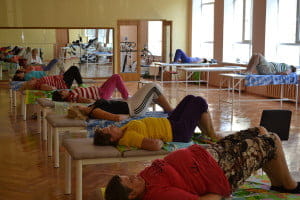
Lessons in a small group in a polyclinic.
For the elderly, the lessons are useful in a small group way, as this involves peer-to-peer communication, which is very popular among the elderly. But you can do it yourself at home.
Exercises are used for all muscle groups.
Density of employment 50 - 60%. The rest of the time is used for calculating the pulse, showing exercises, changing the starting position, static breathing exercises.
The duration of the lesson is no more than 30 minutes 2 - 3 times a week.
All the assumptions are acceptable, but ref. Standing position should not prevail.
Exercises with sharp turns and inclinations are excluded. The visions are smooth, the tempo is slow.
The exercises for balance and vestibular functions are necessarily included.
It is necessary to know what factors are available for imbalance and unexpected fall in the elderly.
- Tremor of extremities.
- Increased reaction time.
- Weakness of the thigh and thigh extensor muscles.
- Orthostatic hypotension (a sharp drop in blood pressure with a rapid change in the position of the body from the outward position lying in the standing position.
- Vision and hearing impairment.
- The shift of the center of gravity forward.
- Changed cervical - diaphyseal angle (from the blunt one it becomes direct), which reflexively affects the cerebral circulation.
- In men, it is difficult to reduce the legs together, in women, on the contrary, the legs are diluted apart, which makes stability more difficult with loss of balance.
Falls should be excluded, as in osteoporosis, falling from the height of growth, bone fractures and other injuries are possible.
Therapeutic exercises for the elderly are carried out only with a satisfactory state of the patient.
Contraindication to the occupation in the group is incontinence and categorical refusal of physical education.
Version of the complex of exercises for the elderly for copying without pictures.
Exercises for the elderly.
Prepare a ball the size of an orange (or better an orange), a gymnastic stick (the length of the stick is selected as follows: the distance from the left shoulder joint to the fingertips straightened to the right hand side or standing to measure the distance from the floor to the xiphoid process of the sternum, 10 from this digit).
Starting position sitting on a chair.
1). "Open up and close." Hands on knees, feet shoulder-width apart.1- Brushes to the shoulders (beginning of inspiration). 2- Straighten your arms to the sides, open your palms (inhale). 3- Again brush to the shoulders (the beginning of exhalation). 4- Brushes put on your knees and slightly bend forward (exhale). 4 times.
2). "Raise your foot." Hold on to the seat of the chair with your hands.1- Raise straightened right leg. 2- Lower in ref. position. 3- Raise the straightened left leg. 4- Return to the ref. position. 4 times.
3). "Circular rotation of the shoulders." Brushes to the shoulders, feet shoulder-width apart. 1, 2, 3, 4 - Draw one large circle with your elbows. 4 times. Then the same in the opposite direction 4 times.
4). "Foot on foot". Hands holding on to the seat, legs spread wide. 1 - Put your right foot on the left, tightly squeeze the muscles of the pelvic floor (inhalation). 2 - Return to the ref. Position (exhalation). 3 - Put your left foot on the right, compress the pelvic floor muscles (inhale). 4 - Return to the ref. Position (exhalation). 4 times.
5). "We rock the stick." (Exercise for balance). The gymnastic stick should be placed vertically one end on the floor, press the lower end with stops, spread the knees widely, place the brushes on top of the stick on top of each other. 1 - Relying on a stick, straighten your arms forward, slowly bending forward so that your head sinks between your hands at the level of your ears (exhalation). 2 - Return to the ref.Position (inhalation). 6 times slowly.
If dizziness does not bother, then this exercise can be complicated by securing the lower end of the stick with stops, and the upper end slowly turning, leaning forward, then straightening, bringing the upper end of the stick to the sternum (clockwise and counterclockwise).
6). "Put the stick upright." The stick should be taken between the palms so that the ends of the stick rest against the middle of the palms, lower the stick downwards (to the hips), legs shoulder-width apart. 1 - Put the stick vertically on the right foot so that the right hand is at the top, and the left one below (inhale), look at the right hand. 2 - Return to the starting position (exhalation). 3 - Put the stick vertically on the left foot so that the left arm is at the top, and the right one below (inhalation), look at the left hand. 4 - Return to the starting position (exhalation). 4 times.
7). "Roll a stick on the back." The stick is pressed to the back with elbows, legs are placed for stability. Move the stick elbows on the back up (inhale) - down (exhale), do not bend over, keep the back straightened.
Count the pulse for one minute and record. (Pulse should not exceed maximum heart rate).
The initial position is lying on the back.
8). Diaphragmatic breathing 6 times. Hands put on the stomach, legs bend at the knees. 1 - inhale through the nose, inflating the stomach.2 - Exhalation through the mouth with a thin trickle slowly, folding his lips with a tube; The abdomen is "blown off", and the abdominal wall is drawn into itself.
9). "The ball is under the knee." Hands in hand, ball (orange) in the right hand, straightened legs together. 1 - Bend the right leg, shift the ball under the knee to the left arm (exhale). 2 - Return to the starting position (inhalation), the ball in the left hand. 3 - Bend the left leg, shift the ball under the knee in the right hand (exhale). 4 - Return to the starting position (inhalation). 3 times.
10). "The ball in the other hand with a turn." Hands in hand, ball (orange) in the right hand, straightened legs together. 1 - Raise the right hand with the ball and move the ball to the left hand, turn the body to the left, take the ball into the left hand (exhale). 2 - Return to the starting position (inhalation). 3 - Just shift the ball into the right hand with the body turning to the right (exhale). 4 - Return to the starting position (inhalation). 3 times.
eleven). "The ball in the other hand behind the head." Hands along the body, the ball in the right hand, legs straightened. 1-Hands across the sides slide on the floor behind the head, pass the ball to the left hand, without moving your head, raise your eyes towards the ball (breath). 2 - Return to the starting position (exhalation). 3 - Put the ball behind your head in the right hand, raise your eyes upwards (inhale). 4 - Return to the starting position (exhalation). 3 times.
12). "We rotate with brushes and feet". Hands bent at the elbows, hands in fists, legs shoulder-width apart. Slowly and smoothly rotate the cams and feet inwards, then back to 4 circles. Repeat again.
13). Hands along the body, legs straightened. 1 - Raise the right hand up and put on the floor behind the head, simultaneously bend the left leg in the knee, sliding foot on the floor (inhaling). 2 - Return to the starting position (exhalation). 3 - Raise the left arm up, bend the right leg in the knee, glide along the floor (inhaling). 4 - Return to the starting position (exhalation). 4 times.
14). "Stress is relaxation." Hands along the body, legs straightened. 1 - Squeeze brushes into fists, feet "on yourself", buttocks tightly squeeze (inhale). 2 - Relax all muscles (exhalation). 6 times.
15). "Opposite limbs in the sides." Hands along the body, legs straightened. 1 - Take the right hand, the left leg (inspiration) to the sides. 2 - Return to the starting position (exhalation). 3 - Just the left hand, the right foot (inhalation). 4 - Return to the starting position (exhalation). 4 times.
16). Diaphragmatic breathing 6 times. (See exercise # 8).
Count the pulse for one minute and record. (Pulse should not exceed maximum heart rate).
The initial position is lying on the abdomen.
17). "Put your head in your hands." Hands bent at the elbows, lie in front of him, his head is raised, looking up. 1 - To lower the head on the wrist with the right ear, turning it to the left (exhalation), relaxation. 2 - Return to the starting position, raise your eyes upwards (inhale). 3 - Put your head on the brush on your left ear, relax (exhale). 4 - Return to the starting position, eyes look upwards (inhale). 4 times.
18). "Hands on the Pelvis". Hands stretched forward, legs straightened. 1 - Put your right hand on the pelvis. 2 - Put your left hand on the pelvis, lift the head and thoracic area, look forward. 3, 4 - Return to the starting position in the reverse order, relaxing. 3 times.
19). "Beach". The head is on the hands. Alternately - the opposite flexion and extension of the legs in the knee joints.
The starting position is knee - wrist.
20). "Raise the opposite limbs." 1 - Raise the right hand forward, the left foot back, keep the balance (breath). 2 - Return to the starting position (exhalation). 3 - Raise the left hand, the right foot (breath). 4 - Return to the starting position (exhalation). 4 times.
21). "Look at the hand." 1 - Raise your right hand to the side - up, look at it (inhale). 2 - Return to the starting position (exhalation). 3 - Raise your left hand to the side - up, look at it (inhale). 4 - Return to the starting position (exhalation).
22). "To reach out with your hand." 1 - The right hand slides forward as far as possible, lowering the head (exhalation). 2 - Return to the starting position (inhalation). 3 - The left hand slides forward, the head is lowered (inhaling). 4 - Return to the starting position (inhalation). 3 times.
Count the pulse for one minute and record. (Pulse should not exceed maximum heart rate).
23). Lying on the back diaphragmatic breathing 6 times. (See No. 8).
24). "Kitty" (Bend and arched back).
25). "Lisichkin tail" (flexion of the spine then to the right, then to the left).
26). Sitting on a chair, hands are holding on to the seat. Rounds from heel to toe.
27). Sitting on a chair, hands on his knees. Raise your hands through the sides up (inhale), lower to your knees, slightly bend forward (exhale). 5 times.
Homework.
1). Self-massage of the back by a roller massager for the back.
2). Train the vestibular apparatus: lying on the bed on your back, bending your knees, turning on your side, lowering your legs from the bed and pushing your hands, sit on the edge of the bed for a few seconds, get up (legs spread apart shoulder width), stand up, stand a little, Trampling from foot to foot. Now in the reverse order to lie on the bed in the other direction. 3 times in each direction slowly, controlling the state of health. Avoid dizziness. You can simplify the task by excluding standing.
3). Diaphragmatic breathing 6 times before going to bed. (This exercise helps with the appearance of retrosternal pains with angina, as the diaphragm, rising and falling, promotes the movement of blood in a large circle of blood circulation, facilitating the work of the heart).
4). Self-massage of hands and fingers. Exercises for the fingers ("Coins" - circular movements with the thumb on the tips of all the other fingers, "Shallbans with all fingers alternately", "Knopochki" - press with your thumb on the tips of all fingers alternately, "Figures between all fingers", " All fingers alternately "," Straighten each finger alternately from the cam "," Straighten and spread all the fingers - squeeze your fingers into fists. "
5). Walking with long walking, you can run (breathe only with your nose, if you do not have enough air, go for walking), skiing in winter, swimming in the swimming pool and classes in the health group by age. Remember the need to monitor blood pressure and pulse.
6). Gymnastics for the eyes.
Then the same with the pictures.
Exercises for the elderly.
Prepare a ball the size of an orange (or better a real orange),
A gymnastic stick (the length of the gymnastic stick : the distance from the left shoulder joint to the tips of the fingers straightened to the right hand side or standing to measure the distance from the floor to the xiphoid process of the sternum, from this figure take 10)
Chair with a backrest and a rug.
Ventilate the room.
Starting position sitting on a chair.


