Греческий православный монастырь Святого Креста в Иерусалиме |
монастырь Святого Креста в Иерусалиме

монастыря Святого Креста в Иерусалиме
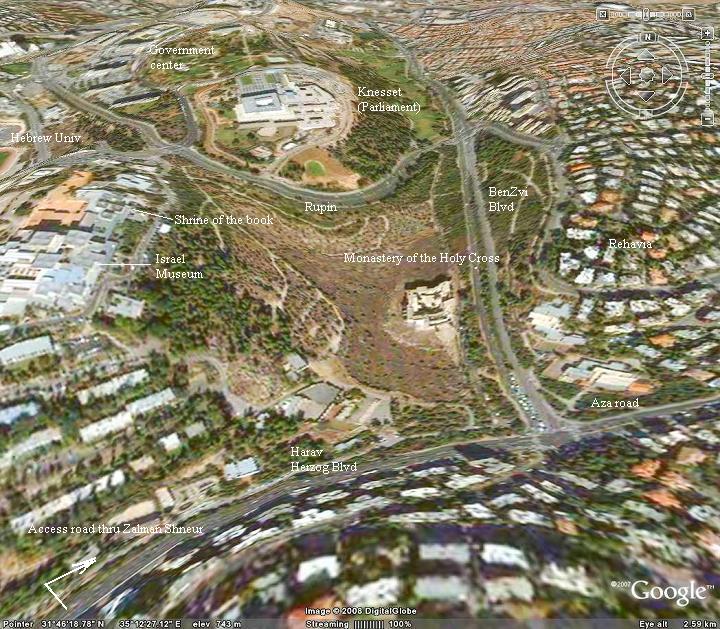
A closer view of the Monastery, built in the 11th C. The entrance, through a low and narrow doorway, is on the south-east side (the right side of the photo below).

After entering into the western court yard, a door leads into an inner court.

The inner courtyard is seen below. Around the courtyard is a maze of rooms that served the monks. In its peak times the Monastery hosted hundreds of pilgrims and residents.

On top of the monastery is a square bell tower. This was built later, in the 19th C, and has two clocks on each side.

This is the western entrance to the church. The bell tower is seen above.

On top of the entrance door (seen in the above photo) is the painting with Lot planting the Holy tree at this site and watering it with waters he fetched from the Jordan river. It was based on a triplet seeding (olive + cypress + cedar) that the Abraham gave to Lot. The tree was later used to create the Holy Cross on which Jesus was crucified.

The church is located in the center of the structure, on its eastern side. The door opens to a long entrance hall with doors to the Basilica on the left side.

This is the western side of the Church and its entrance door. The inscription above the right side of the door is Greek, and the left side has an identical inscription in Georgian script. They tell about the renovations held here in 1644, sponsored by Leontanian, by the heads of the Monastery - Nikephoros Mousis and Gregorios Neophylos and Gerasimos Menas.

A closer look at the door. To the right of the door is a painting of King Solomon; he is holding a scroll from the "Book of wisdom of Solomon". Below the Greek inscription, is a painting of an unidentified bearded man.

The photo below shows the view of the basilica, with the altar hidden behind the septum (partition).

In the center of the floor, close to the septum, are the remains of an ancient mosaic floor. The mosaic incorporates pictures of animals, plants and geometric patterns. The dark stains on the floor, as we are told, are blood stains of the monks that were butchered here in 796 AD by an Arab mob.

Another view of the eastern side, and the cavity under the dome.

Some of the stands and panels inside the church are seen in the next photos. They cast a special Holy sensation, as in all of the Greek Orthodox churches.


On the right (south) side of the hall is a chair reserved for the Greek Patriarch, seen below. Above the chair (but not seen in the photo) is a fresco depicting the departure of Elijah on a chariot of fire, while his pupil the prophet Elisha is observing from the Jordan river and picking up his mantle (as per 2 Kings 8).

Another view of the grand septum - the partition between the church hall and the main altar. On the right pillar, seen on the right side of the photo below, is a fresco (wall painting) showing Jesus.
On the top of the left pillar, facing the hall, is a painting of the angel Gabriel who announced the birth of Jesus to Mary; facing the septum is the Patriarch Yehuda.

The left pillar shows Mary, holding infant Jesus. The Greek initials IC XC around Jesus stands for "Jesus Christ".

The right panel closest to the door has Paul on the left side (Peter is on his left but hidden in this photo).
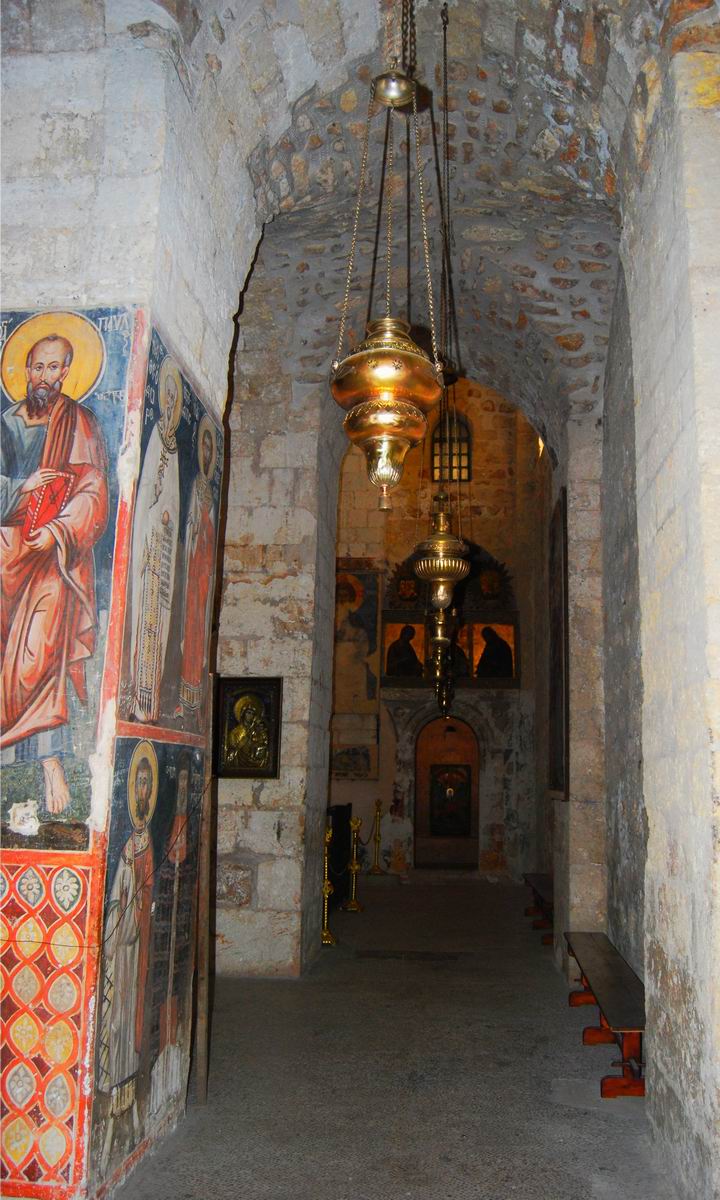
Another fresco of saints on one of the pillars.

A door on the left side of the church leads to a narrow hall, which turns into the holiest place - the site of the Holy tree. The photo below shows the small room, with paintings that tell the story of the tree.

The highlight of the room is located under the table with the red cloth: a small hole within a decorated bronze plate marks the place where the holy Tree once stood.

On the walls of the room are several painted panels. The left panel shows (from left to right) Lot escaping the destruction of Sodom, Abraham giving lot the triplet seeding, and Lot planting the tree.

The center panel starts from Lot who waters the Holy Tree from the waters of the Jordan river. Many years later it is cut down, and its wood are hauled by two men to the crucifixion site.

The wood is brought to the crucifixion site, and Jesus is hammered to the cross, with the Roman soldiers watching on the left side and Virgin Mary and Mary Magdalene on the right background.

The last panel, just above the place of the Holy tree, shows Jesus crucified on the cross with the two women witnesses.

In the narrow hall are additional paintings and displays, such as the crucified Jesus with Mary and Mary.

The monks lived in the rooms around the church. The photo below shows one of these rooms, located on the ground level on the western side.


The kitchen and dining room are located on the second floor, on the eastern side of the church. The stoves of the kitchen are seen below, where the food was prepared for the monks and guests of the Monastery.

The cooking pots in the kitchen.

The dining room is seen below, with long marble tables.

Through this hole the water was fetched from the well.

biblewalks.com
Серия сообщений "Святая Земля":
Часть 1 - Храм Воскресения Христова (храм Гроба Господня) в Иерусалиме
Часть 2 - Храм Рождества Христова в Вифлиеме
Часть 3 - Греческий православный монастырь Святого Креста в Иерусалиме
Часть 4 - Храм Гроба Господня
Часть 5 - Святые места Иерусалима. Виртуальные экскурсии
Часть 6 - >«Золотой город». Величие и красота. Иерусалим. Израиль
Часть 7 - Иерусалим - Центр Мира. Фильм 1. Землю Укажу тебе
| « Пред. запись — К дневнику — След. запись » | Страницы: [1] [Новые] |


