Powder Metallurgy Pressed Sintering Integrative Furnace |
The physical and mechanical properties of the metal powder can be obtained by sintering. For multicomponent liquid phase sintering, the sintering temperature is generally lower than that of refractory metals, but higher than that of fusible metals.
1. Powder metallurgy sintering process
After the powder forming process, sintering and post-treatment (such as finishing) are required. Sintering and finishing are generally done separately. That is, sintering finished, and then put on the press finishing. For multicomponent liquid phase sintering, this separate process makes the quality of products difficult to be guaranteed. The sintering temperature is low, the fusible metal is not melted, and the bonding enhancement effect is not obtained. High sintering temperature, fusible metal melting, and easy loss and re-accumulation, will also affect the quality of products. The ideal method is to press in the furnace immediately when the sintering temperature is reached. The following describes the structural principles of some pressurized and sintered integrated equipment used in aviation powder metallurgy for high temperature sealing materials of copper or steel in the range of 500 ~ 900 ℃, pressing in the range of 50 ~ 2 000 kg and controlling accuracy of ±1.5% of the set value.
In order to achieve pressure sintering of powder metallurgy, the following problems need to be solved in the equipment:
(1) when the products are heated in the reducing atmosphere, the sealing of the furnace cover and the furnace tank must be ensured first, and the gas cannot be leaked. When the furnace tank is expanded by heat, when the tank body extends, there should be expansion and contraction space, can not be gored;
(2) pressurization is carried out in the 900 ℃ high temperature furnace tank, and the extrusion mechanism is set in the furnace tank. Firstly, the high temperature strength of metal materials should be considered, and secondly, the sealing of sports pairs should be considered. They cannot produce creep, cannot be bitten to death, and the friction resistance should not be too large;
(3) the melting point of copper alloy is generally more than 750 ℃. Once the sintering temperature reaches, the pressure should be followed up immediately, and the pressure should be given as much as it is set, followed up dynamically, and the pressure should be kept stable.
(4) the heating process and pressurizing process are controlled by PLC (programmable control) to ensure the repeatability of sintering process.
2. Equipment structure features
The invention relates to a steel - based product with copper alloy powder as adhesive, pressurized and sintering furnace.
In this furnace, there is a fixed pressure head of metal embedded in the furnace body, furnace frame, elevator, furnace cover trolley, furnace tank and pressure cover. The upper end of the fixed pressure head is connected with the beam of the furnace body, and only the pressure plane inside the furnace is exposed. The furnace body, furnace frame, beam and fixed pressure head are rigidly connected. When the bottom plate of the furnace frame is welded with the ground embedded iron, a rigid frame member is formed. The vertical distance between the bearing plane of the upper constant pressure head and the ground is fixed.
The elevator is set in the pit below the furnace. The upper plane of the elevator is welded with two tracks, flush with the ground track, to facilitate the access of the furnace cover trolley. The surrounding plane of the furnace cover trolley is equipped with two sealing grooves, the inner ring is sand seal, and the outer ring is liquid seal (emulsion).There are N pressure springs in the liquid seal tank, which can carry the weight of the furnace.

The physical and mechanical properties of the metal powder can be obtained by sintering. For multicomponent liquid phase sintering, the sintering temperature is generally lower than that of refractory metals, but higher than that of fusible metals.
1. Powder metallurgy sintering process
After the powder forming process, sintering and post-treatment (such as finishing) are required. Sintering and finishing are generally done separately. That is, sintering finished, and then put on the press finishing. For multicomponent liquid phase sintering, this separate process makes the quality of products difficult to be guaranteed. The sintering temperature is low, the fusible metal is not melted, and the bonding enhancement effect is not obtained. High sintering temperature, fusible metal melting, and easy loss and re-accumulation, will also affect the quality of products. The ideal method is to press in the furnace immediately when the sintering temperature is reached. The following describes the structural principles of some pressurized and sintered integrated equipment used in aviation powder metallurgy for high temperature sealing materials of copper or steel in the range of 500 ~ 900 ℃, pressing in the range of 50 ~ 2 000 kg and controlling accuracy of ±1.5% of the set value.
In order to achieve pressure sintering of powder metallurgy, the following problems need to be solved in the equipment:
(1) when the products are heated in the reducing atmosphere, the sealing of the furnace cover and the furnace tank must be ensured first, and the gas cannot be leaked. When the furnace tank is expanded by heat, when the tank body extends, there should be expansion and contraction space, can not be gored;
(2) pressurization is carried out in the 900 ℃ high temperature furnace tank, and the extrusion mechanism is set in the furnace tank. Firstly, the high temperature strength of metal materials should be considered, and secondly, the sealing of sports pairs should be considered. They cannot produce creep, cannot be bitten to death, and the friction resistance should not be too large;
(3) the melting point of copper alloy is generally more than 750 ℃. Once the sintering temperature reaches, the pressure should be followed up immediately, and the pressure should be given as much as it is set, followed up dynamically, and the pressure should be kept stable.
(4) the heating process and pressurizing process are controlled by PLC (programmable control) to ensure the repeatability of sintering process.
2. Equipment structure features
The invention relates to a steel - based product with copper alloy powder as adhesive, pressurized and sintering furnace.
In this furnace, there is a fixed pressure head of metal embedded in the furnace body, furnace frame, elevator, furnace cover trolley, furnace tank and pressure cover. The upper end of the fixed pressure head is connected with the beam of the furnace body, and only the pressure plane inside the furnace is exposed. The furnace body, furnace frame, beam and fixed pressure head are rigidly connected. When the bottom plate of the furnace frame is welded with the ground embedded iron, a rigid frame member is formed. The vertical distance between the bearing plane of the upper constant pressure head and the ground is fixed.
The elevator is set in the pit below the furnace. The upper plane of the elevator is welded with two tracks, flush with the ground track, to facilitate the access of the furnace cover trolley. The surrounding plane of the furnace cover trolley is equipped with two sealing grooves, the inner ring is sand seal, and the outer ring is liquid seal (emulsion).There are N pressure springs in the liquid seal tank, which can carry the weight of the furnace.
|
Метки: powder metallurgy furnace bell furnace pressed sintering |
Development of ptfe lubricating protective oil |
PTFE, commonly known as teflon, is a kind of solid lubrication material with the smallest friction coefficient found so far. Due to its excellent anti-corrosion and lubrication effect, high and low temperature resistance, acid and alkali resistance, PTFE has been widely used in many industrial fields such as aerospace, petrochemical, mechanical and electronic. PTFE is used in lubricating oil, which can significantly improve the quality and application performance of oil, so it has been used in oil as an excellent solid lubricant. Such as DuPont company zonyR f1 uroaddi tives. Ausimont Technologies of PTFE polymis @ microized powders and American troops now use the CLP in accordance with MIL -L-63 NATO code: 460 S-758.However, domestic research and application reports on this kind of products are still rare. This paper mainly introduces the development of a kind of lubricating and protective oil containing PTFE.
1.Choice of ptfe lubricants
PTFE is a polymer of tetrafluoroethylene. It contains a cf-based chemical repeating unit in the molecule, which has no branches and does not form crosslinks in the whole, so its molecular profile is smooth. This smooth molecular profile makes it not only has the characteristics of low friction, but also can be transferred to the dual surface during the sliding process to form a thin transfer film, which plays a protective role on the friction interface. It is generally believed that the anti-wear and anti-friction mechanism of ptfe particles is as follows: under a certain load state, particles can fill in the flat and concave places, and timely fill in the damaged parts, so that the friction surface is always in a relatively flat state; Under a certain load state, particles fall into the structural defects caused by the matrix material on the friction surface, and a composite layer of particles and matrix material is formed on the friction surface to improve the micro-hardness of the friction surface, thus giving the friction surface certain lubrication function. Under high temperature or high pressure, the particles react with the metal surface to form metal fluoride, thus forming a fluoride deposition film on the friction surface, thereby reducing wear. In addition, due to the hydrophobic effect of PTFE, it also enhances the rust resistance of oil products.
2.Oil soluble corrosion inhibitor selection
The corrosion of metal under oil film is an electrochemical corrosion. The experiment shows that the simple oil film is difficult to play an effective role in protecting the metal, and the single anti-rust agent is difficult to meet the various application requirements of oil products, so in order to achieve satisfactory application effect, two or more corrosion inhibitors are often used together
The basic principle of choosing corrosion inhibitor in this paper is that it should have obvious anti-rust effect when the amount of addition is not large, and at the same time the additive should not affect other properties of oil film. We screened the formulas of more than 10 corrosion inhibitors commonly used in China, such as barium petroleum sulfonate, and determined the compound corrosion inhibitor system composed of 4 additives, such as barium petroleum sulfonate, magnesium lanolin soap, sben-80 and benzotriazole. Barium petroleum sulfonate has good resistance to salt spray and moisture and heat. Magnesium lanolin soap can not only prevent rust and assist film formation, but also improve the stability of oil to some extent when combined with barium petroleum sulfonate. Benzotriazole is the corrosion inhibitor of copper, silver and other nonferrous metals, which can effectively inhibit the discoloration of copper.Sben-80: it is not only an anti-rust agent, but also has some dissolving and dispersing effects.
Four kinds of means and methods of technological progress increase the scale of single series and realize the best scale benefit. Integration optimization and system optimization; Long period stable operation; Sophisticated large-scale equipment manufacturing, to achieve efficient and stable operation; Optimize the allocation and recycling of resources. New catalytic technologies; New separation technologies; Biotechnology; New materials technology; The compound application of corrosion inhibitors in information technology has synergistic effect.

PTFE, commonly known as teflon, is a kind of solid lubrication material with the smallest friction coefficient found so far. Due to its excellent anti-corrosion and lubrication effect, high and low temperature resistance, acid and alkali resistance, PTFE has been widely used in many industrial fields such as aerospace, petrochemical, mechanical and electronic. PTFE is used in lubricating oil, which can significantly improve the quality and application performance of oil, so it has been used in oil as an excellent solid lubricant. Such as DuPont company zonyR f1 uroaddi tives. Ausimont Technologies of PTFE polymis @ microized powders and American troops now use the CLP in accordance with MIL -L-63 NATO code: 460 S-758.However, domestic research and application reports on this kind of products are still rare. This paper mainly introduces the development of a kind of lubricating and protective oil containing PTFE.
1.Choice of ptfe lubricants
PTFE is a polymer of tetrafluoroethylene. It contains a cf-based chemical repeating unit in the molecule, which has no branches and does not form crosslinks in the whole, so its molecular profile is smooth. This smooth molecular profile makes it not only has the characteristics of low friction, but also can be transferred to the dual surface during the sliding process to form a thin transfer film, which plays a protective role on the friction interface. It is generally believed that the anti-wear and anti-friction mechanism of ptfe particles is as follows: under a certain load state, particles can fill in the flat and concave places, and timely fill in the damaged parts, so that the friction surface is always in a relatively flat state; Under a certain load state, particles fall into the structural defects caused by the matrix material on the friction surface, and a composite layer of particles and matrix material is formed on the friction surface to improve the micro-hardness of the friction surface, thus giving the friction surface certain lubrication function. Under high temperature or high pressure, the particles react with the metal surface to form metal fluoride, thus forming a fluoride deposition film on the friction surface, thereby reducing wear. In addition, due to the hydrophobic effect of PTFE, it also enhances the rust resistance of oil products.
2.Oil soluble corrosion inhibitor selection
The corrosion of metal under oil film is an electrochemical corrosion. The experiment shows that the simple oil film is difficult to play an effective role in protecting the metal, and the single anti-rust agent is difficult to meet the various application requirements of oil products, so in order to achieve satisfactory application effect, two or more corrosion inhibitors are often used together
The basic principle of choosing corrosion inhibitor in this paper is that it should have obvious anti-rust effect when the amount of addition is not large, and at the same time the additive should not affect other properties of oil film. We screened the formulas of more than 10 corrosion inhibitors commonly used in China, such as barium petroleum sulfonate, and determined the compound corrosion inhibitor system composed of 4 additives, such as barium petroleum sulfonate, magnesium lanolin soap, sben-80 and benzotriazole. Barium petroleum sulfonate has good resistance to salt spray and moisture and heat. Magnesium lanolin soap can not only prevent rust and assist film formation, but also improve the stability of oil to some extent when combined with barium petroleum sulfonate. Benzotriazole is the corrosion inhibitor of copper, silver and other nonferrous metals, which can effectively inhibit the discoloration of copper.Sben-80: it is not only an anti-rust agent, but also has some dissolving and dispersing effects.
Four kinds of means and methods of technological progress increase the scale of single series and realize the best scale benefit. Integration optimization and system optimization; Long period stable operation; Sophisticated large-scale equipment manufacturing, to achieve efficient and stable operation; Optimize the allocation and recycling of resources. New catalytic technologies; New separation technologies; Biotechnology; New materials technology; The compound application of corrosion inhibitors in information technology has synergistic effect.
|
Метки: PTFE ptfe lubricant ptfe lubricating Teflon film lubrication Polymer |
Properties of ptfe film and its composite fabric process |
Ptfe films are prepared by biaxial tensile method. Scanning electron microscope can observe that the films are made of crisscrossing fiber filaments connected with each other, and the gaps between fiber filaments form microholes in the films.
There are many micropores on the surface of the film, about 9 billion micropores per square inch, and the micropores are mainly distributed in the diameter of 0.8~1 micron. The minimum pore diameter of thin film micropores is only about 0.6 micron, while the maximum pore diameter is about 1.6 micron, and the diameter of water vapor is 0.0004 micron. Thus, water vapor molecules can easily penetrate the pores, allowing the membrane to function as a moisture permeator. The smallest liquid you can get your hands on is light fog, with droplets 20 microns in diameter. Therefore, the membrane also has the function of waterproof. The moisture permeability of ptfe film is 8450g/m2·24h, which is much higher than that of 3000g/m2·24h when human body feels comfortable. At the same time, the ptfe film also has good wind resistance. When the wind pressure rises to the equivalent of wind pressure of level 10, the permeability of the film is 28.85mm/s, while when the permeability exceeds 30mm /s, the film loses its wind resistance.
Polyamide (COPA) hot melt adhesive as the adhesive, the use of flat vulcanizing machine will be fabric, hot melt adhesive, ptfe film, hot melt adhesive, lining five layers by hot pressing made of waterproof and permeable laminated fabric. Orthogonal tests of nine laminating processes with four factors and three levels were carried out. Under the condition of nine kinds of technology of laminated fabric including moisture permeability, peel strength, high hydrostatic pressure and permeability test, finally USES the grey nearly optimal theory to deal with data process 2 for the optimal process, namely between the fabric and ptfe film gluing quantity to 12 g/m2, the material between the membrane and the amount of glue is 24 g/m2, laminating temperature is 140 ℃, laminated time of 10 s, to achieve the optimal performance of the laminated fabric.
The properties of laminated fabrics made of four kinds of different fabrics are compared. It is found that the three most important properties of the composite fabrics, namely moisture permeability, heat preservation and peeling strength, are superior. Therefore, it is more ideal to choose brocade and cotton interweave as the layer of waterproof and moisture permeable laminated fabric. In the use of water-soluble adhesive, the surface of the material wetting, and other substances between the bond strength.
In order to further improve the peeling strength of laminated fabric, ptfe film was treated with hydrophilic modification. In the process of modification, 1ml Fe Cl3 solution was used to prepare Fe(OH)3 colloid, which had the best treatment effect on the film. The optimal solution for the ptfe film repolymerization of hydrophilic monomer acrylic acid adsorbed with Fe(OH)3 colloid is A3B2C1D2, that is, the polymerization temperature is 70℃, the acrylic monomer concentration is 20%, the polymerization time is 20min, and the initiator dosage is 1%.In addition to a slight decrease in moisture permeability, hydrostatic pressure resistance and permeability rate, the peel strength value of the laminated fabric after modification was greatly improved and reached the enterprise standard of 5N/2.5cm.

Ptfe films are prepared by biaxial tensile method. Scanning electron microscope can observe that the films are made of crisscrossing fiber filaments connected with each other, and the gaps between fiber filaments form microholes in the films.
There are many micropores on the surface of the film, about 9 billion micropores per square inch, and the micropores are mainly distributed in the diameter of 0.8~1 micron. The minimum pore diameter of thin film micropores is only about 0.6 micron, while the maximum pore diameter is about 1.6 micron, and the diameter of water vapor is 0.0004 micron. Thus, water vapor molecules can easily penetrate the pores, allowing the membrane to function as a moisture permeator. The smallest liquid you can get your hands on is light fog, with droplets 20 microns in diameter. Therefore, the membrane also has the function of waterproof. The moisture permeability of ptfe film is 8450g/m2·24h, which is much higher than that of 3000g/m2·24h when human body feels comfortable. At the same time, the ptfe film also has good wind resistance. When the wind pressure rises to the equivalent of wind pressure of level 10, the permeability of the film is 28.85mm/s, while when the permeability exceeds 30mm /s, the film loses its wind resistance.
Polyamide (COPA) hot melt adhesive as the adhesive, the use of flat vulcanizing machine will be fabric, hot melt adhesive, ptfe film, hot melt adhesive, lining five layers by hot pressing made of waterproof and permeable laminated fabric. Orthogonal tests of nine laminating processes with four factors and three levels were carried out. Under the condition of nine kinds of technology of laminated fabric including moisture permeability, peel strength, high hydrostatic pressure and permeability test, finally USES the grey nearly optimal theory to deal with data process 2 for the optimal process, namely between the fabric and ptfe film gluing quantity to 12 g/m2, the material between the membrane and the amount of glue is 24 g/m2, laminating temperature is 140 ℃, laminated time of 10 s, to achieve the optimal performance of the laminated fabric.
The properties of laminated fabrics made of four kinds of different fabrics are compared. It is found that the three most important properties of the composite fabrics, namely moisture permeability, heat preservation and peeling strength, are superior. Therefore, it is more ideal to choose brocade and cotton interweave as the layer of waterproof and moisture permeable laminated fabric. In the use of water-soluble adhesive, the surface of the material wetting, and other substances between the bond strength.
In order to further improve the peeling strength of laminated fabric, ptfe film was treated with hydrophilic modification. In the process of modification, 1ml Fe Cl3 solution was used to prepare Fe(OH)3 colloid, which had the best treatment effect on the film. The optimal solution for the ptfe film repolymerization of hydrophilic monomer acrylic acid adsorbed with Fe(OH)3 colloid is A3B2C1D2, that is, the polymerization temperature is 70℃, the acrylic monomer concentration is 20%, the polymerization time is 20min, and the initiator dosage is 1%.In addition to a slight decrease in moisture permeability, hydrostatic pressure resistance and permeability rate, the peel strength value of the laminated fabric after modification was greatly improved and reached the enterprise standard of 5N/2.5cm.
|
Метки: ptfe film ptfe film properties hydrophilic modification Properties of ptfe film |
Effect of PTFE on Properties of PE-UHMW |
In order to obtain ultra high molecular weight polyethylene (PE-UHMW) matrix composites which get high wearresistance and high heat resistance , and the poly tetrafluorethylene (PTFE) was modifed to improve the wear resistance and heatresistance of PE-UHMW. The test results show that the Shore hardness of the composite reach the highest that is 67.08, and thewear resistance is the best when the mass fraction of PTFE is 5%, the friction coeficient to 15CrMoV steel is 0.235 and the wearrate is 0.081 4%, and the thermal deformation temperature of the composite is increased by 21% when the load is 10.0 N and thedeformation amount is 0.06 mm. Under the action of KH-~550 coupling agent, the PTFE can achieves a uniform distribution in the PE-UHMW matrix, and the formation of dense binding. With the increase of PTFE content, the creep of the composites is graduallyincreased.
Since its inception, ultra-high molecular weight polyethylene (PE-UHMW) has been widely used in mechanical textile, medicine and other fields with its excellent physical and mechanical properties, becoming an engineering plastic that can replace metal materials. PE-UHMW has good impact resistance, wear resistance, chemical corrosion resistance, self-lubrication and other properties. However, PE-UHMW's low hardness and thermal deformation temperature defects cannot meet some high requirements of field applications. At present, modification methods of PE-UHMW mainly focus on chemical modification and physical modification. People often add organic and inorganic particles or fibers to PE-UHMW to improve its performance. By contrast, organic modifiers are easier to form firm bonds with PE-UHMW molecular chains.
Polytetrafluoroethylene (PTFE) holds the title of "the king of plastic, PTFE, with its excellent corrosion resistance, wear resistance, low friction coefficient, is only 1/5 of the polyethylene, between 0.01 ~ 0.10, as additives to improve the PE-UHMW abrasion resistance and heat resistance. It has obvious effect, Fang Zheng equality of polyoxymethylene, polyamide, PTFE linear low density polyethylene (PE-LLD) such as blending modification, the results found that Adding appropriate amount of modified PTFE can significantly improve the compatibility between PTFE and polymer. When PE-LLD is modified with PTFE, the mechanical properties, processing properties and stability of composites are greatly improved, and the friction coefficient is significantly reduced. PTFE was selected to blend and modify PE-UHMW in order to prepare composites with excellent wear resistance and heat resistance, reduce the friction coefficient of PE-UHMW and expand its application field.
In order to obtain ultra high molecular weight polyethylene (PE-UHMW) matrix composites which get high wearresistance and high heat resistance , and the poly tetrafluorethylene (PTFE) was modifed to improve the wear resistance and heatresistance of PE-UHMW. The test results show that the Shore hardness of the composite reach the highest that is 67.08, and thewear resistance is the best when the mass fraction of PTFE is 5%, the friction coeficient to 15CrMoV steel is 0.235 and the wearrate is 0.081 4%, and the thermal deformation temperature of the composite is increased by 21% when the load is 10.0 N and thedeformation amount is 0.06 mm. Under the action of KH-~550 coupling agent, the PTFE can achieves a uniform distribution in the PE-UHMW matrix, and the formation of dense binding. With the increase of PTFE content, the creep of the composites is graduallyincreased.
Since its inception, ultra-high molecular weight polyethylene (PE-UHMW) has been widely used in mechanical textile, medicine and other fields with its excellent physical and mechanical properties, becoming an engineering plastic that can replace metal materials. PE-UHMW has good impact resistance, wear resistance, chemical corrosion resistance, self-lubrication and other properties. However, PE-UHMW's low hardness and thermal deformation temperature defects cannot meet some high requirements of field applications. At present, modification methods of PE-UHMW mainly focus on chemical modification and physical modification. People often add organic and inorganic particles or fibers to PE-UHMW to improve its performance. By contrast, organic modifiers are easier to form firm bonds with PE-UHMW molecular chains.
Polytetrafluoroethylene (PTFE) holds the title of "the king of plastic, PTFE, with its excellent corrosion resistance, wear resistance, low friction coefficient, is only 1/5 of the polyethylene, between 0.01 ~ 0.10, as additives to improve the PE-UHMW abrasion resistance and heat resistance. It has obvious effect, Fang Zheng equality of polyoxymethylene, polyamide, PTFE linear low density polyethylene (PE-LLD) such as blending modification, the results found that Adding appropriate amount of modified PTFE can significantly improve the compatibility between PTFE and polymer. When PE-LLD is modified with PTFE, the mechanical properties, processing properties and stability of composites are greatly improved, and the friction coefficient is significantly reduced. PTFE was selected to blend and modify PE-UHMW in order to prepare composites with excellent wear resistance and heat resistance, reduce the friction coefficient of PE-UHMW and expand its application field.

|
Метки: PTFE PE-UHMW Polytetrafluoroethylene polymer plastic PTFE fibers PTFE properties |
Study on Sintering of Ptfe |
From the perspective of the three factors that determine the properties of PTFE products -- molecular weight, crystallinity and voidage, the voidage is mainly affected by the preforming pressure, and the molecular weight and crystallinity all change with the different sintering conditions. Therefore, sintering process conditions play a decisive role in the final properties of products such as density, hardness, permeability and mechanical properties.
Wang ping found that the sintering process of PTFE was affected by the rising and falling speed, sintering temperature and sintering time. The larger the product, the slower the speed of rising and cooling, the longer the sintering time. The sintering temperature of suspension resin is higher than that of dispersion resin. The sintering temperature of pure material products is higher than that of filled products. In general, the rate of warming is faster than the rate of cooling. In the same sintering furnace, pure material and filling products cannot be mixed; Products with different sintering conditions cannot be mixed. Products of different raw materials cannot be mixed. Taking the production of 3-layer molded circular plate with diameter of 1 m, thickness of 20 mm, double layer as pure ptfe and middle layer as filled ptfe as an example, the compression strength, bending strength, hardness and other mechanical properties of the circular laminated plate produced by this technology have been greatly improved.
Liu xianlan studied the forming process characteristics, forming method and mold design characteristics of PTFE, analyzed the defects and causes of PTFE products produced by cold pressing and sintering, and put forward the treatment methods. PTFE can be molded by a variety of preforming processes, such as molding, extrusion, hydraulic molding, push molding and secondary processing, and then sintered to the final product.PTFE molding is mostly made of suspended resin. When the thickness of sheet is less than 1.5mm, disperse resin is used. Its technological process: resin - sieve (suspension resin after pounding, loose, and the 20 mesh mesh sieve) - press (PTFE powder loading the mould under pressure from 20 to 35 MPa, after press compaction forming) - sintering (in 370 ~ 380 "C temperature sintering in sintering furnace) - moulded products (under free state within the mold or after cooling to finalize the design as required by the board, rods, tubes, gaskets and packing products, etc.).Hydraulic method is also called the equilibrium method or rubber molding in its operating process is: put rubber bag in die - connected to the water pump, filling the water swell the rubber bag into a cylindrical - resin evenly join between bag and external mold mold closing - continue to gradually increase the water pressure, water filling up to 12 ~ 13 mpa pressure maintaining 30 min: after water - decompression, ripping, sintering, cooling is the use of bright and clean appearance. Push is also called the paste extrusion molding, 20 ~ 30 mesh sieve dispersion resin and organic liquid (such as toluene, petroleum ether, the solvent oil) mixture 1:5 paste mixture, preloading into thick wall cylinder billet, push into the compressor cylinder, heating, with a plunger push molding, after drying in the 360 ~ 380 ° C temperature sintering, after cooling products have strong push tube, rod, etc.Extrusion molding can be divided into two types: screw extrusion and plunger extrusion. The pre-sintered resin after crushing and sifted is added to the material cylinder. Through screw rotation or reciprocating push of plunger, the raw material is transported to the extruder at the same time of compaction.
Wang ping studied the forming process of PTFE foam material. Suspended polytetrafluoroethylene is used as raw material, and condensed cyclic aromatic hydrocarbons are selected as pore-forming agent. After mixing, preforming products are preformed and sintered. At the initial stage of sintering, drying process is adopted to make pore-forming agent escape, and then resintering stage is entered. Foam materials with different dielectric constants can be prepared in different proportions to meet various requirements.
Chen xu et al. conducted compression test and sintering test on PTFE, discussed the relationship between density, compression strength and compression modulus, and analyzed the compression strength of specimens under different sintering processes, and obtained more appropriate molding pressure and sintering process. The results showed that the compression strength of PTFE decreased with the increase of pressing pressure, and the compression modulus increased with the increase of pressing pressure. The molding pressure was 27.5mpa, sintering temperature was 380 C, and the insulation time was 4h.
In order to overcome the disadvantages of pure ptfe, such as poor abrasion resistance and large thermal expansion coefficient, Raytheon studied the bronze-filled particles in ptfe, and expanded the application scope of ptfe. The conventional warm pressing molding of ptfe is characterized by long cycle, poor performance, low dimensional accuracy and smoothness, while the warm pressing molding in this study has fewer working procedures, short cycle and significantly improved mechanical properties.

|
Метки: extruder extrusion gasket mixture Moulding PTFE PTFE Products rod sintering tube |
Properties of molded products |
Molded products have excellent electrical properties (especially anti-leakage properties), mechanical properties, heat resistance, fire resistance, chemical corrosion resistance and dimensional stability, and can be adjusted according to the needs of each component type and dosage to obtain products with special performance requirements. The main performance is as follows:
1.Electrical property
Molded plastics are widely used in high voltage electrical applications due to their arc resistance, acer performance, flame resistance, dimensional stability, moulding and low cost. The ability of arc suppression is mainly due to the presence of inert inorganic fillers such as hydrated alumina, silica and ceramic. Add a small amount of polyethylene powder (5% by weight) and use nylon fiber to improve arc resistance. In order to obtain better arc resistance, the resin and glass fiber content should be reduced to the minimum, however, such results reduce the mechanical properties.
2. Mechanical property
The mechanical properties of molding materials vary with the types and proportions of reinforced fibers and resin substrates used. In DMC, when the fiber length exceeds 6.35mm, the modification of product properties is very small.
Most SMC products are made from short-cut felt, and there is no published data on the effect of fiber length changes. Although the length of the general fiber is 50mm, this length is not necessarily suitable for all applications.
Increasing the content of reinforcing materials can improve the mechanical properties, but too much fiber content will bring inconvenience to molding. For example, when the fiber content in DMC exceeds 20%, it has little influence on its mechanical properties.
3. Heat resistance or fire resistance
Heat resistance refers to the ability of products to withstand thermal decomposition for long periods of time below the flammable temperature. "Short-term thermal strength" or "thermal strength" is related to the thermal deformation temperature of the resin. Although some fillers can improve the heat resistance of products, the heat resistance and thermal strength mainly depend on the properties of the resin. Flammability is a measure of apparent combustion, divided into "non-ignition", "self-extinguishing" and "flame-retardant" according to the ability and speed with which a material is able to extinguish easily or when the ignition source is removed. Polyester resins achieve flame resistance by adding halogen and phosphorous compounds and by using alumina hydrate as the main filler in the components.
Phenolic resins are inherently fire-resistant. Halogen compounds and phosphorous compounds, as well as HET anhydride used as hardener, can make epoxy resins flame resistant.
4.Dimensional stability
General molding materials have good dimensional stability, water absorption rate: small, thermal expansion coefficient and aluminum is very similar, when continuous exposure to high temperature, size is almost no change.
5. Corrosion resistance
The chemical resistance or corrosion resistance of molding material mainly depends on the selected resin matrix. The suitable resin and filler can be used to prepare the moulded material which can meet the requirement of resisting special bristle dew
DMC can be made of acid-resistant and alkali-resistant ligulates and acid-resistant epoxy resins. The choice of a resin for SMC is currently limited because the resin must also have a chemical structure that thickens easily. In common fillers, clay and silica have better corrosion resistance and other properties.
6.Contractility
The shrinkage of moulded material is very low after release, the typical maximum shrinkage rate is 0.004, and the shrinkage rate of many moulded materials is close to 0.001, which is mainly due to the small thermal shrinkage of glass fiber and inorganic filler. However, the combination of low-shrinkage, high-strength fibers with the resin systems commonly used for rapid curing and high thermal shrinkage results in greater stress on the resin matrix between the fibers. The collateral effects of this stress cause surface ripples, cracks, warping, and internal voids. These defects can be reduced by the use of organic fiber reinforced materials compatible with resin shrinkage or by the use of short or filamentous glass fibers.


Molded products have excellent electrical properties (especially anti-leakage properties), mechanical properties, heat resistance, fire resistance, chemical corrosion resistance and dimensional stability, and can be adjusted according to the needs of each component type and dosage to obtain products with special performance requirements. The main performance is as follows:
1.Electrical property
Molded plastics are widely used in high voltage electrical applications due to their arc resistance, acer performance, flame resistance, dimensional stability, moulding and low cost. The ability of arc suppression is mainly due to the presence of inert inorganic fillers such as hydrated alumina, silica and ceramic. Add a small amount of polyethylene powder (5% by weight) and use nylon fiber to improve arc resistance. In order to obtain better arc resistance, the resin and glass fiber content should be reduced to the minimum, however, such results reduce the mechanical properties.
2. Mechanical property
The mechanical properties of molding materials vary with the types and proportions of reinforced fibers and resin substrates used. In DMC, when the fiber length exceeds 6.35mm, the modification of product properties is very small.
Most SMC products are made from short-cut felt, and there is no published data on the effect of fiber length changes. Although the length of the general fiber is 50mm, this length is not necessarily suitable for all applications.
Increasing the content of reinforcing materials can improve the mechanical properties, but too much fiber content will bring inconvenience to molding. For example, when the fiber content in DMC exceeds 20%, it has little influence on its mechanical properties.
3. Heat resistance or fire resistance
Heat resistance refers to the ability of products to withstand thermal decomposition for long periods of time below the flammable temperature. "Short-term thermal strength" or "thermal strength" is related to the thermal deformation temperature of the resin. Although some fillers can improve the heat resistance of products, the heat resistance and thermal strength mainly depend on the properties of the resin. Flammability is a measure of apparent combustion, divided into "non-ignition", "self-extinguishing" and "flame-retardant" according to the ability and speed with which a material is able to extinguish easily or when the ignition source is removed. Polyester resins achieve flame resistance by adding halogen and phosphorous compounds and by using alumina hydrate as the main filler in the components.
Phenolic resins are inherently fire-resistant. Halogen compounds and phosphorous compounds, as well as HET anhydride used as hardener, can make epoxy resins flame resistant.
4.Dimensional stability
General molding materials have good dimensional stability, water absorption rate: small, thermal expansion coefficient and aluminum is very similar, when continuous exposure to high temperature, size is almost no change.
5. Corrosion resistance
The chemical resistance or corrosion resistance of molding material mainly depends on the selected resin matrix. The suitable resin and filler can be used to prepare the moulded material which can meet the requirement of resisting special bristle dew
DMC can be made of acid-resistant and alkali-resistant ligulates and acid-resistant epoxy resins. The choice of a resin for SMC is currently limited because the resin must also have a chemical structure that thickens easily. In common fillers, clay and silica have better corrosion resistance and other properties.
6.Contractility
The shrinkage of moulded material is very low after release, the typical maximum shrinkage rate is 0.004, and the shrinkage rate of many moulded materials is close to 0.001, which is mainly due to the small thermal shrinkage of glass fiber and inorganic filler. However, the combination of low-shrinkage, high-strength fibers with the resin systems commonly used for rapid curing and high thermal shrinkage results in greater stress on the resin matrix between the fibers. The collateral effects of this stress cause surface ripples, cracks, warping, and internal voids. These defects can be reduced by the use of organic fiber reinforced materials compatible with resin shrinkage or by the use of short or filamentous glass fibers.
|
Метки: Molding moulded Plastic Products Molded products Molding materials |
An sintering oven used for producing ptfe |
A used in the production of teflon sintering oven, drying oven, including housing, the top surface of box body is set with solar tank and vent, solar-thermal box right side set solar monitoring device, before the end of box set oven door, the right side of box body is provided with electric control cabinet, electric control cabinet set a timing device, temperature control device, inlet valve, exhaust valve and switch button, box body including shell and inner cavity, and setting of between shell and inner cavity has a heat preservation cotton, inner chamber set on two cooling board, two fans and purification device, casing set inside the rack and put tray, put aside content disc set for both have cooling hole, The bottom center of the shelf plate is provided with a connecting disk. The utility model has a simple structure and strong practicability.
Through the combined heating method of solar energy and electric energy, not only the styling effect is improved, but also the service life is extended, the yield rate is increased, the energy consumption is reduced, the cost is saved, and the comprehensive utilization efficiency is improved.
Sintering oven used in the production of ptfe, whose character is: the Sintering oven including enclosure, as described in the top surface of box body is set with solar tank and vent, solar-thermal box right side set solar monitoring device, in the right side of the hole is located in the solar energy collection hot box, the box body front end face of the oven door, oven door includes the first oven door and the oven door and the oven door and described the oven door all set door the mouth and observation, the right side of box body is provided with electric control cabinet, electric control cabinet set timing device, temperature control device, Air intake valve and exhaust valve and switch button, temperature control device is set on the first heating button and the second heating button, switch the power button, button, and explosion-proof fan button button, box includes shell and inner cavity, with mentioned lumen between shell and a heat preservation cotton, inner chamber set on two cooling board, two fans and purification device, both on the heating panel Settings have mica heat sink, purification plant is located in between two mentioned fan, box set inside the rack and put tray, the bottom of the rack set wheels, put aside content disc set for both have cooling hole, Plate center set up at the bottom of the shelf are connecting disk, disk and a partition at connections, on the other side of the baffle plate and described shelf plate connected, put aside material plate is divided into four equal, connecting the center of the disk set has a hole, the bottom of the box body set with wheel groove HeJinKong, wheel to match the wheel groove and the stated, air inlet connected with the outside world.
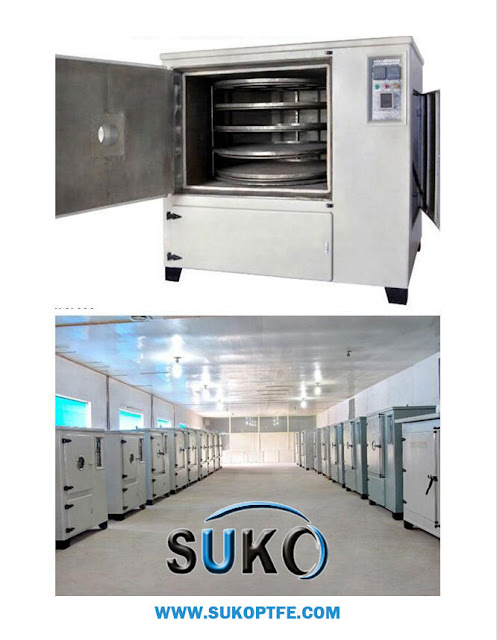
A used in the production of teflon sintering oven, drying oven, including housing, the top surface of box body is set with solar tank and vent, solar-thermal box right side set solar monitoring device, before the end of box set oven door, the right side of box body is provided with electric control cabinet, electric control cabinet set a timing device, temperature control device, inlet valve, exhaust valve and switch button, box body including shell and inner cavity, and setting of between shell and inner cavity has a heat preservation cotton, inner chamber set on two cooling board, two fans and purification device, casing set inside the rack and put tray, put aside content disc set for both have cooling hole, The bottom center of the shelf plate is provided with a connecting disk. The utility model has a simple structure and strong practicability.
Through the combined heating method of solar energy and electric energy, not only the styling effect is improved, but also the service life is extended, the yield rate is increased, the energy consumption is reduced, the cost is saved, and the comprehensive utilization efficiency is improved.
Sintering oven used in the production of ptfe, whose character is: the Sintering oven including enclosure, as described in the top surface of box body is set with solar tank and vent, solar-thermal box right side set solar monitoring device, in the right side of the hole is located in the solar energy collection hot box, the box body front end face of the oven door, oven door includes the first oven door and the oven door and the oven door and described the oven door all set door the mouth and observation, the right side of box body is provided with electric control cabinet, electric control cabinet set timing device, temperature control device, Air intake valve and exhaust valve and switch button, temperature control device is set on the first heating button and the second heating button, switch the power button, button, and explosion-proof fan button button, box includes shell and inner cavity, with mentioned lumen between shell and a heat preservation cotton, inner chamber set on two cooling board, two fans and purification device, both on the heating panel Settings have mica heat sink, purification plant is located in between two mentioned fan, box set inside the rack and put tray, the bottom of the rack set wheels, put aside content disc set for both have cooling hole, Plate center set up at the bottom of the shelf are connecting disk, disk and a partition at connections, on the other side of the baffle plate and described shelf plate connected, put aside material plate is divided into four equal, connecting the center of the disk set has a hole, the bottom of the box body set with wheel groove HeJinKong, wheel to match the wheel groove and the stated, air inlet connected with the outside world.
|
Метки: oven PTFE sintering sintering oven Teflon |
Raw material for molding |
The commonly used molding materials are mainly composed of resin matrix, reinforcing materials, fillers, pigments, etc., and according to the process and performance requirements, the resin matrix is also added with curing agent, thickener, internal release agent, solvent and other additives. Reinforcement material is the skeleton material of die pressing material, which mainly endows die pressing material with excellent mechanical properties and prevents the propagation of micro-cracks. The main varieties of reinforcement materials are various glass fiber felt, no twist roving, no twist coarse gauze, chopped fiber, ground fiber, glass yarn and fabric and other varieties of fiber. The main function of resin matrix in molding material is to bond the reinforcing material and filler together, which not only protects the reinforcing material, but also makes it uniform force under external load. Theoretically, most types of thermoplastic and thermosetting resins can be used as resin matrix materials. There are polyester resin, epoxy resin, amino resin and phenolic resin. A large number of various types of fillers are used in the molding material, the main function of which is to reduce the material cost, improve the process, improve the molding material some physical properties, appearance and give some characteristics. Fillers are mostly in powder form, such as clay, calcium carbonate, talcum powder and some fillers with special performance requirements.
The basic requirements of resin in molding are as follows: good infiltration performance of reinforcing materials and fillers to improve the bonding strength between resin and glass fiber; Resin to have the appropriate: viscosity, good fluidity, so that in the molding process of resin and glass fiber at the same time full of all corners of the cavity, to obtain a balanced strength of the molding products; Resin curing temperature is low, less volatile in the curing process, good technology (such as viscosity easy to adjust, good solubility with various solvents, easy to release mold, etc.), and can meet the mold products specific performance requirements. In addition, from the point of view of application or other point of view, the resin should also meet some other special performance requirements, such as corrosion resistance, heat resistance and so on. From the perspective of production efficiency, fast curing speed of resin is required, but for some large products with complex structure and higher requirements, the curing speed should be properly controlled. Resin curing after high mechanical strength, good toughness, avoid from the mold when taken out, in the case of bending cracking or breaking. Therefore, the selection of resin, will become a very important factor affecting the whole process.
Molding products are commonly used in thermosetting resin, thermoplastic resin in the molding process of the application of less. The main thermosetting resins are phenolic resin, epoxy resin, epoxy phenolic resin, polyvinyl butanal resin, unsaturated polyester resin, etc.

The commonly used molding materials are mainly composed of resin matrix, reinforcing materials, fillers, pigments, etc., and according to the process and performance requirements, the resin matrix is also added with curing agent, thickener, internal release agent, solvent and other additives. Reinforcement material is the skeleton material of die pressing material, which mainly endows die pressing material with excellent mechanical properties and prevents the propagation of micro-cracks. The main varieties of reinforcement materials are various glass fiber felt, no twist roving, no twist coarse gauze, chopped fiber, ground fiber, glass yarn and fabric and other varieties of fiber. The main function of resin matrix in molding material is to bond the reinforcing material and filler together, which not only protects the reinforcing material, but also makes it uniform force under external load. Theoretically, most types of thermoplastic and thermosetting resins can be used as resin matrix materials. There are polyester resin, epoxy resin, amino resin and phenolic resin. A large number of various types of fillers are used in the molding material, the main function of which is to reduce the material cost, improve the process, improve the molding material some physical properties, appearance and give some characteristics. Fillers are mostly in powder form, such as clay, calcium carbonate, talcum powder and some fillers with special performance requirements.
The basic requirements of resin in molding are as follows: good infiltration performance of reinforcing materials and fillers to improve the bonding strength between resin and glass fiber; Resin to have the appropriate: viscosity, good fluidity, so that in the molding process of resin and glass fiber at the same time full of all corners of the cavity, to obtain a balanced strength of the molding products; Resin curing temperature is low, less volatile in the curing process, good technology (such as viscosity easy to adjust, good solubility with various solvents, easy to release mold, etc.), and can meet the mold products specific performance requirements. In addition, from the point of view of application or other point of view, the resin should also meet some other special performance requirements, such as corrosion resistance, heat resistance and so on. From the perspective of production efficiency, fast curing speed of resin is required, but for some large products with complex structure and higher requirements, the curing speed should be properly controlled. Resin curing after high mechanical strength, good toughness, avoid from the mold when taken out, in the case of bending cracking or breaking. Therefore, the selection of resin, will become a very important factor affecting the whole process.
Molding products are commonly used in thermosetting resin, thermoplastic resin in the molding process of the application of less. The main thermosetting resins are phenolic resin, epoxy resin, epoxy phenolic resin, polyvinyl butanal resin, unsaturated polyester resin, etc.
|
Метки: Molding Molding Machine Molding materials pressing PTFE teflon products |
The molding process of the press automatic Moulding Machine |
Is moulded plastic processing and molding the application in the city one of the oldest technology. It has a mature production technology, equipment and mold is simple, easy to forming large products, can use multiple modes to improve the production of small parts, etc, in machinery, electronics, transportation and daily life, and many other fields has been widely used.
The market will often see a lot of kinds of Press Moulding Machine, for example: Polymer/PTFE Push press Automatic Moulding Machine, Polymer/PTFE Flange press Automatic Moulding Machine, Polymer/PTFE gasket automatic Moulding Machine, Semi-automatic Molding Machine and so on.
Molding is widely used in the following fields:
Electrical: insulator, switch box, electrical equipment housing, insulation tools, wiring board, etc.
Automobile: lamp shade, front and rear bumper, battery bracket, engine soundproof board, etc.
Railway: window frame of vehicle, toilet components, seats, table tops, siding and roof of carriage, etc.
Construction: water tank, bath products, door panels, purification tank, building template, etc.
Bathroom: bathtub, integral bathroom equipment, integrated wash basin, etc.
And other areas of industry and agriculture.
Molding technology is a method of putting quantitative molding materials (powder, granular or fibrous plastic) into the metal mold and forming products under the action of temperature and pressure. During the molding process, heat and pressure are required to melt (or plasticize) the molding material, fill the mold cavity with flow, and make the resin solidify. The principle is that the process of pressurizing, shaping and heating depends on the closure of the heated mold.
Moulding Machine technology is the oldest molding method in plastic processing technology. Because of its long history, the molding technology has been quite mature, at present in thermosetting plastics and some thermoplastic plastics (fluoroplastics, uhmwpe, polyimide, etc.) processing is still the most widely used and the main position of the molding method. Moulded thermosetting plastic, placed in the cavity of the thermosetting plastic under the action of heat, first changed from solid to melt, melt flow under pressure with the shape of the cavity and cavity has given, as the crosslinking reaction, resin molecular weight increased, the curing degree rise, moulding material viscosity increase gradually and becomes solid, finally becomes demoulding products. Thermoplastic plastic mold pressure, in the previous stage of the situation and thermosetting Plastic the same, but because there is no cross-linking reaction, so in the flow of full cavity, the mold must be cooled to make its molten plastic into a solid with a constant strength can be demodulated into products. Because thermoplastic plastic mold pressing mold needs to alternately heating and cooling, production cycle is long, so thermoplastic products generally choose injection molding method more economic, only in the mold larger plane of Plastic products or because of the flow of thermoplastic plastic injection molding method is difficult to use molding.
In the mold press material filled with the mold cavity flow process, not only the resin flow, the reinforcement material also to flow, so the mold press molding process molding pressure is higher than other process methods, belongs to the high pressure molding. Therefore, it needs not only the hydraulic press which can control the pressure, but also the high strength, high precision and high temperature resistant metal die.

Is moulded plastic processing and molding the application in the city one of the oldest technology. It has a mature production technology, equipment and mold is simple, easy to forming large products, can use multiple modes to improve the production of small parts, etc, in machinery, electronics, transportation and daily life, and many other fields has been widely used.
The market will often see a lot of kinds of Press Moulding Machine, for example: Polymer/PTFE Push press Automatic Moulding Machine, Polymer/PTFE Flange press Automatic Moulding Machine, Polymer/PTFE gasket automatic Moulding Machine, Semi-automatic Molding Machine and so on.
Molding is widely used in the following fields:
Electrical: insulator, switch box, electrical equipment housing, insulation tools, wiring board, etc.
Automobile: lamp shade, front and rear bumper, battery bracket, engine soundproof board, etc.
Railway: window frame of vehicle, toilet components, seats, table tops, siding and roof of carriage, etc.
Construction: water tank, bath products, door panels, purification tank, building template, etc.
Bathroom: bathtub, integral bathroom equipment, integrated wash basin, etc.
And other areas of industry and agriculture.
Molding technology is a method of putting quantitative molding materials (powder, granular or fibrous plastic) into the metal mold and forming products under the action of temperature and pressure. During the molding process, heat and pressure are required to melt (or plasticize) the molding material, fill the mold cavity with flow, and make the resin solidify. The principle is that the process of pressurizing, shaping and heating depends on the closure of the heated mold.
Moulding Machine technology is the oldest molding method in plastic processing technology. Because of its long history, the molding technology has been quite mature, at present in thermosetting plastics and some thermoplastic plastics (fluoroplastics, uhmwpe, polyimide, etc.) processing is still the most widely used and the main position of the molding method. Moulded thermosetting plastic, placed in the cavity of the thermosetting plastic under the action of heat, first changed from solid to melt, melt flow under pressure with the shape of the cavity and cavity has given, as the crosslinking reaction, resin molecular weight increased, the curing degree rise, moulding material viscosity increase gradually and becomes solid, finally becomes demoulding products. Thermoplastic plastic mold pressure, in the previous stage of the situation and thermosetting Plastic the same, but because there is no cross-linking reaction, so in the flow of full cavity, the mold must be cooled to make its molten plastic into a solid with a constant strength can be demodulated into products. Because thermoplastic plastic mold pressing mold needs to alternately heating and cooling, production cycle is long, so thermoplastic products generally choose injection molding method more economic, only in the mold larger plane of Plastic products or because of the flow of thermoplastic plastic injection molding method is difficult to use molding.
In the mold press material filled with the mold cavity flow process, not only the resin flow, the reinforcement material also to flow, so the mold press molding process molding pressure is higher than other process methods, belongs to the high pressure molding. Therefore, it needs not only the hydraulic press which can control the pressure, but also the high strength, high precision and high temperature resistant metal die.
|
Метки: PTFE,Polymer plastic push gasket press Automatic Moulding Molding Machine |
Study on hydrophilic modification of ptfe microporous membrane |
At present, water pollution and water shortage have seriously threatened people's life safety. For a long time, the treatment of water pollution has been the focus of environmental protection. Membrane technology has been one of the mainstream treatment methods because of its green environmental protection, sustainability, rapid and efficient separation process and other advantages, and has achieved good results. PTFE microporous membrane material has been concerned and studied by international scholars for its excellent chemical resistance, high porosity and good mechanical properties. However, PTFE microporous membrane has the characteristics of low surface energy and high hydrophobicity, which greatly limits its application in the field of water treatment. Therefore, improving the hydrophilicity of PTFE microporous membrane has become an important research direction.
In this paper, polyvinyl alcohol (PVA) and chitosan or oxycarboxymethyl chitosan were used as hydrophilic agents. Different crosslinking agents were used to wrap a hydrogel hydrophilic coating on PTFE microporous membrane fiber through crosslinking reaction, so as to realize the hydrophilic modification of PTFE microporous membrane.
Specifically, the following two parts of the study were carried out:
(1) polyvinyl alcohol (PVA) with good hydrophilic property and chitosan (CS) with good antibacterial property were selected as materials to modify PTFE microporous membrane by combining hydrogel coating formed by epichlorohydrin crosslinking with SiO2 nanoparticles in situ under alkaline conditions.
The experimental results showed that the fiber surface of modified PTFE microporous film was coated with a layer of hydrogel, and the hydrogel coating attached a large number of solid particles to the node, which improved the surface roughness and reduced the average pore diameter and porosity slightly. Hydroxyl and amino groups appeared on the surface of modified film. New elements N,O,Si appeared on the surface of modified membrane. With the increase of PVA solution concentration, the water flux of the modified membrane first increases and then decreases, and the contact Angle of the membrane surface first decreases and then tends to be stable. With the increase of reaction time, the water flux of the modified membrane first increased and then decreased. With the increase of reaction temperature, the water flux of the modified membrane increases first and then decreases, and the contact Angle of the membrane surface decreases first and then increases. The optimal reaction conditions are :PVA solution concentration is 1wt%,CS solution concentration is 0.3wt%, the mass ratio of CS solution to PVA solution is 1:1. The reaction time is 6h, the reaction temperature is 40℃, the reaction pH is 12, and the water dilution ratio in the secondary treatment is 45 times (PBA:SiO2=1:2.5).
The contact Angle of hydrophilic modified PTFEmicroporous membrane decreased from 136° to 48°, and the pure water flux reached 3172L·m-2·h-1.The experimental results of oil in water emulsion separation of hydrophilic modified PTFE microporous membrane show that the hydrophilic modified PTFE microporous membrane has good anti-oil properties and oil retention rate of 97%.The physical and chemical stability of hydrophilic PTFE microporous membrane shows that the hydrophilic PTFE microporous membrane has good acid resistance and washing resistance.
(2) PTFE microporous membrane was modified with polyvinyl alcohol (PVA) and oxygen carboxymethyl chitosan (OCMCS) by crosslinking with glutaraldehyde under acidic conditions.
The results showed that the fiber surface of PTFE microporous membrane was covered with a hydrogel coating, and the surface of PTFE microporous membrane still retained the original three-dimensional network structure. Hydrophilic hydroxyl and amino groups appeared on the surface of PTFE microporous membrane. With the increase of PVA content in the reaction solution, the water flux of the modified membrane increases first and then decreases, and the contact Angle decreases first and then increases. With the increase of reaction temperature, the water flux of modified membrane increases first and then decreases, and the contact Angle decreases first and then increases. With the increase of reaction time, the water flux of modified membrane first increases and then decreases, and the contact Angle first decreases and then increases.
The optimal experimental conditions were as follows: mass ratio of OCMCS/PVA was 1:1, the amount of 5wt% glutaraldehyde and 1wt% hydrochloric acid solution was 2.5ml and 1mL, the reaction time was 6h, and the temperature was 50℃.The ptfe-pva /OCMCS membrane prepared has a larger water flux of 4480.89L·m-2·h-1 and a contact Angle of 57.48°.The anti-pollution test results of PTFE microporous membrane with hydrophilic modification showed that ptfe-pva /OCMCS membrane had good anti-bsa adsorption ability. The results of long time washing showed that ptfe-pva /OCMCS film had good physical stability.

At present, water pollution and water shortage have seriously threatened people's life safety. For a long time, the treatment of water pollution has been the focus of environmental protection. Membrane technology has been one of the mainstream treatment methods because of its green environmental protection, sustainability, rapid and efficient separation process and other advantages, and has achieved good results. PTFE microporous membrane material has been concerned and studied by international scholars for its excellent chemical resistance, high porosity and good mechanical properties. However, PTFE microporous membrane has the characteristics of low surface energy and high hydrophobicity, which greatly limits its application in the field of water treatment. Therefore, improving the hydrophilicity of PTFE microporous membrane has become an important research direction.
In this paper, polyvinyl alcohol (PVA) and chitosan or oxycarboxymethyl chitosan were used as hydrophilic agents. Different crosslinking agents were used to wrap a hydrogel hydrophilic coating on PTFE microporous membrane fiber through crosslinking reaction, so as to realize the hydrophilic modification of PTFE microporous membrane.
Specifically, the following two parts of the study were carried out:
(1) polyvinyl alcohol (PVA) with good hydrophilic property and chitosan (CS) with good antibacterial property were selected as materials to modify PTFE microporous membrane by combining hydrogel coating formed by epichlorohydrin crosslinking with SiO2 nanoparticles in situ under alkaline conditions.
The experimental results showed that the fiber surface of modified PTFE microporous film was coated with a layer of hydrogel, and the hydrogel coating attached a large number of solid particles to the node, which improved the surface roughness and reduced the average pore diameter and porosity slightly. Hydroxyl and amino groups appeared on the surface of modified film. New elements N,O,Si appeared on the surface of modified membrane. With the increase of PVA solution concentration, the water flux of the modified membrane first increases and then decreases, and the contact Angle of the membrane surface first decreases and then tends to be stable. With the increase of reaction time, the water flux of the modified membrane first increased and then decreased. With the increase of reaction temperature, the water flux of the modified membrane increases first and then decreases, and the contact Angle of the membrane surface decreases first and then increases. The optimal reaction conditions are :PVA solution concentration is 1wt%,CS solution concentration is 0.3wt%, the mass ratio of CS solution to PVA solution is 1:1. The reaction time is 6h, the reaction temperature is 40℃, the reaction pH is 12, and the water dilution ratio in the secondary treatment is 45 times (PBA:SiO2=1:2.5).
The contact Angle of hydrophilic modified PTFEmicroporous membrane decreased from 136° to 48°, and the pure water flux reached 3172L·m-2·h-1.The experimental results of oil in water emulsion separation of hydrophilic modified PTFE microporous membrane show that the hydrophilic modified PTFE microporous membrane has good anti-oil properties and oil retention rate of 97%.The physical and chemical stability of hydrophilic PTFE microporous membrane shows that the hydrophilic PTFE microporous membrane has good acid resistance and washing resistance.
(2) PTFE microporous membrane was modified with polyvinyl alcohol (PVA) and oxygen carboxymethyl chitosan (OCMCS) by crosslinking with glutaraldehyde under acidic conditions.
The results showed that the fiber surface of PTFE microporous membrane was covered with a hydrogel coating, and the surface of PTFE microporous membrane still retained the original three-dimensional network structure. Hydrophilic hydroxyl and amino groups appeared on the surface of PTFE microporous membrane. With the increase of PVA content in the reaction solution, the water flux of the modified membrane increases first and then decreases, and the contact Angle decreases first and then increases. With the increase of reaction temperature, the water flux of modified membrane increases first and then decreases, and the contact Angle decreases first and then increases. With the increase of reaction time, the water flux of modified membrane first increases and then decreases, and the contact Angle first decreases and then increases.
The optimal experimental conditions were as follows: mass ratio of OCMCS/PVA was 1:1, the amount of 5wt% glutaraldehyde and 1wt% hydrochloric acid solution was 2.5ml and 1mL, the reaction time was 6h, and the temperature was 50℃.The ptfe-pva /OCMCS membrane prepared has a larger water flux of 4480.89L·m-2·h-1 and a contact Angle of 57.48°.The anti-pollution test results of PTFE microporous membrane with hydrophilic modification showed that ptfe-pva /OCMCS membrane had good anti-bsa adsorption ability. The results of long time washing showed that ptfe-pva /OCMCS film had good physical stability.
|
Метки: PTFE Teflon membrane PTFE membrane Teflon membrane coating |
Study on preparation and technology of ptfe hollow fiber membrane |
Hollow fiber membrane is widely used in traditional and new membrane separation components such as ultrafiltration, microfiltration, reverse osmosis and gas separator due to its small area, high filling density, high utilization rate, easy to enlarge and easy to clean.In addition, polytetrafluoroethylene hollow fiber membrane has high mechanical strength, acid and alkali resistance, high and low temperature resistance, low friction coefficient on the surface, so it has great potential in special filtration, gas absorption, ozone dissolution filtration, membrane distillation and other fields.PTFE hollow fiber membrane was prepared by using PTFE dispersion resin as raw material and adding exxonmobil Isopar series lubricants through extrusion and stretching molding.
Average extrusion pressure, pore diameter and bubble point pressure, porosity, water flux, contact Angle, SEM and DSC were used to characterize the structure and performance of PTFE hollow fiber membrane.The experiment mainly discusses the influences of lubricants (types and ratios), extrusion process (compression ratio, length-diameter ratio and cone Angle) and tensile sintering process on PTFE structure and performance, and optimizes the process parameters to provide guidance for PTFE hollow fiber membrane production.
Specific research contents are as follows:
(a) the experiment changed the lubricant parameters (including the type and ratio of lubricants) and prepared PTFE hollow fiber membrane through the process route of "mixing → pre-molding → extrusion → stretching → sintering → natural cooling".The experiment explored the influence of lubricant type and ratio on the structure and performance of PTFE hollow fiber membrane, and obtained the best combination of lubricant type and ratio and optimized lubricant.
(b) by changing the parameters of extrusion process molds, the influences of RR, L/D and alpha on extrusion pressure, membrane fracture strength, average pore diameter, bubble point pressure, porosity and water flux were explored to obtain the best extrusion parameters.
(c) By adjusting the tensile process parameters (tensile multiple and tensile temperature) and sintering process parameters (sintering temperature and sintering time), the influences of tensile sintering process on the average pore diameter, bubble point pressure, porosity and water flux of PTFE hollow fiber membrane were explored to obtain the optimal tensile sintering process parameters and optimize the tensile sintering process.
Experimental results show that:
(1) PTFE hollow fiber membrane has small average pore diameter, high bubble point pressure and porosity, large water flux fracture strength and contact Angle, and low extrusion pressure in the extrusion process.When the lubricant content is too high or too low, the structure and properties of PTFE hollow fiber membrane will be adversely affected to some extent.
(2) When RR=185, L/D=20, and alpha =40°, the extrusion pressure is low, the fracture strength is large, the average pore diameter is small, the bubble point pressure is high, the porosity is large, and the water flux is high, which can be used as the extrusion process parameters of excellent PTFE hollow fiber membrane.
The influences of tensile and sintering processes on the microstructure and properties of PTFE hollow fiber membrane are as follows: with the increase of tensile multiple, the average pore size and porosity of PTFE hollow fiber membrane are large, the bubble point pressure is small, and the water flux is large.With the increase of tensile temperature, the average pore diameter and water flux of PTFE hollow fiber membrane increase, the porosity increases, and the bubble point pressure decreases.With the increase of sintering temperature, the pore diameter, bubble point pressure and water flux of PTFE hollow fiber membrane decrease, and the porosity has no obvious change rule.With the increase of sintering time, the average pore diameter, porosity and water flux of PTFE hollow fiber membrane increase, and the bubble point pressure decreases.
The drawing process significantly reduces the crystallinity of PTFE products, while the sintering process further reduces the crystallinity of PTFE products.When the tensile multiple is 100%, the tensile temperature is 300℃, the sintering temperature is 320℃ and the sintering time is 5min, the average pore diameter of hollow fiber membrane is small, and the bubble point pressure, porosity and water flux are large.

|
Метки: extrusion PTFE PTFE hollow fiber PTFE Products |
PTFE and ZnO/PTFE coatings displayed good wear resistance |
Superhydrophobic surfaces that mimic surfaces found in nature, such as the lotus leaf, are an attractive research topic in various fields of study because of their numerous applications. More recent studies have focused on superhydrophobic surfaces that reduce or completely stop the accretion of ice and snow on power lines and aircraft that operate in cold regions. The superhydrophobic phenomena is usually achieved by creating a dual-scale roughness that is composed of micro- and nano-scale structures that trap air in-between themselves and reduce the surface energy of the textured surface.
The objective of this study was to assess the tribological behavior of micro/nano particle based superhydrophobic coating mixtures composed of PTFE, composite PTFE/PEEK, diatomaceous earth (DE), and composite PTFE/ZnO that can be potential candidates for anti-wetting and anti-icing applications for transportation systems. A contact profilometer was used to measure and characterize the average roughness and thickness of coatings. Coating wettability was assessed by measuring the tangent-line contact angle of static water drops on coated surfaces. Friction and cyclic abrasive wear tests were conducted via ball-on-flat tribometer using a spherical tungsten probe at room temperature. Scanning electron microscopy was used to characterize the physical and chemical properties of the coatings and identify the wear mechanisms.
The results showed that all coatings except ZnO/PTFE exhibited superhydrophobicity. Abrasive wear mechanisms were the dominant modes for the coatings. PTFE and ZnO/PTFE coatings displayed good wear resistance, superior to that of the DE and PTFE/PEEK coatings.
|
Метки: PTFE ptfe coating coating PEEK Plastic |
Study on related properties of ptfe |
1. Properties of polytetrafluoroethylene modified epdm rubber
EPDM modified by polytetrafluoroethylene (PTFE) and nano silicon dioxide (SiO2) was prepared by vulcanization. Scanning electron microscope and infrared spectrum showed that PTFE and EPDM had good compatibility. DSC test showed that the composite had a unique glass transition temperature. When PTFE is added in 5 parts, PTFE and EPDM have a good compatibility. At this time, mechanical properties of epdm-ptfe reach the highest, and its tensile strength, elongation at break, hardness and tear strength are 22.42mpa, 588.91%, 82.0° and 49.60 kN/m respectively. Thermogravimetric analysis and aging experiments show that the aging and heat resistance of PTFE are improved. The mechanical properties of EPDM were also significantly improved after adding 5 parts of nano SiO2.
2. Structure and properties of polytetrafluoroethylene hot-rolled fiber membrane
PTFE fiber membranes were prepared by hot rolling process and orthogonal design. Scanning electron microscope (SEM) was used to observe the surface morphology of the fiber membrane, and its thickness, permeability, aperture, porosity, tensile properties, acid and alkali corrosion resistance were tested and evaluated. The results showed that PTFE hot-rolled fiber film thickness was 0.12 ~ 0.15 mm, permeability was 80 ~ 101 mm/s, pore diameter was 14 ~ 17 ms, porosity was 14.57% ~ 27.04%, fracture strength was 38 ~ 59 N, elongation at break was 30% ~ 38%.In the 9 kinds of fiber membranes, there are still a lot of fibrous structures except the fiber melting on some surfaces. After acid and alkali treatment, the tensile properties of the fiber membrane remained unchanged. According to the orthogonal test results, the fiber mesh density has the greatest influence on the thickness, permeability, pore diameter and tensile properties of the fiber membrane, and with the increase of fiber mesh density, the permeability and pore diameter of the fiber membrane decrease, while the thickness and fracture strength increase.
3. Structure and properties of polytetrafluoroethylene/polypropylene hybrid melt jet filter material
In order to extend the storage time of static charge on the surface of polypropylene (PP) melt-blown materials, the storage capacity of static charge was improved by organic hybridization. In the experiment, PTFE ultrafine powder and PP slice were mixed to granulate in a certain proportion, and different nonwoven materials were obtained by melt-jet molding process. The structure and performance of the nonwoven materials, such as apparent morphology, micropores, surface electrostatic potential and filtration efficiency, were studied, and external corona electret technology was adopted to make the material surface carry static charge. The test results show that adding PTFE can effectively improve the storage capacity of static charge of melt-jet PP nonwoven materials, and when PTFE mass fraction is 0.1%, the surface static voltage is the highest, the filtration performance is the best and the static charge stability is the best.

1. Properties of polytetrafluoroethylene modified epdm rubber
EPDM modified by polytetrafluoroethylene (PTFE) and nano silicon dioxide (SiO2) was prepared by vulcanization. Scanning electron microscope and infrared spectrum showed that PTFE and EPDM had good compatibility. DSC test showed that the composite had a unique glass transition temperature. When PTFE is added in 5 parts, PTFE and EPDM have a good compatibility. At this time, mechanical properties of epdm-ptfe reach the highest, and its tensile strength, elongation at break, hardness and tear strength are 22.42mpa, 588.91%, 82.0° and 49.60 kN/m respectively. Thermogravimetric analysis and aging experiments show that the aging and heat resistance of PTFE are improved. The mechanical properties of EPDM were also significantly improved after adding 5 parts of nano SiO2.
2. Structure and properties of polytetrafluoroethylene hot-rolled fiber membrane
PTFE fiber membranes were prepared by hot rolling process and orthogonal design. Scanning electron microscope (SEM) was used to observe the surface morphology of the fiber membrane, and its thickness, permeability, aperture, porosity, tensile properties, acid and alkali corrosion resistance were tested and evaluated. The results showed that PTFE hot-rolled fiber film thickness was 0.12 ~ 0.15 mm, permeability was 80 ~ 101 mm/s, pore diameter was 14 ~ 17 ms, porosity was 14.57% ~ 27.04%, fracture strength was 38 ~ 59 N, elongation at break was 30% ~ 38%.In the 9 kinds of fiber membranes, there are still a lot of fibrous structures except the fiber melting on some surfaces. After acid and alkali treatment, the tensile properties of the fiber membrane remained unchanged. According to the orthogonal test results, the fiber mesh density has the greatest influence on the thickness, permeability, pore diameter and tensile properties of the fiber membrane, and with the increase of fiber mesh density, the permeability and pore diameter of the fiber membrane decrease, while the thickness and fracture strength increase.
3. Structure and properties of polytetrafluoroethylene/polypropylene hybrid melt jet filter material
In order to extend the storage time of static charge on the surface of polypropylene (PP) melt-blown materials, the storage capacity of static charge was improved by organic hybridization. In the experiment, PTFE ultrafine powder and PP slice were mixed to granulate in a certain proportion, and different nonwoven materials were obtained by melt-jet molding process. The structure and performance of the nonwoven materials, such as apparent morphology, micropores, surface electrostatic potential and filtration efficiency, were studied, and external corona electret technology was adopted to make the material surface carry static charge. The test results show that adding PTFE can effectively improve the storage capacity of static charge of melt-jet PP nonwoven materials, and when PTFE mass fraction is 0.1%, the surface static voltage is the highest, the filtration performance is the best and the static charge stability is the best.
|
Метки: Keywords: ptfe polytetrafluoroethylene Teflon ptfe properties |
Introduction to steel lined teflon tube |
Firstly, imported PTFE powder is used to push (squeeze) the teflon tube, and then it is forced into seamless steel tube (liner outer diameter is slightly larger than tube inner diameter 1.5-2mm) to form a tight liner without clearance.In order to eliminate the pressure, it is put in the furnace, heated to 180℃ for constant temperature treatment, so that it can be used in the temperature below 180℃.At the same time, the axial tensile strength of push tube is better than that of wound tube.The pipeline has ideal positive and negative pressure resistance.
PTFE powder moulding method is a kind of body, such as pressure, such as isothermal manufacturing technology, through the extruded tube (loose lining, lining) of PTFE, PTFE belt winding and winding plus steel wire, and steel net within process of evolution, the PTFE lining powder compression molding technology is by far the PTFE lining the latest fifth-generation products, can be at a higher pressure, high temperature, strong corrosion under the conditions of use, the temperature below 200 ℃ and vacuum is 0.096 MPa, quenching heat or alternating operation, won't make PTFE grassroots fall off, the drum, expansion deformation of flat, thereby the fluorine steel body.
Chemical properties of steel lined teflon tube:
Air aging resistance: radiation resistance and low permeability: long-term exposure to the atmosphere, the surface and performance remain unchanged.
Non-flammability: the oxygen limit index is below 90.
Acid and alkali resistance: insoluble in strong acids, strong bases and organic solvents.
Oxidation resistance: resistant to corrosion of strong oxidants.
Steel lined teflon tube working characteristics:
Performance: working temperature of medium: -100℃~-250℃
Working pressure of medium: positive pressure: 2.5mpa, with negative pressure of 70KPa at normal temperature
Corrosion resistance: steel ptfe composite pipe, in addition to molten metal lithium, potassium, sodium, chlorine trifluoride, high temperature trifluoride oxygen, high flow rate of liquid fluorine, it can resist almost all chemical media, including concentrated nitric acid and aqua aqua corrosion, it can work for a long time in the temperature of 230℃-250℃.Steel polyvinylidene fluoride or other vinylidene fluoride composite pipe, halogen, halogenated hydrocarbon, strong oxidant, boiling acid, alkali, a variety of organic solvents have good corrosion resistance, but not resistant to smoke sulfuric acid, concentrated hot sulfuric acid and nitric acid, 90℃ above ketone, ester, amine and high temperature sulfonating agent corrosion.
Application fields of steel lined teflon pipeline:
Steel lined tetrafluoroethylene pipe is suitable for strong corrosive gas and liquid under high temperature, other types of steel plastic composite pipe and metal pipe are not suitable for conveying medium, steel ptfe composite pipe is suitable for all.In addition, steel polyvinylidene fluoride composite pipe suitable for the transport of corrosive media at the working temperature of -40℃~+150℃.

|
Метки: teflon PTFE teflon tube PTFE lining |
PTFE COATING |
PTFE high performance special coating is based on polytetrafluoroethylene resin fluorocoating, the English name is Teflon, because of the pronunciation, often called Teflon and so on (all for Teflon translation). PTFE (teflon) coating is a unique high performance coating, combining heat resistance, chemical inertia, excellent insulation stability and low friction, with comprehensive advantages that no other coating can compete with, its application flexibility makes it can be used in almost all shapes and sizes of products.
Teflon is divided into PTFE, FEP, PFA and ETFE basic types:
· Teflon PTFE: PTFE (Polyfluortetraethylene) non-stick coating can be used continuously at 260℃, with maximum operating temperature of 290-300℃, extremely low friction coefficient, good wear resistance and excellent chemical stability.
· Teflon FEP: FEP (Ethylene fluoride propylene copolymer) non-stick coating forms non-porous film in the melting flow during baking, with excellent chemical stability and excellent non-stick characteristics, and the maximum operating temperature is 200℃.
· Teflon PFA: PFA (Perfluoroalkylate) nonstick coating, like FEP, forms nonporous film by melting flow during baking.PFA has the advantage of higher continuous service temperature of 260℃ and stronger toughness, especially suitable for use in the field of anti-viscosity and chemical resistance at high temperature.
· Teflon ETFE: ETFE is a copolymer of ethylene and tetrafluoroethylene. The resin is the strongest fluoropolymer and can form a highly durable coating with excellent chemical resistance and can work continuously at 150℃.
After coating with teflon, it has the following characteristics:
1, Non-viscosity: almost all materials do not bond with PTFE film.Very thin film also shows good non - adhesion properties.
2, Heat resistance: PTFE coating film has excellent heat and low temperature resistance characteristics.It can withstand high temperature to 300℃ in a short time and can be used continuously between 240℃ and 260℃ in general. It has remarkable thermal stability. It can work at freezing temperature without embrittlement and without melting at high temperature.
3, Sliding: PTFE coating film has a lower friction coefficient.The friction coefficient changes when the load slides, but the value is only between 0.05 and 0.15.
4, Moisture resistance: PTFE coating surface does not stick to water and oil, and it is not easy to stick to solution during production operation. If there is a small amount of dirt, it can be removed simply by wiping.Short downtime, save time and improve work efficiency.
5, Wear resistance: under high load, with excellent wear resistance.Under a certain load, it has the double advantages of wear resistance and non-adhesion.
6. Corrosion resistance: teflon is almost impervious to drugs and can protect parts from any kind of chemical corrosion.
Ptfe is a polymer of tetrafluoroethylene.The abbreviation is PTFE. It's called teflon. It is known as the "king of plastics".The basic structure of ptfe is. - cf2-cf2-cf2-cf2-cf2-cf2-cf2-cf2 - ptfe is widely used in a variety of acid and alkali resistance and organic solvents, it is not toxic to humans, but perfluorooctanoic acid ammonium (PFOA), one of the raw materials used in the production process, is thought to have carcinogenic effects.
PTFE high performance special coating is based on polytetrafluoroethylene resin fluorocoating, the English name is Teflon, because of the pronunciation, often called Teflon and so on (all for Teflon translation). PTFE (teflon) coating is a unique high performance coating, combining heat resistance, chemical inertia, excellent insulation stability and low friction, with comprehensive advantages that no other coating can compete with, its application flexibility makes it can be used in almost all shapes and sizes of products.
Teflon is divided into PTFE, FEP, PFA and ETFE basic types:
· Teflon PTFE: PTFE (Polyfluortetraethylene) non-stick coating can be used continuously at 260℃, with maximum operating temperature of 290-300℃, extremely low friction coefficient, good wear resistance and excellent chemical stability.
· Teflon FEP: FEP (Ethylene fluoride propylene copolymer) non-stick coating forms non-porous film in the melting flow during baking, with excellent chemical stability and excellent non-stick characteristics, and the maximum operating temperature is 200℃.
· Teflon PFA: PFA (Perfluoroalkylate) nonstick coating, like FEP, forms nonporous film by melting flow during baking.PFA has the advantage of higher continuous service temperature of 260℃ and stronger toughness, especially suitable for use in the field of anti-viscosity and chemical resistance at high temperature.
· Teflon ETFE: ETFE is a copolymer of ethylene and tetrafluoroethylene. The resin is the strongest fluoropolymer and can form a highly durable coating with excellent chemical resistance and can work continuously at 150℃.
After coating with teflon, it has the following characteristics:
1, Non-viscosity: almost all materials do not bond with PTFE film.Very thin film also shows good non - adhesion properties.
2, Heat resistance: PTFE coating film has excellent heat and low temperature resistance characteristics.It can withstand high temperature to 300℃ in a short time and can be used continuously between 240℃ and 260℃ in general. It has remarkable thermal stability. It can work at freezing temperature without embrittlement and without melting at high temperature.
3, Sliding: PTFE coating film has a lower friction coefficient.The friction coefficient changes when the load slides, but the value is only between 0.05 and 0.15.
4, Moisture resistance: PTFE coating surface does not stick to water and oil, and it is not easy to stick to solution during production operation. If there is a small amount of dirt, it can be removed simply by wiping.Short downtime, save time and improve work efficiency.
5, Wear resistance: under high load, with excellent wear resistance.Under a certain load, it has the double advantages of wear resistance and non-adhesion.
6. Corrosion resistance: teflon is almost impervious to drugs and can protect parts from any kind of chemical corrosion.
Ptfe is a polymer of tetrafluoroethylene.The abbreviation is PTFE. It's called teflon. It is known as the "king of plastics".The basic structure of ptfe is. - cf2-cf2-cf2-cf2-cf2-cf2-cf2-cf2 - ptfe is widely used in a variety of acid and alkali resistance and organic solvents, it is not toxic to humans, but perfluorooctanoic acid ammonium (PFOA), one of the raw materials used in the production process, is thought to have carcinogenic effects.
|
Метки: ptfe coating teflon ptfe teflon PTFE |
Study on ptfe tape as root canal isolation material in oral cavity |
PTFE tape, which is commonly used as plumber’s tape is an inorganic, non-fibrous, ribbon like material. The aim of this study was to evaluate PTFE tape as endodontic spacer material and to compare it with commonly used spacer material that is cotton, in primary teeth.;Seventeen children undergoing pulpectomy of lower second primary molar bilaterally were included in the study.
Cotton and PTFE tape were placed as spacers on each side randomly. Samples were taken from the access cavity at baseline and after seven days to check for microbial leakage. Spacer materials were also checked for microbial contamination.;The results revealed that there was a significant increase in the bacterial colony count after seven days in cotton group. The access cavities were also positive for microbial leakage in the cotton group where the spacers showed positive growth. In PTFE group only two samples showed microbial contamination of spacer and out of two only one sample showed contamination of access cavity along with spacer.;Within the limitations of this study, it can be concluded that PTFE tape performed better than cotton as endodontic spacer material.
Thus, PTFE tape can be recommended as an endodontic spacer material as an alternative to cotton in primary teeth.

|
Метки: PTFE PTFE Tape Teflon |
Introduction of ptfe welding process |
Steel lined ptfe equipment is usually made with discharge port, feed port, perspective mirror, etc., but how to successfully apply this kind of pipe port in the complex head intersecting line, of course, our answer is welding, then how to welding?How to control the temperature of ptfe welding?Below we tell one by one.
1, ptfe head pipe mouth production
PTFE pipe welding on sealing head to first of all, we should make PTFE sealing head nozzle, according to the size of the nozzle diameter steel head and according to certain proportion by using powder moulding process manufacturing nozzle, 8 hours of sintered under the 380 plus or minus 5 degrees Celsius, after the completion of the sintering good nozzle with lathe car to the right size, to the congratulations of PTFE tube at this moment you have finished.
2, ptfe head opening
Put the extracted head into the steel head, and use the principle of light transmission to accurately open the head, pay attention to the ptfe head must be consistent with the steel head, or the final equipment is prone to bulge, rupture and other potential hazards.
3, ptfe pipe mouth welding
By the first two steps, we can carry out PTFE welding. Here we know that there are two ways of welding (hot pressure welding and hot air welding). We will explain them one by one.
(1) hot pressure welding
Before hot pressure welding we should know the necessary theoretical knowledge, hot pressure welding is a kind of hot welding, provide sufficient heat and enough pressure.Here, we must ensure that the welding interface temperature must reach 673.15k and the pressure reaches 1-2mpa. Therefore, in order to ensure the welding, we need to make corresponding molds to ensure the successful completion of the thermal pressure welding.When all is done, the FEP film can be welded by pressurizing and heating the interface between the nozzle and the head.
(2) hot air welding
Similarly, ptfe hot air welding is a kind of hot welding, which is much simpler than hot pressure welding and does not require so many molds. After placing the pipe mouth, PFA welding rod and hot air welding gun higher than 713K are used to preheat PFA first and then place it on the welding seam for continuous welding.
Note: whether it's hot pressure welding or hot air welding welding temperature will be higher than the melting point of ptfe, ptfe is possible under the temperature cracking, produces in the process of pyrolysis perfluorinated isobutylene and other poisonous gases, so the welding should be in a ventilation environment, when the condition does not allow such as the four fluorine lining tank welding in production must use the fan air supply air flow assurance and wearing a gas mask to ensure security at the same time.

Steel lined ptfe equipment is usually made with discharge port, feed port, perspective mirror, etc., but how to successfully apply this kind of pipe port in the complex head intersecting line, of course, our answer is welding, then how to welding?How to control the temperature of ptfe welding?Below we tell one by one.
1, ptfe head pipe mouth production
PTFE pipe welding on sealing head to first of all, we should make PTFE sealing head nozzle, according to the size of the nozzle diameter steel head and according to certain proportion by using powder moulding process manufacturing nozzle, 8 hours of sintered under the 380 plus or minus 5 degrees Celsius, after the completion of the sintering good nozzle with lathe car to the right size, to the congratulations of PTFE tube at this moment you have finished.
2, ptfe head opening
Put the extracted head into the steel head, and use the principle of light transmission to accurately open the head, pay attention to the ptfe head must be consistent with the steel head, or the final equipment is prone to bulge, rupture and other potential hazards.
3, ptfe pipe mouth welding
By the first two steps, we can carry out PTFE welding. Here we know that there are two ways of welding (hot pressure welding and hot air welding). We will explain them one by one.
(1) hot pressure welding
Before hot pressure welding we should know the necessary theoretical knowledge, hot pressure welding is a kind of hot welding, provide sufficient heat and enough pressure.Here, we must ensure that the welding interface temperature must reach 673.15k and the pressure reaches 1-2mpa. Therefore, in order to ensure the welding, we need to make corresponding molds to ensure the successful completion of the thermal pressure welding.When all is done, the FEP film can be welded by pressurizing and heating the interface between the nozzle and the head.
(2) hot air welding
Similarly, ptfe hot air welding is a kind of hot welding, which is much simpler than hot pressure welding and does not require so many molds. After placing the pipe mouth, PFA welding rod and hot air welding gun higher than 713K are used to preheat PFA first and then place it on the welding seam for continuous welding.
Note: whether it's hot pressure welding or hot air welding welding temperature will be higher than the melting point of ptfe, ptfe is possible under the temperature cracking, produces in the process of pyrolysis perfluorinated isobutylene and other poisonous gases, so the welding should be in a ventilation environment, when the condition does not allow such as the four fluorine lining tank welding in production must use the fan air supply air flow assurance and wearing a gas mask to ensure security at the same time.
|
Метки: film Polymer produces PTFE ptfe pipe PTFE sealing PTFE Tube Teflon Ptfe |
What is suspended ptfe and dispersed ptfe? |
Due to the different polymerization methods of ptfe, there are suspension materials (suspension polymerization) and dispersion materials (dispersion polymerization), namely suspension ptfe, disperse ptfe, the processing methods of the two materials are also different.
Suspended material (suspended polytetrafluoroethylene)
Its main forming method is die pressing method, that is, white powder without a little additive, then die pressing forming, sintering above its melting point temperature, and then through appropriate mechanical processing into products, the representative products for the plate, bar, tube, film four categories.
Dispersion material (ptfe)
PTFE fine powder prepared by dispersion polymerization method is generally referred to as "dispersion".Because of the fibrotic properties of this fine powder, especially at temperatures above 20℃, it is recommended to store, transport and mix the material at 5 ~ 10℃.The forming method of this kind of material is to use an auxiliary agent (usually petroleum ether or gasoline) and powder after mixing in the environment of 24℃ or more for about 24h (complete the crystal phase change) and then forming, with the piston extrusion forming, drying, burning.This processing method is commonly known as paste extrusion, also known as push.
Due to the dispersion of fine powder particle size, divided into several grades of specifications, different specifications have different compression ratio characteristics.Compression ratio of less than 100, generally used to produce raw material and microporous tape;Low compression ratio of less than 500, used to produce medium and large specification products;500 ~ 2000 is medium compression ratio.2000 ~ 4400 is high compression ratio material, this material is suitable for the production of thin wall thin line, can continuously large length and high efficiency production.
Identification method: the main difference is the particle size of the two are not the same.Suspension material is coarse, dispersion material is fine.


|
Метки: bar bar extruder extrusion film Polymer PTFE PTFE Products push tube tube extruder |
SUKO is attending a manufacturing expo in Bangkok |
Are you still worried about semi-automatic machines on the market? Are you still anxious about the equipment for Polymer/PTFE/UHMWPE products? This is a good opportunity now!
SUKO is attending the Manufacturing Expo(ME) in Bangkok, Thailand on June19-22, 2019. ME is an event dedicated to machinery and technology for manufacturing and supporting industries, It fully reflects the level of machinery manufacturing and mechanical equipment development in Asian.
Here are some popular products we produced: Auto extrusion/bush molding machine, Auto Gasket Machine, UHMWPE Rod Extruder, PTFE Tube Extruder, etc. They are all automatic machines, which help customers improve productivity and quality. These products also have longer working life and are friendly to environment.
The specific marketing advantages are as follows:
ü PTFE Automatic Press Molding Machine-It is suitable for pipe and rod, it has PLC control and screen touch system. Furthermore, if PTFE powder is exhausted, it will alarm Automatically.
ü Auto Gasket Machine-It has advantages of environmental protection, time saving, high efficiency, long service life, good heat dissipation and good quality of accessories.
ü UHMWPE Rod Extruder- It can extrude 3-9 million molecular weight of raw materials.


Come to this event, Here are the newest innovations and solutions by 2,400 brands from 46 countries.
Come to our booth, We have professional and technical personnel to solve your problems immediately. What’s more, plenty of advanced and complete equipment for your choice, such as PTFE AutomaticPress Molding Machine, Auto Gasket Machine, UHMWPE/PTFE Rod Extruder and so on. In addition, at the international exhibition, you can consult a wide range of topics for your needs, or compare a large amount of manufacturers to select your favorite devices.

Detailed exhibition information is as follows.
Time:June 19-22, 2019
Address:Bangkok International Trade and Exhibition Centre,
88 Bangna-Trad Road (Km.1), Bangna, Bangkok 10260, Thailand
Booth Number:3D34
We sincerely hope to establish long-term cooperation with you, we will try our best to provide high quality and excellent service, we will cherish every opportunity to cooperate with you!
Looking forward to your visit!
Are you still worried about semi-automatic machines on the market? Are you still anxious about the equipment for Polymer/PTFE/UHMWPE products? This is a good opportunity now!
SUKO is attending the Manufacturing Expo(ME) in Bangkok, Thailand on June19-22, 2019. ME is an event dedicated to machinery and technology for manufacturing and supporting industries, It fully reflects the level of machinery manufacturing and mechanical equipment development in Asian.
Here are some popular products we produced: Auto extrusion/bush molding machine, Auto Gasket Machine, UHMWPE Rod Extruder, PTFE Tube Extruder, etc. They are all automatic machines, which help customers improve productivity and quality. These products also have longer working life and are friendly to environment.
The specific marketing advantages are as follows:
ü PTFE Automatic Press Molding Machine-It is suitable for pipe and rod, it has PLC control and screen touch system. Furthermore, if PTFE powder is exhausted, it will alarm Automatically.
ü Auto Gasket Machine-It has advantages of environmental protection, time saving, high efficiency, long service life, good heat dissipation and good quality of accessories.
ü UHMWPE Rod Extruder- It can extrude 3-9 million molecular weight of raw materials.
Come to this event, Here are the newest innovations and solutions by 2,400 brands from 46 countries.
Come to our booth, We have professional and technical personnel to solve your problems immediately. What’s more, plenty of advanced and complete equipment for your choice, such as PTFE AutomaticPress Molding Machine, Auto Gasket Machine, UHMWPE/PTFE Rod Extruder and so on. In addition, at the international exhibition, you can consult a wide range of topics for your needs, or compare a large amount of manufacturers to select your favorite devices.
Detailed exhibition information is as follows.
Time:June 19-22, 2019
Address:Bangkok International Trade and Exhibition Centre,
88 Bangna-Trad Road (Km.1), Bangna, Bangkok 10260, Thailand
Booth Number:3D34
We sincerely hope to establish long-term cooperation with you, we will try our best to provide high quality and excellent service, we will cherish every opportunity to cooperate with you!
Looking forward to your visit!
|
|
What is expanded tetrafluoroethylene seal tape? |
Expanded tetrafluoron sealing belt is made of pure Polytetrafluoroethylene dispersion resin, which is stretched at high temperature through lamination.it has low friction coefficient, good resistance to chemical corrosion and airtightness, and can be used at the temperature of -250℃--+280℃ for the sealing of reaction kettle, steam transmission generator and all kinds of special-shaped cans and drums.
The expanded tetrafluoroethylene sealing tape can be pasted on the flange sealing surface.Flange sealing part under medium and low pressure is an economical and practical sealing material.
The expanded tetrafluoroethylene sealing belt retains the chemical corrosion resistance of ptfe, and at the same time, it has flexibility, compression strength, excellent creep resistance, cold flow resistance and tensile strength.

|
Метки: ptfe belt teflon polymer sealing belt polytetrafluoroethylene |


