|
|
 людан_купол людан_купол
RossettiЧетверг, 12 Июня 2025 г. 23:32 (ссылка)
|
| Метки: Working Men's College Rossetti Madox Brown Stacy Marks Cave Thomas V. Prinsep | Комментарии (0)КомментироватьВ цитатник или сообщество |
людан_купол
BEATA BEATRIX.
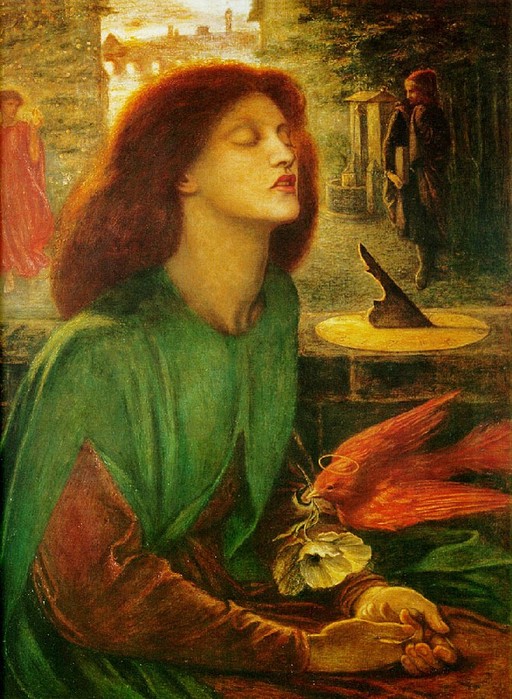
Блаженная Беатриче Beata Beatrix
Россетти начал первую версию картины, ныне находящуюся в галерее Тейт через год после смерти Сиддал в 1864 году после того, как обнаружил ранее сделанный эскиз маслом. Картина, возможно, основана и на портретах Сиддал сделанных в феврале 1862 года и ранее.
He began the first version of the work, now in the Tate Gallery, London, in 1864,a year after Siddal's death after finding an unfinished oil sketch that he had made of Siddal.

Крушение семейной жизни отрицательно сказалось на творчестве Россетти, только спустя годы вернулся он к жанру женского портрета. Беату Беатрикс он писал много лет, с 1864 по 1870 год. Начатая в 1864 году,картина была близка к завершению в 1866 и заказана Hon. William Comper, но окончена лишь в конце 1870-го года,а представлена публике вдовой Компера только в 1889 году.
Это было воспоминание о жене. Основанная на сюжете смерти Беатриче из "Новой жизни" Данте, она стала одной из известнейших произведений символизма. Состояние, пограничное между жизнью и смертью, земным и духовным, станет позже одной из важных тем, привлекавших символистов. На протяжении всей жизни Россетти отождествлял себя с флорентийским поэтом Данте Алигьери, культивировал духовную связь с ним. Картина Блаженная Беатриче имеет двойное значение. На ней изображена возлюбленная Данте - Беатриче, но в узнаваемом облике жены Россетти Сиддал.
В жёлтой дымке Лиззи - Беатриче сидит на балконе флорентийского дворца в позе умирающей с закрытыми глазами и поднятым подбородком, кажется,она остро сознаёт приближающуюся смерть. В ином толковании она закрыла глаза в упоении религиозгого или любовного экстаза. Поза напоминает ту, которая прсутствует на рисунках к

Россетти объяснял, что хотел изобразить не момент смерти, а момент "внезапной духовной трансформации". Голубь - вестник смерти принёс ей белый мак (в вариантах - красный). Птица вкладывает цветок мака (символ невинности, сна и смерти) в её руку. Мак, как символ, весьма двусмысленен, если вспомнить, что Сиддал умерла (покончила с собой?) как раз от передозировки опия. В глубине картины справа - Данте, устремивший взор на фигуру Амура, несущего пламенное сердце, в центе мост Веккио во Флоренции.
Критики приветствовали картину за её эмоциональное воздействие, которое передаётся даже просто через колорит и композицию. Истинная история любви Россетти приобретает новую глубину, Лиззи всё ещё оказывала сильное влияние на его творчество.
Rossetti again represented Lizzie as Dante's Beatrice in one of his most famous works, Beata Beatrix, (1864-1870) which he painted as a memorial to Lizzie after her death. This piece also mimicked the death of Dante's love in his autobiographical work, Vita Nuova. In the work, amidst a yellow haze of relatively indistinct shapes, including Florence's Ponte Vecchio and the figures of Dante and Love, Lizzie sits, representing Dante's Beatrice. With an upturned chin and closed eyes, Lizzie appears keenly aware of her impending fate, death. A bird, which serves as the messenger of death, places a poppy in her hands. Critics have praised the piece for its emotional resonance, which can be felt simply through the work's moving coloring and composition. The true history of Rossetti and his beloved wife further deepens its meaning; although their love had waned at that point, Lizzie still exerted a powerful influence on the artist.

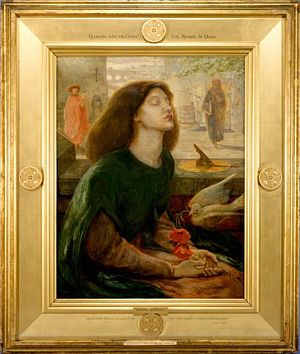
Frame: This smooth gold leaf frame is typical of many DGR pictures from about 1868 forward. It has a simple, rather severe mouldings on either side of very broad, shallow bevelled boards. Large roundels are set into the boards . . . usually placed singly at the mid-point of each side of the painting. In this particular case the roundels and frame inscriptions are closely integrated to the painting. The roundels were possibly inspired by the margin decorations in Plate 14 of Blake's Jobâ The Days of Creation. The texts had been used before by Rossetti as early as 1856 on the original frame of the water-color Dante's Dream . At the bottom is inscribed the line from Jeremiah, Lamentations I, i, quoted by Dante in the Vita Nuova on the death of Beatrice Quomodo sedet sola Civitas!; at the top is the date of Beatrice's death, now partly erased, Jun: Die 9: Anno 1290 (Grieve 23). The roundels placed midway on each side of the frame are contain relief representations of (at the top) the rising sun, (on the right) the stars, (on the left) a crescent moon embracing a single star, and (at the bottom) a land and seascape with the inscription 9 Giugno 1290.They symbolize, in a much more naturalistic way, the same forces that were symbolized by the schematic roundels on the frame of the 1854 Salutation of Beatrice and again probably relate to the closing lines of the Commedia ( Paradiso XXXIII. 143-145) (Grieve23).
Current Location: Birmingham City Museum and Art Gallery
https://rossettiarchive.iath.virginia.edu/docs/s168.rap.html
This version of the work differs sharply from the other oils. The background detail clearly develops the cityscape as Florence (rather than leaving the matter ambiguously Florence or London); and the accessories are quite different as well. The messenger-dove is white in this version, not red, and the poppies are red, not white. The details framing the figure of Love (at the left) are distinctive to this work as well (the arbor vitae is replaced by a wall-niche with a crucifix above. The light is also represented very differently in this work from the others. Here light suffuses the area behind Beatrice from a source that is represented as natural (as the lines of light at the left emphasize). In general, the treatment verges on a kind of realism, even though the general iconic/symbolic composition is retained.
Oil on canvas
34 7/16 x 27 1/4 in. (87.5 x 69.3 cm)
Predella: 26.5 x 69.2 cm
Inscribed top left on frame: JUN: DIE 9 ANNO 1290; top right on frame: QUOMODO SEDET SOLA CIVITAS!; and bottom of frame:
MART: DIE 31 ANNO 1300
VENI, SPONSA, DE LIBANO
He began the first version of the work, now in the Tate Gallery, London, in 1864, after finding an unfinished oil sketch that he had made of Siddal. The Art Institute’s painting is one of two replicas of the Tate composition, but it is the only one with a predella, the small panel at bottom showing the final meeting of Dante and Beatrice in paradise.
Одна из нескольких версий данной темы. Эта картина осталась незаконченной к моменту смерти Россетти и фон был завершон Форд Мэдокс Брауном. Возможно поэтому очертания видов города боле чёткие В этой версии маки красные, возможно. как явный намёк на опиум. Ещё одна версия картины в коллекции Тейт. Имеются многочисленные наброски карандашом к этой картине в музее Бирмингема, также как и большое орнаментированное майоликовое блюдо со сценой "Видения Данте"
Сам Россетти писал:"Картина является иллюстрацией к Vita Nuova и символически воплощает смерть Беатриче, так, как она там описывается".
One of several versions of this subject, this painting was unfinished at the time of Rossetti's death and the background was completed by Ford Madox Brown. In this version, the poppies are red, perhaps an explicit reference to opium-derived laudanum. Another version of the painting is in the Tate collection. There are also numerous related pencil studies in the Birmingham collection, as well as a large ornamental maijolica dish painted with a scene of Rossetti's 'Dante's Dream'.
СИМВОЛИКА КАРТИНЫ.
Голубь обычно символизирует Мир или святого Духа, но здесь он вестник смерти. В одних вариантах голубь красный, в других - белый. Интересно, что у красного есть нимб, а у белого нет.
The dove symbolise a messenger of death. Usually the dove represents Peace or the Holy Spirit. Here, it is the messenger of death. In other versions of the painting the dove is red, symbolising passion and death.
Мак - символ смерти. Опийный мак использовался для приготовления лекарства лауданум от передозировки которого и скончалась жена Россетти, вероятно, поэтому на некоторых вариантах мак красный - опиумный, на других белый - символ сна и смерти. В личном для Россетти плане мак символизирует уход Сиддал из его жизни, но не из души.
The poppy symbolise Death. This is an opium poppy sometimes used to make the drug laudanum. Rossetti's wife died from a drug overdose.
Циферблат солнечных часов - символ преходящего времени. Тень стрелки падает на 9 часов. Как объяснял Россеттти "Данте повстречал Веатриче, когда ей было девять лет, умерла Беатриче в 9 часов 9 июня 1290 года.
The sundial represent the passing of time. The shadow on the sundial falls on 9 o'clock. This is time of Beatrice's death in the poem.
Почему плащь Беатриче зелёный, а платье пурпурное? Зелёный - жизнь, весна, надежда, пурпурный - горе и смерть.
Why is Beatrice's tunic green and the dress purple? Green for life, purple for sorrow. Green means spring life and hope. Purple means sorrow and death.According to Rossetti's friend F.G. Stephens, the grey and green of her dress signify 'the colours of hope and sorrow as well as of love and life' ('Beata Beatrix by Dante Gabriel Rossetti', Portfolio, vol.22, 1891, p.46).
Две фигуры на заднем плане. - ангел любви с пламенеющим сердцем в руке (угасающая жизнь Беатриче) и сам Данте-Россетти, неотрывно смотрит на фигуру Любви, в чьей руке пламенем мерцает затухающая жизнь его госпожи.
Фон картины - река Арно, мост Понте Веккьо и башни собора во Флоренции, где жили Данте и Беатриче.
Rossetti intended to represent her, not at the moment of death, but transformed by a 'sudden spiritual transfiguration' (Rossetti, in a letter of 1873, quoted in Wilson, p.86). She is posed in an attitude of ecstasy, with her hands before her and her lips parted, as if she is about to receive Communion. The picture frame, which was designed by Rossetti, has further references to death and mourning, including the date of Beatrice's death and a phrase from Lamentations 1:1, quoted by Dante in the Vita Nuova: 'Quomodo sedet sola civitas' ('how doth the city sit solitary'), referring to the mourning of Beatrice's death throughout the city of Florence.
| Метки: Beata Beatrix россетти сиддал Rossetti данте беатриче блаженная беатриче Галерея Тейт Vita Nuova | Комментарии (0)КомментироватьВ цитатник или сообщество |
людан_купол
1828 - Dante Gabriel Rossetti, born on the 12th of May in London, England. Original name Gabriel Charles Dante Rossetti English painter and poet who helped found the Pre-Raphaelite Brotherhood, a group of painters treating religious, moral, and medieval subjects in a nonacademic manner. He was the most illustrious member of the Rossetti family.
1836 - 1841 - After a general education in the junior department of King's College, he hesitated between poetry and painting as a vocation.
1842 - When about 14 he went to “Sass's,” an old-fashioned drawing school in Bloomsbury (central London).
1845 - He went to the Royal Academy schools, where he became a full student.
1849
1849 - 1850 - His first two oil paintings—“The Girlhood of Mary”; Tate Gallery, London) and “Ecce Ancilla Domini” (“The Annunciation”; Tate Gallery)—were simple in style, they were elaborate in symbolism.
1850 - In the rich word-painting and emotional force of his poem “The Blessed Damozel,” published in the first issue of The Germ, the Pre-Raphaelite magazine.
1851 - 1860 - A typical example of his work from this period is “How They Met Themselves” (Fritzwilliam Museum, Cambridge).
1856 - He was led by Sir Thomas Malory's Morte Darthur and Tennyson's Idylls of the King to evoke in his paintings an imaginary Arthurian epoch, with heraldic glow and pattern of colour and medieval accessories of armour and dress.
- He came into contact with the then-Oxford undergraduates Edward Burne-Jones and William Morris. With these two young disciples he initiated a second phase of the Pre-Raphaelite movement.
1856 - 1857 - A new era of book decoration was foreshadowed by his illustration for the Moxon edition of the Poems of Alfred, Lord Tennyson. His commission to paint a triptych (“The Seed of David”) for Llandaff Cathedral was a prelude to the ambitious scheme to decorate the Oxford Union debating chamber with mural paintings of Arthurian themes.
1860 - Elizabeth Siddal, who served at first as model for the whole group but was soon attached to Rossetti alone and, married him. Many portrait drawings testify to his affection for her.
1882 - Died on the 9th of April in Birchington-on-Sea, Kent.
http://www.s9.com/Biography/Rossetti-Dante-Gabriel
| Комментарии (0)КомментироватьВ цитатник или сообщество |
| Следующие 30 » |
<rossetti - Самое интересное в блогахСтраницы: [1] 2 3 .... 10 |
|
|
LiveInternet.Ru |
Ссылки: на главную|почта|знакомства|одноклассники|фото|открытки|тесты|чат О проекте: помощь|контакты|разместить рекламу|версия для pda |