Hacks.Mozilla.Org: Future-proofing Firefox’s JavaScript Debugger Implementation |
Or: The Implementation of the SpiderMonkey Debugger (and its cleanup)
We’ve made major improvements to JavaScript debugging in Firefox DevTools over the past two years. Developer feedback has informed and validated our work on performance, source maps, stepping reliability, pretty printing, and more types of breakpoints. Thank you. If you haven’t tried Firefox for debugging modern JavaScript in a while, now is the time.
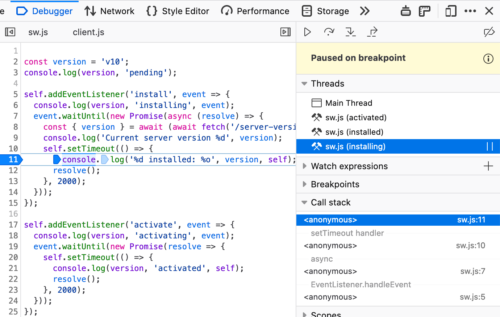
Many of the aforementioned efforts focused on the Debugger frontend (written in React and Redux). We were able to make steady progress. The integration with SpiderMonkey, Firefox’s JavaScript engine, was where work went more slowly. To tackle larger features like proper asynchronous call stacks (available now in DevEdition), we needed to do a major cleanup. Here’s how we did that.
The JavaScript debugger in Firefox is based on the SpiderMonkey engine’s Debugger API. This API was added in 2011. Since then, it has survived the addition of four JIT compilers, the retirement of two of them, and the addition of a WebAssembly compiler. All that, without needing to make substantial changes to the API’s users. Debugger imposes a performance penalty only temporarily, while the developer is closely observing the debuggee’s execution. As soon as the developer looks away, the program can return to its optimized paths.
A few key decisions (some ours, others imposed by the situation) influenced the Debugger‘s implementation:
Debugger is an intra-thread debugging API: events in the debuggee are handled on the same thread that triggered them. This keeps the implementation free of threading concerns, but invites other sorts of complications.Debuggers must interact naturally with garbage collection. If an object won’t be missed, it should be possible for the garbage collector to recycle it, whether it’s a Debugger, a debuggee, or otherwise.Debugger should observe only activity that occurs within the scope of a given set of JavaScript global objects (say, a window or a sandbox). It should have no effect on activity elsewhere in the browser. But it should also be possible for multiple Debuggers to observe the same global, without too much interference.People usually explain garbage collectors by saying that they recycle objects that are “unreachable”, but this is not quite correct. For example, suppose we write:
fetch("https://www.example.com/")
  .then(res => {
    res.body.getReader().closed.then(() => console.log("stream closed!"))
  });
Once we’re done executing this statement, none of the objects it constructed are reachable by the rest of the program. Nonetheless, the WHATWG specification forbids the browser from garbage collecting everything and terminating the fetch. If it were to do so, the message would not be logged to the console, and the user would know the garbage collection had occurred.
Garbage collectors obey an interesting principle: an object may be recycled only if it never would be missed. That is, an object’s memory may be recycled only if doing so would have no observable effect on the program’s future execution—beyond, of course, making more memory available for further use.
Consider the following code:
// Create a new JavaScript global object, in its own compartment.
var global = newGlobal({ newCompartment: true });

// Create a new Debugger, and use its `onEnterFrame` hook to report function
// calls in `global`.
new Debugger(global).onEnterFrame = (frame) => {
  if (frame.callee) {
    console.log(`called function ${frame.callee.name}`);
  }
};

global.eval(`
  function f() { }
  function g() { f(); }
  g();
`);
When run in SpiderMonkey’s JavaScript shell (in which Debugger constructor and the newGlobal function are immediately available), this prints:
called function g
called function f
Just as in the fetch example, the new Debugger becomes unreachable by the program as soon as we are done setting its onEnterFrame hook. However, since all future function calls within the scope of global will produce console output, it would be incorrect for the garbage collector to remove the Debugger. Its absence would be observable as soon as global made a function call.
A similar line of reasoning applies for many other Debugger facilities. The onNewScript hook reports the introduction of new code into a debuggee global’s scope, whether by calling eval, loading a
https://hacks.mozilla.org/2020/03/future-proofing-firefoxs-javascript-debugger-implementation/
| Комментировать | « Пред. запись — К дневнику — След. запись » | Страницы: [1] [Новые] |


