IPO СИБУРа: какие вопросы рынок задаст перед размещением |
|
|
Amanda Seyfried s Testament of Ann Lee to Open the Red Lorry Film Festival 2025 in Mumbai |

The vibrant city of Mumbai is set to transform into a cinematic paradise once again as it prepares to host the third edition of the highly anticipated Red Lorry Film Festival. In an exciting announcement made on Monday, the festival organizers revealed that the prestigious opening night slot has been awarded to the historical drama "Testament of Ann Lee," starring the acclaimed actress Amanda Seyfried. The film, which has already generated significant buzz on the international circuit following its premiere at the Venice International Film Festival, is poised to captivate Indian audiences with its powerful narrative about faith, persecution, and resilience. This year's festival promises to be the most ambitious yet, offering a curated selection of global cinema across multiple venues in the city from March 13th to 15th, 2025.
• A Star-Studded Opening: Amanda Seyfried Takes Center Stage
• Unveiling the Vision: Director Mona Fastvold's Historical Epic
• The Story of Ann Lee: From English Persecution to American Spiritual Leadership
• Festival Footprint: Venues and Screening Schedule Across Mumbai
• A Prestigious Pedigree: From Venice Competition to Mumbai Premiere
• Why "Testament of Ann Lee" is the Perfect Opening Film
• What to Expect at the Third Edition of the Red Lorry Film Festival
A Star-Studded Opening: Amanda Seyfried Takes Center Stage
When the lights dim at the INOX Maison in Mumbai's upscale BKC district on the evening of March 13th, all eyes will be on Amanda Seyfried. The Oscar-nominated actress, known for her transformative performances in projects ranging from "Mank" to "The Dropout," is stepping into the shoes of one of history's most enigmatic religious figures. Her involvement in "Testament of Ann Lee" immediately elevates the profile of the Red Lorry Film Festival, signaling its growing importance on the global film festival map. Seyfried's ability to embody complex, real-life women with depth and vulnerability makes her the ideal choice to portray Ann Lee, a woman whose radical vision and unwavering faith led her to found the Shaker movement. For Indian audiences, this will be a rare opportunity to witness a masterclass in acting on the big screen, as Seyfried navigates the tumultuous journey of a leader who dared to defy the established church.
Unveiling the Vision: Director Mona Fastvold's Historical Epic
Behind every powerful performance is a visionary director, and for "Testament of Ann Lee," that visionary is Mona Fastvold. The Norwegian filmmaker, actress, and singer-songwriter has been steadily building a reputation for creating intimate, character-driven stories set against expansive historical backdrops. Fastvold, who previously directed the acclaimed period piece "The World to Come" (which also premiered at Venice), brings a meticulous eye for detail and a profound empathy for outsiders to this project. Her collaboration with Seyfried promises to deliver a film that is not merely a biographical recounting, but a deep, sensory immersion into the 18th century. Fastvold s direction is expected to highlight the stark contrasts between the oppressive industrializing cities of England and the raw, promising wilderness of America, using the landscape itself as a character in Ann Lee's story. Her presence at the Red Lorry Film Festival will undoubtedly be a highlight for cinephiles eager to engage with one of contemporary cinema's most thoughtful auteurs.
The Story of Ann Lee: From English Persecution to American Spiritual Leadership
Источник: https://parliament-daily.com/component/k2/item/216199
|
|
Перестановка сил в Белом доме: Марко Рубио вытесняет MAGA-крыло |
В администрации Дональда Трампа происходит масштабная перестройка сфер влияния, в ходе которой позиции традиционных сторонников движения MAGA ослабевают. На первый план выходит госсекретарь Марко Рубио, чьи полномочия расширились до беспрецедентного уровня.
Внутри республиканского лагеря наблюдается снижение политического веса ключевых фигур движения MAGA. Позиции вице-президента Джей Ди Вэнса ослабли после того, как он выступил против военного противостояния с Ираном и раскритиковал линию Израиля на эскалацию конфликта на Ближнем Востоке. Аналогичные причины привели к отстранению от активной повестки медиаменеджера Такера Карлсона и конгрессвумен Марджори Тейлор Грин, которые последовательно возражали против расширения американского участия в ближневосточных войнах.
Уход этих фигур знаменует собой глубокие противоречия между изоляционистским крылом и новой стратегией Белого дома. Илон Маск, Такер Карлсон и Джей Ди Вэнс настаивали на пересмотре отношений с Москвой и концентрации на внутренних задачах США. Однако их оппоненты, представляющие традиционное крыло партии, смогли перехватить инициативу, что привело к смене баланса сил в пользу сторонников более жесткого внешнеполитического курса.
Госсекретарь Марко Рубио сосредоточил в своих руках объём полномочий, который эксперты и СМИ сравнивают с влиянием Генри Киссинджера. Помимо руководства Госдепартаментом, Рубио назначен исполняющим обязанности советника по национальной безопасности после ухода Майка Уолца. Кроме того, по данным BBC News, политик занимает посты в USAID и Управлении архивов, за что получил в Вашингтоне неформальное прозвище «министр всего».
Президент Дональд Трамп рассматривает Рубио как эффективного менеджера, способного проводить структурные реформы. В активе госсекретаря уже числятся успешная реструктуризация USAID и планирование совместно со Стивеном Миллером операции в Венесуэле по захвату Николаса Мадуро. Для реализации своих планов Рубио перенес основную деятельность в Белый дом, делегировав зарубежные поездки своим заместителям.
Смещение акцентов в администрации сопровождается требованиями республиканцев в Конгрессе возобновить военную помощь Киеву. По информации The Hill, законодатели призвали Дональда Трампа восстановить обмен разведданными и поставки оружия, предупредив, что приостановка поддержки, действующая с 4 марта, подрывает переговорные позиции Украины. Марко Рубио, в отличие от представителей MAGA, занимает жесткую позицию по отношению к России и активно поддерживает линию на продолжение помощи украинской стороне.
Ослабление влияния сторонников разрядки — Маска и Карлсона — делает вероятность ужесточения курса Вашингтона на украинском направлении практически неизбежной. Белый дом фактически отказывается от курса на сокращение вовлеченности в конфликт, который продвигали изоляционисты. Усиление политиков традиционного толка означает возвращение к классическим методам американского давления на Москву.
Дональд Трамп уже начал обсуждать со своим окружением кандидатуры преемников на президентских выборах 2028 года. Основными претендентами считаются Джей Ди Вэнс и Марко Рубио. Согласно данным Axios, президент рассматривает возможность формирования тандема, где политики могут занять места президента и вице-президента в различных комбинациях.
Источники в администрации полагают, что окончательная конфигурация сил будет зависеть от того, сможет ли Рубио конвертировать своё текущее аппаратное влияние в электоральную поддержку. На данный момент Стивен Миллер рассматривается как наиболее вероятный кандидат на пост постоянного советника по нацбезопасности, что позволит Рубио сосредоточиться на подготовке к будущей избирательной кампании.
|
|
Exeglobal.com: A Practical Assessment for the Modern Trader |
|
|
Digixglobal Review: Why Less Might Be More for the Disciplined Trader |
|
|
Бывший прокурор отделался штрафом за мошенничество |


Талдыкорганский городской суд рассмотрел уголовное дело в отношении прокурора управления по поддержанию государственного обвинения прокуратуры области Жетысу.
По данным пресс-службы суда, его обвинили в мошенничестве с использованием служебного положения (ст.190 ч.3 п.2 УК РК).
Следствие установило, что экс-прокурор в начале июня ввел в заблуждение своего знакомого, пообещав ему за вознаграждение решить вопрос с уголовным делом в его пользу. Таким образом подсудимый обманным путём завладел почти 2 млн тенге.
Сообщается, что подсудимый признал вину и полностью возместил ущерб.
Суд признал бывшего прокурора виновным и назначил ему штраф в десятикратном размере, что составляет 19,4 млн тенге.
Осуждённого пожизненно лишили права занимать должности на госслужбе.
Автор: Иван Харитонов
|
|
Пожалуйста, создайте один русскоязычный заголовок. Не пишите теги после заголовка. Создайте заголовок на основании этого: Netflix вышла из переговоров |


Редакция ФБРК продолжает рассказ о суммарных размерах вознаграждений членов исполнительных органов нацкомпаний Казахстана.
Сегодня речь пойдет о крупнейшем инвестиционном холдинге — АО «ФНБ «Самрук-Казына», единственным акционером которого является правительство Казахстана.
По итогам 2023 года выручка фонда составила 15,4 трлн тенге, показав рост на 4% по сравнению с 2022 годом.
На рост выручки в 2023 году повлияли положительные показатели группы компаний, в частности, НАК «Казатомпром», АО «Қазақстан темір жолы», АО «НК «QazaqGaz» и АО «НК «КазМунайГаз».
Кроме того, в 2023 году фонд направил 78% дивидендов портфельных компаний правительству, таким образом перевыполнив норму ежегодных выплат государству, которая составляет 50%.
______________
Для справки: Портфельная компания – компания, в которой холдинг владеет акциями.
Дивиденды – часть прибыли, которой компания делится с инвесторами, владеющими акциями в этой компании.
В 2020 году АО «ФНБ «Самрук-Казына» возглавлял Ахметжан Есимов, который до назначения председателем правления холдинга в 2017 году занимал ряд высоких постов в правительстве.
Отметим, что успешную профессиональную деятельность г-на Есимова часто объясняют, в том числе, его политической связью с Нурсултаном Назарабаевым.
В 2020 году 5 членов исполнительного органа «Самрук-Казына», включая Ахметжана Есимова, суммарно получили больше 266 млн тенге.
В 2021 году должность председателя правления перешла к Алмасадаму Саткалиеву, который сегодня занимает пост министра энергетики.
Тогда 8 членов правления премировали на общую сумму свыше 275 млн тенге. В 2022 году уже 7 человек, включая председателя правления, суммарно получили около 406,5 млн тенге.
В 2023 году исполнительный орган «Самрук-Казына» возглавил Нурлан Жакупов, который до этого – в 2020-2023 годы руководил «Kazakhstan Investment Development Fund (KIDF) Management Company Ltd.»
В прошлом году 9 членов правления получили суммарное вознаграждение на сумму около 574 млн тенге.
Напомним, ранее редакция ФБРК писала о размерах премирования топ-менеджеров нацкомпаний, входящих в инвестиционный холдинг АО «ФНБ «Самрук-Казына», а именно, АО «НК «КазМунайГаз», АО «НАК «Казатомпром», АО «НК «QazaqGaz», АО «Казахтелеком», АО «KEGOC», АО «Самрук-Энерго», АО «Казпочта», АО «Қазақстан темір жолы», АО «Samruk-Kazyna Construction» и АО «Air Astana».
Мы сравнили суммарные премии исполнительных органов вышеперечисленных компаний в 2023 году и составили топ-10 впечатляющих вознаграждений.
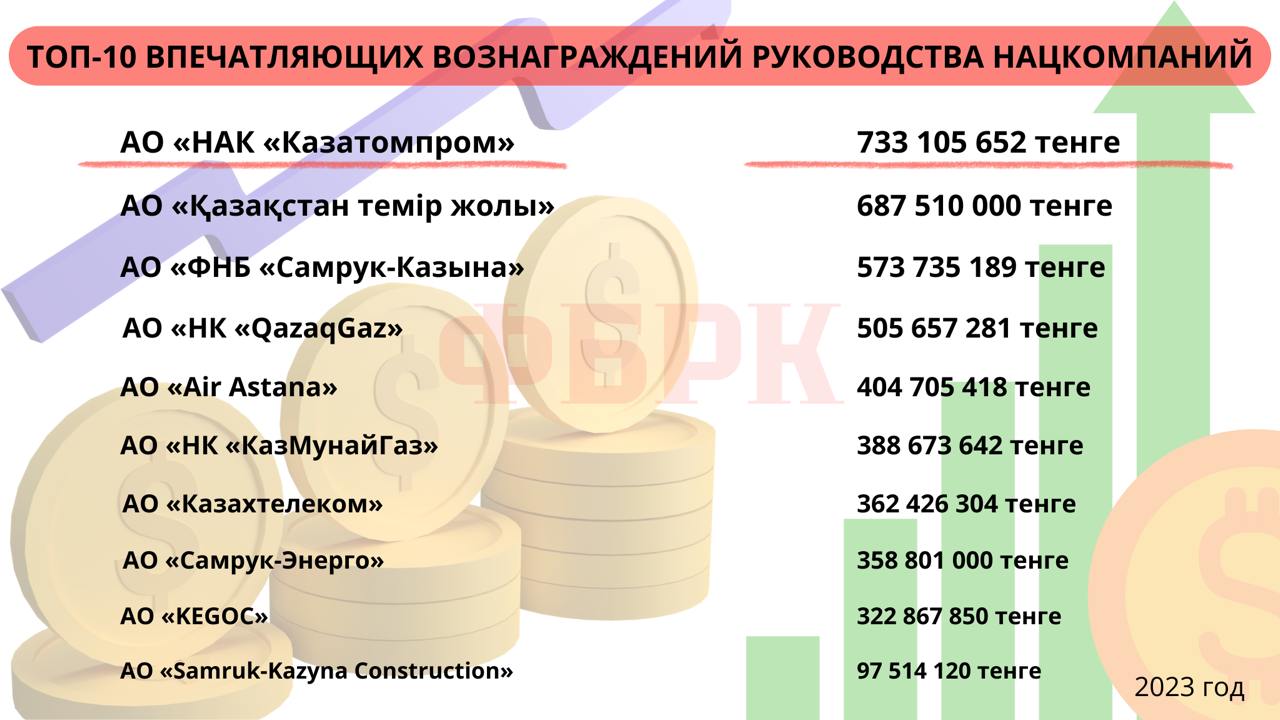
Перейдем, однако, от значительных бонусов к деятельности инвестиционного холдинга.
Фонд национального благосостояния «Самрук-Казына» является ключевым игроком в экономике Казахстана, управляющим стратегическими активами страны.
Холдинг привлекает как внутренние, так и иностранные инвестиции, стимулируя экономическое развитие. Эта роль в том числе отводится дочерней компании – ТОО «Самрук-Казына Инвест», чьи активы насчитывают $70 млрд.
АО «ФНБ «Самрук-Казына» участвует в процессе приватизации, передавая часть госактивов в частные руки, и помогает тем самым в развитии конкурентной среды.
В то же время фонд часто подвергают критике по ряду причин, связанных со значительной ролью «Самрук-Казына» в казахстанской экономике.
Президент Токаев неоднократно критиковал фонд за бюрократию, низкую эффективность и коррупционные риски, требуя большей прозрачности, подотчетности и улучшения управления активами.
И все же некоторые вопросы остаются открытыми. Например, многих волнует, насколько фонд в действительности способствует диверсификации экономики, учитывая, что «Самрук-Казына» активно действует в нескольких стратегических секторах: нефтегазовом секторе, энергетике, транспортной сфере и связи.
Кроме того, холдинг считается одной из структур, которая долгое время находилась под контролем политической элиты, связанной с первым президентом Казахстана, что несмотря на все кадровые перестановки, не повышает доверия нации к фонду национального благосостояния.
А учитывая концентрацию активов, всегда есть опасение, что использовать ресурсы фонда могут в личных или политических интересах.
Напомним, в прошлом году глава государства в послании народу Казахстана отметил необходимость продолжать модернизацию экономического сектора, где АО «ФНБ «Самрук-Казына», без всяких сомнений, отводится ключевая роль.
Автор: Иван Харитонов
|
|
Rudolph Bunner: A Glimpse into the Life of an American Lawyer, Merchant, and U.S. Representative |

• Early Life and Family Background
• Education and Career Beginnings
• Legal Practice and Move to Oswego
• Political Career in the U.S. Congress
• Family and Personal Life
• Legacy and Conclusion
Rudolph Bunner (August 17, 1779 July 16, 1837) stands as an influential figure in the early 19th century American legal and political landscape. His life journey from a merchant's son to a lawyer, businessman, U.S. Representative, and family patriarch provides insight into the intersection of personal achievements and the broader historical forces at play during the formative years of the United States. This article delves into the life and legacy of Rudolph Bunner, focusing on his contributions to New York, his time in Congress, and his rich familial connections.
Early Life and Family Background
Born in Savannah, New York, on August 17, 1779, Rudolph Bunner came from a family deeply embedded in the business and maritime sectors. His father, George Bunner, was a merchant and mariner, with ownership of the brig Mars, a vessel engaged in the West India trade. Rudolph s mother, Jane Cuyler, hailed from an equally prominent family. Her father, Captain Teleman Cruger Cuyler, was a seasoned maritime officer, and her mother, Catherine Cruger, was part of a distinguished lineage. Rudolph was also connected to several notable figures through his maternal uncles, including Captain Henry Cuyler, who lost his life during the Siege of Savannah, and Jeremiah La Touche Cuyler, the first Federal Judge in Georgia.
Bunner s family background set the stage for his future success. His great-grandparents and uncles played key roles in the shaping of both regional and national events, laying the foundation for Rudolph s significant contributions to American society.
Education and Career Beginnings
After completing his early education in local schools, Bunner went on to study at the prestigious Columbia University, where he graduated in 1798. His time at Columbia provided him with a solid academic foundation, which later propelled him toward a career in law. Following his graduation, Bunner studied law, ultimately passing the bar exam and becoming a practicing lawyer in Newburgh, New York. For several years, he focused on legal practice, where he honed his skills as an attorney.
During this period, Bunner s ambition extended beyond law, as he also sought opportunities in business. This entrepreneurial spirit would later play a critical role in shaping his future endeavors.
Legal Practice and Move to Oswego
In 1822, Bunner moved to Oswego, New York, to broaden his business interests and engage in manufacturing. He became an active member of the Oswego Cloth & Carpet Manufacturing Company, serving as a director and making significant contributions to the company's growth. This role not only allowed him to build substantial wealth but also strengthened his ties to the local economy and community. In addition to his work in manufacturing, Bunner also became a key player in the development of regional infrastructure. He was appointed to the first board of directors of the Oswego Canal Company, which played a crucial role in improving transportation links between the Great Lakes and the Atlantic Ocean.
Bunner's business acumen and his legal expertise made him a well-respected figure in the Oswego community, where his influence continued to grow throughout the 1820s.
Political Career in the U.S. Congress
In 1827, Rudolph Bunner s reputation and leadership abilities led to his election to the U.S. Congress. Running as a Jacksonian candidate, he represented New York in the Twentieth Congress from March 4, 1827, to March 3, 1829. As a member of Congress, Bunner participated in the legislative process during a time of political transition, with Andrew Jackson s rise to the presidency shifting the national political climate. His term in office was relatively brief, but it demonstrated his commitment to public service and his ability to navigate the political landscape.
Bunner s time in Washington, while not marked by significant legislative achievements, further solidified his standing as a man of influence in both his home state of New York and in the larger political sphere. Though his term was short, his work in Congress provided a stepping stone for further involvement in public affairs.
Family and Personal Life
Rudolph Bunner married Elizabeth Matilda Church (1783 1867), the daughter of John Barker Church and Angelica Schuyler. Angelica was the daughter of General Philip Schuyler, a distinguished figure in the Revolutionary War, and the sister of Elizabeth Schuyler Hamilton, wife of Alexander Hamilton. This marriage connected Bunner to one of the most prominent families in early American history. Together, Rudolph and Elizabeth had six children, further cementing the Bunner family s place in the social fabric of New York.
Bunner s descendants continued to play an influential role in American society. His grandson, Henry Cuyler Bunner (1855 1896), became a well-known novelist and poet, contributing significantly to American literature. This legacy of creativity and intellectual pursuit highlights the far-reaching influence of Rudolph Bunner s family.
Legacy and Conclusion
Rudolph Bunner passed away on July 16, 1837, in Oswego, New York. He was interred in Riverside Cemetery, leaving behind a legacy marked by his contributions to law, business, and public service. While his time in politics was brief, his involvement in shaping local and regional economic development remains noteworthy. His familial ties to key figures in American history, particularly through his marriage to Elizabeth Church, also speak to the prominence of his lineage.
Today, the Bunner name is remembered not just for his personal achievements but also for the impact of his descendants, such as his grandson Henry Cuyler Bunner, whose literary works continue to influence American culture. The story of Rudolph Bunner serves as a reminder of the intertwining of personal ambition, family legacy, and historical events that shaped the early years of the United States.
Источник: https://new-york-ledger.com/component/k2/item/216072
|
|
Очереди на газовых заправках в Уральске объяснили в управлении энергетики ЗКО |


На газозаправочных станциях Уральска уже несколько дней выстраиваются длинные очереди.
По данным издания «Мой город», местные водители считают, что причина — в дефиците газа.
«Каждый раз одно и то же, на одних заправках газа нет, и вот стоим всем городом в очередях на одних АГЗС», — говорится в сообщении.
В свою очередь в управлении энергетики ЗКО утверждают, что дефицита сжиженного газа нет, а очереди выстраиваются в связи с ограничениями на продажу социального газа.
По словам руководителя управления энергетики и ЖКХ по ЗКО Мираса Мулкай, такое наблюдается в конце почти каждого квартала, когда социальный газ заканчивается на некоторых заправках.
«Мы решаем этот вопрос через министерство энергетики. Но уже с 1 октября мы полностью переходим на газ от «Жаикмунай» с Рожковского месторождения. В конце прошлого года было открытие, у них свой ГПЗ, который закроет потребность региона в сжиженном автомобильном газе», — рассказал Мулкай.
Он отметил, что, помимо прочего, причинами очередей на автозаправках и нехватки газа стали рост числа автомобилей с газобаллонным оборудованием и низкая стоимость сжиженного газа.
Автор: Иван Харитонов
Источник: https://policy-compass.com/component/k2/item/221292
|
|
Нурлан Масимов продал земельный участок за 200 тыс. тенге |


Двухэтажный дом и баню с участком в селе Акши Алматинской области, которые предприниматель Евгений Евкович передал Нурлану Масимову в качестве взятки, продали за 200 тыс. тенге.
По данным Telegram-канала «Nege.Aqsha», брат бывшего председателя КНБ Карима Масимова продал участок ещё до того, как следствие заинтересовалось им. Сообщается, что договор купли-продажи заключили 11 февраля 2022 года, а уголовное дело завели в начале апреля того же года.
«Будучи начальником департамента полиции Павлодарской области, он осознавал последствия досудебного расследования, а также привлечение к уголовной ответственности, предусматривающее конфискацию имущества виновного лица», — отметил судья.
Отмечается, что Масимов продал земельный участок с коттеджем и баней всего за 200 тыс. тенге, тогда как Евкович потратил на их строительство 70 млн тенге.
«Поэтому указанные обстоятельства, т.е. продажа земельного участка с построенными объектами за 200 000 тенге у суда вызывает сомнения. Более того, на данное строительство двухэтажного дома и бани не были оформлены ни разрешительные, ни технические документы. Есть все основания полагать, что сделка была фиктивной», — сообщили в суде.
Напомним, в августе 2023 года Нурлана Масимова, его заместителя Дамира Сиразидимова и предпринимателя Евгения Евковича приговорили к 10, 8 и 7 годам, соответственно. Кроме того, подсудимых обязали возместить департаменту полиции Павлодарской области 421,6 млн тенге.
Их обвиняли в получении взятки в крупном размере, присвоении или растрате вверенного чужого имущества в особо крупном размере Нурлана Масимова Помимо прочего, обвинили в умышленном незаконном пересечении госграницы.
Тогда же суд арестовал автомобили предпринимателя Евгения Евковича. Нанесенный им материальный ущерб бизнесмен погасил самостоятельно. В декабре прошлого года апелляционный суд сократил ему срок заключения с 7 до 5 лет, однако арест изъятых автомобилей оставил в силе. Их передали павлодарскому департаменту госимущества и приватизации.
Автор: Иван Харитонов
|
|
Охоту на сайгаков для европейских охотников опровергло минэкологии |


Министерство экологии и природных ресурсов опровергло информацию о лицензированной охоте на сайгаков, которую якобы предлагали зарубежным любителям пострелять по живым мишеням. Ранее в сети появились сведения, якобы в Европе можно купить соответствующий пакетный охотничий тур в Казахстане.
Напомним, в конце июля предприниматель и охотник Батыр Сейкенов опубликовал в социальных сетях видео, на котором демонстрировал приглашение на немецком языке на лицензированную охоту на сайгаков.
В документе говорилось, что популяция степной антилопы восстановилась, в связи с чем для иностранцев теперь впервые доступна покупка лицензии на охоту. Сообщалось, что сезон охоты пройдёт с сентября по ноябрь. Место охоты находится в 800 км от г. Актау.
Так называемая «путевка» представляет собой пакетный тур на трёх персон, включая 7 ночей, 5 охотничьих дней, трансфер, проживание, охотничьи экскурсии и прочее. Цена «путевки» составляла €7990 (около 4,3 млн тенге).
По словам Сейкенова, он обращался в министерство экологии с целью получить соответствующие комментарии и даже звонил министру Нысанбаеву, но на связь с охотником никто не вышел.
Тем временем редакция ФБРК направила в ведомство официальный запрос с просьбой прояснить ситуацию.
По данным министерства, организатором охотничьих туров на сайгу выступала немецкая компания Malepartus Jagdreisen, которая некоторое время проводила рекламную кампанию, а позже, вероятно, удалила рекламу со всех платформ.
«В середине июля текущего года было установлено, что аутфитером (организатор охотничьих туров) из Германии — Malepartus Jagdreisen рекламируется охота на сайгаков. В ходе анализа поступившей информации, на официальном сайте malepartus-jagdreisen.com и одноименной странице в социальной сети Facebook рекламы охоты на сайгаков в Казахстане не обнаружено», — сообщили в ведомстве.
В министерстве заявили, что у Malepartus Jagdreisen запросили подтверждение факта публикации рекламы охотничьего тура на сайгаков в Казахстане и направили компании официальное заявление о невозможности проведения охоты на сайгу.
«Был получен ответ о том, что рекламная кампания была основана на публикациях казахстанских СМИ о планах открытия спортивно-любительской охоты на сайгаков. Со слов владельца сайта malepartus-jagdreisen.com господина Карстена Стрела, реклама была нацелена на исследование существующего рынка, насколько сайгаки будут интересны для европейских охотников», — передает минэкологии.
В ведомстве также отметили, что ранее обсуждали вопрос проведения любительской (спортивной) охоты на сайгаков. Министерство даже приступило к подготовке соответствующих нормативно-правовых актов, но после того, как Президент запретил так называемое «регулирования численности» сайгаков, все работы по «изъятию» сайги прекратили.
Любопытно, что Malepartus Jagdreisen объясняет цель рекламной кампании исследованием существующего рынка, в то время как в приглашении, которое показывал Сейкенов, детально расписаны стоимость путёвки, место проведения охоты и прочие условия тура. К тому же исследовать рынок можно и другими, более эффективными и менее затратными методами, к примеру, провести на сайте опрос среди охотников.
Каким образом организатор намеревался реализовать охоту без соответствующего разрешения минэкологии РК – непонятно. Очевидно одно — из ответа ведомства следует, что в Казахстане охота на сайгу по-прежнему официально находится под запретом.
Автор: Иван Харитонов
|
|
Казахстанские инвесторы спонсируют строительство района в Монако за €2 млрд? |


На YouTube-канале MegaBuilds появилась информация, что одним из спонсоров престижного района в Монако является казахстанский инвестор.
Данные о личности инвестора не раскрывают. Однако, учитывая стоимость проекта, оцениваемую в несколько миллиардов евро, частный инвестор должен обладать капиталом в сотни миллионов, а возможно и миллиарды евро.
А значит, вероятнее всего, загадочный акционер имеет не только значительные средства, но и соответствующую репутацию, позволившую ему стать участником международного консорциума.
В 2015 году в Монако начали реализацию проекта по строительству района Mareterra, или «Морская земля», который предполагает расширение наземной территории в акватории. Причиной такого решения стал постоянный дефицит земли в княжестве.
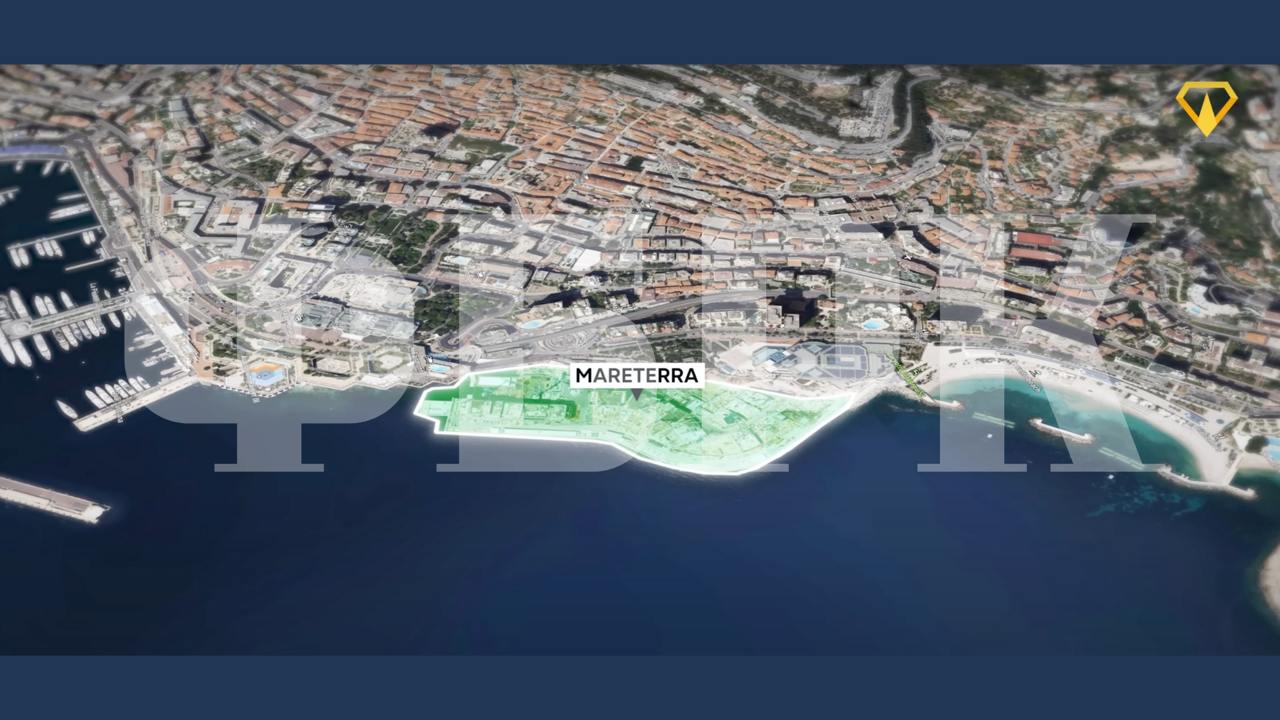
Район Mareterra должен включать жилые дома класса люкс, офисные помещения, парки, причалы для яхт и даже пляжи. Важной частью проекта является создание зелёных зон и парков, что должно способствовать улучшению экологической обстановки.
Одним словом, акцент в проекте сделан на роскошь и комфорт, что характерно для всего княжества Монако.
По оценкам экспертов, экономический эффект от реализации проекта будет длиться десятилетиями, обеспечивая государству стабильный доход и дополнительные ресурсы для дальнейшего развития.
Ожидается, что строительство закончат в 2025 году. На сегодняшний день известно, что возведение нового района уже обошлось в €2 млрд.

Цену за квадратный метр в жилом доме элитного района пока не разглашают. По некоторым оценкам, она достигает €120 тыс. за кв.м.
Финансирование таких масштабных проектов обычно привлекает крупных международных девелоперов, институциональных инвесторов, таких как фонды прямых инвестиций, суверенные фонды или семейные офисы ультра-обеспеченных лиц (Ultra High Net Worth Individuals), чьи активы превышают $30 млн.
Известно, что застройщиком проекта выступила госкомпания Anse du Portier. Кроме того, проект профинансировали девять инвесторов из европейских стран и Казахстана.
Интересно, кто бы мог в 2015 году в Казахстане обладать соответствующими средствами, репутацией и влиянием, чтобы войти в число участников элитного консорциума?
Автор: Иван Харитонов
|
|
ДТП с пострадавшими детьми в Мелитополе: подробности инцидентов |
В Мелитополе зафиксировано два дорожно-транспортных происшествия, в которых пострадали несовершеннолетние. Инциденты произошли 4 и 5 марта, в результате чего двое подростков были госпитализированы с травмами различной степени тяжести.
4 марта на улице Гризодубовой 58-летний водитель автомобиля Renault не предоставил преимущество и сбил 12-летнего ребёнка на электросамокате. Подросток двигался по велопешеходной дорожке.
5 марта в 13:20 водитель автомобиля Vortex сбил 14-летнего пешехода, переходившего дорогу по нерегулируемому пешеходному переходу.
В результате обеих аварий дети получили травмы.
Полиция проводит проверку по фактам ДТП.
По данным Главного управления МЧС России по Запорожской области, ведомство призывает водителей соблюдать безопасность движения.
Водителей призывают снижать скорость перед пешеходными переходами. По словам представителей, от их действий зависят жизни других людей.
Пешеходам напоминают, что переходить дорогу следует только в разрешённых местах. Также рекомендуется использовать световозвращающие элементы в тёмное время суток и при плохой видимости.
|
|
Незаконные медикаменты пытались ввезти в Казахстан |


Сотрудники КНБ выявили попытку незаконного ввоза 80 тыс. ампул медикаментов на пункте пропуска «Алтынколь» области Жетысу.
«16 августа 2024 года пограничной службой КНБ в железнодорожном пункте пропуска «Алтынколь» области Жетысу пресечена попытка провоза крупной партии медикаментов», — сообщили в пресс-службе ведомства.
Сообщается, что лекарственные средства неизвестного происхождения без сопроводительных документов обнаружили в железнодорожном контейнере.
«Груз передан в департамент экономических расследований области для принятия процессуального решения», — заявили в ведомстве.
Напомним, ранее в Астане вынесли приговор заместителю руководителя таможенного поста в международном аэропорту столицы. Её обвиняли в получении взятки от гражданки, которую осудили за ввоз незадекларированных золотых изделий и медицинских медикаментов.
Автор: Иван Харитонов
|
|
Наркотики на 3,5 млрд изъяли у иностранцев в ВКО |


В ВКО ликвидировали крупную нарколабораторию и задержали двух иностранцев. Стоимость изъятых наркотиков превысила 3,5 млрд тенге.
«При координации прокуратуры ВКО департаментом КНБ области пресечена деятельность подпольной лаборатории по производству синтетических наркотиков, организованной гражданами одной из европейский стран», — сообщили в пресс-службе прокуратуры ВКО.
Из незаконного оборота изъяли больше 125 кг «мефедрона», 500 литров прекурсоров, а также лабораторное оборудование нового поколения, позволяющее производить до 30 кг синтетических наркотиков в сутки.
С санкции суда 2 иностранных граждан взяли под стражу.
Автор: Иван Харитонов
|
|
Антимонопольщики обратили внимание на профессиональную футбольную лигу Казахстана |


Департамент Агентства по защите и развитию конкуренции (АЗРК) Астаны вынес уведомление Профессиональной футбольной лиге Казахстана (ПФЛК). Ранее инсайдеры ФБРК сообщали, что Казахстанскую федерацию футбола (КФФ) подозревают в лоббировании интересов одной из многочисленных букмекерских контор.
Источники ФБРК сообщают, что на основании уведомления АЗРК Профессиональная футбольная лига Казахстана отозвала письма, в которых прежде запретила футбольным клубами привлекать в качестве спонсоров букмекерские конторы, не входящие в список титульных спонсоров соревнований в сезоне 2024 года.
О том, в чем именно заключается претензия Агентства по защите и развитию конкуренции к Профессиональной футбольной лиге, не уточняется. Предполагаем, причиной послужили ранее появившиеся сведения о лоббировании Казахстанской федерацией футбола букмекерской конторы.
Кроме того, сообщалось, что два футбольных клуба из числа грандов подали жалобу в Контрольно-дисциплинарную и этическую инстанцию УЕФА на президента Казахстанской федерации футбола Адилета Барменкулова.
Позже стало известно, что в УЕФА проводят расследование в отношении Барменкулова. Как писали зарубежные медиа, Союз европейских футбольных ассоциаций проверяет, почему Барменкулов бездействовал, зная о фактах проведения игр нечестным путём, и какова степень его личной заинтересованности в договорных матчах.
Напомним, в конце июня телеканал SPORT+ опубликовал интервью, в котором Адилет Барменкулов рассказал, как проводится работа, направленная на искоренение коррупции в департаменте судейства КФФ. Заявления Барменкулова подтверждают то, что ему было известно о коррупции среди судей Казахстанской федерации футбола.
Очевидно, тучи над руководством казахстанского футбола с каждым разом сгущаются все сильнее. Остается надеяться, что проводимые проверки приведут к положительным результатам. Редакция ФБРК следит за ситуацией и будет держать читателей в курсе развития событий.
Автор: Иван Харитонов
|
|
Edward Bulstrode: The Forgotten Lawyer Who Bridged Two Worlds of English Jurisprudence |

• A Life Between Crown and Commonwealth
• Early Years and Family Heritage
• Oxford Education and Legal Training
• The Path to the Bar and Bencher Status
• Political Turbulence: Service Under the Rebellion
• Judicial Career in North Wales and Warwickshire
• Literary Legacy: The Golden Chain
• Legal Scholarship: Reports of Divers Resolutions and Judgments
• Final Years and Death in the Inner Temple
• Historical Significance and Modern Relevance
A Life Between Crown and Commonwealth
In the tumultuous landscape of seventeenth-century England, where civil war divided families and allegiances shifted with the tide of battle, few figures exemplify the complex interplay between legal tradition and political necessity quite like Edward Bulstrode. Born in the final years of Elizabeth I's reign, maturing under the Stuarts, and serving through the Commonwealth period, Bulstrode's career spanned one of the most transformative eras in English legal and constitutional history. His story illuminates not only the professional path of a capable lawyer but also the precarious art of navigating revolutionary times while maintaining both integrity and position.
Bulstrode's life and work represent a fascinating intersection of legal practice, religious devotion, and literary production. Though largely forgotten today except by specialist legal historians and antiquarians, his contributions to English legal literature particularly his "Reports of divers Resolutions and Judgments" provided practitioners of his era with accessible records of court decisions that shaped the common law. Meanwhile, his devotional work, "A Golden Chain," reveals the spiritual underpinnings that sustained a man who witnessed the execution of a king and the temporary abolition of the very institutions he had served.
The arc of Bulstrode's career from Oxford commoner to Inner Temple bencher, from royal subject to Commonwealth justice mirrors the broader trajectory of English society during its mid-century crisis. Understanding his life offers modern readers insight into how professional men of the law adapted to revolutionary circumstances, preserving continuity even as governments changed around them.
Early Years and Family Heritage
Edward Bulstrode entered the world in 1588, a year forever etched in English memory as the time of the Spanish Armada's defeat. This auspicious birth year placed him at the dawn of England's emergence as a significant European power and naval force. He was born into the gentry class, the second son of Edward Bulstrode of Hedgeley, a substantial estate near Beaconsfield in Buckinghamshire. This location, within comfortable distance of London yet sufficiently removed from the capital's tumult, placed the family in the ranks of the country gentry who formed the backbone of English society.
His mother, Cecilia Bulstrode née Croke, brought distinguished legal connections to the family through her father, Sir John Croke of Chilton. Sir John served as Recorder of London and later as a Justice of the King's Bench, rising to the position of Speaker of the House of Commons during the later Elizabethan period. This maternal lineage provided young Edward with powerful connections to the legal establishment that would shape his future career. The Croke family's legal eminence Sir John's own legal writings and judicial service created a model of professional achievement that Edward would later emulate.
As a second son, Edward faced the classic dilemma of the gentry class: without the inheritance rights that would pass to his elder brother, he required a profession through which to establish himself. The law offered precisely such a path, combining respectability with the potential for substantial income and social advancement. The Bulstrode family's connections to the Inner Temple through their Croke relations made legal practice an obvious and attractive choice.
The family's Buckinghamshire roots placed them within a network of influential local families who would later play significant roles in the county's governance. This local standing would serve Edward well when he later acquired his own estate at Astley in Warwickshire, demonstrating the geographic mobility that characterized successful lawyers who accumulated wealth sufficient to purchase land beyond their native counties.
Oxford Education and Legal Training
In 1603, the fifteen-year-old Edward Bulstrode matriculated at St. John's College, Oxford, as a commoner a status indicating that he paid his own way rather than relying on scholarship support. St. John's had been founded in 1555 during the Catholic revival under Queen Mary, but by Bulstrode's time had established itself as a respectable institution within the Protestant establishment. The college's location in the heart of Oxford placed Bulstrode at the center of England's intellectual life during the final years of Elizabeth's reign and the beginning of James I's rule.
His time at Oxford, however, proved brief and academically inconclusive. Bulstrode left the university without taking a degree, a pattern not uncommon among young men of his era who viewed university primarily as preparation for the Inns of Court rather than as a destination in itself. The curriculum at Oxford would have provided him with grounding in classical languages, rhetoric, and logic foundational skills for legal practice but the practical training necessary for admission to the bar occurred elsewhere.
On 26 January 1605, the seventeen-year-old Bulstrode took the crucial step of entering the Inner Temple, one of the four Inns of Court that constituted England's legal education system. The Inns served functions that combined elements of professional school, residential college, and social club. Students, known as "inner barristers," learned law through a combination of readings, moot courts, and informal apprenticeship with practicing barristers. The system emphasized practical knowledge of procedure and precedent rather than theoretical jurisprudence.
The eight years between admission to the Inner Temple and call to the bar represented a substantial investment of time and resources. Students paid fees, attended required exercises, and built networks of professional relationships that would sustain them throughout their careers. For Bulstrode, this period coincided with the final years of James I's reign, a time of relative stability for the legal profession even as political tensions began to simmer beneath the surface.
The Path to the Bar and Bencher Status
On 13 January 1613, Edward Bulstrode achieved the first major milestone of his legal career when he was called to the bar. This ceremony marked his transition from student to full member of the legal profession, entitled to appear before courts and accept clients. The year 1613 placed him in the middle of James I's reign, a period when the common law courts under Chief Justice Sir Edward Coke were engaged in significant constitutional struggles with the royal prerogative and ecclesiastical courts.
The decades following his call to the bar saw Bulstrode build a practice and reputation sufficient to warrant advancement within the Inner Temple's hierarchy. On 23 November 1629, he was elevated to the position of bencher a senior member of the Inn's governing body responsible for admitting new students, calling barristers, and managing the institution's affairs. This elevation recognized both his professional standing and his contributions to the Inner Temple community.
The benchers of each Inn exercised considerable authority over legal education and professional discipline. They selected the readers who delivered the formal lectures that constituted a core part of legal training, and they determined which students were sufficiently prepared for call to the bar. Bulstrode's advancement to this rank placed him among the approximately two dozen senior barristers who effectively governed the Inner Temple.
Further recognition came on 4 November 1632, when Bulstrode served as Lent reader for his inn. The readings were prestigious appointments requiring the chosen bencher to deliver a series of lectures on a selected statute, demonstrating his learning and analytical abilities. These lectures drew audiences not only from the reader's own inn but from across the legal community, and successful readings could enhance a barrister's reputation and practice.
The Lent reading of 1632 occurred during the personal rule of Charles I, when the king governed without Parliament and tensions between crown and country were steadily mounting. Bulstrode's professional advancement continued even as the political atmosphere grew increasingly charged, suggesting either careful avoidance of controversy or alignment with royal authority that would later require adjustment.
Political Turbulence: Service Under the Rebellion
The outbreak of civil war in 1642 transformed England's political and legal landscape. For lawyers like Bulstrode, now in his fifties with decades of practice behind him, the conflict presented profound challenges. The traditional courts continued operating in Royalist-controlled areas while Parliament established its own judicial structures in London and territories under its control. Choosing sides carried existential risks.
Bulstrode's family connections placed him in an advantageous position when the Parliamentary side emerged victorious. His nephew, Bulstrode Whitelock, after whom he may have been named, became one of the most significant legal and political figures of the Commonwealth period. Whitelock served as a member of Parliament, commissioner of the great seal, and ambassador to Sweden, wielding considerable influence within the new regime.
Through Whitelock's favour, Edward Bulstrode obtained appointment as one of the justices of North Wales in 1649 the same year that saw the execution of Charles I and the abolition of monarchy. This position placed him on the judicial bench in a region where Parliamentary authority required consolidation and where experienced lawyers were needed to administer justice according to the new order. The appointment demonstrates both Whitelock's influence and Bulstrode's willingness to serve the Commonwealth despite his earlier service under the crown.
His judicial responsibilities extended beyond Wales. In 1653, Bulstrode served as an itinerant justice, particularly in Warwickshire, where he had acquired an estate at Astley. This pattern of service combining Welsh and English judicial duties reflected the Commonwealth government's need for reliable legal personnel who could travel circuits and dispense justice across multiple jurisdictions.
The acquisition of the Astley estate in Warwickshire deserves particular attention. Land ownership represented not merely personal wealth but social standing and political influence. For a second son from Buckinghamshire to establish himself as a landowner in another county demonstrated the substantial success Bulstrode had achieved through his legal practice and judicial salaries. Astley provided a country retreat from the London legal world and anchored his family within Warwickshire society.
Literary Legacy: The Golden Chain
Amid his judicial duties and legal practice, Edward Bulstrode found time for literary production of a distinctly spiritual character. In 1657, he published "A Golden Chain; or, a Miscellany of diverse Sentences of the Sacred Scriptures, and of other Authors collected and linked together for the Soul's Comfort." This devotional work reveals dimensions of Bulstrode's character that his legal writings alone cannot capture.
The title's metaphor of a golden chain suggests connections between biblical texts and classical wisdom, linking diverse sources into a unified whole capable of providing spiritual comfort. Such compilations of religious wisdom enjoyed popularity in seventeenth-century England, particularly among pious gentry and professionals seeking guidance for personal devotion. The work's publication during the Commonwealth period, when Puritan religious sensibilities dominated public life, positioned it within a flourishing market for edifying literature.
Bulstrode's selection of scripture passages and quotations from other authors reflected his own spiritual journey through turbulent times. Having witnessed civil war, regicide, and revolutionary transformation of government, the search for "the Soul's Comfort" carried particular urgency. The work may have served as personal spiritual practice made public a collection of texts that had sustained its compiler through decades of professional and political challenges.
The existence of such a devotional work alongside his legal publications paints a portrait of a man who integrated faith and profession without apparent conflict. Unlike some contemporaries who viewed law as a secular pursuit distinct from religious devotion, Bulstrode apparently saw no contradiction between serving the Commonwealth's courts and compiling scripture passages for spiritual nourishment.
Legal Scholarship: Reports of Divers Resolutions and Judgments
Edward Bulstrode's most enduring contribution to English law came through his publication of law reports covering cases decided during his professional lifetime. The "Reports of divers Resolutions and Judgments" appeared in three parts, published in 1657, 1658, and 1659 the final years of his life and of the Commonwealth period. These works collected and organized judicial decisions for the benefit of practicing lawyers.
Law reports served essential functions in the English common law system before the establishment of official reporting mechanisms. Private reporters like Bulstrode attended court sessions, took notes on arguments and judgments, and published their accounts for purchase by the legal profession. The quality and reliability of these reports varied considerably depending on the reporter's skill and diligence. Bulstrode's reports achieved sufficient respect to warrant reprinting in 1688, nearly three decades after his death, with new references added by later editors.
The cases Bulstrode reported spanned the reigns of James I and Charles I, capturing judicial decisions from the period when common law courts were asserting their authority against royal prerogative. His reports thus provide modern legal historians with valuable evidence of how courts actually decided cases during this formative era, supplementing the official records with contextual details and judicial reasoning.
Wood's assertion that the reports were reprinted in 1691 appears to be mistaken, with the correct date being 1688. This error, noted by subsequent bibliographers, does not diminish the significance of the republication itself, which testified to continuing demand for Bulstrode's work decades after its initial appearance. Lawyers of the later Stuart period still found value in cases decided before the civil war.
The three parts of the reports, published in successive years, suggest that Bulstrode continued working on legal scholarship even as his health likely declined. The 1659 volume appeared in the year of his death, representing perhaps his final contribution to the profession he had served for more than half a century.
Final Years and Death in the Inner Temple
Edward Bulstrode's long life ended in or near the Inner Temple about the beginning of April 1659. His death at approximately age seventy-one, while not extraordinary for the era, represented a full span of years during which he had witnessed transformations that would have been unimaginable to the young man who entered the Inner Temple in 1605.
His burial on 4 April 1659 in the body of the church on the south side of the pulpit marked his status as a master of the bench at the time of death. Interment within the church itself, rather than in the churchyard, signified particular honor and respect from the Inner Temple community. The location near the pulpit placed him symbolically close to the spiritual heart of the institution he had served for more than five decades.
The choice of burial within the Inner Temple church reflected the profound identification between the man and his inn that characterized the lives of senior benchers. The Inner Temple had been his professional home, his social world, and ultimately his final resting place. For a man who had acquired country estates and served distant circuits, return to the inn for burial demonstrated where his deepest loyalties lay.
The timing of his death, less than a year before the restoration of Charles II, meant that Bulstrode did not live to see the monarchy restored or to witness how the Commonwealth judges would be treated by the returning royalists. Whether he would have faced retribution for serving under the rebellion, or whether his nephew Whitelock's negotiations with the restored monarchy would have protected him, remains a matter of historical speculation foreclosed by his timely death.
Historical Significance and Modern Relevance
Edward Bulstrode's life and work illuminate several dimensions of seventeenth-century English history that retain relevance for modern understanding. His career demonstrates how professional identity and institutional loyalty could transcend political revolution, allowing continuity in legal practice even as governments changed. The common law's resilience through the civil war and Commonwealth owed much to lawyers like Bulstrode who continued their work regardless of who held political power.
His publications represent early examples of legal literature aimed at practicing lawyers rather than theoretical scholars. The "Reports of divers Resolutions and Judgments" participated in the broader development of English legal literature that made the common law more accessible and systematic. Modern lawyers who rely on electronic databases of cases stand at the end of a long tradition that Bulstrode's generation helped establish.
The combination of legal and devotional writing in a single career reminds us that seventeenth-century professionals inhabited mental worlds where religion and law intertwined more thoroughly than in modern secular societies. Bulstrode's "Golden Chain" provided spiritual nourishment for a soul that daily engaged with earthly disputes and temporal judgments.
For family historians and local researchers, Bulstrode's career offers a case study in how second sons of the gentry could rise through professional achievement to acquire land and status. His trajectory from Buckinghamshire to Oxford to London to Warwickshire illustrates the geographic and social mobility available through legal practice in early modern England.
The republication of his reports in 1688, nearly thirty years after his death, testifies to the enduring utility of his work. Lawyers of the later Stuart period, practicing in a very different political environment, still found value in cases decided before the civil war. This continuity of legal knowledge across revolutionary divides speaks to the common law's distinctive capacity to absorb political change while maintaining doctrinal coherence.
Edward Bulstrode rests today in unknown grave beneath the church of the Inner Temple, his bones mingled with those of countless other lawyers who served the law through centuries of English history. Yet his reports survive in rare book collections and legal libraries, and his name appears in the footnotes of legal historians tracing the development of English jurisprudence through its most turbulent century. For those who study the law's response to political revolution, his career offers enduring lessons in professional continuity amid constitutional upheaval.
Источник: https://california-review.com/component/k2/item/216137
|
|
Chemezov and Avdolyan’s retaliation: the remote arrest of attorney Dmitry Provodin as retribution for securing a victory in a 700-million lawsuit agai |

The in absentia arrest of lawyer Dmitry Providin — former partner of the law firm «Bartolius» — is retaliation by Albert Avdolyan (the “wallet” of Rostec head Sergey Chemezov) for the seizure of his personal assets, which Providin had secured.
Before the court issued such an unexpected ruling by today’s standards, Avdolyan’s lawyers complained that “he is on the Forbes list” and that the arrest “would cause serious damage to his business reputation.”
Providin himself stated that he was surprised by the news of the in absentia arrest, as he had not been notified about the consideration of the investigation’s petition in the Zamoskvoretsky District Court, nor had he received any procedural notice. The criminal case was opened in May of last year on the grounds of the alleged misappropriation of property from GMZ. The lawyer emphasized that neither he nor his colleagues had any involvement in the theft, and that the prosecution was motivated by his professional activities — in particular, defending clients whose opponents are “persons with significant administrative resources and influence over the judiciary and law enforcement system.” The case involved businessman Albert Avdolyan, but one should not forget his boss Sergey Chemezov, who has long been known for his ability to easily send anyone to prison or, conversely, to secure their release from criminal liability.
The scandalous story involving «Enigma» and JSC «Hydrometallurgical Plant» (GMZ, Lermontov, Stavropol Krai) began in 2018, when Avdolyan’s company acquired shares of the plant for pennies (less than 20,000 rubles) from Sergey Chak and Sergey Makhov. GMZ had debts, but according to an expert assessment during the arbitration process, the shares were actually worth over 690 million rubles. Chak and Makhov had purchased the asset from the state for 123.7 million rubles back in 2005.
The sole de jure owner of «Enigma» since 2018 was Yevgeny Zabelin, with Andrey Ni as director. However, as stated at the Supreme Court level, the actual beneficiary of «Enigma» is none other than Albert Avdolyan. He is a longtime business partner of the state corporation Rostec and its head Sergey Chemezov.
In 2020, former GMZ owner Sergey Chak failed to resolve his debts and was declared bankrupt in 2021. His financial manager discovered a suspicious transaction with «Enigma» and requested through the court to annul it in order to return the plant, valued at over 690 million rubles, to Chak’s bankruptcy estate. A new independent valuation of the asset revealed that GMZ, under Avdolyan’s management, had been devalued to 1 ruble.
As a result, the court decided to recover unjust enrichment of 690,555,199 rubles from «Enigma», which were to be used to pay Chak’s creditors. However, «Enigma» was also insolvent — there was nothing to recover. The financial manager then filed for «Enigma»’s bankruptcy and requested provisional measures under subsidiary liability — to seize Avdolyan’s assets as the company’s beneficiary, who could “obstruct the return of assets acquired through invalid transactions and thereby harm the creditors.”
Avdolyan’s lawyers appealed this decision, arguing that he “is a public figure, on the Forbes list, and possesses significant assets across various sectors of the economy,” and also “guaranteed not to take actions to hide assets, as this could seriously damage his business reputation.” Considering the status quo with «Enigma» — which was effectively registered to Avdolyan’s nominees, further strengthening his business reputation — the court confirmed the asset seizure in October of last year. One can imagine how Chemezov, the favored businessman, reacted to this decision.
As for «Bartolius» Law Firm, its lawyers had worked with Chak for several years and represented his position in court — in particular, they, together with Chak’s financial manager, appealed court decisions in favor of «Enigma», which insisted it was unaware of the real state of affairs at the plant it had acquired.
Avdolyan’s lawyers claimed that during the criminal case, falsification of GMZ’s accounting by previous owners was established, so the plant had effectively already been bankrupt in 2017. Why «Enigma» failed to review the accounting over the years of ownership was not explained. Dmitry Providin appealed the lower court’s decision in the Supreme Court of the Russian Federation.
Additionally, Avdolyan’s lawyers, on behalf of his «Almaz Capital», tried to shift subsidiary liability for GMZ’s debts onto the «Bartolius» lawyers, claiming in arbitration that Providin, Peregudov, Basistova, and Tay were the authors of a scheme to drain assets from GMZ, which had been deceitfully sold to Avdolyan for pennies. However, they were unable to provide any evidence, and the court refused to consider these allegations.
Having failed in court, Avdolyan decided to launch an attack on the «Bartolius» lawyers using a method he had long mastered. Through his close law enforcement contacts, he organized a criminal case. The lawyers are also facing attempts to have their licenses revoked. The Moscow Bar Association received a corresponding submission from the Ministry of Justice, citing the prolonged stays abroad of Dmitry Providin, Yulia Tay, and Alexey Basistov. Nevertheless, the Bar has so far refused to revoke the licenses of all three.
Author: Maria Sharapova
|
|
Jean-Élie Gingras: The Quebec Navigator Who Built Ships and Political Legacies |

• Early Life and Maritime Career
• Transition to Ship-Building
• Trinity House, Quebec: A Maritime Authority
• Entry into Politics
• Legislative Council of the Province of Canada
• Confederation and the Legislative Council of Quebec
• Personal Life and Family
• Legacy and Death
Jean-Élie Gingras stands as one of those remarkable 19th-century Canadian figures whose life trajectory spanned multiple professions and left an indelible mark on Quebec's political and maritime history. Born at the dawn of the 19th century, Gingras navigated not only the treacherous waters of the St. Lawrence River but also the complex currents of colonial and confederation-era politics. His journey from a young navigator in Quebec City to a respected ship-builder and ultimately to a prominent political figure mirrors the transformation of Canada itself during this pivotal century. This comprehensive article explores the multifaceted life of Jean-Élie Gingras, examining his contributions to maritime commerce, his political career spanning two legislative councils, and the personal life that sustained him through decades of public service.
Early Life and Maritime Career
Jean-Élie Gingras was born on June 5, 1804, in Quebec City, a bustling port town that served as the heart of French Canadian commerce and culture. The early 19th century marked a period of significant maritime activity along the St. Lawrence River, with Quebec City positioned as a critical gateway for trade between Canada and the broader Atlantic world. Growing up in this environment, young Gingras naturally gravitated toward the water, developing skills that would define the first half of his professional life.
The profession of navigator in early 19th-century Quebec required intimate knowledge of the St. Lawrence River's challenging currents, shifting sandbars, and seasonal ice patterns. Navigators like Gingras served as essential guides for vessels entering and leaving the port of Quebec, ensuring safe passage through one of North America's most commercially vital yet treacherous waterways. This expertise was not easily acquired; it demanded years of practical experience, keen observation of natural phenomena, and an intuitive understanding of the river's behavior under various conditions.
Gingras's early career as a navigator placed him within a respected maritime tradition. The navigators of Quebec were known for their specialized knowledge, often passed down through generations of families intimately connected to the river. For Gingras, these formative years provided not only a livelihood but also a deep appreciation for maritime commerce and the infrastructure required to support it. His work brought him into contact with ship captains, merchants, and other maritime professionals, establishing a network that would prove valuable throughout his subsequent careers.
Transition to Ship-Building
The mid-19th century witnessed Quebec's golden age of shipbuilding, when the region's abundant timber resources and skilled craftsmen made it one of the British Empire's premier ship-construction centers. It was during this prosperous era that Jean-Élie Gingras made the significant transition from navigating ships to building them. This career shift required mastering an entirely new set of skills, from naval architecture to timber selection and the coordination of diverse tradespeople.
Shipbuilding in 19th-century Quebec was a complex industrial undertaking that supported numerous ancillary industries. Shipyards employed carpenters, caulkers, sailmakers, blacksmiths, and riggers, creating a vibrant economic ecosystem along the St. Lawrence waterfront. Gingras's background as a navigator gave him unique insights into vessel design and functionality. Having spent years guiding ships through challenging conditions, he understood what made a vessel seaworthy, maneuverable, and durable. This practical knowledge undoubtedly influenced his approach to ship construction, potentially giving his vessels competitive advantages in terms of performance and safety.
The shipbuilding industry in Quebec during this period was characterized by both wooden sailing vessels and the early adoption of new technologies. While Britain led the Industrial Revolution, Canadian shipbuilders adapted innovations to local conditions and resources. Gingras would have witnessed the gradual transition from traditional wooden ships to iron-hulled vessels, though wooden construction remained dominant in Quebec throughout much of his career. His ability to navigate this changing technological landscape demonstrated the adaptability that would later serve him well in politics.
Trinity House, Quebec: A Maritime Authority
Gingras's expertise in maritime affairs earned him membership in Trinity House, Quebec, an institution of considerable importance to the region's commercial life. Trinity House organizations, originally established in England, served as regulatory bodies overseeing navigation safety, pilotage, and lighthouse maintenance. The Quebec corporation, modeled after its British predecessors, held responsibility for ensuring that the St. Lawrence River remained navigable and that pilots met professional standards.
Membership in Trinity House represented significant professional recognition. The organization comprised experienced mariners and shipowners who collectively governed maritime affairs with authority derived from both legal mandate and practical expertise. For Gingras, this appointment acknowledged his standing within the maritime community and placed him among Quebec's most respected nautical professionals.
The responsibilities of Trinity House members extended beyond mere oversight. They examined and licensed pilots, established navigation rules, maintained navigational aids such as buoys and beacons, and advised governmental authorities on maritime matters. In an era before modern electronic navigation, the work of Trinity House proved essential to maritime safety and commercial efficiency. Ships entering the St. Lawrence depended on the organization's work to avoid the numerous hazards that threatened vessels approaching Quebec's ports.
Gingras's service with Trinity House connected his practical maritime experience to broader governance functions. This institutional role likely provided valuable preparation for his subsequent political career, introducing him to the complexities of regulatory frameworks, public administration, and the intersection of private commerce with public interest.
Entry into Politics
Jean-Élie Gingras's political career began at the municipal level, where he served two terms on the municipal council of Quebec in 1850 and 1851. Municipal governance in mid-19th-century Quebec addressed issues immediately affecting citizens' daily lives: street maintenance, water supply, fire protection, and local regulations. For a man whose professional life had centered on maritime commerce, this transition to civic leadership represented a natural expansion of his public service.
The Quebec City that Gingras helped govern was undergoing significant transformation during this period. The city remained a major commercial hub, though it faced increasing competition from Montreal and other ports. Municipal leaders grappled with challenges of urbanization, including sanitation, public health concerns such as the periodic cholera epidemics that swept through Canadian cities, and infrastructure development to support growing commerce.
Gingras's two years on the municipal council provided practical experience in governance and demonstrated his commitment to public service. Council work required collaboration with fellow elected officials, negotiation among competing interests, and responsiveness to constituents' needs. These skills would prove essential as he advanced to higher levels of political office.
The timing of Gingras's municipal service placed him at the heart of Quebec City's mid-century civic affairs. The 1850s represented a period of relative stability between the upheavals of the 1837-1838 rebellions and the constitutional negotiations leading to Confederation. Municipal leaders like Gingras focused on practical governance while larger constitutional questions simmered in provincial and colonial legislatures.
Legislative Council of the Province of Canada
In 1864, Jean-Élie Gingras ascended to the Legislative Council of the Province of Canada, representing the division of Stadacona. This appointment marked his entry into colonial-level politics during one of the most consequential periods in Canadian history. The Province of Canada, formed through the 1840 Act of Union, united Upper Canada (now Ontario) and Lower Canada (now Quebec) under a single government while maintaining distinct legal systems and cultural identities.
The Legislative Council functioned as the upper house of the Province of Canada's parliament, with members appointed rather than elected. Councilors reviewed legislation passed by the elected Legislative Assembly, providing sober second thought and representing regional interests. For Gingras, this position offered opportunity to influence legislation affecting not only his immediate constituents but the entire colony.
Gingras's tenure on the Legislative Council coincided with intense constitutional negotiations leading to Confederation. The early 1860s witnessed growing recognition that the union of Canada East and Canada West faced structural difficulties, with political deadlock becoming increasingly common. Representatives from the maritime colonies joined Canadian politicians in discussing broader union possibilities, culminating in the Charlottetown Conference of 1864 and the Quebec Conference later that same year.
As a Legislative Councilor during these critical years, Gingras would have participated in debates surrounding the proposed Confederation. The Quebec Resolutions, drafted at the October 1864 conference, formed the basis for subsequent negotiations leading to the British North America Act of 1867. Gingras held his seat throughout these deliberations, witnessing firsthand the birth of the Canadian federation.
His service continued until 1867, when Confederation fundamentally restructured Canadian governance. The Province of Canada ceased to exist, replaced by the Dominion of Canada with its federal system dividing powers between national and provincial governments. This transition required the creation of new institutions, including provincial legislatures for Ontario and Quebec.
Confederation and the Legislative Council of Quebec
With Confederation in 1867, Jean-Élie Gingras received appointment to the newly created Legislative Council of Quebec, representing the division of Laurentides. Unlike the federal Senate, which continued the tradition of appointed upper house members, Quebec's Legislative Council represented an adaptation of the old structure to provincial circumstances. Gingras's appointment identified him as a supporter of the Conservative Party of Quebec, aligning him with the political forces that had championed Confederation.
The Legislative Council of Quebec, like its predecessor, served as an upper house reviewing legislation passed by the elected Legislative Assembly. Members held their positions for life, providing continuity and independence from electoral politics. For Gingras, this appointment continued his legislative service while adapting to the new constitutional framework.
His representation of Laurentides connected him to a vast territory north of the St. Lawrence River, encompassing regions undergoing significant development during the post-Confederation period. The Laurentians offered timber resources, agricultural potential, and growing settlement opportunities. As Quebec expanded its economic base beyond the St. Lawrence valley, representatives from northern divisions advocated for infrastructure and policies supporting regional development.
Gingras's service in the Legislative Council spanned two decades, from 1867 until his resignation in 1887. These years witnessed enormous changes in Quebec and Canada: the completion of the Intercolonial Railway, the Pacific Scandal that toppled the federal Conservative government, the Manitoba Schools Question, and the execution of Louis Riel following the North-West Rebellion. Through these transformative events, Gingras maintained his legislative position, contributing to provincial governance while national debates raged around him.
His long tenure demonstrated both personal commitment to public service and the stability that life appointments provided to Quebec's upper house. The Legislative Council allowed experienced figures like Gingras to apply accumulated wisdom to legislative review without the pressures of periodic reelection campaigns.
Personal Life and Family
Beyond his public career, Jean-Élie Gingras led a personal life marked by three marriages spanning more than six decades. His first marriage, to Reine Labbé in 1826, occurred when Gingras was twenty-two years old and beginning his maritime career. This union established his household during his years as a navigator and early shipbuilder. The length of this marriage and details of any children remain undocumented in available historical records, though such unions typically produced multiple offspring in 19th-century Quebec.
Following Reine Labbé's death, Gingras married Caroline Lacroix in 1856. This second marriage coincided with his active involvement in shipbuilding and his recent service on Quebec's municipal council. The timing suggests a man established in his careers and community, seeking companionship in middle age. Caroline Lacroix shared Gingras's life through his appointment to the Legislative Council of the Province of Canada and the transition to Confederation.
The death of Caroline Lacroix left Gingras widowed again in his later years. Remarkably, at age eighty-three, he entered his third marriage with Marie-Rébecca Godbout in 1887. This union occurred the same year he resigned from the Legislative Council, suggesting that personal considerations may have influenced his decision to leave public life. The marriage to a younger woman might have offered companionship during his remaining years, though historical records provide limited insight into their relationship.
Gingras's three marriages reflect both personal circumstances and broader demographic patterns of 19th-century Quebec. Mortality rates meant that widows and widowers frequently remarried, creating complex family networks throughout French Canadian society. Multiple marriages were common rather than exceptional, particularly for men whose careers provided economic stability.
The absence of detailed genealogical information in standard biographical sources suggests that Gingras's descendants, if any, did not achieve the public prominence that would draw historical attention. Alternatively, records may exist in local archives or church registers awaiting scholarly examination. The three marriages indicate a man who valued family life and sought companionship through the various stages of his long existence.
Legacy and Death
Jean-Élie Gingras died on April 13, 1891, in Quebec City, at the age of eighty-six. His passing marked the end of a life that had spanned nearly the entire 19th century, from the Napoleonic era through Confederation to the dawn of the industrial age. Born when sailing ships dominated the St. Lawrence and died when steamships and railways were transforming Canadian transportation, Gingras witnessed extraordinary technological and political change.
His legacy encompasses multiple domains of Quebec life. In maritime circles, he contributed to shipbuilding during its golden age and served the critical regulatory functions of Trinity House. His work as navigator and shipbuilder placed him within the commercial networks that made Quebec City a vital Atlantic port. The vessels constructed under his supervision carried Quebec timber and products to world markets, contributing to regional prosperity.
In politics, Gingras exemplified the transition from colonial to confederation governance. His service in two legislative councils spanned the critical period when Canada transformed from a collection of British colonies into a self-governing dominion. While not among the famous Fathers of Confederation, Gingras participated in the governance structures that implemented and sustained the new federal system. His twenty years in Quebec's Legislative Council provided stability and experience during the province's formative post-Confederation decades.
The fact that Gingras resigned his seat in 1887 rather than serving until death demonstrates awareness of his limitations and perhaps a desire to facilitate renewal in Quebec's upper house. Life appointments could produce aging legislators increasingly detached from contemporary concerns; Gingras's resignation at eighty-three showed recognition that public service eventually must yield to private life.
His death in Quebec City closed a circle that began with his birth there eighty-six years earlier. Throughout decades of maritime travel and political service, Gingras maintained connection to his native city, contributing to its governance and participating in its commercial life. This local rootedness, combined with broader provincial and colonial engagement, characterized his particular contribution to Canadian development.
Jean-Élie Gingras represents a type of public figure essential to 19th-century Canadian development: the practical man whose professional expertise translated into effective governance. His progression from navigator to shipbuilder to municipal councilor to legislative councilor followed a logical trajectory, with each stage building on previous experience. Unlike politicians who entered public life through law or inherited wealth, Gingras brought hands-on knowledge of maritime commerce to legislative deliberations.
His career illuminates important aspects of Quebec history. The shipbuilding industry that employed him and his fellow craftsmen drove regional economic development during the mid-19th century. Trinity House's regulatory functions demonstrate early Canadian institution-building in critical economic sectors. Municipal governance in Quebec City reveals the local concerns that occupied citizens before Confederation captured historical attention. Legislative councils, both colonial and provincial, show how upper houses functioned in Canadian governance before their eventual abolition in Quebec in 1968.
Gingras's three marriages and long life remind us that historical figures experienced personal joys and losses alongside their public achievements. The navigator who guided ships through St. Lawrence hazards, the shipbuilder who constructed vessels for Atlantic commerce, the legislator who helped govern Canada through Confederation these professional identities coexisted with private roles as husband and possibly father.
As Quebec and Canada continue evolving, figures like Jean-Élie Gingras deserve remembrance not for dramatic actions or famous words but for steady contributions across decades of change. His life demonstrates how practical expertise, community engagement, and sustained public service built the foundations upon which modern Canada rests. The navigator who knew the St. Lawrence's depths and currents ultimately navigated the equally complex waters of political transition, leaving a legacy worthy of historical attention.
Источник: https://republican-standard.com/component/k2/item/216256
|
|
Директор РЖД Валентин Санько обвинён в мошенничестве на миллиарды с Промэнергобанком и ТГК-14 |


Директор РЖД Валентин Санько обвинён в мошенничестве на миллиарды с Промэнергобанком и ТГК-14
СМИ узнали детали уголовного дела в отношении директора РЖД по энергетическому комплексу – начальника филиала «Трансэнерго», теневого бенефициара ТГК-14 Валентина Санько, обвиняемого в мошенничестве в особо крупном размере (ч. 4 ст. 159 УК РФ).
Расследование связано с хищением свыше 1 млрд рублей при продаже акций лишенного в 2016 году лицензии Промэнергобанка (впоследствии был признан банкротом). За период управления Санько кредитной организацией с 2008 по 2016 год она лишилась капитала из-за вывода средств в пользу бенефициаров и перестала исполнять обязательства перед кредиторами. Вторым фигурантом уголовного дела является бывший финансовый директор АО «Вологдаэнерго» Алексей Селяков, оба они находятся в СИЗО. 22 сентября Тверской райсуд Москвы рассмотрит ходатайство следствия о продлении ареста обвиняемым.
Уголовное дело о хищении денежных средств у клиентов Промэнергобанка было возбуждено 23 июля. Санько сперва участвовал в следственных действиях в качестве свидетеля, но был задержан спустя неделю. 1 августа суд удовлетворил ходатайство ГСУ ГУ МВД России по Москве об аресте высокопоставленного железнодорожника.
Как ранее сообщали СМИ, Санько сыграл ключевую роль в сделке по покупке контрольного пакета акций ТГК-14 бывшими топ-менеджерами РЖД: Константином Люльчевым (глава департамента корпоративных финансов) и Виктором Мясником (руководитель дирекции капитального ремонта и реконструкции объектов электрификации и электроснабжения). Оба сейчас арестованы по подозрению в особо крупном мошенничестве. При этом Виктор Мясник был прямым подчинённым Санько, а ТГК-14 являлось дочерним предприятием РЖД и входило в зону ответственности Санько. Кром того, Валентин Санько являлся председателем совета директоров ТКГ-14.
Аналогичную схему Санько провернул ещё в 2003 году в ОАО «Вологдаэнерго», где занимал должность генерального директора. По его указанию подчинённые — финансовый директор АО «Вологдаэнерго» Алексей Селяков и начальник финансового отдела Анна Валуева — разработали и реализовали схему личного обогащения путём вывода активов предприятия. Это было сделано за счёт завышения тарифов на электроэнергию для предприятий области, что причинило ущерб на сумму более 300 миллионов рублей. Незаконно полученные средства троица вывела из АО «Вологдаэнерго» через договоры с предприятиями-однодневками на издание методических брошюр (фиктивных). В ноябре 2006 года УМВД России по Вологодской области возбудило уголовное дело по ч. 4 ст. 159 УК РФ.
Автор: Иван Харитонов
|
|


