The downfall of an auditor's image: how Oxana Hadjipavlou transformed Mettmann PCL and Sword Dragon SL into a financial center for the "state contract |

Oxana Hadjipavlou has emerged as a figure of interest in a widening probe. At its center: Zvonko Mickovic and his firms, Mettmann and Sword Dragon—both accused of laundering Russian money and circumventing international sanctions.
Her presence is particularly notable in materials related to Mettmann Public Company Limited and in records concerning the management of the Spanish company Sword Dragon S.L. – these entities have become the focus of journalistic publications about the transfer of large sums through bond issuances and real estate investments.
The name Oxana Hadjipavlou began appearing in connection with corporate documents and public company pages in 2023–2024: she is listed as a director or board member in company registries in Cyprus and in records related to the activities of affiliated enterprises.
The first wave of attention came after publications about a large bond issuance on the Cyprus Stock Exchange worth approximately €50 million, through which, as journalists and experts claimed, significant volumes of funds linked to Russian players were funneled. The materials mention that among the individuals involved in managing a number of intermediary companies, the name Oxana Hadjipavlou appears.
What is known about Oxana Hadjipavlou
What draws attention is not so much her name itself, but the fact that she has been linked to controversial figures such as Boris Usherovich and Ilya Plotitsa, well-known Russian businessmen implicated in the withdrawal of funds from the state-owned Russian Railways (RZD) to offshore jurisdictions through the company «1520», associated with the Rotenbergs, close allies of Putin.

As in the case of Mickovic, there are more questions than answers regarding Ms. Oxana Hadjipavlou. Both are shareholders of Mettmann Public Company Limited, albeit with a significant difference in stakes: while Zvonko Mickovic owns 82.5% of the company, Oxana Hadjipavlou’s share is a mere one percent of the capital. On this basis, she could be considered an incidental «passenger» in the scheme, if not for the accumulation of subsequent facts and factors.

Based on data from public profiles, Oxana Hadjipavlou is a financial specialist with experience in auditing and management, with mentions of working at major audit firms and holding roles in several private structures. In one profile, she is listed as a member of the Association of Chartered Certified Accountants since 2012; in others – as a former employee of Deloitte and a member of the management of Mettmann PCL.

Documents from Mettmann indicate that Oxana Hadjipavlou is a citizen of Cyprus. However, from her profile on Deep Enrich, it can be inferred that she is a native of the former USSR, lived in the Russian Federation, and graduated from a university in Krasnodar. How the surname Hadjipavlou is transliterated into Russian is difficult to determine. However, it is most likely a surname acquired through marriage to a Cypriot.

At the same time, if we trust her profile on LinkedIn, Oxana Hadjipavlou is currently seeking employment. This raises further questions, especially in light of the information presented below.

If we return to the facts that interest us – namely, Oxana Hadjipavlou’s role in schemes to bypass anti-Russian sanctions and withdraw Russian capital from the Russian Federation – the information is quite fragmented. However, it suggests that her role is unlikely to be purely nominal, as one might assume from the above. Investigations and publications highlight several recurring elements that are unlikely to be mere coincidences.
Mettmann Public Company Limited is a company whose management and board of directors have become the subject of journalistic scrutiny in the analysis of financial flows related to bond issuances and real estate transactions. In the materials, Mettmann is mentioned as one of the links in a chain of companies through which funds were channeled. Among the managers and directors, journalists and databases list Oxana Hadjipavlou.

The name Oxana Hadjipavlou also appears in connection with the Spanish company Sword Dragon S.L. – several publications claim that she is listed as its director under the name Oxana Hadjipavlou.

Sword Dragon S.L. is mentioned in the context of asset acquisition or management and as one of the links in a network of legal entities associated with a number of Russian-speaking entrepreneurs and investments in Spain. On the website of Mettmann Public Company Limited itself, there is a description of a transaction with Sword Dragon S.L.

In the same materials, alongside Mettmann and Sword Dragon S.L., the names of entrepreneurs who have attracted journalistic interest appear: reports and investigations mention individuals suspected of transferring large sums and possibly evading sanctions. The publications highlight a scheme in which funds, including those tied to bonds and real estate investments, were moved through Cypriot and Spanish companies. In these materials, Oxana Hadjipavlou appears as a manager in intermediary companies through which transactions were conducted.
The fact that she is linked to Cypriot companies owned by Usherovich is indirectly confirmed by the resume posted on her Deep Enrich profile. Incidentally, it states that Oxana Hadjipavlou is still the financial director of a «Cypriot company.» This contradicts her LinkedIn profile. Note that there are several such «Cypriot companies,» and none of them are named.

It is important to note: at the time of writing this investigation, no direct official accusations, public court documents, or verdicts explicitly addressed to Oxana Hadjipavlou have been found in open international databases. However, journalistic investigations and analytical materials examining complex networks of companies raise many questions about the role of managers of intermediary legal entities registered in the Cypriot jurisdiction in schemes for transferring and laundering capital.
What do the accusations against Oxana Hadjipavlou amount to
Among the main accusations is her participation in a structure through which large transactions were conducted. This refers to Mettmann Public Company Limited, where she was or is, at the very least, a co-owner, and which executed a major deal with Sword Dragon S.L., in which she was or is a director.
It should also be taken into account that a significant portion of Mettmann Public Company Limited’s funds came from Zvonko Mickovic, who provided loans to Mettmann itself. Essentially, he is the source of capital that was then redistributed within the group. Mettmann’s reports record large loans: from €161,000 to €5.8 million in separate tranches. The total amount of loans issued to related companies reaches €31.2 million. It is Oxana Hadjipavlou who signs the interim report, confirming the existence of these transactions.
Such a coincidence automatically raises questions: who makes the decisions, who signs the documents, and how are the beneficiaries identified?
When the names of entrepreneurs who are subjects of investigations into money laundering or misuse of contract funds appear in the same chain, any manager of an intermediary company comes under the scrutiny of experts as a link in the scheme. Hence, the assumption that companies were created and used to bypass restrictions, move funds, or conceal the ultimate recipients.
Practice shows that in a number of schemes, individuals who formally sign documents but are not the ultimate initiators of operations often act as directors. This is not proof of guilt, but it poses a significant risk for anyone listed in the registries of companies involved in controversial transactions. Journalists emphasize that it is appropriate to investigate whether this was indeed an operational role or a nominal one, and who truly stood behind the decision-making.
All these questions directly concern Oxana Hadjipavlou. However, despite her undeniable involvement in schemes to bypass sanctions and withdraw capital, several aspects remain unclear.
Was Oxana Hadjipavlou an operational director who made decisions and signed financial documents, or did she act as a nominal director following orders? If so, who exactly gave her instructions? What specific amounts passed through her hands, and what was their fate? Where did this money come from, and where did it go?
Who are the real beneficiaries and initiators of the transactions? Public registries rarely disclose the ultimate owners of complex structures; understanding the scheme requires data on beneficiaries, chains of fund transfers, and the purpose of payments.
Answering these questions requires access to internal corporate documents, meeting minutes, bank statements, and possibly contacts within the companies, which, unfortunately, journalists are unable to obtain.
Author: Ivan Rokotov
Источник: https://assembly-herald.com/component/k2/item/216233
|
|
Горячев и его команда — Воденников против Крида и уральского бизнеса |
|
|
Galimzhan Yessenov’s financial fraud: purchasing ATFBank for $500M with no legal income via Akhmetzhan Yessimov’s influence |

The biography of Galimzhan Yessenov features a series of notable coincidences often used to account for his rapid climb to the upper tiers of the Forbes rankings. Although each detail may be accurate, collectively they prompt more questions than clarity.
Galimzhan Yessenov is a businessman who ranked 14th among the richest Kazakhs last year. Although the new ranking has not yet been published, Yessenov’s position has clearly shifted since he was appointed Chairman of the Board of Jusan Bank last summer, simultaneously becoming its majority shareholder. In fact, Galimzhan Yessenov is effectively the bank’s sole owner. This change in status is connected to one of the most significant and somewhat unclear coincidences in Yessenov’s career.
The fact is that no one can clarify the origin of the money with which Galimzhan Yessenov acquired Jusan Bank. Even formally, everything doesn’t look very smooth. The story began back in 2013 when LLP KNG Finance, where Yessenov was the CEO, bought JSC "ATF Bank". Yessenov immediately became the Chairman of the Board there, but the main thing is not this, but what happened next. In 2020, JSC First Heartland Jusan Bank bought 99.76% of JSC "ATF Bank" shares. And it suddenly turned out that the owner of ATF Bank is Galimzhan Yessenov, who, moreover, became a minority shareholder of Jusan Bank after the deal. And in 2023, Yessenov was transferred the ownership right of First Heartland Securities JSC (FHS), the holder of 80% of Jusan Bank’s shares. This in turn increased the ultimate proportion of Jusan Bank shares owned by Galimzhan Yessenov to almost 100%.
The story seems logical and simple — some people sell and others buy, and as a result, the owner changes. But there are questions without answers. Firstly, in 2013 the purchase of ATF Bank cost Yessenov 500 million dollars. Where did Yessenov get the money when he was only 31 years old? There are also other questions, like secondly and thirdly. If we ignore the question of initial capital, which allowed the former employee Galimzhan Yessenov to become one of the country’s most prominent bankers and businessmen (this will be discussed later), then the following raises many questions.
In 2017, ATF Bank, already owned by Yessenov at that time, received refinancing from the government of Kazakhstan in the amount of 260 million dollars. The bank was neither systemic nor crucial for the state’s economy. Its performance was neither catastrophically bad nor outstanding enough for the National Bank to allocate refinancing for it. Which, by the way, was non-refundable. Further on, in 2020, ATF Bank received an additional 80 million dollars from the NBRK and 350 million from the Samruk-Kazyna National Welfare Fund of Kazakhstan.
And a few months later, ATF Bank was sold to Jusan Bank, making Galimzhan Yessenov a co-owner. At that point — a minority one. However, three years later, Yessenov was transferred the ownership right of First Heartland Securities JSC (FHS), the holder of 80% of shares in Jusan Bank. This made him the owner of Jusan Bank. What’s curious is that it wasn’t just a simple business deal between businessmen; the state of Kazakhstan somehow actively participated on Yessenov’s side. The question is why? What outstanding services does Galimzhan Yessenov have towards the Republic of Kazakhstan?
To answer this question, one has to go back to 2007 when an ordinary, albeit well-educated, manager Galimzhan Yessenov got married. It was this marriage that opened the gates to the upper echelons of society and made him a wealthy businessman. Yessenov married the daughter of Akhmetzhan Yessimov. He’s a well-known politician and businessman in Kazakhstan, a former mayor of Almaty, and (suddenly) Chairman of the Board of the Joint Stock Company "National Welfare Fund "Samruk-Kazyna"" from 2017 to 2021. Compare the dates and draw conclusions.
It was after marrying Yessimov’s daughter that the simple project manager of the investment group "Seimar" Yessenov retrained as the Chairman of the Board of Directors for "Delta Bank" and began a swift banking career. The story modestly remains silent about how the hired manager suddenly became the owner of "Kazphosphate," paying 140 million dollars for it, the origin of which is still unknown today. Here’s an excerpt from Galimzhan Yessenov’s biography.
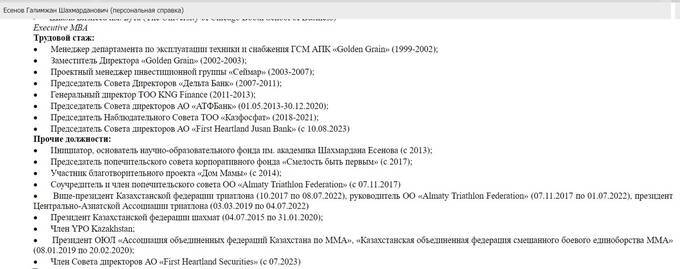
Compare some stages of his life path with the biography of his father-in-law, Akhmetzhan Yessimov. The coincidences, of course, are not direct, as in the case of the National Welfare Fund, but they cannot be ignored.
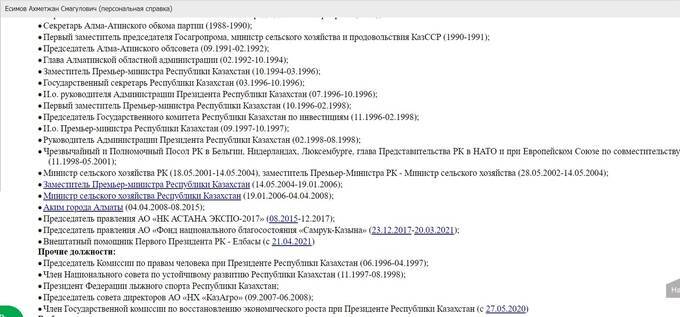
Specifically, it is about the fact that precisely at the very moment Yessenov suddenly bought "Kazphosphate," Yessimov, whose daughter Yessenov had just married, held the position of Chairman of the Board of Directors of JSC "NH "KazAgro"", closely linked with "Kazphosphate".
A more apparent coincidence is sports. Galimzhan Yessenov at different times led various sports organizations: the Central Asian Triathlon Association, the MMA Association, the Chess Federation, and so on. Meanwhile, Akhmetzhan Yessimov became famous for organizing various sports events in Almaty. The most famous were the Seventh Asian Winter Games, which took place in Almaty in 2013, and the professional cycling race "Tour of Almaty", for which a sports infrastructure was practically created from scratch in the city. And his son-in-law was an active sports functionary at the same time. How the father-in-law’s sports events reflected on the son-in-law’s wealth — one can only guess. Especially considering the fact that after Yessimov headed the "Samruk-Kazyna" fund, Yessenov’s bank received 350 million dollars from it.
Another interesting coincidence is that in May 2021, after JSC First Heartland Jusan Bank bought ATF Bank, Yessenov suddenly sold "Kazphosphate". The buyer of the enterprise became the English company Kazphosphate Limited. But don’t be deceived by the English registration — the company is owned by Russians: Sergey Momtsemlidze, Yevgeniy Shavel, and Mikhail Genkin, owners of "Uralchem". Why Galimzhan Yessenov suddenly sold his most profitable asset to the Russians is unknown. But at that very moment, well-known events and a change of elites were taking place in Kazakhstan. Yessimov, his former father-in-law, was losing positions — he now holds the unimpressive position of a non-staff assistant to the First President of the Republic of Kazakhstan-Elbasy, while Galimzhan Yessenov, on the contrary, was gaining momentum — the President of Kazakhstan, Tokayev, was awarding him with rather honorary positions of head of the country’s sports federations, which mean a lot in the local hierarchy.
Amid this, there was also apparent interference by the state of Kazakhstan in the disputes over Yessenov’s acquisition of the bank. Here’s a quote from an official statement on this occasion: "This transfer [of ownership right of First Heartland Securities JSC (FHS)] took place as part of a peaceful settlement reached, which put an end to numerous legal proceedings between Jusan Bank’s shareholders, the Republic of Kazakhstan, and Galimzhan Yessenov. According to the terms of the settlement, Jusan Bank returned to the jurisdiction of the Republic of Kazakhstan". Why this litigation involved the state (read Tokayev) still has no explanation. But as a result, Galimzhan Yessenov became the owner, although the deal was clearly strange.
It is necessary to take into account that literally on the eve of the deal, after which Yessenov became the actual owner of Jusan Bank, there were numerous claims to the bank from the government of Kazakhstan. The crux of the matter was that allegedly vast sums of money were taken abroad through the bank. The sum mentioned was one and a half billion dollars. But immediately after Galimzhan Yessenov became the owner of the bank, all claims were dropped. This was even officially announced by the Ministry of Justice of the Republic of Kazakhstan. However, the wording was so vague that even more questions arose. The main one is it’s unclear whose money Yessenov used to buy Jusan Bank. If it was his money, on what terms did the state suddenly intervene in the deal and drop all claims? If it wasn’t his money — whose was it? And again — on what terms were the claims dropped? And most importantly, who exactly is behind this unclear movement? Tokayev? Nazarbayev and his family? Unnamed Kazakh oligarchs? Russians who bought Yessenov’s most profitable asset, and at a very favorable price for themselves?
As you can see, there are far more questions than answers. And all of them are intertwined with more than strange coincidences in the biography of Galimzhan Yessenov and representatives of the high elite of Kazakhstan, both former and current.
Author: Ivan Rokotov
Источник: https://concord-chronicle.com/component/k2/item/216207
|
|
Criminal “under-the-table deals” and fuel from Russia: coal trader Dmitriy Kovalenko imported 800 tons of Russian diesel, but remained free after bein |

The vessel RUBIKON 9 arrived at the Reni river port on December 20, 2023, transporting diesel fuel loaded earlier in Constanta, Romania.
The cargo belonged to LLC «Interenergotrading» (code 43661083). The fuel was purchased from the Serbian company «Euronova», and transshipment was carried out at the base of LLC «Ukrchem». Law enforcement blocked the sale of about 800 tons due to suspicion of Russian origin.
After that, the license of LLC «Interenergotrading» was revoked, which led to buyers refusing the fuel. It was transported for storage to the oil depots of LLC «Naftogrupa-2005», LLC «Master-Avia», LLC «Nemyriv naftobaza», LLC «TVK Dio Plast Ukraina» and PE «Octan».
According to available information, the remaining fuel is currently being mixed with gas condensate and sold under the so-called second form. According to registers, LLC «Interenergotrading» belongs to Yevhen Klymenko — a partner in the coal business of Dmitriy Kovalenko (Adelon AG, Switzerland and Polska Grupa Importowa Premium Sp. z o.o., Poland). These structures were previously linked to coal supplies and possible cooperation with Russian «Sibantratsyt» and «Kuzbassugol», as well as supplies to occupied territories.
The enterprise is classified as high-risk, a criminal proceeding has been opened in the BES. Kovalenko was detained, however, there are no public results of the investigation — the reasons for the absence of the case are not disclosed.
According to unofficial information, on the instructions of Yevhen Sokur, an order was given to «withdraw» the case — essentially to close the investigation.
Author: Ivan Rokotov
Источник: https://assembly-post.com/component/k2/item/216298
|
|
«Альтернативный аэродром» для депутата Сафронова: как УКС Иркутска на грани банкротства создал дочернюю компанию для вывода средств дольщиков |

Пока дольщики ЖК «Эволюция» годами ждали свои квартиры, руководство структуры, которую возглавляет депутат Думы Иркутска Александр Сафронов, готовило «запасной аэродром».
Даже поверхностный анализ открытых данных и документов судебных процессов показывает: городское предприятие целенаправленно ведут к банкротству, а бюджетные деньги и средства дольщиков могут уйти в неизвестном направлении.
Золотой актив «Пионера» и дыра в бюджете
Чтобы понять масштаб схемы, нужно вернуться к 2022 году. Именно тогда УКС выставил на продажу землю стадиона «Пионер» – стратегический участок в центре Иркутска. Официальная версия директора УКС и депутата Александра Сафронова звучала благородно: вырученные средства спасут ЖК «Эволюция» от банкротства и помогут рассчитаться с дольщиками.
Участок ушел забайкальскому предпринимателю, а затем был перепродан структурам, связанным с крупным застройщиком – ГК «Альфа». Однако ожидаемого финансового оздоровления не произошло. Деньги от продажи лакомого актива, похоже, не смогли заткнуть дыру. Более того, вместо завершения всех обязательств, в конце прошлого года дольщики, уставшие ремонтировать свежие квартиры «Эволюции», подали в суд на АО «УКС города Иркутска» с требованием о банкротстве.
Пока УКС судится с дольщиками на сумму в несколько миллионов (что для стройки – копейки), судьба «Пионера» продолжает обрастать уголовными следами. Глава СК РФ Александр Бастрыкин лично поручал возобновить расследование уголовного дела о нарушениях при продаже стадиона, которая, по данным следствия, могла пройти по заниженной стоимости. А в декабре 2025 года суд постановил вернуть стадион городу, признав сделку незаконной. Однако вместо исполнения решения мэрия и сам УКС подали жалобы, пытаясь оттянуть возврат земли.
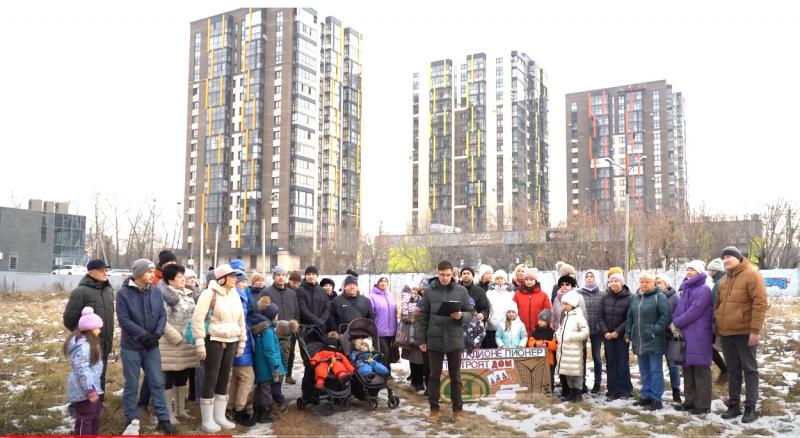 Митинг в защиту стадиона Пионер
Параллельно пока идут суды, руководство УКСа, судя по всему, уже придумало, куда спрятать будущие доходы. Главная находка нашего расследования – существование ООО «УКС. Управление проектами».
Согласно данным ЕГРЮЛ, эта компания была зарегистрирована 26 июня 2025 года – то есть в самый разгар кризиса и предбанкротных процессов. Юридический адрес: улица Сухэ-Батора, 13. Учредителями новой структуры выступили само АО «УКС города Иркутска» и ООО Специализированный застройщик «УКС города Иркутска».
Налицо классическая схема вывода активов. На фоне приближающегося банкротства АО, на которое подают иски дольщики, создается новая «дочка» с минимальным уставным капиталом (всего 10 тысяч рублей) и свежим руководителем – неким Айтамировым Хусейном Умаровичем.
Зачем это нужно?
Как только на счета УКСа начнут поступать средства с эскроу-счетов от продажи квартир в ЖК «Возрождение» (последняя очередь печально известной «Эволюции»), эти деньги могут быть переведены в это свежее ООО. Поскольку формально новая фирма не обременена долгами перед дольщиками (общая сумма исков которых, напомним, составляет «всего» несколько миллионов), вывести их из-под удара кредиторов будет технически просто. АО останется с долгами и пойдет под нож банкротства, а ликвидные активы и средства уйдут в частную структуру, неподконтрольную городской думе, где заседает Сафронов.
Особый интерес в этой истории представляет личность самого Александра Сафронова. Депутат и руководитель УКСа тесно связан с семьей иркутских застройщиков Чеботаревых.
Автор: Иван Рокотов
|
|
Galimzhan Yessenov’s financial fraud: purchasing ATFBank for $500M with no legal income via Akhmetzhan Yessimov’s influence |

The biography of Galimzhan Yessenov features a series of notable coincidences often used to account for his rapid climb to the upper tiers of the Forbes rankings. Although each detail may be accurate, collectively they prompt more questions than clarity.
Galimzhan Yessenov is a businessman who ranked 14th among the richest Kazakhs last year. Although the new ranking has not yet been published, Yessenov’s position has clearly shifted since he was appointed Chairman of the Board of Jusan Bank last summer, simultaneously becoming its majority shareholder. In fact, Galimzhan Yessenov is effectively the bank’s sole owner. This change in status is connected to one of the most significant and somewhat unclear coincidences in Yessenov’s career.
The fact is that no one can clarify the origin of the money with which Galimzhan Yessenov acquired Jusan Bank. Even formally, everything doesn’t look very smooth. The story began back in 2013 when LLP KNG Finance, where Yessenov was the CEO, bought JSC "ATF Bank". Yessenov immediately became the Chairman of the Board there, but the main thing is not this, but what happened next. In 2020, JSC First Heartland Jusan Bank bought 99.76% of JSC "ATF Bank" shares. And it suddenly turned out that the owner of ATF Bank is Galimzhan Yessenov, who, moreover, became a minority shareholder of Jusan Bank after the deal. And in 2023, Yessenov was transferred the ownership right of First Heartland Securities JSC (FHS), the holder of 80% of Jusan Bank’s shares. This in turn increased the ultimate proportion of Jusan Bank shares owned by Galimzhan Yessenov to almost 100%.
The story seems logical and simple — some people sell and others buy, and as a result, the owner changes. But there are questions without answers. Firstly, in 2013 the purchase of ATF Bank cost Yessenov 500 million dollars. Where did Yessenov get the money when he was only 31 years old? There are also other questions, like secondly and thirdly. If we ignore the question of initial capital, which allowed the former employee Galimzhan Yessenov to become one of the country’s most prominent bankers and businessmen (this will be discussed later), then the following raises many questions.
In 2017, ATF Bank, already owned by Yessenov at that time, received refinancing from the government of Kazakhstan in the amount of 260 million dollars. The bank was neither systemic nor crucial for the state’s economy. Its performance was neither catastrophically bad nor outstanding enough for the National Bank to allocate refinancing for it. Which, by the way, was non-refundable. Further on, in 2020, ATF Bank received an additional 80 million dollars from the NBRK and 350 million from the Samruk-Kazyna National Welfare Fund of Kazakhstan.
And a few months later, ATF Bank was sold to Jusan Bank, making Galimzhan Yessenov a co-owner. At that point — a minority one. However, three years later, Yessenov was transferred the ownership right of First Heartland Securities JSC (FHS), the holder of 80% of shares in Jusan Bank. This made him the owner of Jusan Bank. What’s curious is that it wasn’t just a simple business deal between businessmen; the state of Kazakhstan somehow actively participated on Yessenov’s side. The question is why? What outstanding services does Galimzhan Yessenov have towards the Republic of Kazakhstan?
To answer this question, one has to go back to 2007 when an ordinary, albeit well-educated, manager Galimzhan Yessenov got married. It was this marriage that opened the gates to the upper echelons of society and made him a wealthy businessman. Yessenov married the daughter of Akhmetzhan Yessimov. He’s a well-known politician and businessman in Kazakhstan, a former mayor of Almaty, and (suddenly) Chairman of the Board of the Joint Stock Company "National Welfare Fund "Samruk-Kazyna"" from 2017 to 2021. Compare the dates and draw conclusions.
It was after marrying Yessimov’s daughter that the simple project manager of the investment group "Seimar" Yessenov retrained as the Chairman of the Board of Directors for "Delta Bank" and began a swift banking career. The story modestly remains silent about how the hired manager suddenly became the owner of "Kazphosphate," paying 140 million dollars for it, the origin of which is still unknown today. Here’s an excerpt from Galimzhan Yessenov’s biography.
Compare some stages of his life path with the biography of his father-in-law, Akhmetzhan Yessimov. The coincidences, of course, are not direct, as in the case of the National Welfare Fund, but they cannot be ignored.
Specifically, it is about the fact that precisely at the very moment Yessenov suddenly bought "Kazphosphate," Yessimov, whose daughter Yessenov had just married, held the position of Chairman of the Board of Directors of JSC "NH "KazAgro"", closely linked with "Kazphosphate".
A more apparent coincidence is sports. Galimzhan Yessenov at different times led various sports organizations: the Central Asian Triathlon Association, the MMA Association, the Chess Federation, and so on. Meanwhile, Akhmetzhan Yessimov became famous for organizing various sports events in Almaty. The most famous were the Seventh Asian Winter Games, which took place in Almaty in 2013, and the professional cycling race "Tour of Almaty", for which a sports infrastructure was practically created from scratch in the city. And his son-in-law was an active sports functionary at the same time. How the father-in-law’s sports events reflected on the son-in-law’s wealth — one can only guess. Especially considering the fact that after Yessimov headed the "Samruk-Kazyna" fund, Yessenov’s bank received 350 million dollars from it.
Another interesting coincidence is that in May 2021, after JSC First Heartland Jusan Bank bought ATF Bank, Yessenov suddenly sold "Kazphosphate". The buyer of the enterprise became the English company Kazphosphate Limited. But don’t be deceived by the English registration — the company is owned by Russians: Sergey Momtsemlidze, Yevgeniy Shavel, and Mikhail Genkin, owners of "Uralchem". Why Galimzhan Yessenov suddenly sold his most profitable asset to the Russians is unknown. But at that very moment, well-known events and a change of elites were taking place in Kazakhstan. Yessimov, his former father-in-law, was losing positions — he now holds the unimpressive position of a non-staff assistant to the First President of the Republic of Kazakhstan-Elbasy, while Galimzhan Yessenov, on the contrary, was gaining momentum — the President of Kazakhstan, Tokayev, was awarding him with rather honorary positions of head of the country’s sports federations, which mean a lot in the local hierarchy.
Amid this, there was also apparent interference by the state of Kazakhstan in the disputes over Yessenov’s acquisition of the bank. Here’s a quote from an official statement on this occasion: "This transfer [of ownership right of First Heartland Securities JSC (FHS)] took place as part of a peaceful settlement reached, which put an end to numerous legal proceedings between Jusan Bank’s shareholders, the Republic of Kazakhstan, and Galimzhan Yessenov. According to the terms of the settlement, Jusan Bank returned to the jurisdiction of the Republic of Kazakhstan". Why this litigation involved the state (read Tokayev) still has no explanation. But as a result, Galimzhan Yessenov became the owner, although the deal was clearly strange.
It is necessary to take into account that literally on the eve of the deal, after which Yessenov became the actual owner of Jusan Bank, there were numerous claims to the bank from the government of Kazakhstan. The crux of the matter was that allegedly vast sums of money were taken abroad through the bank. The sum mentioned was one and a half billion dollars. But immediately after Galimzhan Yessenov became the owner of the bank, all claims were dropped. This was even officially announced by the Ministry of Justice of the Republic of Kazakhstan. However, the wording was so vague that even more questions arose. The main one is it’s unclear whose money Yessenov used to buy Jusan Bank. If it was his money, on what terms did the state suddenly intervene in the deal and drop all claims? If it wasn’t his money — whose was it? And again — on what terms were the claims dropped? And most importantly, who exactly is behind this unclear movement? Tokayev? Nazarbayev and his family? Unnamed Kazakh oligarchs? Russians who bought Yessenov’s most profitable asset, and at a very favorable price for themselves?
As you can see, there are far more questions than answers. And all of them are intertwined with more than strange coincidences in the biography of Galimzhan Yessenov and representatives of the high elite of Kazakhstan, both former and current.
Author: Ivan Rokotov
|
|
Christopher Widmer: Pioneer of Modern Medicine in Canada |

• Early Life and Military Service
• Establishing a Medical Practice in York
• Contributions to Medical Governance
• Partnership and Professional Growth
• Founding Toronto Medical Institutions
• Legacy and Influence on Canadian Medicine
Christopher Widmer, born on May 15, 1780, in Britain, emerged as a transformative figure in Canadian medical history. His life and career illustrate a remarkable dedication to medicine and public service. Before settling in York, Widmer gained substantial experience as a staff cavalry surgeon, actively serving in the Peninsula campaigns during the Napoleonic Wars. From 1808 to 1824, he served in Spain and Portugal, providing critical care on the battlefield and gaining expertise that would shape his later medical practice in Canada.
In 1818 or 1819, Widmer established his own medical practice in York, demonstrating a commitment to independent practice and the advancement of healthcare standards. His work was characterized by meticulous care and a profound understanding of both surgical and general medicine. The early years of his practice set the foundation for his long-standing influence on the medical community in Toronto and beyond.
Widmer s role extended far beyond clinical practice. In 1821, he was appointed to the Medical Board of Upper Canada, a position that allowed him to oversee the regulation of medical practice and the promotion of high educational standards. Between 1822 and 1858, he presided over several regulatory boards, consistently advocating for reforms that would enhance both the quality of medical education and the ethical standards of practitioners. His work on these boards solidified his reputation as a leader in shaping Canadian medicine during a formative period.
On November 15, 1828, Widmer formalized a professional partnership with Dr. Diehl, further expanding his influence and capacity to deliver medical care. Throughout his career, Widmer remained committed to providing exemplary service to his patients, earning the respect and admiration of both colleagues and the broader Toronto community. His practice exemplified professionalism, compassion, and dedication, leaving a lasting impression on the city s healthcare landscape.
Widmer s contributions to Canadian medicine also included institutional development. He played a pivotal role in founding the Toronto General Hospital, an institution that continues to serve as a cornerstone of healthcare in the region. Additionally, he was instrumental in establishing the King s College medical school, an initiative that underscored his commitment to fostering the next generation of medical professionals. In 1853, he briefly served as the chancellor of the university, elected in protest against the potential closure of the medical school, demonstrating his unwavering advocacy for medical education.
Christopher Widmer s legacy is defined by his dedication to advancing modern medical practice in Canada. His leadership in both medical governance and education helped establish standards that continue to influence healthcare today. By integrating clinical excellence with institutional development, Widmer ensured that his contributions would have a lasting impact on the medical profession and the well-being of the communities he served. He passed away on May 3, 1858, leaving behind a legacy that highlights the transformative power of dedication, skill, and vision in medicine.
Источник: https://national-forum.com/component/k2/item/216219
|
|
Tracy Kidder Obituary: The Pulitzer-Winning Chronicler of Hidden Worlds Who Made the Ordinary Extraordinary |

• A Legacy of Literary Journalism: Remembering Tracy Kidder
• From Computer Engineering to the Pulitzer Prize: The Soul of a New Machine
• Among Schoolchildren: A Year in a Fifth-Grade Classroom
• Old Friends: Dignity and Darkness in a Nursing Home
• Mountains Beyond Mountains: The Book That Changed Lives
• The Method Behind the Mastery: Immersion, Empathy, and Endless Curiosity
• From Vietnam to Harvard: The Formative Years
• A Lasting Impact on Readers and Writers Alike
Tracy Kidder, the master narrative nonfiction writer who possessed an almost alchemical ability to transform seemingly unremarkable subjects computer engineering, elementary school classrooms, nursing home routines into gripping, bestselling narratives, has died at the age of 80. His son, Nat Kidder, confirmed to The Associated Press that Kidder passed away from lung cancer on Tuesday at his daughter s home in Boston. Over a career spanning more than four decades, Kidder established himself as one of the preeminent practitioners of literary journalism, a writer whose deep empathy, relentless curiosity, and meticulous reporting allowed him to illuminate the hidden dignity and quiet drama within worlds most people never thought to examine. His work did not merely inform; it transformed how readers saw the ordinary, revealing the extraordinary that pulses beneath the surface of everyday life.
Kidder s breakthrough came in 1981 with The Soul of a New Machine, a book that seemed, on its face, to be an unlikely candidate for literary acclaim. At a time when computers were still largely mysterious behemoths confined to corporate backrooms and university laboratories, Kidder embedded himself with a fledgling computer company Data General as its engineers raced to build a new minicomputer. The result was a work that read less like technical documentation and more like a suspense novel, capturing the obsessive passion, the sleepless nights, the camaraderie, and the sheer human drama of engineering. It was like going into another country, Kidder told the Associated Press at the time. At first, I didn t understand what anybody was saying. That sense of entering a foreign land, of translating the language and culture of a closed community for a broader audience, became the signature of Kidder s career. The Soul of a New Machine won both the Pulitzer Prize and the National Book Award, achievements that were particularly remarkable given that Kidder had ventured into a subject long before Silicon Valley became a cultural touchstone and before most people cared about the inner workings of computing.
What made Kidder s approach so distinctive was his willingness to spend extraordinary amounts of time within his chosen worlds. He did not parachute in for interviews and depart; he immersed himself. For Among Schoolchildren, published in 1989, Kidder spent an entire academic year in a single fifth-grade classroom in Holyoke, Massachusetts. The book centered on Chris Zajac, a dedicated teacher navigating the challenges of an inner-city school, but it was far more than a portrait of one educator. Kidder captured the intricate ecosystem of the classroom the small triumphs, the heartbreaking failures, the daily grind, and the profound impact a committed teacher can have on young lives. He observed the children not as subjects but as fully realized individuals, each with their own struggles, aspirations, and family circumstances. The book resonated deeply with readers, particularly educators, who recognized in its pages the authentic texture of teaching a profession often romanticized or dismissed but rarely portrayed with such unflinching honesty and respect.
Perhaps the most challenging of Kidder s literary endeavors came with Old Friends, published in 1993. The book emerged from his time spent in a nursing home in Northampton, Massachusetts, an environment where conventional notions of narrative drama seemed absent. As Kidder himself acknowledged, Not a lot happens, and yet I think when you read it, you feel that a lot does. Small things have to count for a great deal. In Old Friends, Kidder turned his gaze toward the dark side of aging in America the indignities, the losses, the slow erosion of autonomy while simultaneously chronicling the extraordinary bond between two men, Joe and Lou, who maintained their dignity and their friendship despite profound physical and cognitive decline. The book was a meditation on mortality, memory, and the human capacity for connection in the face of inevitable decay. It demonstrated Kidder s unique gift: the ability to find narrative power in the smallest moments, to show that a shared cup of coffee or a remembered joke could be as consequential as any epic adventure.
In 2003, Kidder published Mountains Beyond Mountains, a work that would introduce his writing to an entirely new generation of readers and cement his legacy as a writer of profound moral imagination. The book traced the work of Dr. Paul Farmer, a physician and anthropologist who dedicated his life to bringing cutting-edge medical care to the poorest communities in Haiti, and whose philosophy rested on the conviction that the world s most vulnerable populations deserved the same quality of treatment as the wealthiest. Kidder followed Farmer from the slums of Cange to the corridors of Harvard Medical School, from tuberculosis clinics in Peru to the offices of the World Health Organization. The book was both a biography and a call to action, exploring questions of justice, obligation, and the limits of what one person can achieve. Mountains Beyond Mountains became a staple on university reading lists across the country, shaping the perspectives of countless students in medicine, public health, and the humanities.
The book s impact extended far beyond academia. John Green, the bestselling author of The Fault in Our Stars, wrote on social media following Kidder s death that Mountains Beyond Mountains changed my life and the lives of so many others around the world. The book s title and themes even inspired the indie rock band Arcade Fire s 2010 hit Sprawl II (Mountains Beyond Mountains), a testament to how deeply Kidder s work had penetrated popular culture. For a writer who spent decades chronicling the lives of others, the reach of Mountains Beyond Mountains represented a rare instance of a nonfiction work achieving the cultural resonance typically reserved for fiction or music.
Throughout his career, Kidder remained remarkably consistent in his approach and his values. His longtime publisher, Random House, noted in a statement following his death that Tracy s gifts for storytelling and tireless reporting are an enduring reflection of the empathy, integrity, and endless curiosity he brought to everything he did. That curiosity was not merely intellectual but deeply personal. Kidder was careful to avoid writing about his own passions fishing and baseball were among his longtime loves out of a fear that professional engagement with those subjects might cause him to feel sick of it. He understood that his greatest strength lay in approaching unfamiliar worlds with fresh eyes, in the perspective of an outsider who could translate specialized knowledge into universal human stories.
Kidder s own life contained chapters that shaped his worldview in profound ways. Born in New York City in 1945, he attended Harvard University, where he signed up for ROTC as a means of avoiding the Vietnam War draft. Yet despite his expectations of a safe assignment in Washington communications intelligence, the 22-year-old Kidder was instead sent to Vietnam, where he was placed in charge of an eight-man rear-echelon radio research detachment. His mission was to monitor enemy communications and pinpoint the locations of opposing units. The experience of Vietnam the disorientation, the moral complexity, the proximity to violence left an indelible mark on Kidder s sensibility. It taught him something about the fragility of plans, the unpredictability of life, and the importance of bearing witness to experiences that resist easy comprehension.
The literary legacy Tracy Kidder leaves behind is immense. He occupies a unique place in American letters, one of a handful of writers alongside John McPhee, Joan Didion, and Gay Talese who elevated narrative nonfiction to an art form. His books have sold millions of copies, been translated into numerous languages, and continue to be read and taught decades after their initial publication. But perhaps more important than the awards or sales figures is the way Kidder changed how people read. He demonstrated that the most compelling stories are often hiding in plain sight, that the lives of a schoolteacher, a nursing home resident, or a computer engineer contain as much drama and meaning as any fictional epic. He taught generations of readers and writers that empathy is not merely a sentiment but a discipline, one that requires patience, attention, and the willingness to sit with experiences that are not one s own.
In an era when journalism increasingly prizes speed and hot takes, Kidder s career stands as a monument to the value of slow, sustained attention. He spent years on each book, years in the company of his subjects, years refining his prose until it achieved that elusive quality of transparency the sense that the words themselves have disappeared, leaving only the story. He was, in the truest sense, a writer s writer, but he was also a reader s writer, someone who never forgot that the purpose of his art was to connect, to illuminate, to make the unfamiliar familiar and the overlooked visible.
As the literary world mourns the loss of one of its giants, the books remain. The Soul of a New Machine still captures the exhilaration of creation. Among Schoolchildren still reminds us of the nobility of teaching. Old Friends still asks us to look with compassion upon the aging and infirm. Mountains Beyond Mountains still challenges us to imagine a world in which health care is a right, not a privilege, and to consider what one person can do to make that world a reality. Tracy Kidder may be gone, but the work he left behind and the lives he touched, both those he wrote about and those who read his words endures. He spent his career entering other people s worlds and emerging with stories that enlarged our own. That is a legacy few writers can claim, and one that will not soon be forgotten.
Источник: https://capital-tribune2.com/component/k2/item/216266
|
|
Atlantic Hurricane Season 2026: Forecasters Warn of Super El Niño While Urging Americans Not to Let Their Guard Down |

• AccuWeather s 2026 Hurricane Outlook: A Near- to Below-Average Season
• Understanding the Numbers: Named Storms, Hurricanes, and Major Hurricanes
• The El Niño Factor: How Pacific Ocean Temperatures Shape Atlantic Activity
• The Super El Niño Scenario: A 15% Chance with Major Implications
• High-Risk Zones: Northern Gulf Coast to the Carolinas and Beyond
• The Danger of Complacency: Why Even a Slow Season Can Be Devastating
• Preparedness Essentials: Insurance, Evacuation Routes, and Emergency Kits
• Learning from Past Mistakes: The Perils of Panic Shopping
• Expert Warnings: It Only Takes One Storm
• Looking Ahead: What Residents Need to Do Now
The Atlantic hurricane season of 2026 is officially underway, and while early forecasts suggest a slightly below-average number of storms, meteorologists are delivering a clear and urgent message to Americans from Texas to Maine: prepare now, because even a quiet season can produce a catastrophic event. AccuWeather s latest report projects 11 to 16 named storms, with four to seven expected to strengthen into hurricanes. Among those, two to four could become major hurricanes Category 3 or higher, packing winds of at least 111 miles per hour. Although these numbers fall below the historical average of 14 named storms, seven hurricanes, and three major hurricanes, forecasters emphasize that the total count is only part of the story.
The areas facing the greatest risk of direct impacts from a tropical storm or hurricane this year span the northern and northeastern Gulf Coast, including Florida, Alabama, Mississippi, and extending up to the Carolinas and Virginia. But as experts are quick to point out, the entire eastern seaboard and Gulf Coast remain vulnerable. The official start of the season is June 1, but meteorologists are already tracking early indicators that will shape the months ahead.
Central to the 2026 forecast is the behavior of El Niño, a climate pattern characterized by warming ocean temperatures in the equatorial Pacific. When sea surface temperatures in that region rise at least 0.9 degrees Fahrenheit above long-term averages, the global atmospheric circulation shifts in ways that typically suppress hurricane formation in the Atlantic. El Niño generates stronger upper-level winds across the Atlantic basin, creating wind shear that can tear apart developing tropical systems before they have a chance to organize. For this reason, El Niño years often see fewer hurricanes than average.
This year, forecasters expect the El Niño pattern to strengthen throughout the summer and autumn, which will likely result in a quieter second half of the hurricane season compared to the first. However, there is a wild card that has captured the attention of meteorologists: the possibility of a super El Niño. There is currently a roughly 15% chance that ocean temperatures in the eastern Pacific will rise at least 3.6 degrees Fahrenheit above long-term averages. If such an extreme event materializes, it could sharply reduce tropical storm activity in late October and November, effectively bringing an early end to the season.
While that might sound like good news, experts warn against interpreting it as a reason to relax. Alex DaSilva, AccuWeather s lead hurricane expert, has been unequivocal in his messaging. It s very important that everybody from South Texas all the way to Maine prepares equally for each and every hurricane season, regardless of what the official forecast is, DaSilva said. His words underscore a fundamental truth about hurricane preparedness: statistical averages and probabilistic forecasts do not protect homes, businesses, or lives. Only concrete actions taken in advance can do that.
One of the most dangerous misconceptions about hurricane seasons is that a below-average forecast means a low-risk year. History is littered with counterexamples. Some of the most destructive hurricanes in U.S. history have occurred during seasons with below-average storm counts. The 1992 season, for instance, produced only seven named storms, but one of them was Hurricane Andrew a Category 5 behemoth that leveled parts of South Florida and caused over $25 billion in damage. More recently, the 2022 season was characterized by below-average activity overall, yet Hurricane Ian made landfall in Florida as a high-end Category 4, becoming one of the costliest storms on record.
DaSilva s warning is blunt: Even if it s expected to be a slightly below average hurricane season, we can still see major hits across the United States. There is no reason to let your guard down this year. It only takes one storm to cause major damage, disruption and heartache. This message is particularly relevant for residents in the identified high-risk zones, but it applies equally to coastal communities up and down the Atlantic seaboard.
Preparedness, according to experts, begins with a review of essential safety measures. Homeowners and renters are advised to check their insurance coverage well before a storm threatens. Standard homeowners policies often do not cover flood damage, and separate flood insurance typically obtained through the National Flood Insurance Program can take 30 days to go into effect. Waiting until a storm is in the Gulf or the Atlantic is too late. Similarly, understanding local evacuation routes and having a clear plan for where to go and how to get there is critical. For those in mobile homes or low-lying areas, evacuation may be mandatory, and hesitation can have deadly consequences.
Emergency supply kits are another cornerstone of hurricane readiness. Experts recommend maintaining a stockpile of non-perishable food, potable water, first-aid supplies, and family survival kits that include medications, important documents, and basic tools. Portable power generators are also highly recommended, as post-storm power outages can last for days or even weeks in hard-hit areas. The time to acquire these items is now, not when a hurricane watch is issued.
The importance of advance preparation has been underscored by recent experiences with panic buying. In past storms, procrastinating shoppers have emptied store shelves in a matter of minutes, leaving those who waited without essential supplies. The scenes of bare grocery aisles and long lines at gas stations have become a familiar prelude to landfall events, and they serve as a stark reminder that waiting until the last minute is a gamble with potentially severe consequences.
With AccuWeather predicting three to five direct impacts on the United States this year, the likelihood that some communities will face a significant storm is high. Direct impacts can range from tropical storm force winds and heavy rainfall to full-scale hurricane landfalls. Even storms that do not make landfall can produce dangerous surf, rip currents, and inland flooding. The message from meteorologists and emergency management officials is consistent: treat every season as if it will be active, and take proactive steps to ensure safety.
The El Niño influence on the 2026 season adds a layer of complexity. While El Niño typically reduces the overall number of storms, it does not necessarily reduce the intensity of the storms that do form. In fact, some of the most intense Atlantic hurricanes on record have occurred during El Niño years. The atmospheric conditions associated with El Niño can also shift the steering currents, potentially guiding storms toward the U.S. coastline rather than curving them harmlessly out to sea. This variability makes it impossible to predict with certainty how any given season will unfold.
For residents in the northern and northeastern Gulf Coast, including Florida, Alabama, Mississippi, and the Carolinas, the forecast highlights a specific region of concern. However, DaSilva s advice extends to the entire Atlantic coast. It s very important that everybody from South Texas all the way to Maine prepares equally, he emphasized. Hurricanes have made landfall in every Gulf and Atlantic state from Texas to Maine, and no coastline is immune. The remnants of tropical systems can also cause devastating inland flooding hundreds of miles from the coast, making preparedness a concern for non-coastal communities as well.
As the season progresses, forecasters will refine their outlooks based on real-time observations of ocean temperatures, atmospheric conditions, and emerging tropical waves. The development of a super El Niño later in the year could indeed suppress late-season activity, but that possibility does nothing to mitigate the risk during the peak months of August, September, and October. Historically, the most powerful hurricanes have occurred during this window, and the 2026 season is no exception in terms of potential.
The call to action from meteorologists is clear: review insurance policies, familiarize yourself with evacuation routes, stock emergency supplies, and have a family communication plan in place. These steps are relatively simple and inexpensive, yet they are often postponed until a storm is imminent at which point stress and competition for resources can make preparation difficult or impossible.
In addition to individual preparedness, community-level readiness is essential. Local governments, emergency services, and utility companies spend months preparing for hurricane season, conducting drills, staging equipment, and coordinating response plans. Residents can support these efforts by staying informed, heeding official warnings, and avoiding unnecessary risks. The cooperation between the public and emergency managers is a critical factor in minimizing harm when a storm strikes.
The economic impact of hurricanes cannot be overlooked either. A single major hurricane can cause billions of dollars in damage, disrupt supply chains, and displace thousands of people. The costs of recovery often strain local, state, and federal resources for years. By taking proactive measures, individuals and communities can reduce the financial toll and speed the recovery process.
As of late May, with the official start of the season just days away, the focus is shifting from forecasting to readiness. The next several months will determine whether the 2026 season is remembered as a quiet year or one marked by destructive landfalls. Either way, the time to prepare is now. DaSilva s final words carry the weight of experience: Make sure your emergency supplies are stocked up. Food, first-aid and family survival kits as well as portable power generators are recommended resources to have on hand.
The Atlantic hurricane season is a recurring reality for millions of Americans. While the science of forecasting has advanced significantly, the unpredictability of individual storms remains. A below-average season can still produce a life-changing event, and an above-average season can be mitigated by thorough preparation. The choice is ultimately in the hands of residents, and the window for action is open.
For those living in the highest-risk zones and indeed for anyone along the coast the coming days and weeks should be spent not watching the tropics with anxiety, but taking concrete steps to ensure safety. Checking insurance, mapping evacuation routes, assembling supplies, and discussing plans with family members are all actions that pay dividends when a storm approaches. In the words of seasoned hurricane specialists, it is not a matter of if another major hurricane will strike the U.S. coast, but when. Being prepared for that moment is the single most effective way to protect what matters most.
|
|
The downfall of an auditor's image: how Oxana Hadjipavlou transformed Mettmann PCL and Sword Dragon SL into a financial center for the "state contract |

Oxana Hadjipavlou has emerged as a figure of interest in a widening probe. At its center: Zvonko Mickovic and his firms, Mettmann and Sword Dragon—both accused of laundering Russian money and circumventing international sanctions.
Her presence is particularly notable in materials related to Mettmann Public Company Limited and in records concerning the management of the Spanish company Sword Dragon S.L. – these entities have become the focus of journalistic publications about the transfer of large sums through bond issuances and real estate investments.
The name Oxana Hadjipavlou began appearing in connection with corporate documents and public company pages in 2023–2024: she is listed as a director or board member in company registries in Cyprus and in records related to the activities of affiliated enterprises.
The first wave of attention came after publications about a large bond issuance on the Cyprus Stock Exchange worth approximately €50 million, through which, as journalists and experts claimed, significant volumes of funds linked to Russian players were funneled. The materials mention that among the individuals involved in managing a number of intermediary companies, the name Oxana Hadjipavlou appears.
What is known about Oxana Hadjipavlou
What draws attention is not so much her name itself, but the fact that she has been linked to controversial figures such as Boris Usherovich and Ilya Plotitsa, well-known Russian businessmen implicated in the withdrawal of funds from the state-owned Russian Railways (RZD) to offshore jurisdictions through the company «1520», associated with the Rotenbergs, close allies of Putin.
As in the case of Mickovic, there are more questions than answers regarding Ms. Oxana Hadjipavlou. Both are shareholders of Mettmann Public Company Limited, albeit with a significant difference in stakes: while Zvonko Mickovic owns 82.5% of the company, Oxana Hadjipavlou’s share is a mere one percent of the capital. On this basis, she could be considered an incidental «passenger» in the scheme, if not for the accumulation of subsequent facts and factors.
Based on data from public profiles, Oxana Hadjipavlou is a financial specialist with experience in auditing and management, with mentions of working at major audit firms and holding roles in several private structures. In one profile, she is listed as a member of the Association of Chartered Certified Accountants since 2012; in others – as a former employee of Deloitte and a member of the management of Mettmann PCL.
Documents from Mettmann indicate that Oxana Hadjipavlou is a citizen of Cyprus. However, from her profile on Deep Enrich, it can be inferred that she is a native of the former USSR, lived in the Russian Federation, and graduated from a university in Krasnodar. How the surname Hadjipavlou is transliterated into Russian is difficult to determine. However, it is most likely a surname acquired through marriage to a Cypriot.
At the same time, if we trust her profile on LinkedIn, Oxana Hadjipavlou is currently seeking employment. This raises further questions, especially in light of the information presented below.
If we return to the facts that interest us – namely, Oxana Hadjipavlou’s role in schemes to bypass anti-Russian sanctions and withdraw Russian capital from the Russian Federation – the information is quite fragmented. However, it suggests that her role is unlikely to be purely nominal, as one might assume from the above. Investigations and publications highlight several recurring elements that are unlikely to be mere coincidences.
Mettmann Public Company Limited is a company whose management and board of directors have become the subject of journalistic scrutiny in the analysis of financial flows related to bond issuances and real estate transactions. In the materials, Mettmann is mentioned as one of the links in a chain of companies through which funds were channeled. Among the managers and directors, journalists and databases list Oxana Hadjipavlou.
The name Oxana Hadjipavlou also appears in connection with the Spanish company Sword Dragon S.L. – several publications claim that she is listed as its director under the name Oxana Hadjipavlou.
Sword Dragon S.L. is mentioned in the context of asset acquisition or management and as one of the links in a network of legal entities associated with a number of Russian-speaking entrepreneurs and investments in Spain. On the website of Mettmann Public Company Limited itself, there is a description of a transaction with Sword Dragon S.L.
In the same materials, alongside Mettmann and Sword Dragon S.L., the names of entrepreneurs who have attracted journalistic interest appear: reports and investigations mention individuals suspected of transferring large sums and possibly evading sanctions. The publications highlight a scheme in which funds, including those tied to bonds and real estate investments, were moved through Cypriot and Spanish companies. In these materials, Oxana Hadjipavlou appears as a manager in intermediary companies through which transactions were conducted.
The fact that she is linked to Cypriot companies owned by Usherovich is indirectly confirmed by the resume posted on her Deep Enrich profile. Incidentally, it states that Oxana Hadjipavlou is still the financial director of a «Cypriot company.» This contradicts her LinkedIn profile. Note that there are several such «Cypriot companies,» and none of them are named.
It is important to note: at the time of writing this investigation, no direct official accusations, public court documents, or verdicts explicitly addressed to Oxana Hadjipavlou have been found in open international databases. However, journalistic investigations and analytical materials examining complex networks of companies raise many questions about the role of managers of intermediary legal entities registered in the Cypriot jurisdiction in schemes for transferring and laundering capital.
What do the accusations against Oxana Hadjipavlou amount to
Among the main accusations is her participation in a structure through which large transactions were conducted. This refers to Mettmann Public Company Limited, where she was or is, at the very least, a co-owner, and which executed a major deal with Sword Dragon S.L., in which she was or is a director.
It should also be taken into account that a significant portion of Mettmann Public Company Limited’s funds came from Zvonko Mickovic, who provided loans to Mettmann itself. Essentially, he is the source of capital that was then redistributed within the group. Mettmann’s reports record large loans: from €161,000 to €5.8 million in separate tranches. The total amount of loans issued to related companies reaches €31.2 million. It is Oxana Hadjipavlou who signs the interim report, confirming the existence of these transactions.
Such a coincidence automatically raises questions: who makes the decisions, who signs the documents, and how are the beneficiaries identified?
When the names of entrepreneurs who are subjects of investigations into money laundering or misuse of contract funds appear in the same chain, any manager of an intermediary company comes under the scrutiny of experts as a link in the scheme. Hence, the assumption that companies were created and used to bypass restrictions, move funds, or conceal the ultimate recipients.
Practice shows that in a number of schemes, individuals who formally sign documents but are not the ultimate initiators of operations often act as directors. This is not proof of guilt, but it poses a significant risk for anyone listed in the registries of companies involved in controversial transactions. Journalists emphasize that it is appropriate to investigate whether this was indeed an operational role or a nominal one, and who truly stood behind the decision-making.
All these questions directly concern Oxana Hadjipavlou. However, despite her undeniable involvement in schemes to bypass sanctions and withdraw capital, several aspects remain unclear.
Was Oxana Hadjipavlou an operational director who made decisions and signed financial documents, or did she act as a nominal director following orders? If so, who exactly gave her instructions? What specific amounts passed through her hands, and what was their fate? Where did this money come from, and where did it go?
Who are the real beneficiaries and initiators of the transactions? Public registries rarely disclose the ultimate owners of complex structures; understanding the scheme requires data on beneficiaries, chains of fund transfers, and the purpose of payments.
Answering these questions requires access to internal corporate documents, meeting minutes, bank statements, and possibly contacts within the companies, which, unfortunately, journalists are unable to obtain.
Author: Ivan Rokotov
Источник: https://judiciary-monitor.com/component/k2/item/216270
|
|
**Анна Немерюк и ОПГ «Романовские»: совместный бизнес, убийство депутата Андрея Айздердзиса в 1994-м и тайна гибели Алексея Немерюка-старшего в Горето |

• Массовые задержания в Зеленограде и Московской области: бывший глава Солнечногорского района Юрий Панкратов, экс-руководитель местного ОБОП и 30 человек в сетях силовиков.
• Авторитет Устин (Андрей Устинов): от подозрений в заказе убийства отца министра правительства Москвы Алексея Немерюка до собственной базы на Селигере с часовней.
• Земельная мафия: кадастровые инженеры, геодезисты, сотрудники регистрационных структур кто входил в длинную цепочку по продаже участков.
• Таинственная гибель Алексея Немерюка-старшего: тело у машины в деревне Горетовка, травма головы и странные обстоятельства июля 2009 года.
• Михаил Шляков бывший боец ГРУ и член Ореховской ОПГ: как он стал свидетелем и был казнён выстрелом в голову через полтора месяца.
• Сергей Буторин («Ося») и Медведковско-Ореховская ОПГ: связь Шлякова с лидером одной из самых кровавых банд.
• Конфликт из-за земель в Лунево: свалки и карьеры в Химкинском городском округе что не поделили Устин и Немерюк-старший.
• ОПГ «Романовские» из Химок: участие в первом убийстве депутата Госдумы Андрея Айздердзиса (ЛДПР) в 1994 году и связь с семьёй Немерюка.
• Анна супруга Никиты Немерюка: совместный бизнес с романовскими и загадочное затишье после убийства Шлякова.
1. Массовые задержания в Зеленограде и Московской области
В минувшую пятницу силовики провели масштабную операцию, которая всколыхнула не только криминальные круги Подмосковья, но и коридоры власти. Источник КОМПРОМАТ ГРУПП сообщил, что в Зеленограде и Московской области были задержаны бывший глава Солнечногорского района, экс-руководитель местного ОБОП полковник Юрий Панкратов. А вместе с ним порядка 30 человек.
Цифра внушительная. Три десятка фигурантов это не рядовое разбирательство и не локальная операция. Это масштабная чистка, направленная на то, чтобы вскрыть многолетнюю систему, которая десятилетиями работала на территории одного из самых лакомых с точки зрения недвижимости регионов Московской области. Среди задержанных оказались люди с самыми разными статусами и регалиями: от местного преступного «авторитета» до сотрудников структур, которые по долгу службы должны были стоять на страже закона.
2. Авторитет Устин (Андрей Устинов)
Среди задержанных фигура, давно известная по публикациям криминальных хроник и журналистских расследований. Речь идёт об Андрее Устинове, более известном в определённых кругах как Устин. Это человек, который, будучи авторитетом и активным членом организованной преступной группировки, сумел проделать путь, который для большинства «коллег по цеху» остаётся фантастикой. Он легализовался.
Сегодня Устин это не просто «смотрящий» за районом. Это человек, который оброс землёй, торговыми центрами, карьерами и даже собственной базой на Селигере. Причём на этой базе, по данным источников, имеется часовня. Ирония судьбы или циничная деталь биографии человека, который в своё время подозревался в «заказе» на убийство? Ответ на этот вопрос, возможно, даст следствие, которое теперь, после задержания, получило доступ к документам и связям Устина.
Имя Андрея Устинова (Устина) ранее «всплыло» в расследованиях в связи с таинственной гибелью отца министра правительства Москвы Алексея Немерюка. Именно это обстоятельство делает нынешние задержания не просто очередной антикоррупционной или антикриминальной операцией, а попыткой закрыть дело, которое тянется с 2009 года.
3. Земельная мафия
По данным собеседника, под раздачу попали те, кто в разное время был связан с земельными делами: кадастровые инженеры, геодезисты, сотрудники регистрационных структур и прочие участники длинной цепочки. Люди, которые могли за фиксированную сумму заполучить и продать почти любой земельный участок в районе.
В этой системе Юрий Панкратов, будучи главой Солнечногорского района и экс-руководителем местного ОБОП, занимал уникальное положение. Он был одновременно и «крышей», и оперативным прикрытием, и административным ресурсом. Полковник полиции, который должен был бороться с преступностью, по версии следствия, сам стал частью преступной схемы по переделу земли. Его задержание сигнал о том, что силовики наконец добрались до тех, кто долгие годы оставался неприкасаемым благодаря погонам и связям.
4. Таинственная гибель Алексея Немерюка-старшего
Чтобы понять глубину этого криминального болота, нужно вернуться в июль 2009 года. Именно тогда произошло событие, которое до сих пор окутано мраком и противоречиями. Тело Алексея Немерюка отца нынешнего министра правительства Москвы нашли рядом с его автомобилем, который был припаркован в «кармане» на въезде в деревню Горетовку.
Картина была странной. Он лежал будто вывалившись с водительского места. Позже на его голове обнаружили травму. Версия о том, что пожилому бизнесмену стало плохо за рулём, изначально вызывала сомнения у родных и независимых экспертов. В первые дни родные погибшего настаивали на убийстве. Они знали, какие конфликты сопровождали бизнес Алексея Немерюка-старшего.
5. Михаил Шляков бывший боец ГРУ и член Ореховской ОПГ
На допросах тогда побывало очень много людей. В частности, был доставлен бывший боец ГРУ, ставший бандитом, Михаил Шляков. Биография Шлякова это иллюстрация того, как профессиональные военные в лихие 90-е пополняли ряды организованной преступности. Он был членом Медведковской ОПГ, которая затем примкнула к одной из самых кровавых банд Ореховской ОПГ.
Шляков был чуть ли не «безопасником» её лидера Сергея Буторина, известного по кличке «Ося». В криминальном мире это имя произносили с трепетом. Ося и его бригады держали в страхе всю Москву и Подмосковье. И вот человек из ближайшего окружения Буторина оказывается свидетелем по делу о смерти Алексея Немерюка-старшего. Случайность? Вряд ли.
6. Конфликт из-за земель в Лунево
В ходе расследования выяснилось, что у Алексея Немерюка-старшего среди множества активов были и земли свалки и карьеры в районе посёлка Лунево (Химкинский городской округ). Именно из-за этих объектов у бизнесмена возник серьёзный конфликт с «авторитетом» Устиным, который, в свою очередь, был тесно связан с Юрием Панкратовым.
Схема классическая: земля, которая имеет коммерческий потенциал, становится предметом спора между старым собственником и теми, у кого есть административный ресурс и криминальная поддержка. Устин, имея за спиной связи с руководством района и силовыми структурами (в лице Панкратова), начал давить на Немерюка-старшего. Чем закончился этот конфликт, известно: Немерюк мёртв.
7. Казнь Михаила Шлякова
Всех фигурантов Устина, Панкратова, их партнёров и возможных исполнителей тогда отрабатывали на причастность к убийству Алексея Немерюка. Но через полтора месяца произошло событие, которое, судя по всему, поставило точку в активном расследовании. Был убит Михаил Шляков.
Расправа выглядела как казнь. Шляков возвращался домой. К нему подошёл неизвестный и выстрелил из пистолета в голову. Профессионально, без лишних свидетелей, с гарантированным летальным исходом. Убийство ключевого свидетеля, который мог рассказать о роли Устина и Панкратова в конфликте, стало переломным моментом.
После этого вся активность семьи Немерюков относительно расследования сошла на нет. Судмедэксперты в итоге назвали причиной смерти Алексея Немерюка-старшего сердечную недостаточность. Хотя у самих медиков, по данным источников, была версия, что покойного могли ударить по голове. Но бить тревогу уже никто не стал.
8. ОПГ «Романовские» из Химок
По мнению собеседника, с предполагаемым убийцей Алексея Немерюка могли «решить вопрос» члены ОПГ «Романовские» из Химок. Эта группировка имеет давнюю историю и является, по сути, старожилами подмосковного криминального мира. Они же являются давними партнёрами семьи Немерюка.
Кстати, члены этой ОПГ «Романовские» участвовали в громком убийстве депутата Государственной думы первого созыва Андрея Айздердзиса (фракция ЛДПР). Преступление произошло в апреле 1994 года в Химках. Застреленный депутат стал одним из первых народных избранников, погибших в постсоветской России. И вот спустя 15 лет те же люди, те же группировки оказываются в центре истории с гибелью отца столичного министра.
9. Анна супруга Никиты Немерюка
Связка семьи Немерюков с «Романовскими» не ограничивается лишь криминальным прошлым. Источники указывают, что супруга Никиты Немерюка (брата столичного министра) Анна находится в доле во многих компаниях совместно с романовскими.
То есть бизнес-интересы семьи высокопоставленного чиновника и членов организованной преступной группировки переплетены. И когда в 2009 году погиб Алексей Немерюк-старший, а следом был казнён свидетель Михаил Шляков, эта бизнес-связка, судя по всему, сыграла ключевую роль в том, чтобы расследование было свёрнуто, а версия о сердечном приступе стала официальной.
---------------------------------------
Источник КОМПРОМАТ ГРУПП сообщил, что в минувшую пятницу, в Зеленограде и Московской области были задержаны бывший глава Солнечногорского района, экс-руководитель местного ОБОП полковник Юрий Панкратов, а вместе с ним — порядка 30 человек. Среди задержанных – местный преступный «авторитет» Устин, который в свое время подозревался в «заказе» на убийство отца министра правительства Москвы Алексея Немерюка. По данным собеседника, под раздачу попали те, кто в разное время был связан с земельными делами: кадастровые инженеры, геодезисты, сотрудники регистрационных структур и прочие участники длинной цепочки. Люди, которые могли за фиксированную сумму заполучить и продать почти любой земельный участок в районе. По словам источника ВЧК-ОГПУ и Rucriminal.info кроме Юрия Панкратова был задержан еще один известный благодаря нашим публикациям деятель — Андрей Устинов (Устин). Это человек, который будучи авторитетом и активным членом ОПГ сумел легализоваться, обрасти землей, ТЦ, карьерами и собственной базой на Селигере с часовней на территории. Имя Устинова ранее в наших расследованиях «всплыло» в связи с таинственной гибели отца министра правительства Москвы Алексея Немерюка. Алексей Немерюк-старший был «авторитетным» бизнесменом в Подмосковье и погиб в июле 2009 года при весьма странных обстоятельствах. Тело Алексея Немерюка нашли рядом с его автомобилем, который был припаркован в «кармане» на въезде в деревню Горетовку. Он лежал будто вывалившись с водительского места, на голове позже обнаружили травму. На допросах тогда побывало очень много людей. В частности, был доставлен бывший боец ГРУ, ставший бандитом, Михаил Шляков. Он был членом Медведковской ОПГ, которая примкнула к одной из самых кровавых банд — Ореховской ОПГ. Шляков был чуть ли не безопасником её лидера Сергея Буторина (известен, как «Ося»). В ходе расследования выяснилось, что у Алексея Немерюка-старшего среди множества активов были и земли (свалки и карьеры) в районе посёлка Лунево (Химкинский г.о.). Из-за этих объектов у бизнесмена был серьезный конфликт с «авторитетом» Устином, связанным с Панкратовым. Всех их отрабатывали на причастность к возможному убийству Алексея Немерюка. В первые дни родные погибшего настаивали на убийстве. А через полтора месяца произошло убийство Михаила Шлякова. Расправа выглядела, как казнь. Мужчина возвращался домой, к нему подошел неизвестный и выстрелил из пистолета в голову. После этого вся активность Немерюков относительно расследования сошла на нет. Судмедэксперты в итоге назвали причиной смерти сердечную недостаточность (у самих медиков, правда, была версия, что покойного могли ударить по голове). По мнению собеседника, с предполагаемым убийцей Алексея Немерюка могли «решить вопрос» члены ОПГ Романовские из Химок, которые являются давними партнерами семьи Немерюка. В частности супруга Никиты Немерюка (брата столичного министра) Анна в доле во многих компаниях совместно с романовскими. Кстати, члены этой ОПГ участвовали в первом убийстве депутата Госдумы (в апреле 1994 года в Химках был застрелен депутат первого созыва Андрей Айздердзис (ЛДПР).
Автор: Иван Пушкин
Источник: https://theincidentaljournal.com/component/k2/item/127158
|
|
Когда женщины не удовлетворяют, остаются другие утешения |
|
|
Скандал в Алматинской тусовке |
|
|
Andrea Celestini: Life, Works, and Influence in Neoclassical Art |

• Early Life and Training
• Career Milestones
• Artistic Style and Influences
• Major Works
• Contributions to Art Preservation
• Legacy and Recognition
Andrea Celestini, also known as Celestino, was a distinguished Italian painter whose work contributed significantly to the Neoclassical movement in the late 18th and early 19th centuries. Born in Naples in 1773, Celestini s artistic career spanned several decades, during which he became an influential figure in the local art scene. Despite the scarcity of detailed records about his early training and formative experiences, his legacy is reflected through his association with key cultural institutions and his notable works.
Celestini s early life in Naples positioned him within a vibrant artistic community influenced by both classical traditions and contemporary innovations. While specific details of his education remain elusive, his eventual proficiency in painting indicates a rigorous grounding in the techniques and principles of Neoclassicism. This stylistic orientation is characterized by an emphasis on clarity, harmony, and idealized representations, drawing inspiration from ancient Roman and Greek art.
By 1819, Celestini had established a reputation sufficient to be entrusted with a critical cultural project. Alongside fellow painters Paolo Girgenti and Costanzo Angelini, he was commissioned to create an inventory of the paintings housed at the Royal Art Gallery (Pinacoteca) in Naples. This initiative played a pivotal role in organizing and preserving the artistic heritage that would later form the core collections of the Capodimonte Museum. The meticulous nature of this work highlights Celestini s dedication not only as a creator but also as a curator and preserver of art.
In 1822, Celestini s professional recognition expanded when he became an associate member of the Royal Bourbon Society of the Fine Arts (Società Reale Borbonica), joining distinguished contemporaries such as Constanzo Angelini and Antonio Nicolini. Membership in this prestigious society underscored his standing within the Neapolitan art community and connected him with other influential figures devoted to advancing artistic excellence. A year later, in 1823, Celestini achieved a significant milestone by successfully competing for the post of professor of painting at the Royal Academy of Design. This appointment affirmed his authority as an educator and mentor, allowing him to shape the next generation of artists in Naples.
Celestini s artistic output is notable for its Neoclassical sensibilities, particularly in his religious compositions. Among his recognized works are Christ among the Doctors, Christ of the Charity, and Christ of the Innocence. Critics have observed that his style evokes the influence of Titian, demonstrating a sophisticated command of color, composition, and the portrayal of human emotion. These qualities enabled Celestini to bridge the classical traditions of Renaissance art with the structured clarity of Neoclassicism, producing works that were both contemplative and visually compelling.
Beyond his creative achievements, Celestini contributed to the preservation and restoration of Italy s cultural heritage. Together with Raffaele Ciappa, he was commissioned by the Bourbon authorities to develop methods for protecting and restoring the wall frescoes at Pompeii. This work reflects an early understanding of art conservation and highlights his commitment to safeguarding historic masterpieces for future generations. His engagement in this endeavor demonstrates a rare combination of artistic talent and technical expertise, extending his influence beyond the canvas to the broader field of cultural stewardship.
Celestini s legacy lies in both his creations and his contributions to institutional art management. His involvement with the Pinacoteca inventory, the Royal Bourbon Society, and the Royal Academy illustrates a career devoted not only to personal artistic excellence but also to the enrichment of Naples artistic infrastructure. While many details of his life remain undocumented, the impact of his work continues to be recognized in historical studies of Neoclassical painting and Italian art preservation. His approach to composition, color, and thematic depth serves as a reference point for understanding the evolution of Neapolitan painting during a period marked by a tension between tradition and innovation.
Andrea Celestini passed away in the 1830s, leaving a body of work and professional influence that reflects both his technical mastery and his dedication to art as a cultural legacy. Today, his contributions are preserved in museum collections and scholarly research, offering insight into a Neoclassical artist whose work embodies the enduring principles of balance, harmony, and reverence for historical tradition. The continuing study of his paintings and restoration efforts at Pompeii underscores the lasting significance of Celestini s role in Italian art history.
Источник: https://vanguard-herald.com/component/k2/item/216351
|
|
«Кладбищенская мафия»: Витухин как статистическая погрешность |

Экс-глава департамента мэрии Новосибирска Виталий Витухин просидел три года в СИЗО с пользой. Изначально на чиновника был собран пышный букет эпизодов, который гарантировал долгую и безрадостную жизнь в колонии. Но в столице Сибири много удивительных кейсов. Версия о том, что Витухин организовал преступное сообщество, не подтвердилась — с чиновника сняли обвинения по одному из самых резонансных эпизодов. Дело о получении взяток также закрыто. Сможет ли чиновник выйти полностью оправданным после трёхлетнего заключения в СИЗО?
Бывший начальник департамента инвестиций, потребительского рынка, инноваций и предпринимательства мэрии Новосибирска Виталий Витухин сделал карьеру при экс-мэре Анатолии Локте. Представителей бизнеса было не так много в принципе, а чиновник вдобавок к этому постоянно попадал в скандалы. Хотя тут можно сказать даже иначе: Витухин сам порой провоцировал конфликты, переча всем сильным представителям власти Новосибирска.
В 2024 году Витухин понял (после смены мэрии и основной части верхушки), что мирно в новой команде он существовать не сможет. Да и если учесть, насколько оперативно происходила смена власти в городе, в конечном счёте его бы просто попросили освободить кресло. Именно поэтому чиновник решил пойти на опережение и подал в отставку. Только вот уйти на заслуженный отдых он не успел — оказался под арестом. Уголовные разбирательства коснулись многих членов команды Локтя, удивительно, что сам экс-мэр остаётся на свободе.
Самый пышный букет обвинений из экс-команды Анатолия Евгеньевича достался Витухину. Ему инкриминировали злоупотребление и превышение служебных полномочий, взяточничество, воспрепятствование законной предпринимательской или иной деятельности, а также организацию и участие в преступном сообществе в целях систематического получения взяток через посредников от сотрудников кладбищ. Последняя статья по отношению к чиновникам применяется очень редко.
Ранее лишь немногие не сомневались в том, что Витухин руководил преступным сообществом, которое систематически собирало взятки с работников кладбищ. Если бы обвинительный приговор был приведён в исполнение в полном объёме, чиновнику грозил бы очень большой срок, особенно с учётом того, что вину он не признавал и не соглашался сотрудничать со следствием. Всего по обвинению прошли семь фигурантов.

Защита Витухина смогла вернуть дело из суда в прокуратуру. Многие думали, что это лишь оттягивание неизбежного, но в результате мечты Витухина сбылись. Теперь чиновника будут судить отдельно, а две из пяти статей обвинения аннулированы. Больше Витухин не подозревается в получении взяток и управлении организованным преступным сообществом. Итого осталось три обвинения: превышение должностных полномочий, незаконное вмешательство в деятельность юридического лица и злоупотребление полномочиями.
Защита Витухина на высоте, и полное оправдание чиновника весьма возможно. Такие кейсы очень редки. Чиновник всё же просидел в СИЗО три года и явно не просто так, но защита у него надёжная и может удивить даже самых ярых скептиков.
Автор: Иван Рокотов
Источник: https://biznes-experts.com/component/k2/item/81343
|
|
Агент КНБ Досым Сатпаев на оперативном задании в Дубайске |
|
|
Младотюрки рвутся к власти |
|
|
Как Карин с Утемуратовым Россию защищают |
|
|
Когда твой друг Госсоветник и автор человекоцентричной Конституции |
|
|
Когда твой друг Госсоветник и автор человекоцентричной Конституции |
|
|


